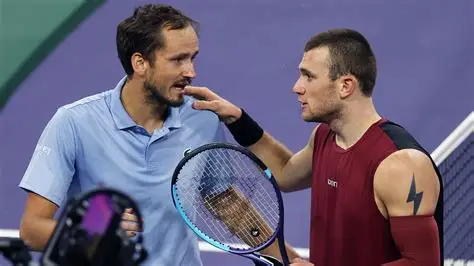
Hindrance Call Explained: How Draper’s Indian Wells Defence Ended Against Medvedev
The hindrance call that went against Jack Draper at Indian Wells became the defining controversy of his 2026 quarter-final defeat to Daniil Medvedev, but it was not the only reason the defending champion lost. Draper was beaten 6-1, 7-5 after Medvedev dominated the opening set and then broke late in the second, with the disputed ruling arriving at 5-5 and 0-15 on the Briton’s serve.
Draper appeared to win the rally. He briefly raised his arms after believing one of Medvedev’s forehands had landed long, play continued for another seven shots, and Medvedev eventually put a backhand into the net. Medvedev then requested a video review. Chair umpire Aurélie Tourte ruled that Draper’s gesture had distracted his opponent and awarded the point to Medvedev.
The hindrance call changed the score from what Draper expected to be 15-15 to 0-30. Medvedev then broke serve and closed out the match. The crowd booed, Draper questioned whether the gesture could reasonably have affected a rally that continued for several more shots, and Medvedev later acknowledged that the situation did not feel comfortable.
Yet the complete story is more complicated than a single disputed point. Medvedev had been the stronger player for most of the match, Draper had spent two hours and 35 minutes beating Novak Djokovic less than a day earlier, and the Briton was still rebuilding after a long injury absence. The hindrance call deserves scrutiny because it exposed a genuine grey area in tennis officiating, not because it can fairly be described as the sole cause of Draper’s defeat.
Draper vs Medvedev: Key Match Facts
| Detail | Confirmed information |
|---|---|
| Tournament | 2026 BNP Paribas Open, Indian Wells |
| Round | Men’s singles quarter-final |
| Result | Daniil Medvedev beat Jack Draper 6-1, 7-5 |
| Draper’s ranking entering event | World No. 14 |
| Controversial moment | 5-5, 0-15 on Draper’s serve in second set |
| Review | Medvedev requested ATP Video Review |
| Ruling | Hindrance against Draper; point awarded to Medvedev |
| What followed | Medvedev broke serve and served out the match |
| Tournament outcome | Medvedev reached the final; Jannik Sinner won the title |
The official ATP match report confirms that Medvedev reached his fourth consecutive Indian Wells semi-final with the victory. He had arrived in California after winning Dubai and was on an eight-match winning streak when he faced Draper. The hindrance call became the talking point because of its timing: it came late in a tight second set and reversed the result of a rally that had already finished on court.
What Actually Happened During the Hindrance Call
Draper was serving at 5-5, 0-15 when Medvedev hit a forehand that the Briton believed had travelled long. No out call came. Draper stretched his arms briefly in disbelief but continued playing rather than stopping the rally.
That detail is central to the hindrance call. Draper did not abandon the point or immediately ask for a review. Both players continued. Another seven shots were played before Medvedev missed a backhand.
Medvedev then approached Tourte and asked for a video review on the basis that Draper’s gesture had distracted him earlier in the rally. After watching the footage, the umpire concluded that Draper had done something different from his normal movement during the point and treated the gesture as a hindrance.
The hindrance call awarded the point to Medvedev. Draper argued that the continuation mattered: if Medvedev had been sufficiently distracted to lose the point, why had the rally continued for seven more shots?
That question explains much of the disagreement, but it is not precisely how the rule is written. Officials are not required to prove that the distraction caused the eventual error. They must decide whether an opponent was hindered and whether the action should be treated as inadvertent or deliberate under the rules.
Draper remained composed despite disagreeing. After the match he described the decision as “pretty harsh” and said he felt hard done by, while also accepting that Medvedev had been the better player overall.
Why the ATP Rule Made the Decision Possible
The hindrance call was controversial, but it was not invented by the umpire. The ATP rulebook gives officials authority to distinguish between inadvertent distractions and deliberate ones.
An inadvertent event can lead to a let. Examples include a ball falling from a pocket, a hat falling off or an involuntary sound. A deliberate distraction can result in loss of the point.
The wording is more nuanced than saying every unintentional distraction automatically costs a player the point. The ATP explains that a distraction caused by a player may be ruled deliberate even if the player did not specifically intend to distract the opponent. The key question is whether the player meant to perform the action that created the distraction. The ATP hindrance rule sets out that distinction.
That is the legal basis for the hindrance call against Draper. He intentionally made the gesture because he believed the ball was out. Tourte therefore had scope to treat the movement itself as deliberate, even if Draper’s purpose was frustration rather than interference.
This is where ordinary language and rulebook language can collide. “Deliberate hindrance” can sound like an accusation that a player intentionally tried to put off an opponent. The ATP framework is broader. A player can intentionally make an unusual movement without intending to cheat, yet still lose the point if the umpire judges that the action distracted the opponent.
The hindrance call was therefore defensible under the written rule. Whether it was the best interpretation of this rally is a separate question.
Why Seven More Shots Made the Ruling So Controversial
The strongest argument against the hindrance call was not that Draper made no unusual movement. He clearly did. The stronger argument was that Medvedev continued competing for seven more shots before missing.
That created an appearance problem. If a player is genuinely hindered, spectators often expect an immediate visible consequence: a hesitation, a stopped point or an instant appeal. None occurred here. Medvedev continued playing and sought review only after losing the rally.
That sequence does not automatically invalidate the hindrance call, but it creates an incentive problem. If players can complete a point and then seek a hindrance review after losing it, critics may wonder whether the process offers a second chance.
The ATP rulebook specifically warns officials to avoid rulings that effectively provide a player with two opportunities to win a point. That warning is one reason the Indian Wells incident attracted so much attention.
Medvedev said the gesture caused some distraction but acknowledged it was not severe, and he left the decision to the umpire. He also rejected suggestions that asking for the review amounted to cheating.
That distinction matters. Medvedev was entitled to request a review. Tourte, not Medvedev, made the hindrance call. The more useful debate is therefore about the rule and review process rather than assigning moral blame to a player for using an available mechanism.
How Video Review Works at Masters 1000 Events
The controversy was possible because the ATP had expanded Video Review across Masters 1000 tournaments from February 2025.
The system can review specific judgment calls including not-up decisions, foul shots, touches, permanent-fixture issues, balls passing through the net, scoring errors and hindrance questions. The ATP Video Review protocol lists the situations that can be reviewed.
For a hindrance call, camera footage helps the chair umpire assess what happened, but the final judgment remains human. Video could prove that Draper raised his arms. It could not objectively measure how much that gesture affected Medvedev.
That is the strength and weakness of the system. Cameras can establish actions with greater accuracy, yet questions about distraction remain subjective.
The ATP protocol also limits unsuccessful review requests during a set. The technology is therefore designed as a controlled review mechanism rather than an unlimited challenge system.
Sabalenka’s Criticism Focused on Review Timing
The debate did not end with the men’s quarter-final. Aryna Sabalenka argued that players should have to stop the point immediately if they believe they have been hindered rather than finish the rally and request a review afterwards.
Her criticism went to the heart of the hindrance call debate. An immediate request would force a player to commit to the claim in real time. Waiting until after the rally can create suspicion that a review is being used only because the point was lost.
There are counterarguments. A player may be momentarily distracted but instinctively keep competing, only understanding the effect after the point ends. Requiring an immediate stop could also create more interrupted rallies.
Still, the Indian Wells hindrance call showed why timing deserves examination. Any system that can reverse a completed point on a subjective distraction claim needs safeguards against tactical use while preserving a remedy for genuine interference.
The News Ink also followed Sabalenka’s tournament through her victory over Naomi Osaka and later Indian Wells progress.
The Call Did Not Explain Medvedev’s Dominance
The hindrance call arrived at the decisive end of the second set, but it should not obscure the rest of the match.
Medvedev dismantled Draper in the first set. He broke in Draper’s opening service game, raced to a 4-0 lead in about 15 minutes and closed the set 6-1 in roughly 25 minutes. His court coverage and flat backhand repeatedly forced Draper into uncomfortable forehand positions.
The second set was far more competitive. Draper stabilised his serve and created his only break point while leading 3-2, but Medvedev saved it with an ace and held. The Briton competed well enough to reach 5-5, yet his service games remained under greater pressure.
Had the disputed point been awarded to Draper, the match would not have ended in his favour. He still would have needed to hold serve, win another return game or a tie-break, and then take a third set against an opponent playing at a very high level.
Draper himself made that distinction. He criticised the hindrance call but did not blame it for the defeat. A decision can be controversial without deciding an entire contest.
Draper Was Running on Limited Recovery
Less than 24 hours earlier, Draper had beaten Novak Djokovic 4-6, 6-4, 7-6(5) in a two-hour, 35-minute fourth-round battle.
The victory was one of the best of Draper’s career and his first over Djokovic. It was especially significant because Draper was playing only his second ATP Tour event since the 2025 US Open after a long absence caused by a left arm problem. The ATP account of the Djokovic match details the demanding three-set contest.
The News Ink also covered Draper’s win over Djokovic, which became the standout victory of his title defence.
The match required him to recover after failing to serve out the contest at 5-4 in the deciding set and then win the tie-break. Against Medvedev, those efforts appeared to have a cost. Draper looked flat in the opening set and struggled to reproduce the explosive first-strike tennis that had carried him through earlier rounds.
The hindrance call became the headline because controversy is memorable. The more useful sporting lesson was that Draper had reached an ATP Masters 1000 quarter-final almost immediately after returning from a long injury layoff.
The Ranking Damage Was Real
Draper entered Indian Wells ranked No. 14 and carrying the 1,000 points he had earned by winning the 2025 title. A quarter-final appearance replaced those points with a much smaller total, causing a sharp ranking fall.
ATP projections showed that a quarter-final exit would leave him on 1,710 points. He was listed at world No. 26 in ATP tournament material for Miami the following week. The ATP ranking projection had outlined how much was at stake before the Medvedev match.
Cameron Norrie, who also reached the Indian Wells quarter-finals, moved above Draper and regained the British No. 1 position for the first time since 2024.
The hindrance call therefore arrived during a tournament where every additional round had unusually large ranking consequences for Draper. Even so, the larger cause of the drop was the expiration of the 1,000 points from his 2025 title.
What Happened to Medvedev After Beating Draper
Medvedev did not disappear in the next round. He defeated world No. 1 Carlos Alcaraz 6-3, 7-6(3) in the semi-finals, ending Alcaraz’s unbeaten start to 2026 and reaching an 11th Masters 1000 final.
Jannik Sinner ultimately stopped him, winning 7-6(6), 7-6(4) to claim his first Indian Wells title. The official tournament results confirm Sinner’s championship victory.
That progression strengthens the argument that Draper ran into an opponent in elite form. The hindrance call affected one crucial game, but Medvedev had already won Dubai, swept through the Indian Wells draw and then defeated Alcaraz.
The result should therefore be remembered as both a controversial officiating episode and a high-level victory by one of the era’s leading hard-court players.
Draper’s Season Became More Difficult After Indian Wells
At the time, Draper hoped Indian Wells would mark the beginning of a stable return. Instead, physical problems continued to shape his 2026 season.
He lost early in Miami and retired from his Barcelona opener. He then withdrew from Madrid, Rome, Hamburg and Roland Garros. After missing Queen’s Club, he returned at Eastbourne and reached the semi-finals, but withdrew from Wimbledon before his first-round match.
Further arm trouble affected the North American summer. By mid-August he had fallen outside the top 100, and Reuters reported him at world No. 143 after his Cincinnati defeat. He later withdrew from the 2026 US Open as his injury problems continued.
Those later developments change how the Indian Wells quarter-final looks. The hindrance call was frustrating, but Indian Wells became his strongest tournament result during a season dominated by attempts to regain health and continuity.
For another British perspective from the same event, The News Ink examined Emma Raducanu’s Indian Wells setback.
What Tennis Can Learn From the Hindrance Call
The Indian Wells incident exposed a rule that works more cleanly in obvious cases than in marginal ones.
If a player shouts during an opponent’s swing or makes an overt movement directly before contact, the remedy is easier to understand. If a hat falls off accidentally, a let is familiar. Draper’s gesture sat between those examples: intentional movement, no clear intent to distract, and a rally that continued for seven shots.
A better framework could make three areas clearer:
- Require a prompt hindrance challenge unless the chair umpire calls the incident independently.
- Give more detailed guidance on how continued play affects judgments about distraction.
- Explain more clearly that intentional conduct is not the same as an intention to cheat.
The hindrance call against Draper did not require Tourte to decide that he was trying to deceive Medvedev. It required a judgment that an intentional action created a distraction serious enough to award the point.
Clearer communication would not eliminate disagreement, but it would make the rule easier for players and spectators to understand.
A Controversial Point, Not an Excuse for the Defeat
The hindrance call will remain the defining image of Draper’s 2026 Indian Wells exit because it combined technology, subjective judgment and a crucial scoreline. Draper raised his arms, Medvedev continued the rally, seven more shots were played, and a point initially won by the defending champion was reversed after review.
There are reasonable arguments on both sides. The ATP rule gave Tourte a basis for the ruling because Draper intentionally made the unusual gesture. At the same time, Medvedev’s ability to continue for seven shots and request review only after losing raised legitimate questions about whether the system risks offering a second opportunity.
What should not be disputed is the broader result. Medvedev won 6-1, 7-5 and was the stronger player for most of the match. Draper accepted that. Medvedev did not make the final decision. The umpire applied a rule that leaves room for judgment.
The hindrance call is therefore most useful as a case study in tennis officiating rather than a story of a match being stolen. It showed why video can clarify actions without eliminating subjectivity, why review timing matters and why rule language can produce outcomes that feel counterintuitive.
For Draper, the larger concern soon became his body rather than one point in California. His Indian Wells quarter-final remained a rare bright spot during an injury-hit 2026 season, and his victory over Djokovic showed that his top level had not disappeared.
For continuing tennis coverage, follow The News Ink on Instagram.