Tottenham’s Survival Hopes: How 5 Turning Points Kept Spurs in the Premier League
Tottenham’s survival hopes looked dangerously fragile when Spurs travelled to Anfield on 15 March 2026. They had lost five consecutive Premier League matches, were without a league win since late December, and Chris Sutton had publicly picked them as the most likely side to occupy the final relegation place.
The immediate forecast was grim. Sutton backed Liverpool to win 2-0. YouTuber Angry Ginge predicted 3-1. Microsoft Copilot Chat went for a 2-2 draw. What actually happened was different: Richarlison scored in the 90th minute to earn Tottenham a 1-1 draw after Dominik Szoboszlai had put Liverpool ahead with a first-half free-kick.
That point did not rescue the season by itself. Igor Tudor left less than two weeks later, Roberto De Zerbi arrived with seven league matches remaining, Spurs briefly dropped into the relegation zone, and survival went all the way to the final day. Tottenham eventually beat Everton 1-0 and finished 17th on 41 points, two above West Ham.
Looking back, Tottenham’s survival hopes were shaped by five turning points: the Anfield draw, the end of the Tudor experiment, De Zerbi’s appointment, the crucial win at Aston Villa and the final-day victory over Everton.
Tottenham’s Survival Hopes Were in Real Danger Before Liverpool
The original concern was not exaggerated. Tottenham entered the Liverpool game after five straight Premier League defeats and had not won a league fixture since 28 December.
Thomas Frank had already been dismissed. Tudor, appointed on 14 February on a deal until the end of the season, was supposed to bring immediate organisation and intensity. Instead, results became worse. Tottenham’s own announcement of Tudor’s appointment said his mandate was to stabilise performances and move Spurs up the table.
BBC Sport’s Chris Sutton said Spurs were his choice to take the final relegation place. His criticism went beyond results. He argued that Tudor had unsettled the squad by publicly challenging players and said Tottenham were in “big trouble” if the club did not change direction.
The table made the warning credible. Spurs were fighting West Ham, Nottingham Forest and other lower-table sides rather than competing for Europe. A club that had entered the season expecting to recover from a poor domestic campaign was suddenly discussing the possibility of Championship football.
Tottenham’s survival hopes also suffered from a depleted squad. At Anfield, Spurs travelled with only seven substitutes, including two goalkeepers and three teenagers. Cristian Romero and Joao Palhinha were injured, Micky van de Ven was suspended and Conor Gallagher was unavailable through illness.
This was not the profile of a team simply experiencing a temporary dip. It was a side short of confidence, availability and tactical certainty.
Turning Point 1: Richarlison’s Late Goal at Anfield
The first important moment for Tottenham’s survival hopes arrived in the match that had prompted the original article.
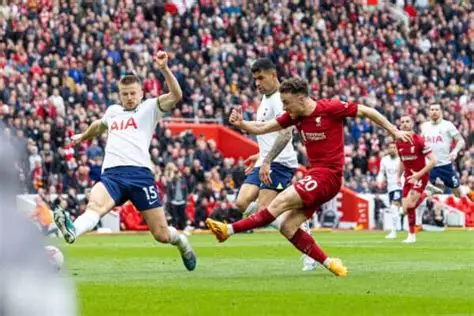
Liverpool took the lead in the 18th minute when Szoboszlai scored from a long-range free-kick. Spurs, however, stayed competitive and created enough chances to remain in the game.
In the 90th minute, Guglielmo Vicario’s long clearance eventually reached Randal Kolo Muani, who held off Virgil van Dijk and found Richarlison. The Brazilian finished from close range to make it 1-1.
The result ended Tottenham’s run of league defeats and gave Tudor his first Premier League point in charge. Tottenham’s official match report described it as a morale-boosting result, while Tudor called it an “immense point.”
For Tottenham’s survival hopes, the draw mattered because it interrupted a losing cycle. Spurs had been arriving at matches expecting something to go wrong. Getting a result at Anfield, even against an inconsistent Liverpool side, demonstrated that the players had not completely stopped fighting.
It also proved the pre-match predictions wrong. Sutton had expected a 2-0 Liverpool win. Angry Ginge went for 3-1. The AI prediction of 2-2 was closer, but none forecast the actual 1-1 score.
The point did not fix Tottenham. It did give Tottenham’s survival hopes a brief but important lift and showed the squad that survival remained possible.
Turning Point 2: Tottenham Ended the Igor Tudor Experiment
The Anfield point bought time, but not enough to save Tudor’s job.
A week later, Tottenham suffered a damaging 3-0 home defeat by Nottingham Forest. On 29 March, the club announced Tudor’s departure by mutual agreement with immediate effect.
His Tottenham spell lasted only 44 days and seven matches. Reuters reported that he won just once in all competitions during that period, while five of the seven games ended in defeat. The club was 17th and only one point above the relegation places.
This was the moment when Tottenham’s survival hopes became a boardroom decision as much as a football question.
Keeping Tudor would have offered continuity, but it would also have meant trusting a short-term appointment whose impact had been overwhelmingly negative. Changing again carried its own danger: a new manager would have almost no preparation time and would inherit players already working under their third senior coaching regime of the season.
Tottenham chose change. At that stage, Tottenham’s survival hopes depended on finding a coach who could produce points immediately without creating even more confusion.
The decision also gave weight to Sutton’s earlier criticism. He had argued before the Liverpool match that the club needed to act quickly. Tottenham did not dismiss Tudor immediately after that prediction, but the evidence over the following two weeks pushed them to the same conclusion.
The News Ink’s broader football guide explains why managerial changes are rarely guaranteed solutions. In this case, though, Spurs had reached the point where doing nothing appeared more dangerous than making another change.
Turning Point 3: Roberto De Zerbi Took Over With Seven Games Left
On 31 March, Tottenham appointed Roberto De Zerbi on a long-term contract.
The former Brighton and Marseille coach was not hired only as an emergency firefighter. Spurs described the appointment as part of a longer-term plan, but his first task was brutally simple: keep the club in the Premier League.
De Zerbi inherited a team one point above the relegation zone and without a league victory since December. Reuters later reported that Tottenham had collected only five points from the 13 league games immediately before his arrival.
His first match made Tottenham’s survival hopes look even worse.
Sunderland beat Tottenham 1-0 on 12 April, pushing Spurs into the bottom three with six games remaining. It was Tottenham’s seventh defeat in eight league matches and extended their winless run to 14 Premier League games.
At that point, Tottenham’s survival hopes were not improving because of a new-manager bounce. De Zerbi had to create one under pressure.
What changed over the following weeks was not a complete tactical revolution. Sky Sports later noted that Spurs became more aggressive without the ball and found a more functional midfield balance under their new coach.
De Zerbi adjusted rather than insisting on immediately reproducing every possession principle associated with his Brighton teams.
That flexibility mattered to Tottenham’s survival hopes. A relegation fight with six matches left is not the ideal environment for a lengthy tactical education.
Why Tottenham Had Fallen So Far
The relegation battle was shocking because of Tottenham’s resources and recent achievements, but the decline had been building. Tottenham’s survival hopes became vulnerable because several problems arrived at the same time.
Spurs finished 17th in 2024-25 despite winning the Europa League. The following season brought more instability instead of recovery. Thomas Frank was removed, Tudor failed to stabilise the team, and De Zerbi became the third head coach of the campaign.
Injuries repeatedly weakened the squad. Defensive partnerships changed, senior players missed matches and young players were pushed into difficult situations.
Confidence also deteriorated. Teams in prolonged winless runs often become conservative even when managers demand aggression. Players hesitate in possession, react more slowly after mistakes and begin protecting against failure instead of playing to create advantages.
The problem was institutional as well as tactical. Tottenham had enough individual quality to avoid relegation comfortably, yet the team performed for months like less than the sum of its parts.
The News Ink has examined similar instability in its report on Manchester United’s managerial struggles. Different clubs have different problems, but repeated coaching changes usually indicate that recruitment, squad construction and leadership are also under strain.
Tottenham’s survival hopes therefore depended on more than finding a clever formation. The players had to recover trust in one another and in the idea that one bad moment would not automatically become another defeat.
Turning Point 4: Aston Villa Changed the Relegation Picture
The decisive shift came away to Aston Villa in early May.
Tottenham won 2-1 and moved above West Ham and out of the relegation zone with three games remaining. Villa had rotated heavily after a Europa League semi-final, but De Zerbi rejected the suggestion that the victory should be discounted.
For Tottenham’s survival hopes, the quality of Villa’s selection mattered less than the three points. Spurs needed a result against whoever was on the pitch, and they finally produced one.
That win altered the psychological shape of Tottenham’s survival hopes and the wider relegation battle. Tottenham were no longer chasing safety from inside the bottom three. West Ham now had to respond.
It also gave De Zerbi proof that his adjustments were producing results. A team that had gone 14 league games without a victory was suddenly capable of winning a high-pressure away fixture.
Survival races often turn on one match that changes who is pursuing whom. Aston Villa was that match for Tottenham.
Turning Point 5: Palhinha’s Goal Finished the Job
Tottenham’s survival hopes remained alive until the final day on 24 May.
West Ham were two points behind and still had a route to safety. They needed to beat Leeds and hope Tottenham lost at home to Everton.
West Ham did their part by winning 3-0.
Spurs did not collapse.
Joao Palhinha scored in the 43rd minute against Everton, and Tottenham protected the 1-0 lead through a tense second half and 10 minutes of stoppage time. Goalkeeper Antonin Kinsky made a vital late save to preserve the result.
Tottenham finished 17th with 41 points. West Ham were relegated in 18th with 39. The final Premier League table recorded Spurs with 10 wins, 11 draws and 17 defeats, scoring 48 goals and conceding 57.
De Zerbi finished his seven-game rescue mission with three wins, two draws and two defeats, collecting 11 points.
That return was not spectacular in isolation. In the context of Tottenham’s previous form, it transformed Tottenham’s survival hopes.
Spurs did not surge away from danger; they survived by two points.
Tottenham’s Survival Hopes in Numbers
| Moment | Position or result | Why it mattered |
|---|---|---|
| Before Liverpool, 15 March | Five straight league defeats | Spurs looked like a genuine relegation candidate |
| Liverpool 1-1 Tottenham | Richarlison, 90th minute | Ended the losing sequence and earned Tudor’s first league point |
| Tudor leaves, 29 March | Spurs 17th, one point above danger | Club abandoned the short-term experiment |
| De Zerbi appointed, 31 March | Seven league games remaining | Long-term coach given an immediate survival mission |
| Sunderland 1-0 Tottenham | Spurs dropped into bottom three | Relegation threat reached its most serious stage |
| Aston Villa 1-2 Tottenham | Spurs moved above West Ham | Changed the momentum of the survival race |
| Tottenham 1-0 Everton | Final-day victory | Secured 17th place with 41 points |
The table shows why Tottenham’s survival hopes cannot be reduced to one Liverpool match. The Anfield draw was the first interruption in the collapse; De Zerbi’s late run completed the rescue.
What Happened to Sutton’s Prediction?
Sutton was wrong about the final outcome but right about how fragile Tottenham’s survival hopes had become.
Tottenham did not take the third relegation place. West Ham did. Yet Sutton’s argument that Spurs were in serious trouble under Tudor proved difficult to dismiss. Tudor left before the end of March, and Tottenham later needed a new manager and a final-day victory to survive.
That is an important distinction. Predictions should be judged against the information available at the time, not only the final table.
When Sutton made his call, Tottenham had lost five league games in succession, West Ham were showing signs of recovery and Spurs were not responding to Tudor. Picking Tottenham for relegation was aggressive, but it was not irrational.
The Liverpool draw was the first reason to reconsider it.
Angry Ginge and the Prediction Feature Became a Side Story
The original BBC prediction feature paired Sutton with YouTuber Morgan “Angry Ginge” Burtwistle, a Manchester United supporter from Salford.
At the time, Angry Ginge was preparing to play in Soccer Aid for UNICEF at London Stadium. That event has since taken place. England beat the World XI 3-2 on 31 May 2026, and organisers said the 20th-anniversary match raised £16,462,353 for UNICEF.
That update is useful context, but Tottenham’s survival hopes became a much bigger story than the prediction feature itself. The original Manchester United discussion also belonged to the guest interview rather than Spurs’ relegation battle.
Survival Did Not Solve Tottenham’s Problems
Avoiding relegation prevented a sporting and financial disaster. Tottenham’s survival hopes had been realised, but 17th place could not be presented as success.
Tottenham finished 17th for the second consecutive Premier League season. A club with a modern stadium, major commercial revenues and European ambitions should not need final-day survival.
That is why the summer response was so significant. Spurs backed De Zerbi with an expensive rebuild and entered 2026-27 expecting a sharp improvement.
The News Ink’s Premier League 2026-27 coverage provides the wider context for the new campaign.
Tottenham’s first result, however, was another warning. Reuters reported that Brentford beat Spurs 3-0 on the opening weekend despite a summer rebuild costing more than £300 million.
One defeat does not recreate the previous season’s crisis, but Tottenham’s survival hopes should never again become the club’s defining target. Survival alone could never be the final objective.
De Zerbi now has what Tudor never had: a full project, major investment and time to establish a clear identity. Expectations have changed accordingly.
What Tottenham Should Learn From the Escape
The first lesson is that managerial instability has a cost. Tottenham used three head coaches in one league season. Each change required players to absorb new messages while results were already deteriorating.
The second is that squad depth must be functional, not theoretical. Injuries are unavoidable, but a club of Tottenham’s scale should not arrive at a crucial Anfield fixture with two goalkeepers and three teenagers among seven substitutes.
The third is that relegation battles punish delay. Sutton’s warning sounded dramatic in March, yet Tottenham did eventually conclude that Tudor’s spell could not continue. De Zerbi had only seven matches to repair the situation.
The fourth is that mentality becomes tactical. The Anfield draw mattered because it restored belief; the Aston Villa victory mattered because it changed the table; the Everton win mattered because Spurs handled pressure without conceding the decisive mistake.
Finally, Tottenham’s survival hopes showed that resources do not create immunity. Big clubs can fall into relegation battles when recruitment, fitness, coaching and confidence all fail at the same time.
The Bottom Line
Tottenham’s survival hopes looked bleak before the March trip to Liverpool, and Chris Sutton’s warning was far closer to reality than it may have sounded.
Spurs had lost five consecutive Premier League games and appeared to be deteriorating under Igor Tudor. Liverpool were expected to deepen the crisis. Instead, Richarlison’s 90th-minute equaliser earned a 1-1 draw at Anfield and gave Tottenham a small but valuable break in the losing sequence.
The crisis still got worse before it improved. Tudor left on 29 March. Roberto De Zerbi arrived two days later, lost his first game and saw Tottenham enter the relegation zone.
Then the direction changed. De Zerbi collected 11 points from seven matches, the 2-1 victory at Aston Villa moved Spurs back above West Ham, and Palhinha’s final-day goal against Everton secured a 1-0 win.
Tottenham finished 17th with 41 points, two clear of relegated West Ham.
So the final answer to the question that surrounded the Liverpool clash is now known: Tottenham’s survival hopes were justified, but only just. The Anfield point helped stop the collapse, the managerial change gave the team a new route forward, and the season ultimately came down to one goal on the final day.
Survival was relief, not vindication. After two consecutive 17th-place finishes, Tottenham’s challenge under De Zerbi is no longer simply to stay up. It is to make sure another season never reaches that point again.
For more football analysis and Premier League coverage, follow The News Ink on X.