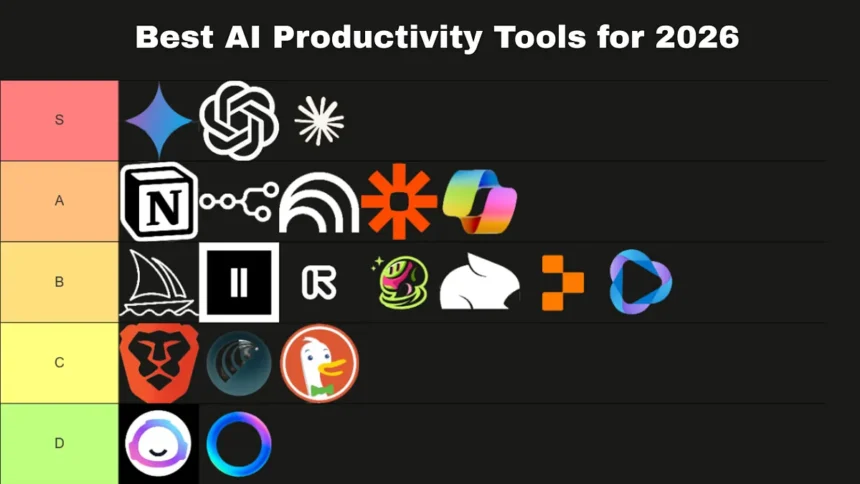
Best AI Tools in 2026: Complete Guide to the Most Powerful AI Platforms Transforming Technology
Artificial intelligence is no longer a futuristic concept limited to research labs and science fiction movies. In 2026, AI tools have become deeply integrated into everyday life for businesses, students, developers, marketers, content creators, and millions of internet users around the world.
The rapid growth of platforms like ChatGPT, Google Gemini, Claude, Midjourney, GitHub Copilot, and other advanced AI systems has completely changed how people work, search for information, create content, and interact with technology.
From automating business operations to generating realistic artwork and improving productivity, artificial intelligence is now influencing nearly every major industry.
The best AI tools in 2026 are not only helping companies save time and reduce costs, but they are also reshaping entire workflows and creating new opportunities across technology, healthcare, education, finance, entertainment, and digital marketing.
As competition between major technology companies intensifies, users are gaining access to faster, smarter, and more specialized AI systems than ever before.
Recent global AI industry reports show that businesses worldwide are significantly increasing investments in artificial intelligence infrastructure and automation technologies.
For more technology updates, digital trends, and AI news, visit our Technology section.
Why AI Tools Are Growing Rapidly
The artificial intelligence industry has experienced explosive growth over the last few years.
Advancements in machine learning, cloud computing, and large language models have made AI systems significantly more powerful and accessible than ever before.
Businesses are investing heavily in AI because these tools improve productivity, automate repetitive tasks, reduce operational costs, and enhance customer experiences.
At the same time, consumers are increasingly relying on AI-powered assistants for writing, research, coding, image generation, and workflow management.
Several factors are accelerating the growth of AI tools globally:
- Faster cloud infrastructure
- Better machine learning models
- Increased demand for automation
- Integration of AI into smartphones and apps
- Rising popularity of AI-powered search
- Easier access for everyday users
- Strong investment from major technology companies
One of the biggest changes happening in 2026 is the transformation of online search experiences.
Users no longer want to browse dozens of websites to find answers manually. Many now expect AI-generated summaries and instant responses directly within search engines.
This shift is already changing the future of SEO, digital publishing, and content marketing.
Businesses are also adopting AI tools at a faster pace than ever before.
Recent workplace automation research suggests companies using artificial intelligence solutions are seeing major improvements in efficiency, workflow management, and customer support.
Related Reading:
“How AI Is Changing Search Engines”. Visit here!
What Makes an AI Tool Powerful?
Not every artificial intelligence platform becomes successful.
The best AI tools in 2026 are those that solve real-world problems while remaining accessible to businesses and everyday users.
Modern AI platforms are expected to provide speed, accuracy, scalability, reliability, and seamless integrations with existing digital ecosystems.
The most successful AI tools often combine multiple features into a single platform.
| Feature | Why It Matters |
|---|---|
| Ease of Use | Helps non-technical users benefit from AI |
| Speed | Saves time and improves productivity |
| Accuracy | Produces reliable outputs |
| Integrations | Connects with business software and apps |
| Scalability | Supports both individuals and enterprises |
| Security | Protects user data and privacy |
| Customization | Adapts to different industries and workflows |
The best AI tools in 2026 are increasingly becoming all-in-one ecosystems capable of handling writing, coding, automation, analytics, image generation, and customer service.
ChatGPT Continues to Dominate Conversational AI
OpenAI’s ChatGPT remains one of the most recognized AI platforms in the world.
Originally launched as a conversational chatbot, ChatGPT has evolved into a highly advanced productivity platform used by students, developers, businesses, marketers, and researchers.
The platform is now commonly used for:
- Content writing
- Coding assistance
- Research and brainstorming
- Customer support automation
- Business communication
- Workflow automation
- Learning and tutoring
- Data analysis
One major reason behind ChatGPT’s popularity is its ease of use.
Users can interact naturally with the AI and receive detailed responses within seconds.
The latest ChatGPT models have improved significantly in reasoning, contextual understanding, and multimodal capabilities.
Businesses worldwide are integrating AI chatbots into websites and customer service systems to automate repetitive communication tasks.
OpenAI’s latest platform developments continue pushing conversational AI technology forward.
For more info visit here.
Google Gemini Is Reshaping AI-Powered Search
Google has aggressively expanded its artificial intelligence ecosystem through Gemini.
The platform is integrated into Google Search, Android smartphones, cloud products, and workplace applications.
Gemini’s biggest advantage comes from Google’s massive search infrastructure and data ecosystem.
Artificial intelligence is changing how users discover information online.
Instead of simply displaying lists of websites, search engines increasingly provide direct AI-generated answers and summaries.
This transformation is having a major impact on SEO strategies, digital publishing, and online advertising.
Google is integrating Gemini into:
- Google Search
- Gmail
- Google Workspace
- Android devices
- AI assistants
- Cloud applications
The competition between OpenAI and Google is accelerating innovation across the technology industry.
Many analysts believe the future of online search will rely heavily on AI-generated experiences.
Google AI research and Gemini updates continue showcasing how artificial intelligence is being integrated into consumer products. Read More!
Claude Is Becoming Popular for Long-Form AI Assistance
Claude, developed by Anthropic, has become increasingly popular among professionals looking for more thoughtful and context-aware AI interactions.
Unlike many AI chatbots that focus heavily on speed, Claude is often praised for handling long-form writing and document analysis more effectively.
Professionals frequently use Claude for:
- Research assistance
- Long-form writing
- Strategic planning
- Document summarization
- Business communication
- Legal analysis
One of Claude’s biggest strengths is its ability to maintain context during extended conversations.
This makes it particularly useful for workflows that require detailed analysis and structured responses.
Anthropic has also emphasized responsible AI development and safety-focused training methods.
More information about Claude AI and Anthropic highlights the growing competition within the AI industry.
AI Image Generation Platforms Are Transforming Creativity
The best AI tools in 2026 can generate:
- Realistic portraits
- Anime-inspired artwork
- Product designs
- Website graphics
- Branding materials
- Social media creatives
- Concept art
- Marketing visuals
The quality of AI-generated images has improved significantly over the last few years.
Many businesses now use AI-generated visuals in advertising campaigns and content production.
However, the rise of AI-generated art has also sparked discussions around copyright, originality, and ethical concerns.
| AI Tool | Main Purpose |
|---|---|
| Midjourney | Artistic image generation |
| DALL·E | AI-generated visuals and illustrations |
| Adobe Firefly | Commercial creative assistance |
| Canva AI | Social media and marketing graphics |
The official Mid-journey platform remains one of the most popular AI art tools among creators. Learn More!
AI Coding Assistants Are Changing Software Development
Software development is another industry being heavily transformed by artificial intelligence.
Developers now use AI coding assistants to improve efficiency, automate repetitive tasks, and accelerate application development.
Modern AI coding tools help developers:
- Generate code snippets
- Detect bugs faster
- Explain programming concepts
- Automate documentation
- Learn programming languages
- Improve testing workflows
GitHub Copilot has become one of the most widely used AI coding assistants globally.
The platform helps developers write code more efficiently and reduce repetitive work.
GitHub Copilot official platform demonstrates how AI is becoming integrated into modern software engineering.
Although AI coding tools improve productivity, most experts believe human developers will continue playing a critical role in software architecture, security, and advanced engineering decisions.
Instead of replacing programmers entirely, AI is becoming a collaborative development assistant.
AI Productivity Tools Are Reshaping Modern Workplaces
Businesses worldwide are rapidly integrating artificial intelligence into workplace operations.
AI productivity platforms help companies automate repetitive tasks while improving efficiency and reducing operational costs.
Organizations now use AI for:
- Meeting summaries
- Email generation
- Scheduling automation
- Customer support
- Workflow management
- Marketing campaigns
- Data organization
- Project management
Employees who understand AI tools often gain significant productivity advantages.
At the same time, discussions about workforce transformation and job automation continue growing.
Despite concerns, many industry experts believe artificial intelligence will create new career opportunities alongside automation.
The rise of AI productivity tools is also changing workplace expectations.
Companies increasingly expect employees to understand AI-assisted workflows and automation systems.
Recent workplace AI research highlights how artificial intelligence is influencing modern business environments.
AI in Smartphones and Consumer Technology
Artificial intelligence is no longer limited to desktop software and enterprise systems.
Smartphone manufacturers are aggressively integrating AI features into mobile devices.
Modern smartphones now use artificial intelligence for:
- Photography enhancement
- Real-time translation
- Voice assistants
- Battery optimization
- Smart recommendations
- AI-powered search
- Live transcription
- Personalized user experiences
Apple, Samsung, and Google are all competing heavily in the AI smartphone market.
This competition is pushing companies to develop more intelligent and personalized mobile experiences.
AI-powered smartphones are expected to become even more advanced over the next few years as on-device AI processing improves.
Ethical Concerns Around Artificial Intelligence
As AI technology becomes more powerful, ethical concerns are becoming increasingly important.
Major concerns surrounding artificial intelligence include:
- Misinformation
- Deepfake content
- Data privacy risks
- Bias in AI systems
- Copyright disputes
- Job automation concerns
- AI-generated fake news
Governments and technology companies are working to establish regulations and safety standards for artificial intelligence.
Many experts believe responsible AI development will become one of the most important global technology challenges over the next decade.
Balancing innovation with regulation remains a major debate within the AI industry.
Several organizations, including UNESCO’s AI ethics initiative, are already promoting ethical guidelines for artificial intelligence development.
Best AI Tools by Industry
Different industries are using artificial intelligence in unique ways.
Below is a breakdown of some of the best AI tools in 2026 based on industry applications.
| Industry | Popular AI Tools |
|---|---|
| Content Creation | ChatGPT, Claude |
| Graphic Design | Midjourney, Canva AI |
| Software Development | GitHub Copilot |
| Marketing | Jasper AI, Canva AI |
| Customer Support | AI chatbots and automation systems |
| Business Productivity | Google Gemini, Microsoft Copilot |
| Education | AI tutoring platforms |
| E-commerce | AI recommendation engines |
Artificial intelligence is becoming increasingly industry-specific as companies build tools tailored for specialized workflows.
The Future of Artificial Intelligence Looks Even Bigger
Artificial intelligence is still in the early stages of global adoption.
Experts believe AI will continue transforming industries including healthcare, finance, education, transportation, entertainment, cybersecurity, and scientific research.
Future AI systems are expected to become:
- More personalized
- Faster and more efficient
- Better at reasoning
- More integrated into daily life
- More autonomous
- More industry-specific
Technology companies are investing billions into AI infrastructure, advanced chips, data centers, and machine learning research.
The race to dominate artificial intelligence is becoming one of the most important technological competitions in modern history.
As AI tools become more deeply integrated into society, understanding how these systems work will become increasingly important for businesses and individuals.
Artificial intelligence may eventually become as essential as the internet itself.
According to global technology forecasts, AI adoption is expected to continue expanding rapidly across nearly every industry.
Frequently Asked Questions
What are the best AI tools in 2026?
Which AI tool is best for writing?
Many users prefer ChatGPT and Claude for content writing because of their conversational abilities and long-form writing support. ChatGPT has become one of the best AI tools in 2026 for content writing, brainstorming, research assistance, and conversational AI experiences, while Google Gemini is gaining popularity because of its deep integration with Google Search, Android devices, and productivity tools. Claude is also considered among the best AI tools in 2026 for long-form writing, document analysis, and thoughtful AI conversations that require strong contextual understanding.
Which AI tool is best for image generation?
Midjourney and DALL·E remain among the most popular AI image generation platforms. In the creative industry, Midjourney and DALL·E remain some of the best AI tools in 2026 for generating realistic artwork, cinematic visuals, product mockups, and social media graphics within seconds. Meanwhile, GitHub Copilot has become one of the best AI tools in 2026 for developers looking to improve coding efficiency, automate repetitive programming tasks, and accelerate software development workflows.
Are AI tools replacing jobs?
AI is automating certain repetitive tasks, but many experts believe it will also create new job opportunities and industries.
Which industries are using AI the most?
Technology, healthcare, finance, education, marketing, and e-commerce are among the industries adopting artificial intelligence rapidly.
Conclusion
Artificial intelligence is transforming the technology landscape faster than almost any innovation in recent history.
From AI chatbots and coding assistants to image generation platforms and workplace automation systems, the best AI tools in 2026 are reshaping how people work, communicate, create content, and interact with digital experiences.
The growing competition between OpenAI, Google, Anthropic, Microsoft, and other technology giants is accelerating innovation across the industry.
As artificial intelligence continues evolving, businesses and individuals who understand these technologies may gain significant advantages in productivity, creativity, and digital transformation.
Whether used for business operations, software development, marketing, content creation, or personal productivity, AI tools are becoming increasingly difficult to ignore.
For more updates on artificial intelligence, digital innovation, and technology trends, visit our Technology section.
Learn more about our publication on the About Us page or contact our team directly through the Contact page.