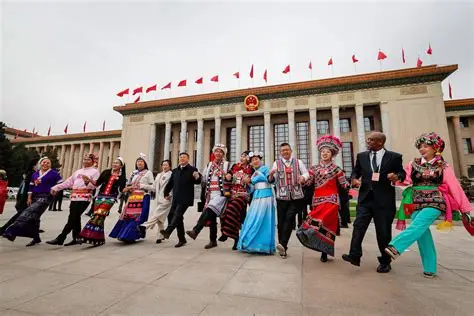
China is preparing to approve a new law aimed at promoting “ethnic unity,” a move that critics say could further limit the rights of minority communities.
The legislation is expected to pass during the annual session of the National People’s Congress. Officials describe it as a step toward national unity and modernization. However, many academics and rights groups argue the law will strengthen existing policies that pressure minorities to adopt the dominant culture.
Law Focuses on Unity and Integration
The proposed law promotes Mandarin as the primary language and encourages stronger cultural integration among different ethnic groups. It also includes measures that discourage actions seen as harmful to national unity.
The policy aligns with the long-standing agenda of Xi Jinping, who has promoted the “Sinicisation” of religion. This concept requires religious practices to align with Chinese cultural values as defined by the government.
Experts say the law turns previous policies into formal legal requirements.
Impact on Minority Languages and Culture
China officially recognizes 55 ethnic minority groups alongside the majority Han population. The Han make up more than 90% of the country’s citizens.
Critics say the new legislation may reduce the role of minority languages and cultural traditions. For example, Mandarin education is expanding in schools across minority regions.
Analysts also believe the law could strengthen social integration policies. These include promoting contact and marriage between Han Chinese and other ethnic groups by preventing restrictions based on religion or ethnicity.
Regions Under Stronger Scrutiny
Some regions have drawn particular attention due to tensions between local communities and the central government.
Serious human rights allegations have emerged in Xinjiang, where the Uyghur population lives. Rights groups claim more than a million Uyghur Muslims have been detained in facilities described by authorities as vocational training centers.
Similar concerns exist in Tibet, where monasteries are closely monitored and state schools emphasize Mandarin education over traditional learning.
History of Unrest
Ethnic tensions have occasionally led to violent clashes in these regions.
In 2008, protests in Lhasa turned violent during demonstrations against Chinese rule. Security forces later suppressed the uprising.
In 2009, deadly clashes broke out in Urumqi between Uyghurs and Han Chinese. Nearly 200 people died in the unrest.
Chinese authorities say strong policies are necessary to prevent separatism and maintain stability.
Strategic and Economic Importance
Many minority regions sit along China’s borders and hold vast natural resources. Areas historically associated with Tibetans, Uyghurs, and Mongolians contain major agricultural land and mineral reserves.
These regions also connect China to international trade routes, which increases their strategic importance.
Government Encourages Migration and Integration
Over the years, the Chinese government has encouraged Han Chinese migration to regions such as Xinjiang and Tibet. Cities like Lhasa and Urumqi now show stronger influence from Han culture.
Authorities have also offered incentives that encourage interaction between ethnic groups, including policies that support inter-ethnic marriages.
Analysts say the new law will make it easier for officials to enforce these policies. It provides clearer legal authority to support government initiatives aimed at strengthening national unity.