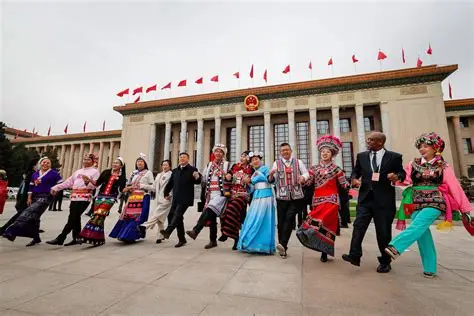
China’s Ethnic Unity Law Raises New Fears for Minority Rights
China’s ethnic unity law is no longer only a proposal moving through the National People’s Congress. It has now passed, taken effect and become a major legal pillar of Xi Jinping’s approach to minority policy. Beijing says the measure will strengthen national cohesion, promote development and create a shared identity among China’s 56 officially recognised ethnic groups. Critics say it gives legal force to years of assimilationist policy affecting Uyghurs, Tibetans, Mongols and other minority communities.
The law, formally known as the Law on Promoting Ethnic Unity and Progress, was adopted by China’s top legislature on 12 March 2026 and entered into force on 1 July 2026. That update matters because the original version of this story described China as preparing to approve the measure. The stronger current version is that the ethnic unity law is now active.
Its most important provisions promote Mandarin, patriotic education, interethnic integration and the idea of a single “community of the Chinese nation.” Chinese officials describe this as a modern legal framework for unity. Rights groups, UN experts and overseas activists argue that vague language around national unity, separatism and overseas enforcement could further restrict minority languages, religion and cultural identity.
This is why the ethnic unity law is one of China’s most significant domestic policy developments of 2026. It does not create Beijing’s approach to Xinjiang, Tibet or Inner Mongolia from nothing. Instead, it codifies a direction that has been building for years: stronger central control, reduced space for distinct minority identity and a much heavier emphasis on loyalty to the Chinese state.
What Changed Since the First Report
The key change is legal status. China has moved from debate to implementation.
| Issue | Updated position |
|---|---|
| Law status | Passed on 12 March 2026 |
| Effective date | 1 July 2026 |
| Official purpose | Promote ethnic unity, national cohesion and common prosperity |
| Main policy direction | Shared national identity, Mandarin use, patriotic education and integration |
| Main criticism | Forced assimilation and weakening of minority rights |
| Overseas concern | Legal basis for action against people abroad accused of harming unity |
| Most affected communities in debate | Uyghurs, Tibetans, Mongols and other ethnic minorities |
Reuters reported that the law passed with overwhelming support at the National People’s Congress, with 2,756 votes in favour, three against and three abstentions. China’s Ministry of Justice, through Xinhua, described it as a “fundamental law on ethnic affairs” that strengthens law-based governance in ethnic work.
That official phrasing is important. Beijing is not presenting the ethnic unity law as a narrow school-language measure. It is presenting it as a foundational national-policy law.
Beijing’s Case: Unity, Stability and Modernisation
China’s government argues that the ethnic unity law is necessary for national cohesion. The official position is that all ethnic groups should develop together, share prosperity and strengthen the idea of belonging to one Chinese nation. State media has described the law as part of the country’s drive toward modernisation by 2035.
This argument is built on three themes.
First, China says ethnic unity is essential to stability. Beijing frequently links unrest, separatism and terrorism with the need for stronger national integration, especially in border regions such as Xinjiang and Tibet.
Second, the government says common language and education help development. Mandarin, or Putonghua, is framed as a tool for social mobility, employment and communication across provinces.
Third, officials say the law protects minority cultures while integrating them into the wider national story. The official language often presents minority traditions as part of the broader Chinese civilisation rather than as separate political identities.
That is the government’s public case. The dispute begins with what “integration” means in practice.
Why Critics See Assimilation
Human rights groups argue that the ethnic unity law gives a legal foundation to forced assimilation. Their concern is not only that Mandarin will be promoted. It is that minority languages, religious education and local identity may become increasingly subordinate to state-defined Chinese identity.
Human Rights Watch warned when the draft was moving forward that the law could justify repression and force assimilation of minority communities inside and outside China. Amnesty International later said the measure risked entrenching assimilation once it came into force.
UN experts also raised concerns in April. According to the International Service for Human Rights, eight UN human rights experts wrote to China warning that the law could restrict social and cultural rights, including rights connected to language, education, family life and minority identity.
The criticism focuses on the law’s broad wording. Terms such as “ethnic unity,” “national unity” and “separatism” may sound clear in official speeches, but in practice they can give authorities wide discretion. A cultural association, religious teacher, language campaigner or overseas activist could be accused of undermining unity if officials interpret their work as separatist or harmful.
That is why the ethnic unity law has become controversial beyond China’s borders.
Mandarin at the Centre of the Debate
Language is one of the clearest pressure points. Reuters reported that the law prioritises Mandarin in education and official functions, including requirements that the national language be displayed prominently where it appears alongside minority languages.
For Beijing, Mandarin is a national tool. It allows people from different regions to communicate, study and work across the country. For minority communities, however, language is also identity. Tibetan, Uyghur, Mongolian, Kazakh and other languages carry literature, religion, family memory and community life.
The dispute is not whether Mandarin should be taught. Most critics accept that Mandarin fluency can be useful. The dispute is whether Mandarin is being promoted in a way that crowds out minority languages.
This has already been a sensitive issue. In Inner Mongolia, protests erupted in 2020 after changes expanded Mandarin-language instruction in key school subjects. In Tibet, rights groups have raised concerns about boarding schools and the reduced role of Tibetan-language education. In Xinjiang, Uyghur-language education has been heavily restricted as part of broader state control.
The News Ink has already covered the related issue of minority children learning Mandarin. This latest article goes further by explaining why the ethnic unity law turns that education debate into a national legal framework.
The Xinjiang Question
Xinjiang sits at the centre of international concern. The region is home to many Uyghurs and other Muslim minorities. Over the past decade, researchers, governments and rights groups have accused China of mass detention, forced labour, intrusive surveillance, restrictions on religion and efforts to reshape Uyghur identity.
Beijing rejects genocide and forced-labour accusations. It says its policies in Xinjiang have fought extremism, improved stability and supported development. It has described detention facilities as vocational training centres and argues that its policies have prevented terrorism.
The ethnic unity law will be read through that existing dispute. Critics fear that a law requiring stronger national identity could make it easier to punish Uyghur cultural or religious expression as a threat to unity. Chinese officials, by contrast, are likely to argue that the law provides a clearer legal basis for stability, development and equal citizenship.
The problem is that the two sides are not arguing from the same assumptions. Beijing sees integration as stability. Critics see state-imposed integration as erasure.
That tension will shape every future discussion of the ethnic unity law in Xinjiang.
Tibet and the Struggle Over Cultural Survival
Tibet is another major focus. China says Tibet has benefited from development, poverty reduction, infrastructure and modern education under Chinese rule. Tibetan activists and rights groups argue that Beijing has restricted religious freedom, controlled monasteries, increased surveillance and weakened Tibetan-language education.
The ethnic unity law comes at a sensitive moment. In July, Reuters reported that the United States had reiterated support for Tibetan cultural preservation after a Tibetan activist self-immolated outside the United Nations in New York. China responded by rejecting outside criticism and repeating that Tibet is part of China.
For Tibetans, the law’s emphasis on shared Chinese identity raises questions about whether Tibetan Buddhism, language and education will be allowed to continue as living traditions or increasingly reshaped through state ideology.
This is where “Sinicisation” matters. Xi Jinping’s policy of Sinicising religion means religious practice must align with socialist values and Chinese cultural identity as defined by the Communist Party. In Tibet, that can affect monasteries, religious education, the display of religious symbols and the selection of religious leaders.
The ethnic unity law does not stand alone. It fits into that wider system of political control.
Inner Mongolia and the Language Warning
Inner Mongolia shows why language policy can become political quickly. In 2020, changes to school instruction triggered rare protests from ethnic Mongols who feared that their language was being pushed aside. Authorities later moved to suppress dissent and require compliance with the new curriculum.
The ethnic unity law may strengthen that direction because it gives national legal backing to Mandarin-first policy. Even if minority languages remain officially protected on paper, the hierarchy matters. If Mandarin is the language of examinations, state employment, official communication and political loyalty, minority languages may survive culturally but lose practical power.
That is one of the central fears among scholars. A language does not need to be formally banned to decline. It can be weakened through school rules, job incentives, official signage, media limits and parental pressure to prioritise the language of advancement.
The law’s defenders will say this is integration. Critics will call it assimilation.
The Overseas Reach Problem
One of the most controversial parts of the ethnic unity law is its possible overseas reach. Reuters reported that the United States and European Union expressed concern after the law took effect because it gives Beijing a legal basis to act against people outside China accused of undermining ethnic unity.
This echoes concerns around Hong Kong’s national security laws and China’s broader use of legal tools against critics abroad. Activists fear that Uyghur, Tibetan, Mongolian or Taiwanese voices overseas could face new pressure if Beijing frames their advocacy as separatist or harmful to national unity.
Al Jazeera reported that activists worry the law could justify transnational repression. Beijing rejects such accusations and says the law is about national unity and stability.
The News Ink has covered similar legal-pressure themes in Hong Kong stories such as Jimmy Lai’s national security case and the jailing of the father of activist Anna Kwok. The ethnic unity law now extends that concern into minority-rights advocacy.
Why China’s Border Regions Matter Strategically
China’s ethnic policy is also shaped by geography. Many minority regions sit along sensitive borders. Xinjiang borders Central Asia and connects China to energy routes and trade corridors. Tibet borders India, Nepal and Bhutan. Inner Mongolia borders Mongolia and sits across a vast northern region. Other minority areas connect China with Southeast Asia and Central Asia.
These regions are not only cultural spaces. They are security corridors, resource zones and strategic buffers.
That explains why Beijing treats ethnic governance as a national-security issue. The government worries about separatism, foreign influence, religious networks and border instability. It also wants infrastructure, mining, agriculture and trade routes to operate without political challenge.
The ethnic unity law gives the state another legal instrument to connect identity policy with national security. That may make sense from Beijing’s perspective, but it increases the pressure on minority communities whose cultural expression can be interpreted through a security lens.
The News Ink’s wider China coverage, including reports on China’s exports and South China Sea tensions, shows how domestic policy, security and geopolitics often overlap in Chinese strategy.
How the Law Fits Xi Jinping’s Ethnic Policy
Under Xi Jinping, China’s ethnic policy has moved away from older forms of limited autonomy and toward a stronger emphasis on common national identity. The idea often translated as “forging a strong sense of community for the Chinese nation” has become central to official speeches, education campaigns and governance.
The ethnic unity law codifies that idea. It tells schools, institutions, local governments, companies and citizens that promoting ethnic unity is a shared duty. It also gives local authorities a legal basis to develop rules that fit local conditions.
This is why analysts call the law important. It is not only one more regulation. It brings Xi-era ethnic policy into national legislation.
The older Chinese model officially recognised minority groups, autonomous regions, minority-language rights and some cultural protections. In practice, that autonomy was always limited. Under Xi, the emphasis has shifted more clearly toward integration into a single national identity.
That shift is especially visible in education. Children are the focus because schools shape language, loyalty and identity. If the state controls curriculum, textbooks, boarding arrangements and language of instruction, it shapes the next generation of minority citizens.
What the Law Means for Everyday Life
For ordinary people, the ethnic unity law may not appear as one dramatic change. Its effects are more likely to show up through schools, workplaces, official signs, local campaigns and political education.
Possible everyday effects include:
- more Mandarin instruction in schools;
- stronger patriotic education for children;
- more pressure on officials to promote “shared Chinese identity”;
- tighter scrutiny of religious teaching;
- stronger penalties for activity described as separatist;
- more encouragement of interethnic contact and mixed communities;
- less room for local institutions to prioritise minority-language education;
- greater pressure on overseas activists and community groups.
The law’s supporters will say these measures build national harmony. Critics will say they weaken the right of minority communities to preserve their own languages, religious traditions and local identity.
The hardest part is enforcement. A national law can be applied differently across provinces and regions. In some areas, it may mean more symbolic slogans. In others, especially politically sensitive regions, it may strengthen already strict controls.
What Supporters and Critics Are Really Arguing About
The debate over the ethnic unity law is not simply “unity versus division.” Almost every state wants some form of national unity. The real argument is about what kind of unity is acceptable.
A pluralistic model says people can share citizenship while keeping strong cultural, linguistic and religious differences. A more assimilationist model says differences must be subordinated to one national identity. Critics argue that China’s law moves toward the second model.
Beijing rejects that framing. It says all ethnic groups are equal, minority cultures are protected and shared identity does not mean erasing diversity. But rights groups argue that the lived reality in Xinjiang, Tibet and Inner Mongolia shows the opposite trend.
The dispute is therefore practical, not only philosophical. The question is whether minority communities can maintain schools, religious spaces, languages and civil society without being accused of resisting unity.
A Timeline of China’s Ethnic Unity Push
| Date | Development |
|---|---|
| 2008 | Protests and unrest in Tibet bring renewed security focus |
| 2009 | Deadly unrest in Urumqi deepens Xinjiang security policy |
| 2014 onward | Stronger Xinjiang controls expand after attacks and official anti-terror campaigns |
| 2020 | Inner Mongolia language-policy protests draw attention to Mandarin education |
| September 2025 | Draft ethnic unity legislation moves forward |
| 12 March 2026 | National People’s Congress adopts the law |
| April 2026 | UN experts raise concerns about rights restrictions |
| 1 July 2026 | Law enters into force |
| July 2026 | US and EU express concern over overseas reach |
This timeline shows that the ethnic unity law is not a sudden policy invention. It is the legal expression of a long-running political trend.
Why the Law Matters Outside China
The ethnic unity law matters internationally for three reasons.
First, it affects communities with diasporas around the world. Uyghur, Tibetan and Mongolian activists outside China may now worry that their speech, campaigning or family contacts could be framed as violations of unity.
Second, it influences diplomatic relations. Western governments have already criticised China over Xinjiang, Tibet, Hong Kong, religious freedom and transnational repression. The new law adds another pressure point.
Third, it shapes the global debate over minority rights. China is not the only country that promotes national language, citizenship and integration. But China’s one-party system, surveillance capacity and record in Xinjiang make its approach especially concerning to rights groups.
That is why this is more than a domestic legal story. It is part of a wider contest over how states define unity, identity and dissent.
What to Watch Next
The ethnic unity law will now be judged by enforcement. The text matters, but the practical impact will depend on what ministries, courts, police, schools and local governments do next.
Key things to watch include:
- new local regulations in autonomous regions;
- changes to school curriculum and language instruction;
- prosecutions or penalties under unity-related provisions;
- pressure on overseas minority activists;
- changes in religious education or monastery oversight;
- state media campaigns around shared national identity;
- reactions from the US, EU, UN experts and rights groups;
- whether China uses the law in cases involving Taiwan, Hong Kong or diaspora groups.
The biggest test will be whether the law is used mainly as political messaging or as a concrete enforcement tool. Given China’s recent record, many critics expect enforcement to matter.
The Bottom Line
China’s ethnic unity law has moved from legislative proposal to active law. Beijing says it will promote harmony, shared identity and national modernisation among China’s 56 ethnic groups. Critics say it legalises assimilation, prioritises Mandarin over minority languages and gives authorities another tool to restrict religious, cultural and political expression.
The law matters because it codifies Xi Jinping’s long-running push to build a stronger common Chinese identity. It also matters because it affects communities already under heavy scrutiny, especially Uyghurs in Xinjiang, Tibetans in Tibet and Mongols in Inner Mongolia.
The most important question is not whether China can promote national unity. Every country does that in some form. The real question is whether unity will leave room for minority communities to preserve their languages, beliefs and local identity without fear.
For now, the ethnic unity law gives Beijing more legal authority. For minority communities and overseas activists, it raises a deeper concern: that “unity” may increasingly mean conformity.
For more China and global-policy coverage, follow The News Ink on Medium or read our latest report on China’s Mandarin policy.