


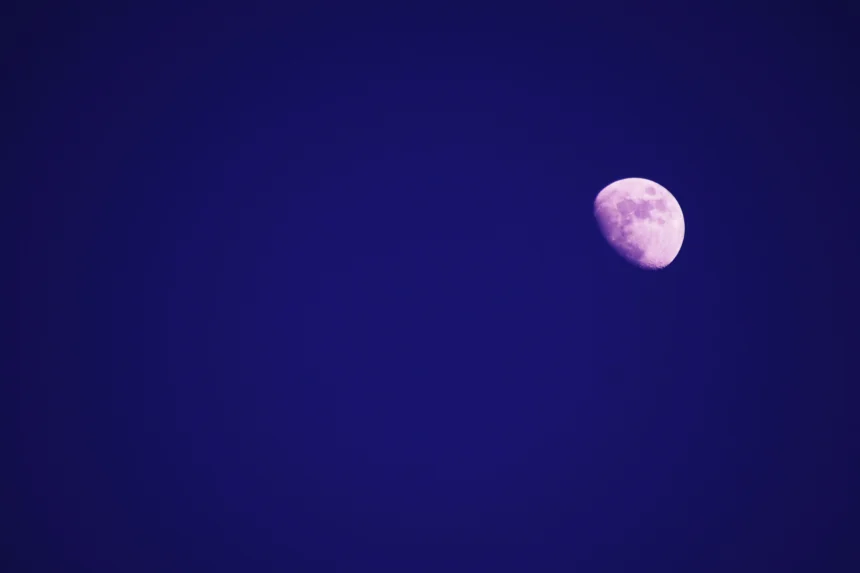
What Would Happen If the Moon Disappeared Overnight?
Imagine walking outside on a clear night and looking up at the sky. The stars are there. The planets are where astronomers predicted. But the Moon—the object that has accompanied Earth for billions of years—is missing.
There has been no explosion, no enormous asteroid impact and no trail of debris. The Moon has simply vanished. What would happen next?
If the Moon disappeared overnight, the first effects would be surprisingly quiet. Naturally moonlit landscapes would become darker, astronomers would discover an impossible event, and the gravitational forces responsible for most of our familiar tides would change. But Earth would not suddenly fall into the Sun, spin out of control or lose its oceans.
The deeper consequences would arrive on very different timescales. Coastal environments would have to adjust to weaker tides. Many animals would lose signals used for feeding and reproduction. Over geological time, Earth’s rotational behavior and possibly its climate would develop differently.
For wider context, The News Ink’s Space & Astronomy guide and NASA Explained guide cover the science and missions behind our understanding of the solar system. According to NASA’s explanation of the Moon’s influence, our satellite plays important roles in tides, long-term rotational stability and the evolution of Earth’s environment. The challenge is separating what would happen immediately from changes that could take thousands or millions of years.
So what would actually happen if the Moon disappeared—and which frightening predictions are scientific exaggerations?
First, What Does It Mean for the Moon to Disappear?
For this thought experiment, assume the Moon vanishes completely, without breaking into fragments or releasing energy. Earth’s position, speed and the rest of the solar system remain as they were at the moment it vanishes.
This is not a physically realistic event. Matter cannot simply be erased from the universe through any known natural process. Destroying the Moon with a collision would be a different scenario, involving potentially dangerous debris and enormous energy. Here, we are studying only the effects of removing its light, mass and gravitational influence.
There is also a subtle timing point. Changes in a gravitational field do not travel instantaneously; general relativity predicts that gravitational information propagates at the speed of light. The Moon is an average of approximately 384,400 kilometers from Earth, according to NASA’s Moon facts. Light crosses that distance in about 1.3 seconds.
Therefore, if the Moon disappeared by some impossible mechanism at one instant, an observer on Earth would not immediately know. The last reflected moonlight, and the corresponding change in gravitational influence, would reach Earth after roughly the same short delay.
That detail does not change the practical outcome, but it illustrates why even an impossible thought experiment should respect the rules of physics wherever possible. If the Moon disappeared under these assumptions, the sky would change before anyone could physically travel there to investigate.
Moon Disappeared: What Would Change and When?
| Time after the event | Likely consequence |
|---|---|
| About 1.3 seconds | The final moonlight reaches Earth and the altered gravitational influence becomes detectable |
| First night | Moonlit landscapes become darker, though stars and artificial lighting remain |
| Hours to days | Existing ocean tides begin adjusting to the missing lunar forcing |
| Days onward | Weaker solar-driven tides continue; the familiar spring–neap cycle is lost |
| Weeks to years | Organisms dependent on lunar illumination and timing encounter disruptions |
| Immediately onward | There can be no future eclipses involving Earth’s Moon |
| Years onward | Lunar missions and lunar-based planning lose their destination |
| Very long timescales | Earth’s tidal braking and axial-tilt evolution follow different paths |
The important distinction is that the Moon disappeared at one moment, but Earth’s response would not unfold as one sudden worldwide catastrophe.
1. The Night Sky Would Become Noticeably Darker
The most obvious immediate change would be visual. If the Moon disappeared during a bright full-moon night, the countryside would quickly become much darker. In a city surrounded by streetlights, the difference might be much less dramatic.
Moonlight is reflected sunlight, as NASA explains. The Moon does not produce its own visible glow; it reflects a portion of incoming sunlight toward Earth. As its orbit changes the angle at which we see the illuminated half, its familiar phases appear.
Without our natural satellite, there would never again be a crescent, half Moon or full Moon. Landscapes that were previously lit by a full Moon would rely on starlight, planets, atmospheric airglow and any artificial lighting.
But if the Moon disappeared, Earth would not be plunged into absolute darkness. The Sun would still illuminate the daytime hemisphere, and other natural sources of night light would remain. A night that would otherwise have been close to new Moon would not experience the same dramatic brightness change as a full-moon night.
The result would be a permanently moonless sky, not a planet where people could no longer see anything after sunset. If the Moon disappeared during the day, by contrast, many people might notice nothing until astronomers or news organizations reported it.
2. Ocean Tides Would Become Much Weaker
The most important rapid physical consequence would involve tides. The Moon’s gravity is the largest contributor to Earth’s familiar rise and fall of sea level.
This happens because the Moon pulls more strongly on the side of Earth nearest to it than on the far side. That difference in gravitational attraction produces tidal forces, while the response of real oceans is shaped by continents, seafloor depth and coastal geography.
If the Moon disappeared, the lunar part of that forcing would be removed. The oceans would not vanish, and their total quantity of water would remain essentially the same. What would change is how water is redistributed over time.
The Sun also produces tides. In fact, NASA’s tidal explanation states that the Sun’s tide-generating force is slightly less than half as strong as the Moon’s. NOAA puts the comparison at approximately 46% of lunar tidal forcing.
That means a moonless Earth would still experience solar tides. The daily height difference between high and low water would generally be substantially reduced, although the exact change would vary greatly by location.
Would Tides Become Exactly 46% as High?
No. The 46% figure compares the underlying tide-generating forces, not the measured height of every coastal tide. Ocean basins resonate, currents travel around landmasses, and local geography can amplify or suppress water-level changes.
It would be incorrect to claim that every coastline would retain precisely 46% of its current tides. Some places would change more than others. The familiar interaction between lunar and solar forcing would disappear, including the usual spring and neap tide cycle explained by NOAA.
Once the Moon disappeared, coastal tide tables based on the old lunar cycle would become obsolete and would need to be recalculated for the new solar-dominated system. Ports and fishing fleets would have to learn the new local tidal rhythms rather than use schedules built around the old ones.
3. The Oceans Would Adjust, but Not Produce an Automatic Global Tsunami
A popular version of this scenario imagines every ocean suddenly racing across continents. That is not a scientifically justified consequence of the Moon simply vanishing.
Ocean water has inertia. The tides present at the moment of disappearance would not instantly flatten into a uniform sea level. Waves and currents already in motion would continue, while the loss of lunar forcing changed how those motions developed.
Some coastlines might experience unusual temporary water-level changes or currents during the adjustment. The details would depend on when the Moon disappeared, the shape of the coastline, the depth of the sea and the existing tidal state.
But a tsunami is not simply another word for a large tide. Major tsunamis are ordinarily triggered by sudden displacement of water, such as from underwater earthquakes or landslides. There is no established reason that the hypothetical removal of lunar gravity would necessarily create one synchronized, planet-wide megatsunami.
The serious consequence is the long-term replacement of today’s tidal patterns, not an inevitable instant wall of water swallowing every continent.
4. Coastal Habitats Would Begin Changing
A coastline is more than a strip of land beside the ocean. It is an environment organized partly around repeated flooding and exposure.
Mudflats, tide pools, rocky shores, estuaries and mangrove areas contain organisms adapted to particular tidal ranges. Some feed when water retreats. Others use incoming tides to move, reproduce or avoid predators.
If the Moon disappeared, many of these habitats would experience a different pattern of flooding. Intertidal areas accustomed to strong lunar tides might have less frequent exposure or inundation at particular elevations.
Animals would not necessarily die the next morning. Some could adjust their behavior or occupy different habitats. Others could lose access to feeding or breeding conditions that have shaped their life cycles for generations.
This could have knock-on effects for birds, fish and larger marine animals that depend on coastal food webs. The Institute of Physics highlights grunion fish and certain sea turtles as examples of animals whose life cycles are closely connected with tides.
The consequences if the Moon disappeared would therefore extend far beyond visibly lower high tides. They would reach the relationships between predators, prey, habitat and reproduction.
5. Wildlife Would Lose an Important Biological Clock
Many species respond to more than daylight and seasons. Some also respond to moonlight and the timing of lunar phases.
Coral provides one particularly important example. During mass-spawning events, large numbers of coral colonies release eggs and sperm into seawater during relatively narrow windows. According to NOAA, water temperature and lunar cycles help coordinate these events.
Research published in Communications Biology has also identified the timing of moonrise as an important cue for synchronized spawning in a coral species.
If the Moon disappeared, species using those signals would need to rely on other environmental cues, and the disruption could reduce successful reproduction in some populations. The magnitude would vary by species and environment; it is not possible to predict a universal extinction rate.
Moonlight also influences nocturnal movement. Some animals avoid exposed places during brightly moonlit nights because predators can see them more easily. Others use brighter conditions to hunt or navigate.
This is why, if the Moon disappeared, a species that benefits from dark nights could respond differently from one that uses moonlight to navigate. A study of tropical forest mammals found different responses to lunar illumination across species, underscoring that no single reaction describes all wildlife.
If the Moon disappeared, that natural variation between bright and dark lunar nights would end. Some species could benefit from more consistently dark conditions, while others could struggle to adapt.
6. Solar and Lunar Eclipses Would End
A solar eclipse occurs when the Moon passes between Earth and the Sun, blocking some or all of the Sun’s apparent disk for observers in the right place. A lunar eclipse occurs when the Moon passes through Earth’s shadow.
If the Moon disappeared, neither event could happen in its familiar form. There would be no total or annular solar eclipse caused by Earth’s Moon, and no lunar eclipse because there would be no lunar surface to darken.
NASA’s eclipse guide explains how the geometry of the Sun, Earth and Moon creates these phenomena.
Other celestial transits would still be possible. For example, Mercury and Venus can pass in front of the Sun as viewed from Earth, although they cover much smaller portions of the solar disk than the Moon does during a total solar eclipse.
If the Moon disappeared, those familiar eclipses would be lost permanently unless some entirely different astronomical arrangement arose. The loss would be scientific as well as cultural. Astronomers use eclipses for research and education, while generations of people have relied on lunar cycles to mark calendars and festivals.
7. Earth Would Keep Orbiting the Sun
One of the strangest misconceptions is that the Moon somehow holds Earth in place. In reality, Earth orbits the Sun primarily because of the Sun’s gravity and Earth’s existing motion.
If the Moon disappeared, Earth would not immediately fly into deep space or fall into the Sun. It would continue moving along a broadly similar solar orbit.
The Moon does affect the precise motion of Earth. Both bodies move around a shared center of mass, or barycenter, while traveling around the Sun. Removing the Moon would change that small monthly component of Earth’s motion and its future orbital perturbations.
But these changes would be minor compared with the dominant Sun–Earth gravitational relationship.
Earth’s surface gravity would also remain essentially normal. You would not suddenly become lighter, float out of your chair or watch the atmosphere escape into space.
In this thought experiment, the Moon disappeared; Earth’s mass did not. Our planet would continue holding its oceans, air, buildings and people by its own gravity.
For related explanations of extreme gravity, see The News Ink’s black hole science guide.
8. A Day Would Still Last About 24 Hours
If the Moon disappeared, Earth would not suddenly spin dramatically faster. The current rotation of our planet would continue almost unchanged at first.
The Moon has, however, influenced Earth’s rotation for billions of years. Through tidal friction and gravitational interaction, angular momentum has gradually been transferred between Earth and its satellite.
This interaction slowly lengthens the day and causes the Moon to move outward. NASA reports that the Moon currently recedes by approximately 3.8 centimeters each year.
Removing the Moon would remove the main lunar component of that tidal braking. Solar tides would still contribute to tidal friction, so Earth’s spin would not become permanently fixed at exactly its current rate.
The important difference would be in the future evolution of Earth’s rotation, not in the length of tomorrow’s workday.
No clocks would need immediate resetting. Sunrise and sunset would continue on approximately their existing schedule, and the familiar 24-hour civil day would remain useful.
If the Moon disappeared permanently, scientists examining Earth millions of years later could find a rotational history substantially different from that of an Earth that retained its satellite.
9. Earth’s Axial Tilt Could Become Less Stable Over Very Long Periods
Earth’s axis is currently tilted by about 23.4 degrees relative to its orbital plane. This tilt is a primary reason we experience seasons: it determines how sunlight is distributed across the hemispheres during the year.
The Moon helps stabilize Earth’s rotational orientation. Its gravitational influence changes the way our planet’s axis responds to perturbations from the Sun and other planets.
If the Moon disappeared, that stabilizing interaction would be lost. Over sufficiently long timescales, Earth’s tilt could undergo greater variations than it does today, with consequences for where sunlight reaches the surface and how intense seasons become.
But this subject requires careful wording. Some popular explanations claim that Earth’s axis would instantly flip or inevitably swing wildly between nearly zero and 85 degrees. Those are not reliable predictions for the morning after the disappearance.
A landmark 1993 study in Nature showed how the Moon contributes to Earth’s obliquity stability. Later simulations produced a more nuanced picture.
A study available through NASA’s Technical Reports Server found that some simulated moonless Earths maintained relatively limited tilt variations over very long periods, depending on their initial conditions and rotational histories.
The scientifically defensible conclusion is that losing the Moon could increase long-term axial variability, but the exact future behavior would not be predetermined by one dramatic number. If the Moon disappeared, scientists would need to model Earth’s evolving axis rather than assume a single catastrophic outcome.
If the Moon disappeared tonight, tomorrow would still have the current season. Any major changes associated with altered axial evolution would be the concern of the distant geological future.
10. Ocean Mixing, Human Life and Space Exploration Would All Change
Tides do more than raise and lower the waterline. Tidal currents help mix water in estuaries, continental shelves and parts of the deep ocean. That movement influences nutrients, sediment and the distribution of heat.
If the Moon disappeared, the loss of much of the tidal forcing would alter some of these mixing processes. The ocean would not stop circulating: winds, temperature differences, salinity and Earth’s rotation would continue driving substantial currents.
But weakening a major component of tidal energy could gradually change marine ecosystems and some regional ocean processes. The full climate implications would be complex and could not be responsibly reduced to a precise global temperature prediction.
Human activities would change too. Fishing communities, harbors and marine operators use tidal predictions to plan movements. Their schedules would have to be recalculated after the oceans settled into new patterns.
Traditional lunar calendars would lose their recurring astronomical reference, although solar calendars and the ordinary seven-day week would not suddenly cease to function.
Meanwhile, lunar exploration would come to an abrupt end. Spacecraft already traveling toward or orbiting the Moon would require entirely new trajectories; surface equipment on the vanished body would be gone in this hypothetical scenario.
The News Ink’s Artemis III explainer and NASA Moon Base guide explain the enormous scientific and engineering effort currently devoted to lunar exploration. If the Moon disappeared, those plans would lose their destination.
Earth-orbiting GPS, weather and communications satellites would not all stop functioning simply because the Moon vanished. Their trajectories would require new gravitational modeling and sometimes adjustments, but that is very different from the wholesale satellite failure discussed in The News Ink’s satellite systems explainer.
Would the Moon’s Disappearance Cause Global Climate Collapse?
Not overnight. Earth’s temperature, atmosphere, seasons and oceans have substantial inertia. The Sun would still provide the overwhelming majority of energy driving Earth’s climate.
If the Moon disappeared, two different types of climate-related change would need to be considered. The first involves the gradual consequences of reduced tidal mixing in some ocean regions. The second involves possible changes in axial tilt over immensely long periods.
Neither gives scientists a sound basis for claiming that humanity would face a new ice age the following week or that the entire planet would become uninhabitable within a year.
The long-term consequences could still be important. A different axial history could change seasonal extremes and the geographic patterns of ice and rainfall. Marine ecosystems would adapt to different circulation and coastal conditions.
But the range and timing of those effects depend on complicated interactions. They are possibilities requiring models, not exact events that can be confidently placed on a calendar.
Earth With the Moon vs Earth After the Moon Disappeared
| Feature | Earth today | Earth without the Moon |
|---|---|---|
| Night sky | Lunar phases and moonlit nights | No moonlight or lunar phases |
| Ocean tides | Lunar and solar forcing together | Predominantly solar forcing; generally weaker tides |
| Spring and neap cycle | Follows Moon–Sun alignments | Familiar lunar-driven cycle absent |
| Coastal habitats | Adapted to existing tidal ranges | Changing flooding, feeding and breeding patterns |
| Wildlife rhythms | Many species respond to lunar cycles | Those cues disappear or change |
| Eclipses | Solar and lunar eclipses occur | No eclipses involving Earth’s Moon |
| Day length | Approximately 24 hours | Approximately unchanged initially |
| Earth’s solar orbit | Dominated by Sun’s gravity | Continues with relatively small orbital changes |
| Axial stability | Influenced by lunar gravity | Greater long-term variations possible |
| Space exploration | Moon is a major destination | Lunar exploration cannot continue as planned |
The table makes clear why the phrase “Moon disappeared” should not be mistaken for “Earth destroyed.” Our planet would remain intact, but it would begin operating under a different set of gravitational and ecological conditions.
Common Myths About a World Without the Moon
| Claim | What science supports |
|---|---|
| Earth would instantly fall into the Sun | False. The Sun dominates Earth’s orbit |
| Everyone would float because gravity disappeared | False. Earth’s surface gravity would remain |
| The oceans would disappear | False. Earth still holds its water |
| All tides would stop | False. Solar tides remain |
| A gigantic tsunami would instantly circle Earth | Not an established or necessary consequence |
| Earth’s day would become much shorter overnight | False. Its spin would not suddenly reverse its history |
| Seasons would immediately vanish | False. Axial tilt would remain initially |
| The entire planet would become pitch-black | False. Daylight, starlight and artificial light remain |
| Every satellite would immediately fail | False. Most Earth-orbiting systems would continue |
| Climate would never change | Also false. Long-term changes could be substantial |
The real danger of exaggerated claims is that they obscure the physical processes the Moon genuinely influences.
Frequently Asked Questions
What would happen first if the Moon disappeared overnight?
After approximately 1.3 seconds, the last moonlight would stop reaching Earth and the change in the Moon’s gravitational influence would be felt. Ocean tides would begin adjusting, while Earth kept rotating and orbiting the Sun.
Would Earth survive if the Moon disappeared?
Yes. If the Moon disappeared without an explosion or debris, Earth would remain intact and initially habitable. Important long-term changes could affect coastal ecology, rotational stability and climate patterns.
Would there still be high and low tides?
Yes. The Sun also creates tides. When the Moon disappeared, the main lunar component would vanish, leaving weaker solar-driven tides whose local heights would depend on ocean geography.
Would a tsunami occur if the Moon disappeared?
A sudden removal of lunar tidal forcing could produce complicated temporary ocean adjustments, but there is no basis for claiming it would automatically create one global megatsunami. Tsunamis and ordinary tides arise through different processes.
Would humans become lighter if the Moon disappeared?
No meaningful change in everyday weight would occur. Earth provides nearly all of the gravitational acceleration that keeps people and objects on its surface.
Would the Earth’s day become six hours long?
No. Earth’s rotation would continue at nearly its existing rate. The loss of lunar tidal braking would affect future changes in day length over immense timescales, not cause an instant reset.
Would the seasons disappear if the Moon disappeared?
No. Earth’s existing axial tilt would remain at first, so seasons would continue. The long-term stability of that tilt could change, but the resulting range depends on orbital dynamics and initial conditions.
Would there ever be another solar eclipse?
Not an eclipse produced by Earth’s Moon. With the Moon gone, it could no longer cover the Sun as seen from Earth. Small transits of Mercury or Venus would still be possible.
Would the Moon disappeared event kill all ocean animals?
No such immediate outcome is established. Some coastal and marine species would face significant disruption to tides and reproductive cues, while others might adapt or be less affected.
Would satellites and GPS stop working if the Moon disappeared?
Not automatically. Earth-orbiting satellites would remain gravitationally bound to Earth in most ordinary cases, although operators would need updated orbit models and potentially corrective maneuvers.
Could the Moon really vanish overnight?
There is no known physical mechanism by which the Moon could simply disappear without other consequences. The scenario is a hypothetical used to explore how the Moon influences Earth.
The Bottom Line: Earth Would Survive, but It Would Never Be Quite the Same
The Moon looks like a quiet companion in our sky, yet its influence is woven into physical and biological systems across the planet.
If the Moon disappeared overnight, we would notice the missing moonlight first. The oceans would then adjust to the loss of lunar tidal forcing, leaving generally weaker tides controlled mainly by the Sun. Coastal animals and species that rely on lunar cycles would face new environmental pressures, and future eclipses involving our Moon would be impossible.
But Earth would not shatter, lose its atmosphere or fall into the Sun. Tomorrow’s day would still be approximately 24 hours long, and the familiar seasons would continue at first.
The most profound uncertainties concern the distant future. Without the Moon’s stabilizing influence, Earth’s axial behavior could become more variable, while changes in tidal mixing and ecosystems would reshape parts of the environment over time.
If the Moon disappeared in our thought experiment, its long history of helping shape Earth would not be erased. That history is written into the oceans, the rotation of our planet and the rhythms of living things.
The surprising truth is that a moonless Earth would not end overnight—it would slowly become a different world.
For more research-driven explainers, science coverage and global stories, follow The News Ink on X, Instagram, Threads, Medium, Substack, Bluesky, Pinterest, TikTok, Quora and Mastodon.