




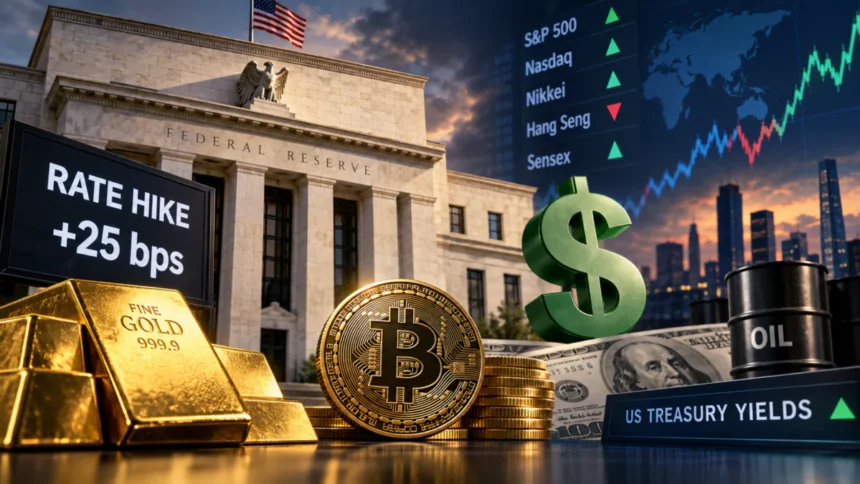
Fed Rate Hike Explained: What the 3.75%–4.00% Rate Means for Your Money
The Federal Reserve has raised interest rates again, and the effects could reach household budgets surprisingly quickly.
On September 16, 2026, the Federal Open Market Committee voted unanimously to raise its target range for the federal funds rate by 0.25 percentage point, taking it from 3.50%–3.75% to:
3.75%–4.00%
The Fed rate hike was approved by a 12–0 vote. The Federal Reserve said economic activity was expanding at a solid pace, domestic spending remained resilient and inflation was still elevated. Policymakers said the higher rate was intended to support a more timely return of inflation toward the Fed’s 2% goal.
For ordinary households, however, the important question is much simpler:
What does the Fed rate hike actually mean for your money?
The answer depends on whether you are borrowing, saving, buying a home, carrying credit-card debt, running a business or investing in financial markets.
Higher rates usually make borrowing more expensive.
They can also make savings accounts and certificates of deposit more attractive.
Mortgage rates may face additional upward pressure, although the Fed does not set mortgage rates directly.
Stocks can become more volatile as investors reassess company valuations and the possibility of additional tightening.
And perhaps most importantly, this may not be the final Fed rate hike of 2026.
The Federal Reserve’s latest economic projections show a median federal-funds-rate expectation of 4.1% at the end of 2026, implying that policymakers collectively see room for roughly another quarter-point increase from the current midpoint.
Here is what households and markets need to know.
The Fed Rate Hike in Numbers
| Measure | Latest Position |
|---|---|
| Previous target range | 3.50%–3.75% |
| New target range | 3.75%–4.00% |
| Increase | 0.25 percentage point |
| FOMC vote | 12–0 |
| 2026 median GDP projection | 2.3% |
| 2026 median unemployment projection | 4.1% |
| 2026 median PCE inflation projection | 3.7% |
| 2026 median core PCE projection | 3.4% |
| Median year-end policy rate | 4.1% |
| Fed inflation goal | 2% |
The September projections are notable because the Fed expects relatively solid growth while inflation remains well above target. Officials now project 2026 PCE inflation at 3.7% and core PCE inflation at 3.4%, while unemployment is projected at 4.1%.
That combination helps explain why policymakers were willing to tighten monetary policy.
Why Did the Federal Reserve Raise Rates?
The Fed has two statutory monetary-policy goals:
maximum employment
and
stable prices.
The Federal Reserve uses the federal funds rate as its primary policy tool.
Higher interest rates make borrowing more expensive and generally encourage households and businesses to spend less or delay purchases. Over time, weaker demand can reduce pressure on prices.
The Fed itself explains that higher interest rates tend to restrain household and business borrowing and spending, which can help prevent excessive demand from sustaining inflation.
The latest Fed rate hike therefore is primarily an inflation-fighting move.
The FOMC said inflation remains elevated even as the economy continues to expand at a solid pace.
This matters because a strong economy gives the central bank more room to raise rates without immediately responding to a major deterioration in employment.
The risk is that monetary policy works with delays.
A rate increase today can influence economic activity for months afterward.
Too little tightening may allow inflation to remain high.
Too much could weaken economic growth and employment more than intended.
That balance will dominate the next several Fed meetings.
What the Fed Rate Hike Means for Mortgages
Housing is one of the first places people look after a Fed rate hike.
But there is an important misconception:
The Federal Reserve does not directly set 30-year mortgage rates.
Fixed mortgage rates are influenced heavily by longer-term Treasury yields, expectations about future inflation, the future path of Fed policy and mortgage-market risk.
Federal Reserve research notes that long-term mortgage rates respond not only to today’s policy rate but also to expectations about where rates are heading in the future.
That means mortgage rates can rise before an expected Fed decision.
They can even fall after a rate hike if investors believe future inflation will decline and the Fed will not need to tighten as much as feared.
Still, the current environment is difficult for homebuyers.
Freddie Mac’s September 10 survey showed the average 30-year fixed mortgage at 6.76%, already substantially higher than the same period a year earlier.
Rates have since moved close to 7% in the broader market as bond yields have climbed.
So the Fed rate hike is unlikely to provide immediate relief for buyers.
A Mortgage Payment Example
Consider a $400,000, 30-year fixed mortgage.
At roughly 6.75%, principal and interest would be about $2,594 per month.
At 7.00%, it would be about $2,661.
That is roughly $67 more every month, before property taxes, insurance or homeowners association costs.
A quarter-point difference may sound small.
Across a large mortgage, it can materially affect affordability.
Existing Fixed-Rate Homeowners Are Better Insulated
People who already have a fixed-rate mortgage generally will not see their rate change simply because of the Fed rate hike.
If you locked a 30-year fixed mortgage several years ago, the Fed cannot retroactively rewrite that interest rate.
This gives existing homeowners a degree of insulation from monetary tightening.
The effect is stronger on:
new homebuyers,
people refinancing,
borrowers using adjustable-rate mortgages,
home-equity lines of credit.
Federal Reserve research shows that fixed-rate mortgages slow some immediate transmission of monetary policy, although new borrowing and refinancing still allow higher rates to work through the housing system over time.
What Happens to Credit Cards?
Credit cards can react much faster than mortgages.
Many cards use a variable annual percentage rate linked to benchmarks such as the U.S. prime rate.
When benchmark rates rise, variable credit-card APRs can increase.
The Consumer Financial Protection Bureau notes that card issuers may increase an existing variable interest rate when the index underlying that rate, such as the prime rate, increases.
That makes the Fed rate hike particularly important for people carrying balances month to month.
Imagine someone owes:
$10,000
on a high-interest credit card.
Even a small additional increase in the APR means more money going toward interest rather than reducing principal.
For borrowers already paying rates above 20%, the larger issue is not necessarily this single quarter-point move.
It is the cumulative effect of elevated rates over time.
The biggest protection is generally reducing high-cost revolving debt where practical rather than trying to predict the exact date of the next Fed decision.
What the Fed Rate Hike Means for Auto Loans
Car financing can also become more expensive.
Auto-loan rates depend on:
the benchmark-rate environment,
Treasury yields,
lender funding costs,
the borrower’s credit history,
loan length,
the vehicle.
The Fed rate hike does not guarantee every auto loan rises exactly 0.25 point.
But a higher policy-rate environment generally increases financing costs.
That can produce a double burden for buyers if vehicle prices also remain high.
A slightly higher monthly payment may seem manageable, but longer loan terms can cause borrowers to pay considerably more interest over the life of the loan.
Consumers shopping for a vehicle may therefore see greater value in comparing financing offers rather than focusing only on the monthly payment.
Personal Loans and HELOCs Could Become More Expensive
Variable-rate debt tends to feel a Fed rate hike relatively quickly.
This includes many:
home-equity lines of credit,
business credit lines,
variable personal loans,
adjustable-rate products.
The Federal Reserve explains that changes in the federal funds rate are rapidly reflected in many short-term and floating-rate loans.
A HELOC borrower, for example, may see borrowing costs rise as the rate adjusts.
That can affect homeowners who planned to use home equity for:
renovations,
education,
debt consolidation,
large purchases.
Fixed-rate loans already in place are generally less immediately affected.
Savers Could Be Among the Winners
The Fed rate hike is bad news for many borrowers.
For savers, it can be positive.
As short-term interest rates rise, banks and financial institutions may increase yields on:
high-yield savings accounts,
money-market accounts,
certificates of deposit,
short-term Treasury securities.
Federal Reserve research confirms that changes in the federal funds rate affect both what lenders charge borrowers and what financial institutions pay depositors.
But do not assume every bank will automatically add 0.25 percentage point to every savings account.
Traditional savings accounts at large banks can respond slowly.
More competitive online banks and money-market products may move faster.
That creates an opportunity for savers to compare rates.
The Fed rate hike may therefore widen the gap between a low-paying savings account and a competitive one.
CDs Could Become More Attractive
Certificates of deposit can benefit from higher rates because banks may offer better yields when short-term market rates rise.
But timing matters.
If additional Fed rate hike moves are coming, locking money into a long-term CD immediately could mean missing higher rates later.
On the other hand, nobody knows with certainty how many more increases will occur.
A saver who values certainty may prefer locking a rate.
Someone expecting further increases may prefer shorter maturities.
The key point is that higher Fed rates generally increase the range of returns available to people holding cash.
What the Fed Rate Hike Means for Businesses
Businesses also borrow money.
They finance:
factories,
equipment,
inventories,
office buildings,
acquisitions,
payroll,
technology investment.
A Fed rate hike raises the hurdle for those investments.
A project that made financial sense with cheaper financing can become less attractive if interest costs rise.
The Fed describes this as a major transmission channel of monetary policy: higher borrowing costs can reduce investment by businesses and spending by households.
Small businesses can be especially sensitive because they may depend heavily on:
bank loans,
credit lines,
credit cards,
variable-rate financing.
Large companies may have greater access to bond markets, but corporate bond yields can also rise when broader interest rates increase.
Could the Fed Rate Hike Slow Hiring?
Potentially.
Higher rates are intended to reduce demand.
If households buy fewer homes, cars and expensive goods, businesses may experience slower sales.
If financing becomes more expensive, companies may postpone expansion.
Over time, that can reduce hiring.
But the latest Fed forecasts do not currently point to a dramatic deterioration in employment.
The median FOMC projection puts the unemployment rate at 4.1% in 2026 and 2027.
The Fed is therefore attempting to reduce inflation without causing an unnecessarily large weakening in employment.
Whether it succeeds will depend on inflation, energy prices, consumer demand, business investment and other factors outside the central bank’s direct control.
What the Fed Rate Hike Means for Stocks
Stocks generally prefer lower interest rates, all else equal.
There are several reasons.
Higher rates increase corporate financing costs.
They can reduce economic demand.
And safer investments such as Treasury securities become more competitive with stocks.
Higher interest rates also reduce the present value investors may place on profits expected far into the future.
That can be particularly important for high-growth companies.
The market reaction to this Fed rate hike reflected those concerns.
On September 16, the S&P 500 finished 0.4% lower, the Dow fell about 1.2%, while the Nasdaq was nearly flat as investors processed the hike and the prospect of additional tightening.
But markets can reverse quickly.
By the following session, falling oil prices and easing long-term yields helped improve sentiment.
That is why one day of trading should not be treated as a definitive verdict on the Fed rate hike.
Why Technology Stocks Can Be Sensitive
Growth-oriented companies often derive a large share of their expected value from earnings projected many years into the future.
When interest rates rise, investors generally apply a higher discount rate to those future earnings.
That can pressure valuations.
However, company fundamentals still matter.
A strong earnings outlook can outweigh rate pressure.
Likewise, a Fed rate hike does not automatically mean every technology stock will fall.
Interest rates are one force among many.
What Happens to Bonds?
Bonds have an inverse relationship between prices and yields.
When market yields rise, prices of existing lower-yield bonds generally fall.
Short-term Treasury yields are particularly sensitive to expectations about Fed policy.
Following the latest Fed rate hike, shorter-term yields initially moved higher as investors increased expectations that additional tightening could follow.
Longer-term yields depend on a broader mix of:
inflation expectations,
economic growth,
government borrowing,
future Fed policy,
global demand for Treasury securities.
This is why the bond market can sometimes send a different signal from the federal funds rate itself.
What Happens to the U.S. Dollar?
Higher U.S. interest rates can make dollar-denominated assets more attractive relative to assets in countries offering lower yields.
That can support the dollar.
After the Fed announcement, the dollar posted its biggest one-day gain in around three months before easing somewhat the following day as Treasury yields retreated.
A stronger dollar can have mixed effects.
It can make imported goods cheaper for American consumers.
But it can also make U.S. exports more expensive to foreign buyers and reduce the dollar value of overseas earnings for multinational companies.
Could This Fed Rate Hike Reduce Inflation?
That is the objective.
But not immediately.
Monetary policy works through financial conditions and spending decisions over time.
Higher borrowing costs can discourage:
home purchases,
vehicle purchases,
business expansion,
large consumer purchases.
Lower aggregate demand can eventually reduce businesses’ ability to continue raising prices.
The Federal Reserve specifically said the latest action is intended to support a more timely return of inflation to 2%.
Still, rate increases cannot directly fix every source of inflation.
Higher rates cannot immediately produce more oil, repair a supply chain or increase housing supply.
They work mostly by influencing demand and broader financial conditions.
The Fed Still Expects Inflation Above Target
The latest projections explain why the Fed rate hike happened.
FOMC participants now project:
3.7% headline PCE inflation in 2026
and
3.4% core PCE inflation.
Both are well above the Fed’s 2% longer-run target.
The median projection does not show headline PCE inflation returning to 2% until 2029.
That implies policymakers expect the inflation problem to take time to resolve.
It also means households hoping for a rapid return to extremely low borrowing rates may need to remain cautious.
Will the Fed Raise Rates Again?
Possibly.
The September Summary of Economic Projections shows a median federal funds rate of 4.1% at the end of 2026, compared with the current range midpoint of 3.875%.
Sixteen of 18 policymakers projected at least one further increase this year, according to Reuters’ review of the projections.
That does not guarantee another Fed rate hike.
The Fed can change course if economic conditions change.
Policymakers will be watching:
inflation,
employment,
consumer spending,
economic growth,
energy prices,
financial conditions.
One surprisingly weak jobs report or a sharp drop in inflation could alter the outlook.
Likewise, stronger inflation could increase pressure for more tightening.
What Households Should Watch Now
The impact of the Fed rate hike will not arrive everywhere at once.
Credit-card and other variable borrowing rates may adjust relatively quickly.
Mortgage rates will remain tied more closely to the bond market and expectations of future Fed policy.
Savings yields may rise, but banks will decide how much of the increase they pass on.
Stock and bond markets will react continuously to incoming data.
For households, the most important indicators over the coming weeks are likely to be:
inflation data,
employment reports,
Treasury yields,
mortgage rates,
and signals from the Federal Reserve about the next meeting.
What This Means for the Wider Economy
The Fed rate hike represents a shift toward tighter financial conditions.
The intended chain is straightforward:
higher policy rates → more expensive credit → slower borrowing and spending → weaker inflation pressure.
The Federal Reserve describes this transmission process as central to how monetary policy affects inflation and employment.
But monetary policy is not an on-off switch.
Millions of households have fixed-rate mortgages.
Companies may have already locked in long-term financing.
Some consumers have enough savings to keep spending despite higher rates.
That can make the economy less immediately sensitive to a single quarter-point increase.
If the Fed continues raising rates, however, the cumulative effect becomes more significant.
Frequently Asked Questions
How much did the Fed raise interest rates?
The Federal Reserve increased the target range by 0.25 percentage point, taking the federal funds target to 3.75%–4.00%.
When did the Fed rate hike happen?
The FOMC announced the decision on September 16, 2026, with implementation changes effective September 17.
Will mortgage rates rise because of the Fed rate hike?
They could face upward pressure, but the Fed does not directly set fixed mortgage rates. Mortgage rates depend heavily on longer-term Treasury yields, inflation expectations and expectations for future monetary policy.
Will my existing fixed mortgage become more expensive?
Normally no. A fixed mortgage rate does not change simply because the Fed raises its policy rate.
Will credit-card rates rise?
Variable credit-card APRs can increase when benchmark indexes such as the prime rate rise.
Is the Fed rate hike good for savings accounts?
It can be. Higher short-term rates can lead banks and other institutions to offer higher deposit yields, although individual banks decide how much to pass through.
What does the Fed rate hike mean for stocks?
Higher rates can pressure valuations and increase borrowing costs, but stock prices are also influenced by earnings, growth expectations and many other factors.
Will the Fed raise rates again in 2026?
The Fed has not guaranteed another move, but its September projections indicate that most policymakers expect at least one additional increase by year-end.
Conclusion: The Real Impact May Come From What Happens Next
The Fed rate hike is only 0.25 percentage point.
But its significance is larger than the number itself.
It tells households, businesses and investors that the Federal Reserve remains concerned enough about inflation to make borrowing more expensive.
The new target range is now:
3.75%–4.00%.
For borrowers, the immediate message is uncomfortable.
Credit cards and other variable-rate debt can become more expensive.
Mortgage borrowers face a housing market where rates are already close to 7%.
Businesses face higher financing costs.
New car and personal-loan borrowers may also encounter more expensive credit.
For savers, the Fed rate hike can create an opportunity.
High-yield savings accounts, CDs and short-term interest-bearing investments may become more competitive as institutions respond to higher market rates.
For investors, the picture is more complicated.
Higher rates can put pressure on stocks and bonds, but the market reaction will depend heavily on whether the Fed succeeds in bringing inflation down without causing a severe economic slowdown.
The September decision also cannot be viewed in isolation.
Fed projections show inflation remaining above target through the near term, with median PCE inflation at 3.7% for 2026 and the median projected policy rate ending the year at 4.1%.
That makes the next question more important than yesterday’s decision:
Is this a one-off Fed rate hike, or the beginning of another tightening sequence?
For now, policymakers appear to be leaving that decision to incoming data.
Consumers should probably do the same.
Rather than trying to predict every Fed meeting, borrowers can focus on reducing expensive variable-rate debt, comparing lenders and avoiding taking on more interest costs than their budgets can absorb.
Savers can compare deposit rates.
Homebuyers can watch Treasury and mortgage yields rather than assuming the federal funds rate directly determines their mortgage quote.
And investors can distinguish short-term market volatility from longer-term financial goals.
The latest Fed rate hike changes the price of money.
What happens next will determine how deeply that change moves through the economy.
For more explainers on inflation, interest rates, consumer finances and the wider U.S. economy, visit The News Ink’s Economy coverage.
Follow The News Ink
The headline tells you what happened. We explain what it means.
Breaking news: X • Threads • Bluesky
Daily stories: Instagram • TikTok • Pinterest
Deeper analysis: Substack • Medium • Quora • Mastodon

