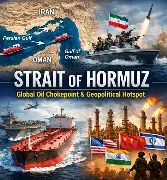
Three Supertankers Break Through the Strait of Hormuz — Is the World’s Most Critical Oil Route Finally Reopening?
For the first time in over two months, three massive commercial supertankers have successfully navigated through the Strait of Hormuz, carrying a combined 6 million barrels of Middle East crude oil. The move marks a significant — though cautious — development for global energy markets that have been watching the world’s most important oil chokepoint with growing anxiety.
The vessels departed the strategic waterway on Wednesday after sitting stranded inside the Persian Gulf since early March. Their safe passage is now fueling cautious optimism that the prolonged disruption to one of the planet’s most critical energy corridors may finally be moving toward resolution.
The Three Vessels That Made the Breakthrough
All three ships are classified as Very Large Crude Carriers — the workhorses of the global oil shipping industry, each capable of carrying up to 2 million barrels of crude in a single voyage. Here is a closer look at each vessel and its cargo:
1. Universal Winner — South Korean-Flagged VLCC
- Cargo: 2 million barrels of Kuwaiti crude oil
- Destination: Ulsan, South Korea
- Discharge Facility: SK Energy refinery
- Expected Arrival: June 9
- This vessel represents a direct lifeline to South Korea’s refining sector, which has been managing crude supply shortfalls since the strait disruption began.
2. Yuan Gui Yang — Chinese-Flagged VLCC
- Cargo: 2 million barrels of Iraqi Basrah crude
- Chartered By: Unipec, the trading arm of Sinopec
- Destination: Guangdong Province, China
- Expected Arrival: June 4
- Sinopec’s trading arm secured this cargo for one of China’s most industrially active southern provinces, where refining demand remains extremely high.
3. Ocean Lily — Hong Kong-Flagged VLCC
- Cargo: 2 million barrels split evenly between Qatari Al-Shaheen crude and Iraqi Basrah crude
- Owned By: Sinochem
- Destination: Fujian Province, China
- Expected Arrival: June 5
- The mixed cargo reflects the diversified sourcing strategies that Asian buyers have adopted during the disruption period to secure supply from multiple origins.
The three ships together represent the largest single movement of crude oil through the Strait of Hormuz since the waterway effectively closed to most commercial traffic weeks ago.
Why the Strait of Hormuz Matters So Much
The Strait of Hormuz sits between Iran and Oman at the mouth of the Persian Gulf. It is the single most important oil transit chokepoint in the world. Every day under normal conditions, approximately 20 to 21 million barrels of crude oil and petroleum products move through this narrow passage — roughly 20% of total global oil consumption.
When access to the strait becomes restricted, the consequences ripple across every major economy on earth. Asian nations — including China, Japan, South Korea, and India — depend heavily on Persian Gulf crude to fuel their economies. Europe and the United States feel the impact through rising energy costs and supply chain pressure.
The prolonged disruption over the past two months has:
- Pushed Brent crude prices significantly higher, with July delivery contracts trading at $109.13 per barrel as of Wednesday morning.
- Driven WTI crude to $102.31 per barrel, reflecting tightening supply conditions in North American markets.
- Forced Asian refiners to scramble for alternative crude sources from West Africa, the Americas, and Russia.
- Created a shipping backlog that analysts say will take months to clear even after full reopening.
The three departing supertankers carry enormous symbolic weight. They signal that movement through the strait is at least partially possible — but they represent only a fraction of what the global market needs.
Diplomatic Progress — Real or Fragile?
The successful transit of these vessels coincides with reports of diplomatic activity behind the scenes. Recent briefings from Washington suggest that productive conversations between the United States and Iran have taken place through intermediary channels, raising hopes for a more permanent de-escalation agreement.
However, the situation remains far from settled. Several key points define the current diplomatic landscape:
- Talks are ongoing but contradictory — statements from different parties frequently conflict with each other, making it difficult to assess true progress.
- No formal agreement exists — details on any permanent enforcement mechanism or official reopening conditions remain extremely limited.
- Mediators are active — third-party nations are reportedly facilitating dialogue between Washington and Tehran, though their identities and mandates remain largely undisclosed.
- Energy markets are cautiously hopeful — the 1.9% drop in Brent crude prices on Wednesday reflects some optimism, but prices remain historically elevated above $100 per barrel.
The diplomatic picture suggests movement in the right direction — but experienced energy market observers caution against reading too much into early signals that have previously disappointed.
Why High Oil Prices Will Likely Persist Even After a Resolution
Even if diplomats reach a full agreement tomorrow and the Strait of Hormuz reopens completely, energy analysts are delivering a sobering message to markets — do not expect an immediate return to normal.
The reasons are structural, not political:
- Upstream infrastructure damage — production facilities, pumping stations, and pipeline networks in the region have suffered operational disruptions that take time and significant capital to restore.
- Shipping backlog — dozens of tankers remain backed up in the Persian Gulf waiting to load or transit. Clearing that backlog takes weeks under the best conditions.
- Supply chain realignment — Asian refiners have already begun securing alternative crude sources. Unwinding those contracts and returning to Gulf supply takes time.
- Insurance and risk premiums — shipping insurers have added significant war-risk surcharges to vessels transiting the region. Those premiums do not disappear overnight once hostilities ease.
Energy analysts estimate that full market normalization will take three to four months from the moment a genuine resolution takes effect. That means elevated oil prices — likely above $100 per barrel for Brent — are here to stay for the foreseeable future, regardless of how quickly diplomacy moves.
What This Means for Global Energy Markets
The broader picture for oil markets right now reflects a delicate balance between hope and structural reality:
- Brent crude for July delivery fell 1.9% to $109.13 per barrel on Wednesday, reflecting cautious optimism from the tanker news.
- WTI crude dropped 1.8% to $102.31 per barrel in corresponding trading.
- Asian buyers remain on high alert, actively monitoring every development for signs of a more sustained reopening.
- Oil-producing nations outside the Gulf — including the United States, Norway, and West African producers — continue to benefit from elevated prices driven by the supply disruption.
- Few ships have managed to exit the strait before this week’s breakthrough, meaning regional oil exports remain well below pre-conflict levels.
The fact that Brent and WTI both declined — even modestly — on Wednesday shows that markets are beginning to price in some probability of a resolution. But the continued trading above $100 per barrel reflects deep uncertainty about when and how fully the strait will reopen.
Key Takeaways
- Three VLCCs carrying 6 million barrels successfully exited the Strait of Hormuz on Wednesday after more than two months of disruption.
- The cargoes head to South Korea and China, supplying critical crude to Asian refining hubs that have been managing significant supply shortfalls.
- Diplomatic talks between Washington and Tehran are reportedly progressing through mediators, but no formal agreement exists yet.
- Oil prices remain above $100 per barrel despite modest declines following the tanker news — a sign that markets remain cautious.
- Energy analysts warn that even a full resolution will take three to four months to normalize market conditions due to structural infrastructure damage and shipping backlogs.
- This breakthrough is significant but not conclusive — it signals possibility, not certainty, of a full reopening.
Final Word
Three supertankers breaking through the Strait of Hormuz is genuinely encouraging news for global energy markets. After more than two months of severe disruption to one of the world’s most critical oil corridors, any movement represents meaningful progress.
But markets and policymakers should resist the temptation to declare victory prematurely. The diplomatic process remains fragile, the structural damage to regional energy infrastructure runs deep, and the backlog of delayed shipments will take months to clear.
The world is watching the Strait of Hormuz more closely than at any point in recent memory. Wednesday’s tanker transit offers a reason for hope. Whether that hope translates into a genuine, lasting reopening depends entirely on decisions being made right now — in diplomatic back channels far from the public eye.