The PSG Champions League celebrations arrests France 2026 toll reached more than 400 people as Paris Saint-Germain’s penalty shootout victory over Arsenal in the Champions League final sparked a night of widespread violence, property damage, and clashes between fans and police across the French capital. Thousands of officers deployed across Paris could not prevent scenes that Interior Minister Laurent Nuñez described as “absolutely unacceptable” — with flares set off on the Champs-Élysées, electric bikes burned on roads, shopfronts smashed, and tear gas deployed against crowds in the city centre.
By the early hours of Sunday, 416 people had been arrested — 280 of them in Paris alone. Seven police officers sustained injuries during the unrest. Six vehicles, two businesses, and a bus shelter were damaged. Bus, train, and rail services in the capital were disrupted as the unrest spread through the city’s most iconic streets following one of French football’s greatest nights.
The violence follows an almost identical pattern to last year’s Champions League celebrations — when PSG won the same trophy and celebrations turned deadly. This time, authorities had prepared more robustly for the possibility of disorder. The fact that the night ended without fatalities — despite widespread violence — may be the most significant measure of how the additional preparation paid off.
PSG Champions League Celebrations Arrests France 2026: How the Night Unfolded
The PSG Champions League celebrations arrests France 2026 violence did not wait for the final whistle. Earlier in the day, clashes broke out between police and supporters who gathered to watch the match on giant screens at PSG’s Parc des Princes stadium — a sign of the volatile atmosphere that preceded and then followed the game itself.
When PSG secured victory in a penalty shootout, the scenes that followed were simultaneously joyful and destructive in a combination that has become grimly familiar to Parisian authorities. The Champs-Élysées — Paris’s iconic grand avenue and the traditional gathering point for French sporting celebrations — was swarmed by fans within minutes of the final result.
Video footage from across the city captured the full range of what followed. Flares were set off in crowds and on streets throughout central Paris. Electric bikes were set on fire on roads — creating hazards for both emergency services and other road users. At least one shopfront had its glass smashed by revellers. Fireworks were launched in densely packed areas. And police, ultimately, deployed tear gas to disperse crowds in the city centre — a tool of last resort that signals how serious the situation had become.
The timeline of unrest on the night:
- Clashes between fans and police at the Parc des Princes during the pre-match fan viewing event
- PSG win the Champions League final against Arsenal in a penalty shootout
- The Champs-Élysées swarmed by fans within minutes of the final result
- Flares and fireworks set off across central Paris throughout the night
- Electric bikes set on fire on roads across the city
- At least one shopfront’s glass smashed by revellers in the unrest
- Tear gas deployed by police to disperse crowds in the city centre
- Bus, train, and rail services disrupted across the capital
- 416 people arrested by the early hours of Sunday — 280 in Paris alone
- Seven police officers injured during the unrest
- Six vehicles, two businesses, and a bus shelter damaged in the disorder
The disruption to transport infrastructure — buses, trains, and rail services — added a practical dimension to the violence that affected Parisians well beyond those directly involved in the unrest. Residents attempting to travel through or around the city during and after the celebrations found services suspended or disrupted by events they had no part in creating.
PSG Champions League Celebrations Arrests France 2026: The Official Response
The PSG Champions League celebrations arrests France 2026 official response began with preparation — following last year’s deadly celebrations, Interior Minister Laurent Nuñez confirmed that authorities had put a “very robust, very solid system in place” for this year’s final. Thousands of officers were deployed across the capital in advance of the match — a deployment scale that reflected the lesson learned from the previous year’s events.
That preparation appears to have prevented the worst outcomes. Despite the violence — which was widespread and serious — the night did not produce fatalities, as last year’s celebrations had. Whether that outcome should be attributed to the additional policing or to the nature of the events themselves is difficult to determine with certainty, but the absence of deaths represents the clearest distinction between this year’s celebrations and last year’s.
Nuñez addressed the violence directly and without diplomatic softening. He confirmed that seven officers had been injured and described the unrest as “absolutely unacceptable” — language that conveyed both official condemnation and personal frustration at a pattern that appears to repeat itself whenever PSG achieves major success.
The official response — confirmed facts:
- Interior Minister Laurent Nuñez confirmed a “very robust, very solid system” was in place
- Thousands of officers were deployed across Paris in advance of the final
- The enhanced preparation followed last year’s celebrations which turned deadly
- 416 people arrested by the early hours of Sunday — the official confirmed figure
- 280 of those 416 arrests were made in Paris specifically
- Seven police officers were injured during the unrest
- Tear gas was deployed to disperse crowds in the city centre
- Nuñez described the unrest as “absolutely unacceptable”
- Six vehicles, two businesses, and a bus shelter were confirmed damaged
- Bus, train, and rail services were disrupted across the capital during the unrest
The scale of the arrest operation — 416 people detained in a single night — represents a significant law enforcement effort and a direct consequence of the robust preparation that Nuñez described. Whether those arrests will result in prosecutions and what sentences those convicted might face will be questions that the French justice system addresses in the weeks and months ahead.
PSG Champions League Celebrations Arrests France 2026: The Pattern of Violence
The PSG Champions League celebrations arrests France 2026 events follow a deeply troubling pattern that has now repeated itself across multiple PSG victories in major competitions. Last year’s Champions League celebrations were the most severe recent precedent — when violence following PSG’s victory turned deadly, establishing a baseline of risk that shaped the enhanced preparation for this year’s final.
The pattern raises fundamental questions about why major PSG victories reliably produce this kind of unrest — and what, if anything, can prevent it in the future. Football celebrations turning violent is not unique to France or to PSG — similar scenes have followed major sporting victories in cities across Europe and beyond. But the scale and regularity of Paris’s post-PSG disorder has given it a specifically French dimension that politicians and commentators cannot ignore.
The pattern of PSG celebration violence:
- Last year’s Champions League celebrations turned deadly — the direct precedent for this year’s enhanced preparation
- The current unrest is described as the second consecutive year of serious disorder following PSG’s European triumph
- Thousands of officers deployed specifically because of what happened last year
- The pattern suggests structural and cultural factors — not merely individual behaviour — driving the disorder
- Questions about the relationship between sporting success and civic disorder in France remain unanswered
- Interior Minister Nuñez’s “absolutely unacceptable” language suggests official frustration at a recurring pattern
- The recurrence despite enhanced policing raises questions about what additional measures might be effective
- Political commentators across the spectrum are using the events to make broader arguments about French society
PSG Champions League Celebrations Arrests France 2026: The Political Dimension
The PSG Champions League celebrations arrests France 2026 violence immediately became a political flashpoint — with far-right leader Marine Le Pen using the events to make a broader argument about French society and its relationship with collective celebrations.
Writing on social media platform X in the immediate aftermath, Le Pen said: “Only in France does a football club’s victory spark riots.” She continued: “Only in France does everyone feel compelled to lock themselves in their homes on the evening of a victory to avoid being confronted with violence.”
Le Pen’s comments — sweeping in their characterisation of France as uniquely prone to this kind of disorder — are politically motivated and disputed. Football celebration violence has occurred in multiple countries and contexts across European sporting history, and the “only in France” framing is challenged by examples from other nations. However, the fact that a politician of Le Pen’s profile deployed the events so quickly and so pointedly reflects how politically charged the recurring pattern of PSG celebration violence has become.
The political reaction — key statements:
- Marine Le Pen wrote on X that only in France does a football victory spark riots
- She claimed residents feel compelled to lock themselves in their homes during victory celebrations
- Le Pen’s framing positions the violence as evidence of a specifically French social pathology
- Her “only in France” claim is disputed — football celebration violence has occurred across Europe
- The political deployment of the events reflects how combustible the topic of disorder has become in French politics
- Interior Minister Nuñez’s “absolutely unacceptable” language represents the government’s official condemnation
- The political debate around the violence is likely to intensify as details of arrests and damage emerge
Le Pen’s political use of the unrest is consistent with her broader positioning on issues of public order and social cohesion — and her comments will generate the kind of debate and counter-argument that extends the political life of the night’s events well beyond the sporting context in which they occurred.
PSG Champions League Celebrations Arrests France 2026: PSG’s Victory Over Arsenal
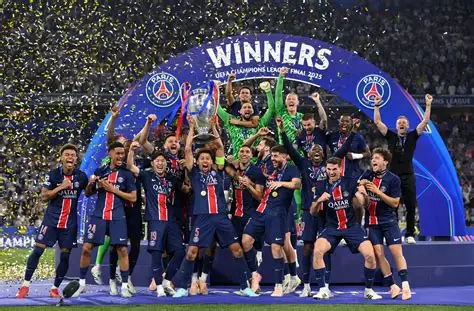
The PSG Champions League celebrations arrests France 2026 violence was the dark aftermath of a genuine footballing triumph — PSG’s victory over Arsenal in the Champions League final, secured in a penalty shootout. The match itself was one of the competition’s most anticipated finals in years — a clash between two of European football’s most recognised and supported clubs, carrying the weight of expectation from millions of fans across France, England, and the wider global football community.
PSG’s victory in a penalty shootout — one of football’s most dramatic and nerve-shredding conclusions — delivered the kind of emotional release that sends supporters onto streets worldwide. The intensity of that emotional release, combined with the other factors that appear to contribute to Paris’s recurring post-victory disorder, created the conditions for the night that followed.
PSG vs Arsenal Champions League final — key facts:
- PSG defeated Arsenal in the Champions League final
- The match was decided by a penalty shootout — one of football’s most dramatic conclusions
- The final was PSG’s second consecutive Champions League victory — following last year’s triumph
- Arsenal’s defeat continued English clubs’ long wait for Champions League success in this era
- The Champs-Élysées was swarmed within minutes of the final result — a pattern now familiar from previous PSG victories
- The celebration-turned-disorder followed immediately after the sporting triumph
Final Word on PSG Champions League Celebrations Arrests France 2026
The PSG Champions League celebrations arrests France 2026 night produced 416 arrests, seven injured officers, smashed shopfronts, burning bikes, and tear gas on one of the world’s most beautiful streets — all because a football club won a trophy.
PSG’s victory deserved to be celebrated. Champions League triumphs are extraordinary achievements that bring genuine joy to millions of supporters. The players, staff, and genuine fans who celebrated that victory without violence did nothing wrong.
But 416 people arrested. Seven officers injured. A city centre choked with tear gas. Residents — in Le Pen’s uncharitable but not entirely inaccurate description — considering whether it is safe to go outside.
Paris is one of the world’s great cities. France is one of the world’s great footballing nations. PSG are, for the second consecutive year, Champions of Europe. None of that makes what happened in the city’s streets on Saturday night acceptable — and Interior Minister Nuñez is right to say so.
The pattern is clear. What France does about it next is the question that will define whether these scenes are still happening the next time PSG lift a trophy.
MORE ON THE NEWS INK SPORTS.