Man City Drop Points Against Nottingham Forest in Costly Title Race Blow
Man City drop points against Nottingham Forest became one of the defining moments of the 2025-26 Premier League title race, as Pep Guardiola’s side twice led at the Etihad Stadium but still had to settle for a damaging 2-2 draw.
At the time, the result felt like a painful night. In hindsight, it looked even more costly. Manchester City finished the season second on 78 points, seven behind champions Arsenal, who ended their long wait for a league title with 85 points. A March draw against a relegation-threatened Forest side did not decide the season alone, but it captured the weakness that haunted City’s challenge: control without complete authority.
City had the ball, the territory and the chances. Antoine Semenyo put them ahead in the first half. Morgan Gibbs-White levelled with a clever backheel after the break. Rodri restored the lead from a corner, only for Elliot Anderson to curl in a second Forest equaliser. By full-time, City players walked off frustrated while Arsenal supporters watched the title picture tilt further in their favour.
Man City drop points was the immediate headline. The deeper story was about a champion side that still looked powerful, but no longer felt inevitable.
For wider context on the domestic season, The News Ink’s Premier League season review 2026 tracks the title race, relegation fight and European qualification drama that shaped the campaign.
City controlled the game but not the result
Man City drop points despite dominating long spells of the match. ESPN’s match data listed City with 70% possession, 21 shots and seven efforts on target. Nottingham Forest had fewer chances, but they made their best moments count.
That contrast told the story. City were not outplayed. They were not passive. They created enough pressure to win. Yet they lacked the ruthless control that usually separates title winners from title challengers.
The official Manchester City match report described Forest as a team willing to defend deep, stay compact and wait for counter-attacking openings. That plan worked because Forest did not need to control the ball. They needed to survive pressure, strike in transition and make City uncomfortable when the game became stretched.
Semenyo’s opener should have settled City. Rodri’s header should have finished Forest. Instead, each City goal became only a temporary advantage.
Man City drop points because they failed to turn dominance into security. That is often the difference in a title race. Great teams do not only score first. They close games down when the pressure rises.
How the goals changed the game
City’s first goal came in the 31st minute. Rayan Cherki created the opening with clever movement and delivery, and Antoine Semenyo steered home a volley to put Guardiola’s side in front. It was another important contribution from a forward who had quickly become influential after arriving at the Etihad.
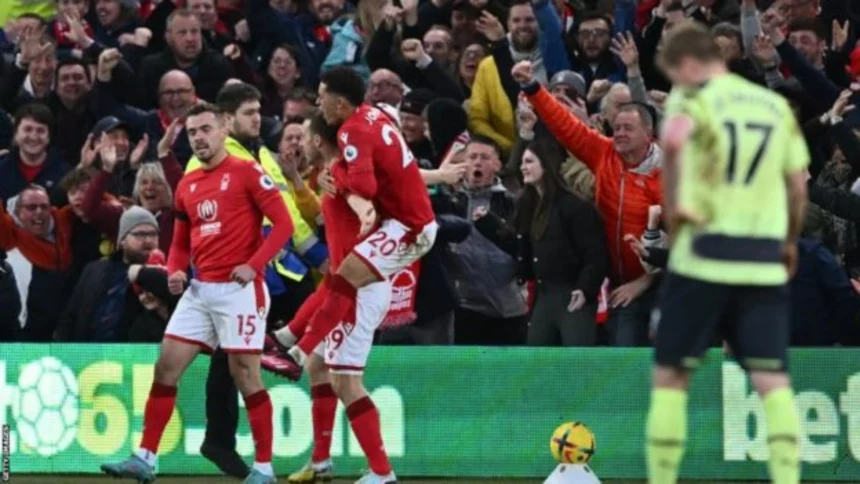
Forest did not collapse. They stayed in the game and waited for one clear moment. It arrived in the 56th minute, when Morgan Gibbs-White finished with a smart backheel after Forest broke through City’s defensive structure.
Rodri responded six minutes later. He rose to meet Rayan Ait-Nouri’s corner and headed City back into the lead. At that stage, the match looked ready to return to a familiar Etihad script: City pressure, City control, City win.
Then Anderson changed it. In the 76th minute, Forest found space again and Anderson curled a composed equaliser beyond Gianluigi Donnarumma. The goal gave Forest belief and left City chasing a winner they could not find.
Man City drop points because the match’s emotional rhythm never stayed under their command. Each time City appeared to take control, Forest found a way back.
Match facts at a glance
| Detail | Manchester City | Nottingham Forest |
|---|---|---|
| Final score | 2 | 2 |
| Goals | Antoine Semenyo 31’, Rodri 62’ | Morgan Gibbs-White 56’, Elliot Anderson 76’ |
| Possession | 70% | 30% |
| Shots | 21 | 9 |
| Shots on target | 7 | 4 |
| Key late moment | Savinho denied by Murillo | Murillo goal-line clearance |
| Table impact at the time | City fell seven points behind Arsenal | Forest stayed above the relegation zone |
The numbers made City’s frustration understandable. But the scoreline made Forest’s resilience impossible to ignore.
Guardiola refused to blame his players
Pep Guardiola’s response was important. He did not publicly attack his team. He said there were many games left, praised the overall performance and pointed to the number of chances City created against a defensive opponent.
That was classic Guardiola in a difficult moment. He protected the group while still admitting improvement was needed. Asked about City’s points dropped from winning positions, he accepted it was a lot, but argued that the performance itself had not been poor.
Man City drop points had already become a theme by then. Sky Sports reported that City had dropped 13 points from winning positions that season after the Forest draw. That figure mattered because it suggested a pattern rather than a one-off.
City’s best Guardiola teams have often strangled matches. They keep possession not only to attack, but to remove oxygen from opponents. Against Forest, the possession was there, but the old sense of inevitability was missing.
That was why the draw hurt so much. City did many things right and still left with only one point.
The Haaland penalty controversy
The match also included a major flashpoint involving Erling Haaland and Matz Sels. Haaland went down in the penalty area after contact from the Forest goalkeeper, but referee Darren England did not award a penalty. VAR Tony Harrington did not recommend a review.
Bernardo Silva was frustrated afterwards. He said he had watched the incident and believed it was a penalty. He also suggested City had been on the wrong side of too many 50-50 calls during the season.
Guardiola took a more careful line. He avoided turning the draw into a refereeing complaint and said City had to do better themselves rather than rely on officials.
That was the right message for a title-chasing team. Refereeing decisions can shape individual moments, but City still had enough control and chances to win. The penalty debate was real, but it could not hide the larger issue.
Man City drop points because they allowed Forest to remain alive. The controversial decision became part of the story, not the whole explanation.
Forest’s point was not luck alone
It would be unfair to describe Nottingham Forest’s result as pure fortune. They defended for long periods, but they also showed courage at key moments. Gibbs-White’s backheel was not a scrappy accident. Anderson’s equaliser was a high-quality finish. Murillo’s late goal-line clearance from Savinho was the kind of defensive intervention that can define a season.
Forest were fighting to survive, and this point mattered. Reuters reported that the draw kept them above the relegation zone on goal difference at the time. By the end of the season, Forest survived, finishing 16th with 44 points.
That gives the result a double meaning. For City, it was a failure to win a title-race match. For Forest, it was proof that they could take points from elite opposition and stay alive in a brutal relegation battle.
Man City drop points was the main headline, but Forest earned their part of it.
The News Ink’s guide to winning the relegation battle explains why results like this can transform belief near the bottom of the table.
Arsenal seized the opening
The damage was made worse because Arsenal won on the same night. Bukayo Saka’s deflected goal gave Mikel Arteta’s side a 1-0 victory at Brighton & Hove Albion. It was not a beautiful win, but title races are often shaped by ugly wins and avoidable draws.
Reuters described Arsenal as taking control of the title race that night. The table showed why. Arsenal moved to 67 points from 30 games, while City had 60 from 29. City still had a game in hand and a home meeting with Arsenal to come, but the pressure had shifted heavily toward Guardiola’s side.
Man City drop points and Arsenal win was the combination that hurt. A draw on its own can be survivable. A draw on the same night your main rival wins away from home can feel like a turning point.
At the end of the season, that feeling proved justified. Arsenal finished seven points clear. City’s late push narrowed the gap for a while, but the margin created by nights like the Forest draw never disappeared completely.
For more on Arsenal’s pressure during that period, The News Ink has covered Arteta warning Arsenal players to handle the pressure.
Why dropped leads damaged City’s title defence
The most concerning detail was not simply that City drew. It was how they drew.
Twice they were ahead. Twice Forest came back. That is not the usual City title-race formula. Guardiola’s teams can concede, but they are normally built to control the next phase. They slow the game, circulate possession, force opponents to chase, and wait for the next opening.
This version of City looked more vulnerable. The attacking patterns were still dangerous, but defensive transitions were less secure. The midfield still had quality, but opponents sensed moments when City could be turned around. The final third still produced chances, but not always the finishing needed to kill matches.
Man City drop points became a repeated theme because leads did not feel safe enough. In a tight title race, every lost lead becomes heavier than an ordinary draw. It tells rivals there is a way back. It tells opponents that belief is justified. It tells the dressing room that control can slip.
City’s 2025-26 league season did not collapse. They still finished second, qualified for the Champions League and pushed Arsenal late into the campaign. But compared with their strongest title-winning sides, the margins were no longer as ruthless.
The tactical problem Forest exposed
Forest exposed a familiar problem for possession-heavy sides: what happens when dominance becomes predictable?
City circulated the ball, pushed Forest back and created pressure. But Forest were compact enough to protect central areas for long spells. When City lost the ball, Forest looked immediately for forward runners and quick combinations. Their goals came from moments when City’s defensive shape was not settled.
Guardiola’s sides are built around counter-pressing. The first few seconds after losing the ball are crucial. Against Forest, those moments were not clean enough. Gibbs-White and Anderson punished gaps that City usually close.
Man City drop points because they could not fully control the spaces behind their attacks. The danger was not constant, but it was sharp enough.
That is why Guardiola mentioned transitions after the game. City’s issue was not effort. It was precision at the moments that decide elite matches: the pass before the turnover, the duel after losing possession, the runner not tracked, the second ball not won.
Semenyo and Rodri offered positives
There were positives for City. Antoine Semenyo’s goal continued a strong run of form. He gave City directness, speed and aggression from wide areas, and his volley showed sharp movement in the box.
Rodri’s goal was also significant. The official City report described him as the star man and highlighted his growing return to top form after a long-term injury setback. His header put City back ahead and his midfield influence remained central to everything Guardiola wanted.
Man City drop points, but the performance was not empty. City created chances. Rodri looked influential. Cherki produced creative moments. Bernardo Silva forced a strong save. Haaland’s movement still unsettled Forest even without a goal.
That is why Guardiola’s refusal to blame individuals made sense. The problem was not that City played badly from start to finish. The problem was that title races punish incomplete performances.
The late scramble summed up the night
The final moments were chaotic. City pushed hard for a winner. Rodri missed a late chance. Savinho had an effort cleared off the line by Murillo with the final action of the game.
That clearance became one of the lasting images of the match. City were inches from changing the story. Forest were inches from losing everything they had worked for. The ball stayed out, and the title race changed again.
Man City drop points can sometimes sound like a calm phrase. This was not calm. This was desperate late pressure, groans around the Etihad, and a visiting side celebrating a point that felt like far more.
Those moments are why football seasons are remembered through small details. A clearance, a save, a missed penalty appeal, a misplaced pass, a late equaliser. Over 38 games, they add up.
The final table made the draw look even bigger
At the time, some could argue there were still enough matches left for City to recover. That was fair. City still had nine league games to play and a home match against Arsenal ahead.
But the final table gave this draw more weight. Arsenal finished first with 85 points. Manchester City finished second with 78. The final gap was seven points, the same margin Arsenal opened that night after City failed to beat Forest.
One match did not decide the title, but this was one of the nights when City’s margin for error shrank dramatically. Arsenal had to stay strong, and they did. City had to be almost perfect, and they were not.
Man City drop points against Nottingham Forest therefore belongs in any serious review of the 2025-26 title race. It was not the only reason Arsenal became champions, but it was one of the clearest signs that the race was slipping from City’s hands.
The News Ink’s football guide offers more context on how league titles are shaped by points, momentum, squad depth and tactical control.
What City must learn from the draw
City’s lesson is simple but difficult: domination must become protection. Having the ball is not enough if opponents can still score twice from limited openings. Creating chances is not enough if the game stays open. Complaining about decisions is not enough if leads are lost.
Guardiola will know that better than anyone. His best teams have always treated control as a defensive weapon. Against Forest, City’s control looked impressive on the stat sheet but incomplete on the scoreboard.
Man City drop points in games like this when three problems meet at once:
- chances are created but not fully converted;
- transitions are not stopped early enough;
- opponents stay confident because the scoreline remains close.
Fixing one of those issues may not be enough. Title winners usually fix all three.
FAQ: Man City drop points against Nottingham Forest
Why did Man City drop points against Nottingham Forest?
Man City drop points because they twice surrendered the lead in a 2-2 draw. City dominated possession and chances, but Nottingham Forest punished defensive gaps through Morgan Gibbs-White and Elliot Anderson.
Who scored in Man City vs Nottingham Forest?
Antoine Semenyo and Rodri scored for Manchester City. Morgan Gibbs-White and Elliot Anderson scored for Nottingham Forest.
How did the draw affect the title race?
The draw left City seven points behind Arsenal at the time, although City had a game in hand. Arsenal later finished the season as Premier League champions, seven points ahead of City.
Was Haaland denied a penalty?
Erling Haaland went down after contact from Matz Sels, but referee Darren England did not award a penalty and VAR Tony Harrington did not intervene. Bernardo Silva said he believed it was a penalty.
Where did Nottingham Forest finish the season?
Nottingham Forest finished 16th in the 2025-26 Premier League table with 44 points, avoiding relegation.
The bottom line
Man City drop points against Nottingham Forest was more than a frustrating draw. It was a warning that Manchester City’s title defence had become fragile in the moments that usually define champions.
City had 70% possession, 21 shots, two leads and late chances to win. Still, Forest left the Etihad with a point. Gibbs-White’s backheel, Anderson’s curling finish and Murillo’s stoppage-time clearance turned the match into a title-race setback for Guardiola and a survival boost for Forest.
Guardiola was right not to blame individuals. City played enough good football to win. But the best title teams do not only play well; they close games. On this night, City did not.
Arsenal’s win at Brighton made the damage worse, and the final table later confirmed how costly these dropped points became. Arsenal won the league by seven points. City finished second and were left to look back at matches like this as missed opportunities.
Man City drop points was the headline. The lesson was sharper: in a title race, control only matters if it ends with three points.
For more Premier League analysis and football coverage, follow The News Ink on Threads.