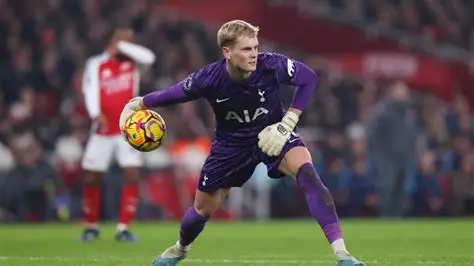
Tottenham Collapse Against Atletico Madrid After Kinsky’s 17-Minute Nightmare
The Tottenham collapse against Atletico Madrid lasted only 22 minutes, but it damaged an entire Champions League campaign. Antonin Kinsky was substituted after 17 minutes, Atletico had already scored three times, and the fourth arrived almost immediately after Guglielmo Vicario replaced him. By the end of the first leg in Madrid, Spurs had lost 5-2 and were carrying a deficit too large to erase completely.
Kinsky’s mistakes became the most painful images of the night. He slipped while trying to play out for the opening goal and later mishit a clearance that allowed Julian Alvarez to walk the ball into an empty net. Yet reducing the Tottenham collapse to one young goalkeeper would miss the larger failure. Micky van de Ven also lost his footing before Antoine Griezmann scored, the defence stopped reacting as a unit, and interim manager Igor Tudor had selected a goalkeeper who had not played competitively since October for a Champions League knockout tie.
Tottenham later beat Atletico 3-2 in London, restoring some pride but losing 7-5 on aggregate. That result confirmed the true cost of the first leg: Spurs did not exit because they lacked courage in the return. They exited because the Tottenham collapse in Madrid left almost no room for recovery.
The Match in One View
| Detail | What happened |
|---|---|
| Competition | UEFA Champions League round of 16 |
| First leg | Atletico Madrid 5-2 Tottenham |
| Kinsky’s time on the pitch | 17 minutes |
| Score when he left | Atletico 3-0 Tottenham |
| Atletico’s fourth goal | 22nd minute, after Vicario entered |
| Tottenham scorers in Madrid | Pedro Porro and Dominic Solanke |
| Second leg | Tottenham 3-2 Atletico Madrid |
| Aggregate score | Atletico Madrid won 7-5 |
| Main controversy | Tudor’s decision to start and then remove Kinsky |
The Tottenham collapse was historic as well as humiliating. UEFA’s official first-leg report described Atletico’s opening as a four-goal burst across 22 minutes, while Reuters reported that Tottenham became the earliest team to fall three goals behind in a Champions League knockout match.
Nine Minutes That Destroyed Tottenham’s Plan
The Tottenham collapse began in the sixth minute. Kinsky received the ball as Spurs tried to build from the back, slipped and lost possession. Alvarez collected it and moved the ball to Marcos Llorente, who finished low beyond the exposed goalkeeper.
That error was serious, but it should not have destroyed the team. Elite sides concede unexpected goals and continue playing. Tottenham instead became visibly anxious. Passes were rushed, the defensive line stopped trusting the build-up, and Atletico sensed that another mistake was coming.
It arrived in the 14th minute. Van de Ven slipped while trying to control a routine pass, allowing Griezmann to attack the penalty area and score. This goal mattered when judging the Tottenham collapse because it showed the problem had spread beyond Kinsky. The surface was difficult, but Atletico were applying pressure with greater clarity and Tottenham’s players were reacting individually rather than collectively.
One minute later, the tie moved from bad to extraordinary. Kinsky attempted a first-time clearance from a back-pass and barely connected with the ball. Alvarez was left with an open goal. Atletico were 3-0 ahead after 15 minutes, and Tudor immediately prepared Vicario.
The Tottenham collapse had produced three goals from three sequences in which Spurs failed to execute basic actions. No tactical plan can survive that level of self-destruction. Reuters’ match account confirmed that the three goals arrived between the sixth and 15th minutes, with two directly following errors by Kinsky.
Was Tudor Right to Remove Kinsky?
The first managerial question created by the Tottenham collapse concerns the substitution. There is a football argument for it.
Tudor said he made the change to protect both the goalkeeper and the team. He described the situation as something he had never experienced during 15 years of coaching and insisted that selecting Kinsky had seemed like the correct decision before kick-off.
Kinsky looked emotionally overwhelmed, Atletico were pressing every touch, and another mistake might have caused even greater damage. A manager is responsible for stopping a game from becoming uncontrollable.
There is also a strong argument against the decision. Goalkeepers are rarely substituted for performance because the public walk from the penalty area can be humiliating. Removing a 22-year-old after 17 minutes on his Champions League debut risked attaching the Tottenham collapse permanently to his name.
Paul Robinson, Joe Hart, Peter Schmeichel and David de Gea were among the former or current elite goalkeepers who expressed sympathy or questioned how the situation was handled. Sky Sports’ analysis reported that Robinson and Hart criticised the treatment, De Gea offered support, and Schmeichel warned about the potential effect on Kinsky’s career.
The hardest criticism is not necessarily that Tudor took Kinsky off. It is that he created the situation by starting him. Kinsky had not played since October and was making only his third appearance of the season. Vicario had been the regular Champions League goalkeeper. Changing that hierarchy for an away knockout tie placed enormous pressure on a young player without recent match rhythm.
Once the Tottenham collapse began, Tudor had no good option. Leaving Kinsky on might have looked negligent. Removing him looked brutal. The decision before the game deserves more scrutiny than the decision after the third goal.
Vicario Entered, but the Panic Continued
If Kinsky had been the only problem, replacing him should have stabilised Tottenham. It did not.
Five minutes after Vicario entered, Griezmann’s free kick created another emergency. Vicario parried the ball, Robin Le Normand attacked the rebound, and goal-line technology confirmed Atletico’s fourth.
Four goals had arrived in 22 minutes.
This sequence widened responsibility for the Tottenham collapse. The replacement goalkeeper was immediately exposed, the defensive organisation remained weak, and Atletico continued arriving first to important balls.
Sky Sports reported that Spurs committed four errors leading to goals during that short opening period—twice as many as any other team had made in an entire Champions League match that season.
Pedro Porro scored in the 26th minute and Cristian Romero later struck the post, giving Spurs a short period of resistance. Yet Alvarez ran from inside his own half to score Atletico’s fifth after the interval. Dominic Solanke then capitalised on a Jan Oblak mistake to make it 5-2.
Those two Tottenham goals mattered because they kept the tie technically alive. They did not change the diagnosis. The Tottenham collapse was a team breakdown in which individual errors, poor selection, fragile confidence and Atletico’s ruthless pressing all reinforced one another.
A Goalkeeper’s Mistake Is Never Private
Outfield players can lose the ball and sometimes disappear into the next phase. A goalkeeper’s error normally ends with the ball in the net and a replay shown repeatedly from several angles.
That is why the Tottenham collapse triggered such a strong reaction from other goalkeepers. They recognised a familiar fear: one mistake changes the player’s movements, the second makes every decision feel dangerous, and the stadium begins waiting for the next failure.
Kinsky’s response the following day was brief: “From dream to nightmare to dream again. See you.”
The message suggested that he wanted to treat the Tottenham collapse as one part of a longer career rather than a permanent definition.
That is the correct perspective. Tottenham signed him from Slavia Prague in January 2025 for a reported £12.5 million on a contract running to 2031. The Premier League’s transfer announcement confirmed his arrival as Tottenham’s first signing of the January window.
He arrived as a highly regarded young goalkeeper with the technical profile to play behind an aggressive defensive line. One terrible match does not erase those qualities. It does, however, test how a club protects and develops a young player after public failure.
The Decision to Start Kinsky Exposed Tottenham’s Instability
The wider context of the Tottenham collapse matters. It did not happen in a stable team experiencing one strange night.
Spurs arrived in Madrid after five consecutive Premier League defeats, with pressure growing around Tudor and the squad’s confidence already badly damaged. Sky Sports noted that the Atletico loss became Tottenham’s sixth straight defeat in all competitions and Tudor’s fourth defeat in his first four matches. The manager later called the side fragile and weak.
That context made the goalkeeper change more dangerous. Rotating into a confident team can protect a young player because the structure around him is reliable. Rotating into a team expecting something to go wrong can expose him.
The Tottenham collapse therefore raises a broader recruitment and management question. Clubs often sign ball-playing goalkeepers because they want defenders to build under pressure. But technique is only one part of the role. Timing, communication, match rhythm and trust with the back line are equally important.
Kinsky was asked to perform the most psychologically exposed job on the pitch while playing behind a defence already struggling with confidence. Tottenham’s football guide explains how pressing and build-up systems rely on coordinated distances. In Madrid, those relationships broke almost immediately.
Atletico Did More Than Wait for Errors
It would also be unfair to describe the Tottenham collapse as a collection of gifts with no Atletico influence. Diego Simeone’s team pressed aggressively, attacked hesitation and transitioned quickly whenever Spurs lost control.
Llorente reacted instantly to the opening turnover. Griezmann attacked the space after Van de Ven slipped. Alvarez anticipated Kinsky’s clearance rather than remaining passive. Le Normand followed the free kick and reached the rebound.
Atletico converted uncertainty into goals before Tottenham could reset emotionally. The match sequence documented by UEFA and Reuters demonstrates how efficiently Simeone’s side punished each mistake.
That ruthlessness is part of Champions League quality. The best sides do not simply create chances through long passing moves. They recognise when an opponent is frightened and increase the pressure.
Newcastle experienced a similar lesson in their tie with Barcelona, covered in The News Ink’s analysis of Eddie Howe’s European challenge. Knockout matches can remain balanced for long periods, but a short loss of control can decide the entire contest.
For Tottenham, the loss of control lasted less than a quarter of the first leg. It was enough.
The Second Leg Proved the Tie Was Not Impossible
Eight days later, Tottenham produced the response Tudor had wanted. Spurs beat Atletico 3-2 in north London and pushed forward with intensity, but Atletico advanced 7-5 on aggregate.
The official UEFA second-leg record confirms the result, while Reuters described a rousing Tottenham fightback that restored pride without overturning the damage from Madrid.
Randal Kolo Muani scored first, Xavi Simons struck twice, and Spurs created periods when a remarkable comeback felt possible. Atletico answered through Alvarez and David Hancko, repeatedly forcing Tottenham to score again.
The second leg changed the meaning of the Tottenham collapse. It showed that Spurs were capable of competing with Atletico when organised and emotionally engaged. They did not lose the tie because of an unbridgeable quality gap. They lost it because the first 22 minutes in Madrid created a three-goal deficit that even a winning return performance could not repair.
Tudor said the second leg gave the squad “beautiful energy.” That may have helped domestically, but it could not return Tottenham to the quarter-finals. Atletico moved on to face Barcelona.
What the Second Leg Said About Kinsky’s Substitution
Kinsky did not need to play in the return for the decision to remain part of the conversation. Vicario started, Tottenham looked more settled, and the team produced a much stronger performance.
That does not prove Tudor was right to remove Kinsky after 17 minutes. It supports the simpler conclusion that the goalkeeper position needed stability and that changing the established choice before the first leg had been an unnecessary gamble.
The Tottenham collapse should therefore be separated into two decisions:
- Starting Kinsky after months without competitive football.
- Removing him once the match had reached 3-0.
The first was avoidable. The second was a crisis response. Mixing them together allows the manager’s selection mistake to disappear behind the drama of the substitution.
The News Ink’s analysis of Manchester United’s managerial struggles examines a similar pattern: unstable clubs often make individual players carry the visible consequences of wider structural decisions.
Why Former Goalkeepers Defended Him
Goalkeepers tend to judge these moments differently from other pundits. They understand that confidence is not motivational language; it affects footwork, starting position, communication and decision speed.
Robinson described the substitution as potentially soul-destroying. Hart expressed heartbreak. Schmeichel warned about career damage. De Gea’s response focused on how difficult the position is.
Their support did not deny that Kinsky made serious errors. It questioned whether the public punishment was proportionate.
This reaction is one reason the Tottenham collapse became a player-welfare story as well as a match report. Modern clubs employ psychologists, performance coaches and welfare staff, but the strongest psychological message often comes from the manager’s actions in front of millions of viewers.
Tudor said he was protecting Kinsky. Protection after the match also matters: private conversations, training opportunities, media support and a clear development plan. Without those steps, the word “protect” becomes difficult to defend.
The News Ink’s guide to sports training technology looks at data and performance tools, but no technology can remove the emotional pressure of elite goalkeeping. Human management remains essential.
What Tottenham Should Learn From the Collapse
The Tottenham collapse offers several practical lessons for coaches and sporting directors.
First, match rhythm matters. Training quality cannot fully reproduce the pressure of a Champions League knockout match.
Second, selection changes must consider the surrounding team. A young goalkeeper can succeed behind a stable defence, but instability multiplies risk.
Third, playing from the back requires alternative solutions. When the pitch is slippery or the press is winning, a team must be willing to play longer rather than repeating the same dangerous pattern.
Fourth, managers must distinguish between protecting the score and protecting the player. A substitution may help one while damaging the other.
Fifth, responsibility should remain collective. Kinsky made two major mistakes, but Tottenham conceded five and produced several defensive failures involving experienced internationals.
Finally, a club must prevent one night from becoming a permanent label. Kinsky’s future should be judged across seasons, not 17 minutes.
The Wider Problem Was Tottenham’s Fragility
The most concerning part of the Tottenham collapse was not any single error. It was how quickly one error became four goals.
Strong teams absorb embarrassment. A defender tells the goalkeeper to reset. Midfielders slow the match. The captain chooses safer passes. The manager changes the build-up shape without immediately sacrificing a player.
Tottenham did none of those things effectively. Their body language became uncertain, Atletico accelerated, and each mistake increased the probability of another.
Tudor’s decision to substitute Kinsky was the most visible attempt to stop the spiral, but it did not address the panic throughout the team.
This is why the night belongs in the same conversation as pressure at other major clubs. Mikel Arteta’s warning that Arsenal players must handle elite pressure reflected the reality that technical ability matters less when confidence disappears. Tottenham in Madrid demonstrated the negative version of that lesson.
How the Article Should Remember Kinsky
The Tottenham collapse should not be written as comedy. Goalkeeping errors are easy to mock because they produce simple clips, but Kinsky was a young player placed in an unusually difficult situation by an interim manager leading a fragile team.
Accurate reporting on the Tottenham collapse should say that his errors directly contributed to two goals. It should also say that Van de Ven’s mistake led to another, Vicario conceded after replacing him, and Atletico scored five against the team.
It should mention the early substitution because it was extraordinary. It should not suggest that Kinsky alone lost the tie.
The strongest description is that he became the face of a collective failure. That framing preserves accountability without turning one bad performance into cruelty.
The Bottom Line
The Tottenham collapse against Atletico Madrid began with Antonin Kinsky’s slip in the sixth minute and became a historic Champions League breakdown. Antoine Griezmann scored after Micky van de Ven lost his footing, Julian Alvarez punished Kinsky’s failed clearance, and Robin Le Normand made it 4-0 shortly after Guglielmo Vicario entered.
Tottenham eventually lost the first leg 5-2. Tudor defended the 17th-minute substitution as necessary to protect the goalkeeper and the team, while several leading former goalkeepers criticised the handling of the 22-year-old.
Spurs responded with a 3-2 victory in the second leg but were eliminated 7-5 on aggregate. That fightback proved how damaging the Tottenham collapse in Madrid had been.
The Tottenham collapse was not simply an awful goalkeeping performance. It was a management gamble followed by a team-wide loss of confidence that decided the tie before it had properly begun.
The Tottenham collapse will remain part of Kinsky’s career, but it should not define it. Kinsky must own his mistakes, while Tottenham must own the conditions in which they happened. A club protects a young goalkeeper not by pretending he played well, but by giving him a stable structure, honest coaching and the opportunity to recover.
For more Champions League and football analysis, follow The News Ink on Instagram or read our football guide and report on Newcastle’s tie with Barcelona.