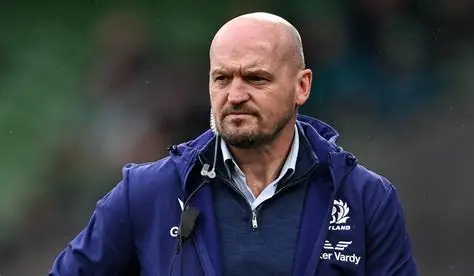
Gregor Townsend Selection Decisions Before Scotland’s 43-21 Ireland Defeat
Gregor Townsend selection decisions dominated the build-up to Scotland’s 2026 Six Nations finale, but the debate changed once the match was played. Scotland travelled to Dublin with championship hopes, a possible Triple Crown and a chance to end a long losing run against Ireland. They left the Aviva Stadium with a 43-21 defeat, a third-place finish and another reminder that selection can shape a Test without fully explaining it.
The original preview focused on the choices Townsend still had to make. By match day, those choices were confirmed. Gregor Brown and Scott Cummings were ruled out, Grant Gilchrist and Max Williamson started in the second row, Zander Fagerson returned at tighthead prop, and D’Arcy Rae moved to the bench after his effective start against France. The backline remained unchanged after Scotland’s seven-try victory at Murrayfield. The Gregor Townsend selection therefore combined forced changes in the pack with continuity behind it.
Ireland still won by six tries to three, claimed the Triple Crown and extended their winning sequence over Scotland to 12 matches. Scotland fought back to within five points during the second half, but Ireland’s accuracy, breakdown work and late finishing turned a competitive contest into a clear victory. The Gregor Townsend selection deserves analysis, yet the result was not simply a case of choosing the wrong 23.
Gregor Townsend Selection at a Glance
The official Scotland announcement confirmed three changes to the starting side that had beaten France 50-40 one week earlier. Two were enforced at lock, while the third restored a senior prop to the front row.
| Selection area | Decision for Ireland | Reason or context |
|---|---|---|
| Tighthead prop | Zander Fagerson started | D’Arcy Rae returned to the bench |
| Second row | Max Williamson and Grant Gilchrist started | Gregor Brown and Scott Cummings were injured |
| Back row | Matt Fagerson, Rory Darge and Jack Dempsey retained | Combination unchanged |
| Half-backs | Ben White and Finn Russell retained | They started every Scotland match in the championship |
| Midfield | Sione Tuipulotu and Huw Jones retained | Fifth consecutive championship start together |
| Back three | Blair Kinghorn, Darcy Graham and Kyle Steyn retained | Same unit that excelled against France |
| Bench | Alex Craig, Magnus Bradbury and Kyle Rowe included | First 2026 Six Nations involvement for all three |
The official Scotland team announcement showed that Townsend did not respond to the France performance with wholesale change. The Gregor Townsend selection kept the attacking framework intact and attempted to rebuild the damaged second row with the most experienced and physically credible options available.
Scotland had just produced one of the most exciting attacking displays of Townsend’s tenure, so changing a functioning backline would have created another risk.
The Injuries That Narrowed Townsend’s Options
Townsend’s final team was shaped first by injury rather than preference. Brown suffered a hamstring problem against France, while Cummings left with a calf issue. Townsend initially suggested Brown was unlikely to recover and that Cummings required further assessment. Both were subsequently ruled out, as the injury update had indicated.
Their absence mattered because the second row influences almost every demanding area of Test rugby. Locks provide line-out targets, push in the scrum, clear rucks, defend close carries and supply repeated physical actions that rarely appear in highlight packages. Losing both starters from the previous week removed continuity from the engine room at precisely the moment Scotland faced one of Europe’s most cohesive packs.
Gilchrist offered experience and won his 88th cap, moving beyond Scott Murray’s Scotland appearance record for a second-row forward. Williamson brought mobility and familiarity with several Glasgow team-mates around him. The pairing balanced experience with youth.
Alex Craig covered lock from the bench and Magnus Bradbury reinforced the back row, but neither could recreate the exact balance Brown and Cummings had offered.
It is therefore misleading to judge the Gregor Townsend selection as though Townsend had a complete squad and simply preferred the wrong locks. The difficult decision was not whether to keep Brown and Cummings; it was how to redistribute roles after both became unavailable.
Why Zander Fagerson Returned to the Starting Front Row
The most debatable call concerned tighthead prop. D’Arcy Rae had started against France after Townsend named an entirely changed front row. Rae helped Scotland establish a strong set-piece platform before Fagerson came from the bench.
Retaining Rae could have preserved the France plan: an early technical contest followed by Fagerson’s experience against tiring defenders.
Townsend chose the opposite. Fagerson started beside Pierre Schoeman and George Turner, with Rae held back as a replacement. The Gregor Townsend selection suggested that Scotland valued Fagerson’s experience in the opening exchanges and wanted their strongest established front-row combination on the field immediately.
The first major scrum did not reward that choice. Fagerson was penalised for bringing the scrum up, giving Ireland field position for the attack that led to Jamie Osborne’s third-minute try. One penalty does not prove the decision was wrong, but it showed how quickly a selection call could become part of the match narrative.
Fagerson later carried effectively and contributed to Scotland’s attempts to build pressure. Rae’s role from the bench was less influential than it had been at Murrayfield. The Gregor Townsend selection at tighthead can therefore be questioned, particularly because the France plan had worked, but Ireland’s victory was not created by one prop change alone.
Continuity in a Backline That Had Earned Trust
Townsend resisted the temptation to alter his backs. Blair Kinghorn remained at full-back, Darcy Graham and Kyle Steyn started on the wings, Huw Jones partnered captain Sione Tuipulotu in midfield, and Ben White joined Finn Russell at half-back.
Townsend backed the same group that had helped score seven tries against France. Graham and Steyn had both crossed twice in that victory, while Scotland’s pace, support running and willingness to move the ball had troubled the defending champions.
Duhan van der Merwe remained absent, but his omission no longer carried the same sense of crisis that it might have created in earlier seasons. Graham had reclaimed a starting place and Steyn had delivered a player-of-the-match performance against France. The News Ink’s profile of Finn Russell’s influence also explains why Scotland’s attack continued to revolve around the fly-half’s decision-making rather than one individual winger.
The Gregor Townsend selection was rewarded after seven minutes. Scotland built through 19 phases before Kinghorn released Graham on the right. Graham scored his 38th international try, becoming Scotland’s outright leading men’s try-scorer, and Russell converted from the touchline.
That response showed why Townsend kept the backline together. Ireland had scored almost immediately, yet Scotland did not panic or retreat into conservative rugby. Their established combinations created an equaliser of patience and precision.
Ireland’s Opening Exposed More Than the Team Sheet
Ireland’s first-half lead came from execution rather than a single selection mismatch. Osborne scored after three minutes, Dan Sheehan crossed from a line-out maul in the 10th, and Robert Baloucoune finished a wide attack in the 19th.
The Gregor Townsend selection could not prevent Scotland from losing decisive moments. Ireland converted an early scrum penalty into territory, turned line-out possession into a try and then used Stuart McCloskey as a midfield decoy before moving the ball to Baloucoune.
Scotland had almost equal possession and territory by half-time, but Ireland led 19-7. That gap reflected defensive efficiency and accuracy near the scoring zones. Scotland could move the ball and enter Irish territory, yet the hosts repeatedly slowed attacks, forced hurried decisions or won the breakdown contest.
George Turner’s head injury assessment disrupted the starting front row and brought Ewan Ashman on during the first half, altering how the bench could be managed later.
Ireland’s defence was especially important. Scotland often carried through several phases without creating the quick ball required for Russell to manipulate the defensive line. Tadhg Beirne and Caelan Doris repeatedly influenced the breakdown, while the green defensive line advanced with enough speed to reduce Scotland’s time.
That is why the Gregor Townsend selection must be separated from performance. A coach chooses the structure and personnel; players still have to win collisions, protect possession and make accurate decisions under pressure.
The Second-Half Fightback Justified Parts of the Plan
Scotland’s response after the interval showed that the chosen side remained capable of hurting Ireland. Russell scored from close range in the 52nd minute after Scotland sustained pressure through 10 phases. His conversion cut the deficit and gave the visitors a route back into the contest.
Ireland replied through debutant Darragh Murray, but Scotland struck again. Williamson and Gilchrist combined in a fast handling sequence before Gilchrist passed Rory Darge over for a try in the 59th minute. Russell converted, reducing Ireland’s lead to 26-21.
The move mattered to the selection debate. Both replacement locks had been central to the score. Williamson’s athleticism and Gilchrist’s awareness helped create the opening, showing that the enforced pairing could contribute beyond set-piece duties.
At that stage, Scotland were one score from taking the lead. The championship and Triple Crown possibilities had not disappeared. The Gregor Townsend selection had given Scotland enough attacking quality, leadership and resilience to remain in the match despite a difficult first half.
What followed was the real separation between the teams. Ireland absorbed the pressure and responded through Tommy O’Brien in the 68th minute. Jack Crowley added a penalty, and O’Brien scored again at the end to complete the 43-21 result.
Scotland did not lose because they lacked a route into the game. They lost because Ireland closed that route with greater control.
Did the Gregor Townsend Selection Fail?
A simple verdict would be attractive: Scotland lost heavily, so the Gregor Townsend selection failed. That conclusion ignores the conditions under which the team was named and the way the match developed.
The locks were forced changes. The backline had earned continuity. The back row contained Scotland’s most established available combination. Fagerson’s promotion was debatable, but it was hardly reckless to start an 80-cap prop in Dublin.
A fairer assessment is that the Gregor Townsend selection was defensible but did not produce the physical control Scotland needed. Ireland scored from an early set-piece sequence, defended the breakdown more effectively and had greater impact during the final quarter.
Three questions remain reasonable:
- Could Rae have started again to preserve the successful France front-row plan?
- Would a six-two bench split have given Scotland more forward power late in the match?
- Could another back-row or lock combination have improved breakdown resistance?
None has a certain answer. A six-two split would have reduced backline cover, while Scotland already lost Turner early. Starting Rae may have changed the scrum contest without changing Ireland’s maul, breakdown or finishing. The Gregor Townsend selection can be scrutinised, but alternative choices also carried risks.
Townsend’s post-match assessment focused on tactical and technical errors. He said Scotland had not reproduced the exceptional ruck accuracy and discipline shown against France.
The Championship Context Made Every Choice Feel Larger
The original preview was correct about the scale of the occasion. Scotland entered the final round with a chance to win their first championship since the final Five Nations campaign in 1999. A victory would also have secured a first Triple Crown since the 1990 Grand Slam.
Scotland recovered from an 18-15 opening defeat in Italy by beating England 31-20, Wales 26-23 and France 50-40.
The News Ink had already examined the changes made for France and the title implications surrounding France at Murrayfield. Those results transformed the Ireland match from a routine finale into a championship contest.
The Gregor Townsend selection therefore carried more pressure than an ordinary team announcement. Every injury replacement and bench role appeared capable of deciding a trophy.
Ireland’s win secured the Triple Crown and kept their championship hopes alive, but France later beat England 48-46 through Thomas Ramos’ last-gasp penalty and finished two points above Ireland. Scotland remained third. The Gregor Townsend selection was ultimately part of a final day on which three teams entered with title possibilities and France emerged as champions. The complete championship-winning match report confirmed the final standings.
The Ireland Problem Remained Unsolved
The defeat was Scotland’s 12th consecutive loss to Ireland, including heavy setbacks at two World Cups. Their last victory in Dublin remained the 2010 success at Croke Park.
This history magnified the Gregor Townsend selection debate because the same broad pattern appeared again. Scotland produced attractive passages, threatened through Russell and their outside backs, and stayed close enough to create hope. Ireland then imposed greater accuracy, breakdown pressure and defensive endurance.
Townsend rejected the idea of a mental block, arguing that the sequence coincided with Ireland’s rise into one of the world’s strongest teams. Ireland’s recent titles and provincial cohesion support that view.
Yet Scotland cannot treat the matchup as merely unfortunate timing. The Gregor Townsend selection and future tactical plans must address why Ireland so often dictate the contact area and force Scotland to attack slowly. Until Scotland can protect quick ball and defend Ireland’s repeated phase patterns, changing one or two names may not be enough.
The News Ink’s report on Jack Crowley’s role explains the control Ireland seek from fly-half, while their record win over England showed their attacking ceiling.
What the 2026 Campaign Said About Townsend
The Gregor Townsend selection for Dublin was his 103rd Test team as Scotland head coach, according to the contemporary count surrounding the match. It came near the end of his ninth season in charge and reflected both the strengths and frustrations of his tenure.
Scotland played with imagination and courage. Graham became the national men’s try-scoring record holder, Russell remained an elite attacking conductor and the Tuipulotu–Jones midfield continued to create opportunities.
They also lost in Rome, conceded six tries in Dublin and finished without the title that had briefly appeared reachable. The Gregor Townsend selection could not solve Scotland’s recurring difficulty in turning individual statement wins into a complete championship.
Townsend said the side had played some of the best rugby of his tenure, while Tuipulotu described the campaign as a starting point rather than an ending.
The more difficult question is whether progress should still be measured through style and isolated victories after so many years. The Gregor Townsend selection debate belongs inside that wider judgement. Townsend had developed depth and an attacking identity, but Ireland again exposed the gap between competitive ambition and championship control.
What Scotland Should Carry Forward
The 43-21 score was clear, but the Gregor Townsend selection and performance still offered lessons that can improve future campaigns.
Scotland should preserve the attacking relationships that created tries for Graham, Russell and Darge. The unchanged backline justified its selection by producing moments of high quality. Williamson also gained valuable experience in one of rugby’s most demanding away fixtures.
The priorities are equally clear:
- Build greater second-row depth so two injuries do not reshape the pack.
- Improve ruck protection against teams that attack the ball aggressively.
- Develop more than one front-row deployment plan without losing cohesion.
- Turn pressure inside the opposition 22 into points more consistently.
- Control the 10 minutes after scoring, when Ireland repeatedly answered.
- Reduce the gap between Scotland’s best performance and its weekly standard.
These are the areas separating an exciting team from a championship-winning one.
By July 2026, Townsend was still leading Scotland in the new Nations Championship, including matches against Argentina and South Africa. That continuation showed that the Dublin defeat did not end his tenure or the project. It also meant the Gregor Townsend selection lessons remained relevant rather than historical.
A Defensible Team, but Another Painful Ending
The Gregor Townsend selection was more complicated than the original preview could know. Brown and Cummings did not recover. Gilchrist and Williamson started, Fagerson returned to the front row, Rae moved to the bench, and the attacking backline stayed together.
Some decisions worked. Graham became Scotland’s record try-scorer, Russell and Darge crossed during the comeback, and the replacement locks combined impressively for one of the tries. Other areas fell short. Scotland conceded early from scrum and line-out situations, struggled to generate quick possession and could not contain Ireland after closing to 26-21.
The Gregor Townsend selection did not hand Ireland the match, but neither did it give Scotland the control needed to win in Dublin. The stronger side responded to pressure with greater precision and claimed the Triple Crown.
Scotland finished third after a campaign of genuine progress and familiar regret. The most useful conclusion is not that Townsend made one fatal selection mistake. It is that selection alone could not bridge the distance between Scotland’s thrilling attacking potential and Ireland’s ability to manage the decisive phases of a Test.
For continuing rugby coverage and major sports analysis, join The News Ink’s WhatsApp channel.