Gianni Infantino: 10 Years of FIFA Reform, Expansion and Rising Controversy
Gianni Infantino has now spent a decade at the centre of world football’s most powerful institution. When he was elected FIFA president on 26 February 2016, the organisation was recovering from one of the deepest corruption crises in sports history. His early message was reform, transparency and a promise to reconnect FIFA with football.
Ten years later, the picture is more complicated.
FIFA is financially stronger than it was when Infantino arrived. The men’s World Cup has expanded from 32 teams to 48. The Club World Cup has been transformed into a 32-team global tournament. FIFA’s development funding has grown sharply, and the governing body expects the expanded tournament model to drive record revenue.
At the same time, Gianni Infantino faces increasing criticism over governance, player workload, ticket pricing, tournament expansion and the political direction of FIFA. His presidency has made FIFA richer and more global, but it has also raised a central question: has football’s growth been balanced with fairness, transparency and the interests of players and fans?
Gianni Infantino at FIFA: Key Facts
| Category | Key detail |
|---|---|
| First elected | 26 February 2016 |
| Previous role | UEFA general secretary |
| Election result | Beat Sheikh Salman bin Ebrahim al-Khalifa 115-88 in the second round |
| Reform context | FIFA was recovering from the 2015 corruption crisis |
| Major tournament change | Men’s World Cup expanded to 48 teams from 2026 |
| Match expansion | 2026 World Cup increased from 64 to 104 matches |
| Club competition change | Club World Cup expanded to 32 teams |
| Development funding | FIFA Forward has channelled more than $5bn since 2016 |
| Current controversy areas | Ticket prices, dynamic pricing, player workload, governance, political ties |
| Future question | Infantino has signalled his intention to seek another term |
This summary shows why Gianni Infantino is such a divisive football figure. His supporters point to money, growth and global development. His critics point to centralised power, commercial expansion and a calendar that many players and leagues say is becoming unsustainable.
From FIFA Crisis to Infantino’s Election
Gianni Infantino did not inherit a stable organisation.
FIFA’s reputation had been damaged by the 2015 corruption scandal that led to raids, arrests, investigations and the eventual fall of Sepp Blatter’s presidency. Sponsors were nervous. Public trust was low. Football’s global governing body needed to show that it could function with stronger oversight and cleaner governance.
Infantino was not the obvious successor at first. Michel Platini, then UEFA president, had been widely seen as a likely candidate before his own disciplinary problems removed him from the race. Infantino, best known to many fans as the UEFA official who conducted Champions League draws, became UEFA’s candidate and campaigned on reform, expanded development funding and a bigger World Cup.
The 2016 FIFA Extraordinary Congress approved reform measures before the presidential vote. Those reforms included replacing the old Executive Committee with the FIFA Council, adding term limits and introducing governance changes designed to reduce the concentration of unchecked power.
The election itself was competitive. Gianni Infantino led the first round narrowly and then won the second round by 115 votes to 88 against Sheikh Salman bin Ebrahim al-Khalifa. The victory gave FIFA a new face at the moment it needed one.
For broader football context, readers can also explore The News Ink’s football guide.
What Did Gianni Infantino Promise?
Gianni Infantino’s early pitch was built on two major themes: reform and redistribution.
The reform message was aimed at repairing FIFA’s credibility. The redistribution message was aimed at FIFA’s 211 member associations. Infantino promised greater development funding, more support for smaller football nations and a more inclusive global game.
That promise was politically powerful. FIFA is a global democracy of national associations, and many smaller federations care deeply about funding for pitches, training centres, youth football, women’s football, travel and administration.
Infantino understood that FIFA’s legitimacy outside Europe depended partly on whether smaller nations felt included in the game’s wealth. His presidency has therefore focused heavily on the idea that World Cup revenue should fund global development.
The question is not whether FIFA has generated more money. It has. The question is whether the governance around that money has become more transparent and whether expansion has created new problems for the game.
FIFA’s Financial Turnaround Under Infantino
The strongest argument in favour of Gianni Infantino is financial.
FIFA’s revenue outlook has grown dramatically during his presidency. The expanded 2026 World Cup in the United States, Canada and Mexico has become the financial centrepiece of his decade in office. The tournament features 48 teams and 104 matches, giving FIFA far more content to sell to broadcasters, sponsors, hospitality buyers and ticket holders.
A Guardian financial analysis described the 2026 World Cup as central to a projected $13bn FIFA balance-sheet cycle. Broadcast rights remain the biggest revenue stream, while ticket sales and hospitality have become a much larger source of income in the North American market.
Reuters later reported that FIFA has forecast a record $14bn in revenue for the 2027-30 cycle. Infantino said the money was not just about numbers but about “concrete outcomes,” including more opportunities for players, improved infrastructure and greater access to technology across member associations.
That quote captures the case Infantino wants to make. FIFA says commercial success allows it to reinvest in football worldwide. Since the launch of FIFA Forward in 2016, more than $5bn has been channelled into domestic and regional football development.
For supporters, this is the clearest evidence that Gianni Infantino has delivered. For critics, the financial story is only one side of the ledger.
Revenue Growth: The Numbers Behind the Infantino Era
| Financial or development marker | Reported figure |
|---|---|
| Projected 2026 World Cup-related FIFA cycle revenue | Around $13bn |
| FIFA projected revenue for 2027-30 | $14bn |
| FIFA Forward funding since 2016 | More than $5bn |
| FIFA Forward funding planned for 2027-30 | $2.7bn |
| 2026 World Cup match count | 104 matches |
| Previous men’s World Cup match count | 64 matches |
| 2026 World Cup teams | 48 teams |
| Previous men’s World Cup format | 32 teams |
These figures explain why Gianni Infantino’s FIFA is often described as expansionist. More teams, more matches and more competitions have created more commercial inventory. FIFA’s argument is that this growth helps football reach more countries. The counterargument is that the sport is being stretched too far.
World Cup Expansion: Inclusion or Overload?
The 48-team World Cup is the signature tournament reform of Gianni Infantino’s presidency.
For FIFA, expansion is about representation. More teams means more countries get access to the world’s biggest football stage. Africa and Asia received more direct qualifying places for the 2026 tournament, and Oceania received a direct World Cup berth for the first time. A record 209 teams entered qualification for the expanded 2026 edition.
That matters. The World Cup has historically been dominated by Europe and South America. A larger tournament gives more national teams, fans and markets a stake in the event.
However, expansion has also created concerns. The 2026 World Cup increased from 64 to 104 matches. The tournament added a round of 32 and a more complex qualification structure from the group stage. Critics argue that more matches increase player workload, dilute quality and create scheduling pressure for clubs and leagues.
The News Ink has covered related World Cup issues, including World Cup 2026 security fears and fans challenging FIFA over rising World Cup ticket prices. Those issues show how expansion is not only a sporting question. It also affects travel, policing, ticketing, local costs and fan access.
The Club World Cup Becomes a Global Business Project
Gianni Infantino has also reshaped club football.
The old Club World Cup was a short annual event involving continental champions. Under Infantino, FIFA turned it into a 32-team tournament held every four years. The first expanded edition in 2025 was staged in the United States and was designed to become a true global club championship.
The commercial logic is clear. Clubs have large global fanbases, and a bigger Club World Cup gives FIFA another premium product outside the men’s national-team World Cup.
But the expanded competition has been one of the most controversial parts of the Infantino era. European leagues, clubs and players’ unions have argued that the calendar is already overcrowded. FIFPRO and European Leagues have complained that FIFA’s control of the international match calendar creates a conflict because FIFA is both regulator and competition organiser.
The concern is simple: players cannot keep adding tournaments without more rest. Elite players may already face long domestic seasons, continental club competitions, national-team windows and summer tournaments. Adding another major FIFA competition increases pressure on bodies, squads and medical departments.
This is where Gianni Infantino’s growth model faces its hardest sporting test. FIFA can create more events, but players must physically play them.
Player Workload and Legal Pushback
Player welfare has become one of the defining disputes of Gianni Infantino’s presidency.
In 2024, European Leagues and FIFPRO Europe moved toward a formal complaint against FIFA’s international match calendar, arguing that it was unsustainable and created health risks for players. The complaint accused FIFA of favouring its own competitions and commercial interests.
FIFA has defended its calendar and says it balances the needs of international, domestic and continental football. But the disagreement has not gone away. The expanded World Cup, the new Club World Cup and tighter football calendars have made the issue more urgent.
This is not only a legal argument. It is also a credibility issue. If FIFA claims to grow the game for players, it must also show that players have meaningful input into decisions that shape workload and rest.
A sustainable football calendar needs consultation. It also needs transparent medical evidence, predictable rest periods and a serious conversation about how much football is too much football.
Ticket Prices and the Fan Access Debate
A second major criticism of Gianni Infantino’s FIFA concerns ticket pricing.
The 2026 World Cup has generated huge demand, but that demand has come with very high ticket prices and the use of dynamic pricing. Reuters reported that through 44 matches, total attendance had topped 2.85 million and stadiums were about 99.6% full on average. That suggests the tournament is commercially powerful even with expensive tickets.
But strong demand does not remove the access problem.
The Guardian reported criticism over FIFA’s dynamic pricing strategy and noted high price ranges for 2026 World Cup tickets. FIFA has defended the model by saying it reflects market demand and helps keep money within football rather than allowing secondary markets to capture the value.
Infantino’s argument is commercially logical. If fans are willing to pay large sums, FIFA wants that revenue going to football development rather than resale platforms. The fan argument is different. Supporters say the World Cup is not just a luxury entertainment product; it is the sport’s biggest cultural event and should remain accessible to ordinary fans.
The News Ink has also covered practical fan-side issues around the tournament, including the FIFA World Cup 2026 water bottle stadium rule, which became part of wider fan-access and matchday-experience debate.
Hydration Breaks and Commercial Suspicion
Even match management has become controversial during the Infantino era.
At the 2026 World Cup, FIFA introduced mandatory three-minute hydration breaks in the 22nd and 67th minutes of every match. FIFA said the breaks were designed to protect players from high temperatures across North America.
The rule drew criticism from some players, coaches and fans, especially because the breaks created additional advertising windows for broadcasters. Infantino rejected the commercial criticism and said there was no additional revenue for FIFA because commercial agreements had already been signed.
His defence was direct: the breaks were a sporting matter, not a financial one.
Still, the debate showed how FIFA is now viewed by some critics. Even safety-related decisions can attract commercial suspicion because the organisation’s revenue growth has become so central to its identity.
That is one of the lasting challenges for Gianni Infantino. Once fans and players believe money is driving too many decisions, even reasonable policy choices become harder to defend.
Governance: Reform Promises and Power Questions
Gianni Infantino came to power on a reform platform, but criticism of FIFA governance has continued.
The 2016 reforms changed structures, added term limits and created a stronger formal governance framework. FIFA also increased public language around human rights, compliance and development.
Yet critics argue that power remains highly centralised around the president. Recent profiles and investigations have described Infantino as a leader who has expanded FIFA’s commercial reach while becoming increasingly dominant inside the organisation.
The New Yorker described the 2026 World Cup as the first tournament fully shaped by Infantino’s leadership. It also reported criticism from former officials who believe FIFA’s governance looks strong on the surface but lacks deeper independence.
These claims should be handled carefully. They are criticisms and assessments, not court findings. But they matter because governance was the original promise of the Infantino era. If FIFA’s finances have improved while questions about accountability remain, then the reform story is incomplete.
Politics and FIFA’s Neutrality Problem
FIFA says it is neutral in matters of politics and religion. In practice, world football has always operated near power.
World Cups require governments, security agencies, transport networks, stadium approvals and huge public coordination. FIFA presidents inevitably deal with political leaders. The question is how close those relationships become and whether they damage the perception of neutrality.
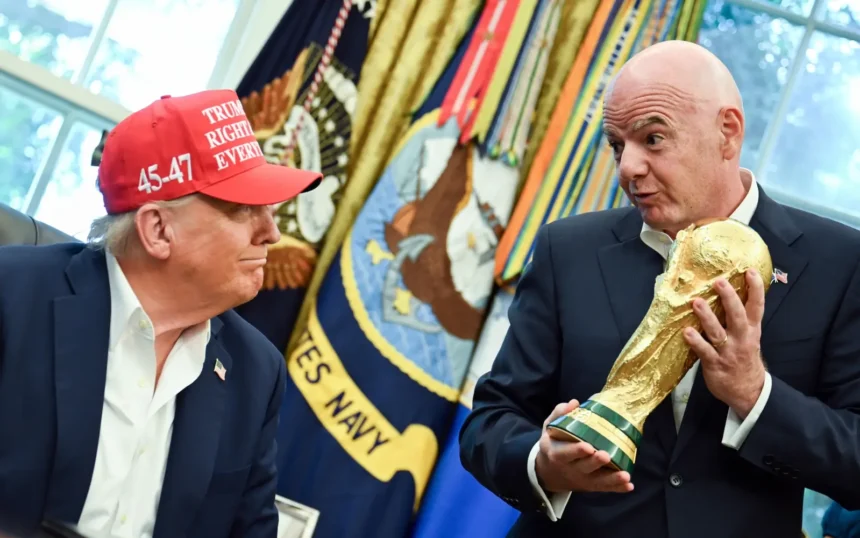
Gianni Infantino has faced scrutiny over relationships with powerful political figures and states. Recent controversy around FIFA’s Peace Prize and Infantino’s relationship with Donald Trump has intensified that debate.
The issue is not only one person or one event. It is about whether FIFA can maintain a credible global role while staging tournaments in politically complex environments and seeking government support for mega-events.
For FIFA, political access can help deliver tournaments. For critics, it risks turning the governing body into a political actor rather than a neutral sports institution.
Infantino’s Strongest Achievements
Any balanced assessment of Gianni Infantino must acknowledge his achievements.
First, FIFA is financially stronger. The revenue numbers are far higher than when he arrived.
Second, development funding has increased. FIFA Forward has directed billions into member associations, giving smaller football nations more resources.
Third, the World Cup is more inclusive. The 48-team format gives more countries a realistic route to the tournament.
Fourth, FIFA has built new commercial properties. The expanded Club World Cup gives the organisation a larger role in club football.
Fifth, Infantino has kept strong political support among many FIFA member associations. That matters because FIFA’s president is elected by those associations, not by fans, players or European leagues.
These achievements explain why Gianni Infantino remains powerful. Many national federations see his presidency as a period of greater access and funding.
The Biggest Criticisms of Infantino’s FIFA
The criticisms are just as important.
First, tournament expansion has increased pressure on the football calendar. Players and leagues argue that the game is being asked to absorb too many matches.
Second, World Cup ticket pricing has raised access concerns. A sold-out event can still be criticised if ordinary fans feel priced out.
Third, governance concerns remain. FIFA has formal reforms, but critics argue that decision-making is still too concentrated.
Fourth, FIFA’s political optics have become more controversial. Relationships with powerful leaders and states raise questions about neutrality.
Fifth, the commercial direction of football appears stronger than ever. Many critics believe the governing body is prioritising revenue growth over the rhythm and welfare of the sport.
This is the contradiction at the heart of Gianni Infantino’s decade. FIFA has become richer and more expansive, but not necessarily less controversial.
What Comes Next for Gianni Infantino?
Gianni Infantino has signalled that he intends to seek another term. Reuters reported in April 2026 that he plans to run again, with the next election scheduled for 18 March 2027 in Morocco.
That means the 2026 World Cup may become the defining event before the next phase of his presidency.
If the expanded tournament is remembered as a commercial and sporting success, Infantino’s position will be strengthened. If it is remembered for high prices, heat problems, travel issues or calendar fatigue, criticism will grow.
His next legacy test will likely involve three questions:
- Can FIFA keep increasing revenue without alienating fans?
- Can it expand tournaments without harming players?
- Can it maintain political influence without losing neutrality?
These questions will shape the final judgement of the Infantino era.
FAQ
When did Gianni Infantino become FIFA president?
Gianni Infantino became FIFA president on 26 February 2016 after winning the FIFA presidential election in Zurich.
Why was Gianni Infantino elected?
He was elected after FIFA’s corruption crisis and campaigned on reform, transparency, expanded development funding and a bigger World Cup.
What is Gianni Infantino’s biggest change at FIFA?
His biggest change is the expansion of FIFA competitions, especially the men’s World Cup from 32 to 48 teams and the Club World Cup to 32 teams.
Why is Gianni Infantino controversial?
Gianni Infantino is controversial because critics question FIFA’s governance, ticket pricing, player workload, tournament expansion and political relationships under his leadership.
Has FIFA made more money under Gianni Infantino?
Yes. FIFA’s revenue outlook has grown sharply, with the 2026 World Cup cycle linked to around $13bn and FIFA projecting $14bn for the 2027-30 cycle.
What is FIFA Forward?
FIFA Forward is the development programme launched in 2016 to fund football projects across member associations. FIFA says it has channelled more than $5bn into domestic and regional football development since launch.
Final Verdict
Gianni Infantino’s decade at FIFA cannot be judged in one sentence.
He inherited an organisation in crisis and turned it into a more financially powerful governing body. He expanded the World Cup, grew development funding and gave more national associations a stake in FIFA’s wealth. On those measures, his presidency has been highly successful.
But the same expansion has created new tensions. Players worry about workload. Fans worry about ticket prices. Critics worry about governance and political neutrality. European leagues worry that FIFA is using its regulatory power to grow its own competitions.
That is why Gianni Infantino’s legacy remains unsettled. He has made FIFA bigger, richer and more global. Whether he has made football fairer, more transparent and more sustainable is the question that will define the next stage of his presidency.
For more football analysis and major tournament coverage, follow The News Ink on X.