From Tbilisi to PSG: How Khvicha Kvaratskhelia Became Europe’s Best
Khvicha Kvaratskhelia once developed his imagination in the football cages and courtyards of Tbilisi. By the end of the 2025-26 season, he had become a consecutive Champions League winner with Paris Saint-Germain and UEFA’s official Player of the Season.
The journey between those worlds was neither direct nor predictable. Khvicha Kvaratskhelia moved through Georgian academies, Russian football, an emergency return home after the invasion of Ukraine, a transformative spell at Napoli and finally PSG.
At Napoli, supporters called him “Kvaradona” after his dribbling and creativity helped deliver the club’s first Serie A title in 33 years. At PSG, he evolved into a more complete forward, pressing aggressively, defending for the team and producing decisive Champions League performances.
The original version of this story looked ahead to a last-16 meeting with Chelsea. That tie has now become part of his legend. PSG won 5-2 in Paris and 3-0 in London, advancing 8-2 on aggregate before retaining the Champions League by defeating Arsenal on penalties in the final. Khvicha Kvaratskhelia finished the competition with 10 goals and six assists in 16 appearances and was named its best player.
The Boy From Dighmis Masivi
Khvicha Kvaratskhelia grew up in Dighmis Masivi, a district of Soviet-era apartment blocks in Tbilisi.
The neighbourhood did not resemble the polished training centres he would later experience in Paris. Football was played in enclosed cages and shared spaces where young players learned to protect the ball, react quickly and improvise.
His family home remained important even after he became an international star. Profiles from Tbilisi described trophies, shirts and reminders of the stages through which his career had passed.
Khvicha Kvaratskhelia still returned to the smaller spaces associated with childhood. That connection helped preserve a sense of ordinary life around a career that had become extraordinary.
Football Was the Family Language
Kvaratskhelia was born on 12 February 2001 into a family already connected with football.
His father, Badri, had played professionally and understood both the appeal and uncertainty of the sport. Rather than treating talent as sufficient, the family emphasised work, respect and responsibility.
Khvicha Kvaratskhelia reportedly carried a ball constantly as a child. The detail has become common in football biographies, but in his case the later style makes it believable: his game appears built around an unusually intimate relationship with the ball.
He does not dribble only to move forward. He uses touches to alter balance, invite defenders closer and create a different angle.
Those instincts began long before formal tactical systems.
Dinamo Tbilisi and an Early Debut
Khvicha Kvaratskhelia entered Dinamo Tbilisi’s development structure and made his senior debut at 16.
That age matters because professional football tests more than technique. Teenagers must adapt to stronger opponents, tactical responsibility and public judgment.
Kvaratskhelia showed enough to attract attention quickly. He later moved to Rustavi, where regular senior football provided another stage in his development.
Georgia had produced gifted players before, but few had moved from the domestic game towards the centre of European football so rapidly.
Khvicha Kvaratskhelia’s early career established the pattern that followed: each level appeared too small soon after he entered it.
The Russian Step
Lokomotiv Moscow gave Kvaratskhelia his first major experience outside Georgia.
He joined on loan, contributed to a Russian Cup-winning squad and showed that his dribbling could survive a more physical league.
Lokomotiv did not secure him permanently. Rubin Kazan did.
At Rubin, Khvicha Kvaratskhelia became one of the league’s most exciting young players and received repeated recognition for his performances.
Russian football was an important developmental stage. It gave him exposure, tactical demands and financial stability.
It later became impossible to separate from geopolitics.
The Ukraine Invasion Changed His Route
After Russia’s full-scale invasion of Ukraine in 2022, FIFA introduced temporary rules allowing foreign players to suspend contracts with Russian clubs.
Khvicha Kvaratskhelia returned to Georgia and joined Dinamo Batumi.
The move could have interrupted his progress. Instead, it gave him competitive football while agents and European clubs reconsidered the next step.
Napoli acted.
The Italian club signed him from Dinamo Batumi in the summer of 2022 for a fee widely regarded as one of the bargains of the modern transfer market. Reuters reported that Napoli had first seen him emerge from Georgian and Russian football before bringing him to Serie A for around €10 million.
Napoli Needed More Than a Replacement
Napoli entered the 2022-23 season after losing several established figures.
Supporters were uncertain whether a young Georgian winger could replace the personality and attacking influence departing from the squad.
Khvicha Kvaratskhelia answered immediately.
He scored, assisted and attacked defenders without hesitation. His combination with Victor Osimhen gave Napoli one of Europe’s most dangerous forward partnerships.
The nickname “Kvaradona” connected him with Diego Maradona, the club’s greatest symbol. It was affectionate, excessive and revealing. Napoli supporters had recognised a player capable of changing how the team felt.
The Scudetto Season
Napoli won Serie A for the first time since 1990.
Khvicha Kvaratskhelia was central to that achievement. His dribbling broke organised defences, his passing created chances and his willingness to shoot gave opponents multiple threats to manage.
The title carried enormous emotional meaning in Naples. Maradona’s teams had delivered the previous championships, and generations had grown up waiting for another.
Kvaratskhelia did not reproduce Maradona. No player could.
He helped create a new championship identity, one built around Osimhen’s finishing, Luciano Spalletti’s structure and a Georgian winger playing with freedom.
The News Ink’s football guide explains why wide forwards have become central creators rather than players asked only to cross.
Khvicha Kvaratskhelia embodied that evolution.
Why His Dribbling Is Different
Kvaratskhelia is not the fastest winger over every distance. His advantage comes from changes of speed and direction.
He can slow almost to a stop, encouraging a defender to plant his feet, then accelerate through the new angle.
His upper body disguises intention. A shoulder movement suggests an outside run; the next touch carries the ball inside.
Khvicha Kvaratskhelia also uses both feet well enough to prevent defenders from forcing him towards one predictable route.
His most effective dribbles are not always spectacular. A small touch can move a defender half a metre and create the space required for a shot or final pass.
The Antonio Conte Phase
Napoli changed after the title season.
Coaches, expectations and tactical demands evolved. Under Antonio Conte, Kvaratskhelia was required to contribute more consistently without the ball.
That experience influenced the player who later succeeded in Paris.
Khvicha Kvaratskhelia had always possessed attacking creativity. The next stage required pressing discipline, defensive recovery and an understanding of how his position affected teammates.
He has credited demanding coaching with improving those areas.
That development helped PSG view him not merely as an entertainer, but as a forward suitable for Luis Enrique’s collective system.
The Move to Paris
PSG signed Kvaratskhelia in January 2025.
The transfer placed him inside a club attempting to rebuild its identity after the era of superstar dependence.
Luis Enrique wanted intensity, positional flexibility and collective pressing. Every forward had to defend. Reputation did not remove tactical responsibility.
Khvicha Kvaratskhelia entered during the season and had to learn quickly.
He adapted because the requirements matched the evolution already taking place at Napoli. His role was still creative, but he had to react immediately when possession was lost.
PSG’s First Champions League Triumph
PSG won the Champions League for the first time in 2025.
Kvaratskhelia scored in the final, becoming part of the night that ended the club’s longest obsession.
The achievement also made him one of Georgia’s most successful football exports.
For years, PSG had assembled famous attacking names without securing Europe’s biggest trophy. The winning team was younger, more balanced and tactically collective.
Khvicha Kvaratskhelia represented that change. He possessed star quality but accepted defensive work and shared responsibility.
Chelsea Became a Statement Tie
The 2026 last-16 meeting with Chelsea was expected to test PSG seriously.
Instead, it became a demonstration of the defending champions’ attacking level.
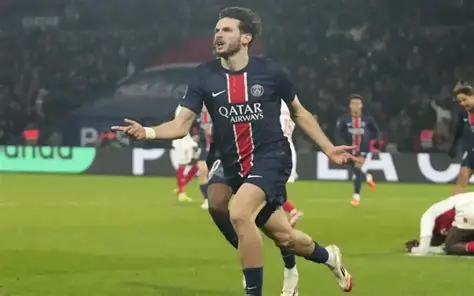
PSG won the first leg 5-2 in Paris. Khvicha Kvaratskhelia scored twice and created another goal, repeatedly attacking Chelsea’s defensive structure.
The second leg finished 3-0 at Stamford Bridge, producing an 8-2 aggregate victory.
A preview about whether Chelsea could contain “Kvaradona” became outdated within 90 minutes. They could not.
The tie confirmed that Kvaratskhelia had moved beyond being an exciting supporting player. He was shaping Champions League knockout rounds directly.
A Record of Consecutive Impact
Before the final, reports noted that Khvicha Kvaratskhelia had produced a goal contribution in seven consecutive Champions League knockout matches.
That consistency distinguished him from players whose reputations depend on occasional highlights.
Knockout football reduces time and space. Opponents prepare specifically for a player’s favourite movements.
Kvaratskhelia continued producing because his game contained several solutions:
- dribble outside;
- drive inside;
- combine through short passes;
- attack the far post;
- press a defender into an error;
- create for teammates.
Defenders could limit one route without removing all of them.
The 2026 Final Against Arsenal
PSG faced Arsenal in the Champions League final.
The match finished 1-1 before PSG won 4-3 on penalties. Khvicha Kvaratskhelia helped earn a penalty during the contest and contributed to another demanding collective performance.
The victory gave PSG consecutive European titles.
That achievement separated the team from a one-season breakthrough. Retaining the Champions League requires adaptation because every opponent begins the season studying the champions.
Khvicha Kvaratskhelia improved rather than fading under that scrutiny.
UEFA Player of the Season
UEFA named Khvicha Kvaratskhelia the 2025-26 Champions League Player of the Season.
His official competition numbers were exceptional:
| Category | Total |
|---|---|
| Appearances | 16 |
| Minutes | 1,141 |
| Goals | 10 |
| Assists | 6 |
| Total goal contributions | 16 |
| Distance covered | 124.17km |
| Top speed | 33.7km/h |
Those figures show both attacking quality and physical commitment.
Khvicha Kvaratskhelia averaged a goal contribution per appearance while covering more than 124 kilometres across the competition.
The distance figure supports the visual evidence: he was not waiting for possession. He was pressing, recovering and participating in PSG’s structure.
Why Luis Enrique’s System Suited Him
Luis Enrique’s PSG does not depend on one fixed superstar.
Players rotate positions, create overloads and press collectively. Wide forwards may begin near the touchline but move inside as full-backs or midfielders change position.
Khvicha Kvaratskhelia benefits from that movement because defenders cannot isolate him as easily.
The system also demands intelligence. A winger must know when to remain wide, when to attack the penalty area and when to create space for another player.
Kvaratskhelia’s street-developed improvisation now operates inside an elite tactical framework.
That combination made him more difficult to defend than the Napoli version.
The Defensive Work Matters
Spectacular dribbling remains the most shareable part of his game, but coaches often focus on the moments after possession is lost.
Khvicha Kvaratskhelia presses with urgency and tracks runners. His willingness to defend allows PSG to keep the team compact.
Reuters’ profile before the Champions League final highlighted Luis Enrique’s demand that every attacker work for the collective and Kvaratskhelia’s ability to meet that standard.
This work is one reason he has become more than a highlights player.
Georgia’s National Symbol
Kvaratskhelia’s success carries unusual weight in Georgia.
The country has a proud football culture but limited representation among Europe’s biggest clubs. His rise gives young players a visible route from Tbilisi to the Champions League.
Murals, shirts and public celebrations reflect that importance.
Khvicha Kvaratskhelia is not only a famous athlete from Georgia. He has become part of how the country presents itself internationally.
That responsibility could become burdensome, but family and home appear to keep his public image grounded.
Humility and Competition
Profiles of Kvaratskhelia repeatedly describe a contrast between his football and personality.
On the field, he attacks defenders with confidence. Away from it, he is quieter and closely connected with family.
The contrast is not unusual among elite athletes. Competition provides a defined space in which aggression and risk are rewarded.
Khvicha Kvaratskhelia has said that team victory matters more than individual recognition. The statement is conventional, but his defensive work gives it credibility.
What He Learned From Ronaldo and Ronaldinho
Kvaratskhelia has studied expressive attackers including Cristiano Ronaldo and Ronaldinho.
The influences are visible without turning him into an imitation.
From Ronaldo, he can take directness, finishing ambition and physical preparation. From Ronaldinho, he can absorb disguise and playfulness.
Khvicha Kvaratskhelia combines those references with the tight-space instincts developed in Georgia.
Great players borrow movements but eventually create a rhythm recognised as their own.
The Training Behind the Style
Dribbling appears spontaneous, yet it relies on physical preparation.
Kvaratskhelia’s game requires:
- single-leg strength;
- balance during contact;
- rapid deceleration;
- explosive first steps;
- reaction speed;
- ankle and hip mobility;
- repeated sprint capacity.
Plyometric and reaction work help turn an idea into movement before a defender can respond.
The News Ink’s sports training technology guide explains how elite clubs measure these qualities while managing injury risk.
Khvicha Kvaratskhelia’s creativity is natural. Its repeatability is trained.
Why He Was Once Considered a Recruitment Risk
European clubs have historically recruited less aggressively from Georgia than from major football markets.
Scouts may question league strength, transfer pathways or whether a player can adapt culturally.
Khvicha Kvaratskhelia forced clubs to reconsider those assumptions.
Napoli’s relatively modest investment became one of the decade’s best transfers. PSG later paid for a proven European star.
His success may improve opportunities for the Georgian players following him. Scouts now have a powerful example of what can be missed when a market is underestimated.
What Comes Next
At 25, Kvaratskhelia has already won major domestic titles and consecutive Champions Leagues.
The next challenge is sustaining that level.
Opponents will adjust. PSG’s squad will change. Injuries, tactical evolution and expectations will test him.
Khvicha Kvaratskhelia can also deepen his international legacy by helping Georgia qualify for and compete at major tournaments.
Individual awards have established his current status. Longevity will determine where he belongs historically.
The Bottom Line
Khvicha Kvaratskhelia’s rise began in the football cages and apartment districts of Tbilisi and reached its highest point with consecutive Champions League titles at PSG.
He developed through Dinamo Tbilisi, Rustavi, Lokomotiv Moscow, Rubin Kazan and Dinamo Batumi before Napoli signed him in 2022.
At Napoli, Khvicha Kvaratskhelia helped deliver a first Serie A title in 33 years and earned the nickname “Kvaradona.”
At PSG, he became more complete. He pressed, defended and combined his dribbling with consistent knockout-stage production.
Khvicha Kvaratskhelia scored twice during the 5-2 first-leg demolition of Chelsea, helped PSG advance 8-2 on aggregate and later contributed to victory over Arsenal in the Champions League final.
UEFA named Khvicha Kvaratskhelia its 2025-26 Player of the Season after 10 goals and six assists in 16 appearances.
His story is no longer simply about a talented Georgian reaching a major European club. It is about a player from Tbilisi becoming the outstanding performer in Europe’s biggest competition.
For more Champions League profiles and football analysis, follow The News Ink on Instagram or read our reporting on PSG’s European preparations and Premier League setbacks in Europe.