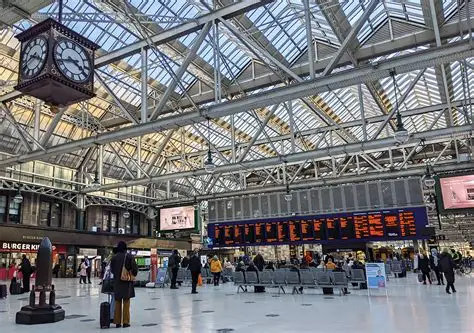
Glasgow Central Station Fire: How a Union Street Blaze Shut Scotland’s Busiest Rail Hub
The Glasgow Central Station fire began as a major emergency beside Scotland’s busiest railway station and quickly became a transport, business and heritage crisis for the city. Flames tore through a commercial building on Union Street, smoke rose over the city centre, nearby premises were evacuated and train services were brought to a halt while firefighters worked through the night.
The original warning was that Glasgow Central could remain closed for at least two days. That was true at the time, but the full story became larger. Low-level services returned first, high-level platforms took longer, and some station entrances and street access remained affected for months while engineers, council teams and Network Rail worked around the damaged structure.
The fire broke out on Sunday, 8 March 2026, in a building beside Glasgow Central Station at Union Street and Gordon Street. Early reports said the blaze began in a vape shop, while the Scottish Fire and Rescue Service officially described it as a fire affecting the ground floor of a four-storey commercial building. That cautious wording matters because the cause was subject to investigation, even as local reports focused on the ground-floor unit.
More than 60 firefighters were involved during the early response, with multiple appliances, high-reach vehicles and specialist resources sent to the scene. No injuries were reported, but the damage was severe. Parts of the building collapsed, nearby businesses were destroyed or badly affected, hotel guests were evacuated and thousands of passengers faced cancellations, diversions and uncertainty.
For Glasgow, the Glasgow Central Station fire was not only a dramatic blaze. It was a reminder that one damaged building beside a major transport hub can disrupt an entire city.
What Happened First
The first emergency calls came on the afternoon of 8 March. Firefighters arrived at Union Street as smoke and flames spread through the building near one of the busiest corners of Glasgow city centre. The location made the incident unusually serious. The fire was not in an isolated warehouse or distant industrial unit. It was beside Glasgow Central, close to hotel entrances, shops, pavements, bus routes and passenger flows.
Witnesses saw smoke pouring from the building before flames became visible from street level. Emergency services closed surrounding streets and asked the public to avoid the area. Nearby residents were advised to keep windows closed because of smoke. Hotel guests at the nearby Grand Central area were moved as a precaution, and businesses close to the blaze faced immediate disruption.
As the fire intensified, structural risk became a major concern. The building suffered severe damage, including partial collapse. That meant the emergency did not end when flames were brought under greater control. Fire crews, engineers and council officers still had to deal with falling masonry, unstable walls, damaged upper floors and the danger of further collapse.
That is why the Glasgow Central Station fire forced a longer rail response than many passengers first expected. The station itself had to be protected from risk next door.
Why Glasgow Central Had to Close
Glasgow Central is not an ordinary station. Network Rail describes it as Scotland’s busiest railway station, handling long-distance, regional and suburban routes. When it closes, disruption spreads quickly across the west of Scotland and beyond.
The Glasgow Central Station fire created several risks at once:
| Risk | Why it mattered |
|---|---|
| Smoke | Could affect passengers, staff and nearby buildings |
| Falling debris | Made entrances and surrounding streets unsafe |
| Structural instability | Prevented normal passenger movement near the damaged façade |
| Emergency access | Fire crews needed space around the scene |
| Rail safety checks | Engineers had to confirm the station and tracks were safe |
| Passenger crowding | Crowds could not be allowed near a live emergency zone |
This is why rail authorities suspended services and told passengers to follow alternative advice. It was not simply a timetable problem. It was a public-safety decision.
Network Rail later confirmed that the low-level station would reopen first after assessment, while high-level services remained closed because of the instability of the building façade on Gordon Street. The 10 March Network Rail update made clear that the high-level station would not reopen that week because further building assessment work was required.
That detail is important because the phrase “closed for at least two days” became only the beginning. The early disruption turned into a phased reopening.
The Timeline From Fire to Reopening
The Glasgow Central Station fire moved through several stages. The first was the live firefighting operation. The second was the emergency closure. The third was structural assessment and demolition. The fourth was gradual restoration of platforms, concourse access and surrounding streets.
| Date | Key development |
|---|---|
| 8 March 2026 | Fire breaks out beside Glasgow Central Station on Union Street |
| 9 March 2026 | Firefighting continues; station disruption remains severe |
| 10 March 2026 | Network Rail confirms low-level services can return, but high-level station will stay closed |
| 12 March 2026 | Safety work progresses after firefighting ends and site control passes to council teams |
| 25 March 2026 | Network Rail confirms all high-level platforms will reopen |
| 13 July 2026 | Full station concourse set to reopen after exclusion zone removal |
| 17 July 2026 | Union Street and Gordon Street entrances due to reopen fully |
This timeline shows how a fire that first appeared to threaten two days of disruption became a months-long recovery around entrances, street access and building safety.
The latest Network Rail recovery update said the full station concourse would reopen on 13 July, with the Union Street and Gordon Street entrances reopening on 17 July. Glasgow City Council also said Union Street would fully reopen to pedestrians and vehicles at 1pm on 17 July as recovery from the March fire continued.
For passengers, that meant the practical impact lasted far beyond the first news alerts.
What Passengers Faced
The immediate passenger impact was heavy. Trains were cancelled or diverted, many journeys had to be rearranged, and passengers were told not to travel through Glasgow Central until operators could confirm safe routes. ScotRail, Network Rail and other operators had to manage disruption across a network that depends heavily on Central.
A closure at Glasgow Central affects more than one set of passengers. It affects commuters, long-distance travellers, airport connections, tourists, workers heading into the city, people travelling to medical appointments and families making essential journeys. It also affects rail staff, station retailers, cleaners, security teams and businesses that rely on station footfall.
The Glasgow Central Station fire therefore had a ripple effect. People who were nowhere near Union Street still felt it through missed trains, changed routes, longer journeys and crowded alternatives.
The incident fits a wider lesson from The News Ink’s smart travel coverage: modern travel depends on fragile systems. A single emergency near a hub can affect thousands of plans in minutes.
Businesses Took a Severe Hit
The human and commercial cost was felt most sharply by local businesses. Several premises inside or near the damaged building were destroyed or badly affected. Reports identified cafés, retail units, salons and other small businesses among those hit.
For many owners, the loss was not just a shopfront. It was equipment, stock, customer records, specialist tools, bookings, staff income and years of work. A small business does not recover from a city-centre fire simply because the flames go out. Insurance claims, temporary premises, lost trade and uncertainty can last for months.
That is why the Glasgow Central Station fire became an economic story as well as a transport story. A major station closure reduces footfall. Street closures change customer routes. Scaffolding, hoardings and safety zones can discourage passing trade. Even businesses that were not burned can lose revenue if people avoid the area.
The News Ink’s economy and personal finance sections often cover how shocks move through households and businesses. The same idea applies here: one event can create hidden costs long after the most visible danger has passed.
The Heritage Loss on Union Street
The damaged Union Street building was also part of Glasgow’s built heritage. Historic Environment Scotland records the site at 101–115 Union Street and 59–69 Gordon Street as a B-listed commercial building dating from the mid-19th century.
That makes the Glasgow Central Station fire more than a railway disruption. It was also a blow to the historic fabric around one of Glasgow’s best-known transport landmarks. The building’s position at the corner of Union Street and Gordon Street made it familiar even to people who never knew its listing details.
Urban heritage is often noticed most clearly when it is damaged. People walk past Victorian façades for years without thinking about them, then suddenly realise how much they shaped the character of a street once they are gone or fenced off.
The News Ink’s historical travel coverage often looks at how buildings carry memory. In Glasgow, the Union Street fire showed the same principle in a city-centre setting: everyday architecture can matter deeply to a place.
Why the Fire Was So Difficult to Manage
City-centre fires are difficult because buildings are close together, streets are narrow, access is limited and nearby infrastructure remains active. Firefighters must protect life, prevent spread, manage smoke, keep the public away and work around buildings that may become unstable.
The Glasgow Central Station fire had all of those complications. Fire crews had to operate beside a major station and hotel, close to businesses, road routes and crowds of onlookers. High-reach vehicles were needed because flames and hotspots were affecting upper parts of the building. Structural collapse risk meant crews and engineers had to think not only about fire suppression but also about what might fall next.
The fact that no injuries were reported is significant. It suggests the emergency response, evacuations and cordons prevented a dangerous situation from becoming a human tragedy. But no injuries does not mean no damage. Buildings, businesses and transport systems were badly affected.
That distinction matters in responsible reporting. The Glasgow Central Station fire did not cause reported casualties, but it still caused serious public disruption and economic loss.
What Network Rail Had to Check
After a major fire beside a railway station, reopening is not as simple as clearing smoke and restarting trains. Engineers need to examine station structures, access routes, platform safety, roof areas, nearby façades, trackside conditions, emergency exits and passenger circulation.
Network Rail’s later updates show how carefully that reopening had to happen. The low-level station was able to resume before the high-level station because the risks and access issues were different. High-level platforms remained affected until further assessment and safety work allowed phased restoration. By 25 March, Network Rail said all high-level platforms would reopen, restoring all train routes through the high-level station after the Union Street fire.
That phased approach can frustrate passengers, but it reflects how transport safety works. Engineers do not reopen a major station because demand is high. They reopen it when the risk has been assessed and controlled.
The same lesson applies in wider rail and travel disruption. Passengers want speed. Operators must prioritise safety.
The Role of Glasgow City Council
Once firefighting ended, the recovery became a multi-agency operation. Glasgow City Council had to deal with the damaged building, street closures, public safety, demolition or stabilisation work, traffic management and longer-term plans for the site.
The council’s July update said Union Street would fully reopen after recovery from the March fire, marking a major step for pedestrians, vehicles, passengers and local businesses. The reopening mattered not only because people could move more easily again, but because Glasgow was preparing for the Commonwealth Games, bringing additional pressure on transport and city-centre movement.
Major incidents like the Glasgow Central Station fire show why council recovery work is just as important as the initial emergency response. Firefighters deal with the immediate danger. Councils, engineers, businesses and transport operators deal with the consequences.
Why This Story Needed Updating
The headline “fire closes Glasgow Central Station for at least two days” captured the urgency of the first stage. But readers now need a fuller version because the story developed in several ways.
First, the disruption lasted longer than the earliest minimum warning. Second, all platforms did not return at once. Third, entrances and surrounding streets remained affected even after train services improved. Fourth, the damaged building became part of a longer recovery and heritage story. Fifth, businesses faced losses that were not solved by the station reopening.
This is why updating breaking-news articles matters for SEO and reader trust. A reader landing on the page months later should not see only the first emergency snapshot. They should understand the whole arc: fire, closure, safety checks, reopening, business impact and recovery.
The News Ink’s earlier detailed report on the massive Glasgow Central blaze gives a broader view of the building collapse and evacuations, while this article explains how the closure unfolded from the first travel warning into a longer transport recovery.
What Travellers Should Do During Similar Disruption
The Glasgow Central Station fire also offers practical lessons for passengers during major station closures.
When a major hub shuts, passengers should check official operator updates before travelling. Social media can be useful, but official information from ScotRail, Network Rail and National Rail is more reliable for service changes. People should also check whether tickets are accepted on alternative routes, whether replacement buses are operating and whether nearby stations are open.
Travellers should avoid assuming that “station closed” means every railway line in the city has stopped. In Glasgow, different services were affected differently as low-level and high-level operations returned in phases. Nearby options may exist, but they depend on route, destination and timing.
For people with appointments, work shifts or onward travel, the best approach is to leave extra time, keep receipts if delay compensation may apply and document disruptions if expenses become an issue.
The incident also shows why city travellers should know more than one route. A fire, signal failure, security alert or severe weather event can quickly make the usual route unusable. The News Ink’s global travel disruption coverage has made a similar point in another context: flexible travel planning is now essential, not optional.
The Bigger Safety Question
The Glasgow Central Station fire raises a wider question about old buildings beside critical infrastructure. Many UK city centres contain historic commercial blocks close to railway stations, bus routes, hotels, shops and dense pedestrian areas. When those buildings are well maintained, they add character and economic value. When they burn or become structurally unsafe, the risk extends beyond their own walls.
That does not mean historic buildings are the problem. It means fire safety, building maintenance, tenant controls, electrical standards, emergency access and inspection regimes matter. Older buildings can be safe, but they require proper oversight and responsible use.
The exact cause of the Union Street blaze should be left to investigators and official findings. However, the incident has already renewed concern about how dangerous a fire can become in older city-centre properties, especially when they contain multiple businesses and sit beside high-footfall infrastructure.
A serious response should avoid speculation and focus on evidence: what was the source, how did the fire spread, what safety systems were in place, what worked, what failed and what can reduce risk next time?
How Glasgow Moved Toward Recovery
By July, the recovery story had become more positive. Network Rail said the full concourse would reopen, followed by the Union Street and Gordon Street entrances. Glasgow City Council confirmed Union Street’s full reopening to pedestrians and vehicles. That marked a major step back toward normal city-centre movement.
Still, recovery is not the same as restoration. The damaged building, affected businesses and changed streetscape remain part of the longer story. Some businesses may never return in the same form. A lost historic corner cannot be replaced quickly. The site will need decisions about future use, safety, design and regeneration.
For passengers, normal service may feel like the end. For business owners and heritage campaigners, the consequences continue.
The Bottom Line
The Glasgow Central Station fire forced the closure of Scotland’s busiest railway station after flames tore through a Union Street building beside the station. Emergency crews worked through the night, no injuries were reported, and authorities closed rail services while engineers assessed the danger from smoke, debris and structural instability.
What began as a warning of at least two days of disruption became a much longer recovery. Low-level services returned first. High-level platforms reopened later. All platforms were restored by late March, while entrances and surrounding streets remained affected until July.
The fire damaged businesses, disrupted thousands of journeys and destroyed part of Glasgow’s historic city-centre fabric. It also showed how closely transport, heritage, small businesses and public safety are connected in a dense urban centre.
The main lesson is clear. A major fire beside a transport hub does not have to burn the station itself to shut it down. It only has to make the surrounding area unsafe. That is what happened at Glasgow Central, and the city spent months working its way back.
For more UK transport and city-impact coverage, follow The News Ink on X or read our full report on the Glasgow Central building collapse.