

Cristiano Ronaldo at Manchester United: Goals, Trophies, Two Spells and Old Trafford Legacy
Cristiano Ronaldo at Manchester United is one of the most important player-development stories of the Premier League era.
The relationship began in 2003 with an 18-year-old winger arriving from Sporting CP with extraordinary speed, confidence and technical ability but an unfinished game. Six years later, Ronaldo left England as a Premier League champion, UEFA Champions League winner, Ballon d’Or holder and one of the most valuable footballers in the world.
Then, twelve years after leaving, he came back.
The second story of Cristiano Ronaldo at Manchester United was dramatically different.
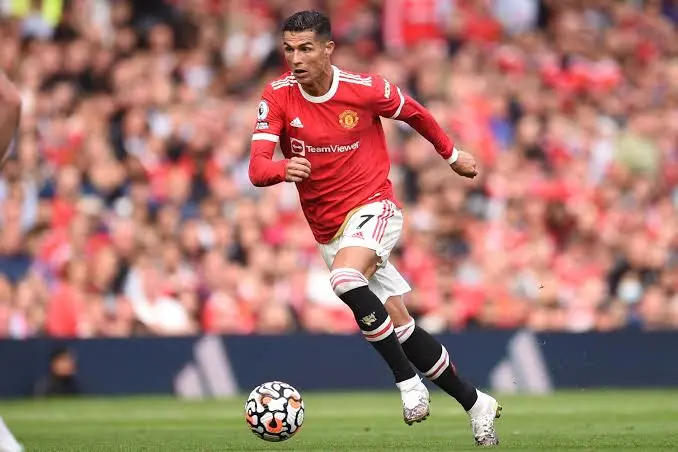
Ronaldo returned in 2021 at 36, no longer the young winger Sir Alex Ferguson had developed but one of football’s greatest goalscorers. He scored 24 goals during his first season back, won Manchester United’s Sir Matt Busby Player of the Year award and produced several memorable Champions League and Premier League performances.
But Manchester United were no longer the stable, title-winning team Ronaldo had left in 2009.
Managers changed. Results declined. Ronaldo’s role became increasingly difficult under Erik ten Hag, and in November 2022 his second spell ended by mutual agreement.
Across both periods, Manchester United officially credits Ronaldo with 145 goals in 346 appearances.
The Premier League records 103 goals and 37 assists in 236 league appearances, together with three league championships, one Golden Boot and two Player of the Season awards.
Those statistics are substantial.
But Cristiano Ronaldo at Manchester United is important for a deeper reason.
Old Trafford was where a talented winger learned to become a decisive forward.
For Ronaldo’s complete journey across Sporting CP, Manchester United, Real Madrid, Juventus, Al Nassr and Portugal, start with The News Ink’s Cristiano Ronaldo Explained.
For the full chronological career, continue with Cristiano Ronaldo Career Explained.
Cristiano Ronaldo at Manchester United: Career Statistics
| Category | Cristiano Ronaldo Manchester United Record |
|---|---|
| First spell | 2003–2009 |
| Second spell | 2021–2022 |
| Total appearances | 346 |
| Total goals | 145 |
| First-spell appearances | 292 |
| First-spell goals | 118 |
| Premier League appearances | 236 |
| Premier League goals | 103 |
| Premier League assists | 37 |
| Premier League titles | 3 |
| Champions League titles | 1 |
| FA Cups | 1 |
| League Cups | 2 |
| FIFA Club World Cups | 1 |
| Premier League Golden Boots | 1 |
| Ballon d’Or won as United player | 1 |
Manchester United confirmed the final total of 145 goals in 346 matches, while the Premier League’s official database records 103 league goals.
View Cristiano Ronaldo’s official Premier League statistics
How Cristiano Ronaldo at Manchester United Began
Before there was CR7, there was an unusually confident teenager from Madeira.
Manchester United faced Sporting CP in a pre-season friendly in Lisbon in August 2003.
Ronaldo impressed against Ferguson’s team with his pace, dribbling and willingness to attack defenders.
The story is sometimes simplified into the idea that Manchester United’s players discovered Ronaldo that evening and demanded the club sign him.
In reality, United had already been tracking the Sporting prospect.
The friendly helped confirm what the club already suspected: Ronaldo was ready for a much bigger stage.
Manchester United moved quickly.
At 18, Ronaldo left Portugal for England.
The young player also inherited one of Manchester United’s most famous shirt numbers:
No. 7.
It had been associated with players including George Best, Bryan Robson, Eric Cantona and David Beckham.
For a teenager arriving in a new country, the expectations were enormous.
Cristiano Ronaldo at Manchester United Makes His Debut
The competitive story of Cristiano Ronaldo at Manchester United began against Bolton Wanderers on August 16, 2003.
Ronaldo entered as a substitute at Old Trafford.
Manchester United won 4–0.
The numbers from that afternoon were less important than the impression.
Ronaldo immediately attacked defenders.
He used stepovers.
He accelerated into space.
He demanded the ball.
He looked fearless.
But the debut also showed what Ronaldo was at that stage of his development.
He was an exciting winger rather than an elite goalscorer.
The finishing, movement and efficiency that later defined his career still had to be developed.
The First Manchester United Goal
Ronaldo had to wait until November 1, 2003 for his first Manchester United goal.
It came against Portsmouth at Old Trafford.
Ryan Giggs won a free kick on the left, and Ronaldo struck the ball toward goal. Portsmouth goalkeeper Shaka Hislop could not keep it out.
Manchester United won 3–0.
It was the first goal in what would eventually become a 145-goal Manchester United career.
The early version of Cristiano Ronaldo at Manchester United was still more creator than scorer.
That would change dramatically.
Ronaldo Wins the 2004 FA Cup
Ronaldo’s first season ended with an important trophy.
Manchester United faced Millwall in the 2004 FA Cup final at Cardiff’s Millennium Stadium.
Ronaldo started and scored the opening goal with a header.
Ruud van Nistelrooy scored twice as Manchester United won 3–0.
The goal was significant.
Ronaldo was only 19, yet he had already scored in a major English cup final.
His Premier League output remained relatively small, with four league goals during his first season.
That did not make the campaign unsuccessful.
Cristiano Ronaldo at Manchester United was still a development project.
The question was how much of his spectacular individual ability could eventually be converted into consistent match-winning output.
From Entertaining Winger to Effective Forward
The early criticism of Ronaldo often focused on excess.
Too many stepovers.
Too many touches.
Too much emphasis on beating the same defender more than once.
There was some truth inside the criticism.
But Manchester United did not attempt to remove Ronaldo’s creativity.
Instead, the environment gradually taught him when those skills were useful.
His decision-making improved.
His strength improved.
His final pass became better.
His movement without the ball became more dangerous.
He also began moving into central scoring positions more frequently.
That development is essential to understanding Cristiano Ronaldo at Manchester United.
The player did not suddenly become a goalscorer in Madrid.
The transformation had already begun in England.
Wayne Rooney and Ronaldo
Wayne Rooney became an important part of that development.
The two young attackers had different strengths.
Rooney could drop deeper, combine with midfielders, press and create.
Ronaldo increasingly attacked space and moved toward goal.
Their relationship was sometimes overshadowed by the 2006 World Cup quarter-final between England and Portugal, but at Manchester United they remained central to the same emerging team.
Carlos Tevez later joined them, creating an attacking group capable of playing with speed, movement and positional flexibility.
Ronaldo increasingly became the main scorer inside that system.
The 2005–06 League Cup
The next major trophy arrived in the League Cup.
Manchester United defeated Wigan Athletic 4–0 in the 2006 final.
Wayne Rooney scored twice, while Louis Saha and Ronaldo also found the net.
The trophy was useful.
But Manchester United’s major objective remained the Premier League.
Chelsea had become the dominant English team under José Mourinho.
For Ronaldo and United, returning to the top of the league became the real test.
Cristiano Ronaldo at Manchester United in 2006–07
The 2006–07 season was the breakthrough.
Manchester United won the Premier League, finishing six points above defending champions Chelsea.
Ronaldo was central to the title.
Manchester United’s historical account notes that he collected numerous individual honours, including the PFA Players’ Player of the Year and PFA Young Player of the Year.
His output was growing, but so was the maturity of his game.
He could still operate wide and attack defenders.
Now he was also arriving in areas where matches were decided.
The season formed the bridge between promising Ronaldo and superstar Ronaldo.
Then came 2007–08.
Cristiano Ronaldo at Manchester United Reaches His Peak
The greatest individual season of Cristiano Ronaldo at Manchester United was 2007–08.
The statistics were extraordinary:
42 goals in all competitions.
31 Premier League goals.
Premier League Golden Boot.
Premier League champion.
Champions League champion.
And eventually:
2008 Ballon d’Or winner.
Manchester United’s official history confirms Ronaldo’s 42-goal season as a central part of the club’s Premier League and European double.
Read Manchester United’s official history of the 2007–08 season
The development was remarkable because Ronaldo was not simply playing as an old-fashioned center-forward.
He still attacked from wider areas.
But by this point he had become capable of scoring through almost every major route.
Headers.
Free kicks.
Long-range shots.
Counterattacks.
Penalty-box movement.
Penalties.
That variety made Ronaldo extraordinarily difficult to defend.
The 31-Goal Premier League Season
Ronaldo scored 31 league goals in 2007–08.
That gave him the Premier League Golden Boot.
It also represented the clearest evidence of how far his game had moved from the four-goal league season of 2003–04.
The Premier League currently credits Cristiano Ronaldo at Manchester United with one Golden Boot and two Player of the Season awards.
Allow Ronaldo space and he could shoot from distance.
Defend deep and he could attack crosses.
Push higher and Manchester United could release him in transition.
Give away a free kick near goal and he could threaten from the dead ball.
Few players offered that range of scoring threats simultaneously.
The 2008 Champions League Triumph
The Champions League completed Ronaldo’s greatest Manchester United season.
UEFA records him as the tournament’s top scorer in 2007–08 with eight goals.
Manchester United eventually faced Chelsea in the final in Moscow.
Ronaldo opened the scoring in the 26th minute, heading Wes Brown’s cross past Petr Čech.
Frank Lampard equalized.
The match eventually reached penalties.
Ronaldo missed his attempt.
John Terry then had the opportunity to win the competition for Chelsea but slipped and sent his penalty against the post.
Edwin van der Sar later saved Nicolas Anelka’s kick.
Manchester United were European champions.
Read UEFA’s official report of Manchester United’s 2008 Champions League triumph
For the full European record Ronaldo eventually created, see The News Ink’s Cristiano Ronaldo Champions League Records.
Cristiano Ronaldo at Manchester United Wins the Ballon d’Or
The 2007–08 achievements led to Ronaldo’s first Ballon d’Or.
He won the award in December 2008.
UEFA’s contemporary report noted that Ronaldo became the third Portuguese player to win the prize after Eusébio and Luís Figo.
This matters enormously when assessing Cristiano Ronaldo at Manchester United.
Manchester United did not merely develop Ronaldo for Real Madrid.
He became officially recognized as the world’s leading player while still representing United.
The 2008 Ballon d’Or was the first of five he eventually won.
The next four came during his extraordinary Real Madrid career.
For that next chapter, read Cristiano Ronaldo at Real Madrid.
Cristiano Ronaldo at Manchester United in 2008–09
Ronaldo remained in England for another season.
Manchester United won a third consecutive Premier League championship in 2008–09.
The club also won the League Cup and FIFA Club World Cup.
Ronaldo produced several more memorable moments.
Against Porto in the Champions League quarter-final, he scored a spectacular long-range goal from roughly 35 metres that secured United’s progression. UEFA described the strike as decisive in making Manchester United the first English team to win away against Porto.
In the semi-final second leg against Arsenal, Ronaldo scored twice in a 3–1 victory as United reached another Champions League final.
Barcelona defeated Manchester United 2–0 in Rome.
That match became the final competitive appearance of Ronaldo’s first United spell.
First Spell: 118 Goals in 292 Matches
When Manchester United announced Ronaldo’s return in 2021, the club summarized his original period with:
118 goals in 292 appearances.
Those totals only tell part of the story.
The first version of Cristiano Ronaldo at Manchester United did not score at the same rate throughout all six seasons.
That is exactly why the period is so important.
The player in 2003 and the player in 2009 were almost different types of attacker.
United had watched a winger become a forward.
For Ronaldo’s complete scoring numbers across every club and Portugal, see Cristiano Ronaldo Career Goals.
Trophies Won by Cristiano Ronaldo at Manchester United
Using the same player-honours methodology applied throughout The News Ink’s Ronaldo cluster, Ronaldo won nine team trophies during his first United spell.
| Trophy | Titles |
|---|---|
| Premier League | 3 |
| FA Cup | 1 |
| League Cup | 2 |
| Community Shield | 1 |
| UEFA Champions League | 1 |
| FIFA Club World Cup | 1 |
| Total | 9 |
The second spell added no team trophy.
The three consecutive Premier League titles and 2008 Champions League remain the defining championships.
For his full trophy cabinet across Sporting CP, United, Real Madrid, Juventus, Al Nassr and Portugal, read Cristiano Ronaldo Trophies Explained.
Why Ronaldo Left Manchester United in 2009
Real Madrid’s interest in Ronaldo had existed for some time.
The possibility of a move was already a major story in 2008.
Ronaldo ultimately remained for one additional season before leaving in 2009.
The important context is that Cristiano Ronaldo at Manchester United did not end its first chapter because his influence had declined.
He had just helped United win a third consecutive Premier League title.
The club had reached two consecutive Champions League finals.
Ronaldo had won the Ballon d’Or months earlier.
He left at the height of his power.
Real Madrid then became the setting for the most prolific scoring period of his career.
Cristiano Ronaldo Returns to Manchester United
Twelve years later, Manchester United announced Ronaldo’s return.
On August 27, 2021, United confirmed it had reached an agreement with Juventus for the transfer. The club’s announcement highlighted his 118 goals from his original spell.
Read Manchester United’s official 2021 Ronaldo return announcement
Emotion around the return was enormous.
But Cristiano Ronaldo at Manchester United now represented something completely different.
The 18-year-old prospect was gone.
Ronaldo returned as:
- a five-time Ballon d’Or winner;
- five-time Champions League winner;
- Real Madrid’s record scorer;
- Portugal legend;
- Juventus centurion;
- one of football’s greatest goalscorers.
The question was no longer whether Ronaldo could develop.
It was whether an ageing superstar could still dominate Premier League matches.
Two Goals on His Second Debut
The return initially looked almost perfectly scripted.
Ronaldo started against Newcastle United at Old Trafford on September 11, 2021.
He scored twice.
Manchester United won 4–1.
The crowd celebrated his return.
The No. 7 shirt was back.
And Ronaldo was immediately scoring.
The second spell began with extraordinary momentum.
Cristiano Ronaldo at Manchester United in 2021–22
Individually, 2021–22 was productive.
Ronaldo scored 24 goals in all competitions.
He scored hat-tricks against Tottenham Hotspur and Norwich City.
He delivered important Champions League goals against Villarreal and Atalanta.
Manchester United supporters voted him the Sir Matt Busby Player of the Year for a fourth time.
His long-range goal against Tottenham also won the club’s Goal of the Season award.
At 37, Cristiano Ronaldo at Manchester United remained capable of deciding matches through movement and finishing.
The larger team, however, struggled.
Why the Second Spell Was Different
The second spell cannot be judged simply by asking whether Ronaldo still scored.
He did.
The problem was context.
Ronaldo had returned to a Manchester United team very different from the one he left in 2009.
The Ferguson era had provided:
- managerial stability;
- title-winning experience;
- clear tactical expectations;
- elite squad depth.
The 2021 team changed managers during Ronaldo’s first season back.
Ole Gunnar Solskjær departed.
Ralf Rangnick became interim manager.
United eventually finished sixth.
The returning version of Ronaldo was also tactically different.
The young Ronaldo could carry the ball from deeper areas and threaten from the wing.
The older Ronaldo was primarily a central striker.
That created different requirements around pressing, chance creation and team structure.
The Difficult Final Months
Erik ten Hag became Manchester United manager in 2022.
Ronaldo’s role decreased.
He started fewer Premier League matches and increasingly appeared from the bench.
Tension grew.
By November, the relationship had reached breaking point.
On November 22, 2022, Manchester United announced that Ronaldo would leave the club by mutual agreement with immediate effect.
The club’s official statement thanked Ronaldo and confirmed his final record:
145 goals in 346 appearances.
Read Manchester United’s official 2022 Ronaldo departure statement
The ending was difficult.
But it should not be allowed to rewrite the entire history of Cristiano Ronaldo at Manchester United.
Cristiano Ronaldo at Manchester United: Premier League Record
The official Premier League statistics provide another useful summary.
| Premier League Statistic | Ronaldo |
|---|---|
| Appearances | 236 |
| Goals | 103 |
| Assists | 37 |
| Wins | 152 |
| Premier League titles | 3 |
| Golden Boots | 1 |
| Player of the Season awards | 2 |
| Player of the Month awards | 6 |
| Free-kick goals | 10 |
| Headed goals | 11 |
The distribution also shows Ronaldo’s development.
He scored only four Premier League goals in his first season.
He scored 31 in 2007–08.
Then, after returning at 36, he still produced 18 Premier League goals during 2021–22.
That is one of the clearest numerical demonstrations of his longevity.
Cristiano Ronaldo at Manchester United in the Champions League
Ronaldo’s greatest Champions League period came at Real Madrid.
But his European story began in Manchester.
UEFA credits Ronaldo with 21 Champions League goals in 59 competition-proper appearances for Manchester United.
His United achievements included:
- winning the 2008 Champions League;
- finishing as 2007–08 tournament top scorer;
- scoring in the 2008 final;
- reaching another final in 2009;
- returning in 2021–22 and scoring six group-stage goals.
Ronaldo eventually finished his Champions League career with a record 140 competition-proper goals.
The detailed European statistics belong in The News Ink’s Cristiano Ronaldo Champions League Records cluster page rather than being duplicated here.
How Cristiano Ronaldo at Manchester United Changed as a Player
The two United spells provide an unusually clear view of Ronaldo’s tactical evolution.
2003 Ronaldo
A winger.
He wanted the ball.
He attacked full-backs.
He dribbled constantly.
He used skill to create separation.
2006–07 Ronaldo
A more complete attacker.
The dribbling remained, but decision-making and goal output had improved.
2007–09 Ronaldo
A hybrid winger-forward.
He could begin wide but finish attacks like a center-forward.
He became an elite aerial threat and high-volume scorer.
2021–22 Ronaldo
Primarily a striker.
Movement, anticipation, positioning and finishing had become more important than sustained dribbling.
The evolution of Cristiano Ronaldo at Manchester United helps explain how he later remained productive well beyond the normal peak age for attacking players.
The Importance of Manchester United’s No. 7
The No. 7 shirt became part of Ronaldo’s identity.
At Manchester United, it carried a history before he arrived.
Eventually, Ronaldo transformed it into the global CR7 brand.
His return in 2021 made the symbolism even stronger.
Edinson Cavani changed shirt number, allowing Ronaldo to wear No. 7 again.
The number therefore connects both chapters of Cristiano Ronaldo at Manchester United:
the teenager trying to justify it and the global superstar returning with it already inseparable from his identity.
First Spell vs Second Spell
| Category | First Spell | Second Spell |
|---|---|---|
| Years | 2003–2009 | 2021–2022 |
| Age profile | 18–24 | 36–37 |
| Main role | Winger → forward | Center-forward |
| Goals | 118 | 27 |
| Major trophies | 9 | 0 |
| Premier League titles | 3 | 0 |
| Champions League titles | 1 | 0 |
| Ballon d’Or | 1 | 0 |
| Main story | Development and dominance | Goals amid instability |
The comparison is clear.
The first spell is historically much greater.
The second spell still contained important individual performances, but it never recreated the sporting environment in which Ronaldo originally flourished.
Was Cristiano Ronaldo at Manchester United a Success?
Overall, yes.
The first spell alone answers the question.
Ronaldo arrived as an 18-year-old prospect.
He left with:
118 goals
three Premier League titles
one Champions League
one Premier League Golden Boot
and
one Ballon d’Or.
The second spell complicates the legacy rather than destroying it.
Ronaldo scored 24 goals in his first season back but finished without a team trophy, and the final months became increasingly confrontational.
A balanced assessment should include both realities.
Manchester United’s Place in Ronaldo’s Career
Real Madrid eventually became the club most closely associated with Ronaldo’s record-breaking scoring.
Portugal became the stage for his international longevity.
But Manchester United occupies another role.
It was the transformation club.
Cristiano Ronaldo at Manchester United began as potential.
By 2008, it had become proven greatness.
Manchester gave Ronaldo Premier League competition, Champions League experience, Ferguson’s management and a high-pressure environment in which spectacular talent had to become consistent production.
That is why the United chapter remains essential to understanding the complete Ronaldo career.
For his wider achievements, see Cristiano Ronaldo Records Explained.
For the full comparison with his defining rival, read Cristiano Ronaldo vs Lionel Messi.
Frequently Asked Questions About Cristiano Ronaldo at Manchester United
When did Cristiano Ronaldo at Manchester United begin?
Cristiano Ronaldo joined Manchester United from Sporting CP in August 2003 at age 18 and made his Premier League debut against Bolton Wanderers on August 16.
How many goals did Cristiano Ronaldo at Manchester United score?
Manchester United officially credits Ronaldo with 145 goals in 346 appearances across his two spells.
How many goals did Ronaldo score in his first Manchester United spell?
Ronaldo scored 118 goals in 292 appearances between 2003 and 2009.
How many Premier League goals did Ronaldo score for Manchester United?
The Premier League records Ronaldo with 103 goals in 236 appearances.
How many trophies did Cristiano Ronaldo at Manchester United win?
Ronaldo won nine team trophies during his first spell under the player-honours methodology used in this article, including three Premier League titles and the 2008 Champions League.
What was Ronaldo’s best Manchester United season?
The 2007–08 campaign was his greatest. Ronaldo scored 42 goals in all competitions, won the Premier League and Champions League, claimed the Premier League Golden Boot and later won the Ballon d’Or.
Did Ronaldo win the Ballon d’Or at Manchester United?
Yes. Ronaldo won the 2008 Ballon d’Or while playing for Manchester United.
How many goals did Ronaldo score after returning in 2021?
Ronaldo scored 24 goals in all competitions during 2021–22 and finished his second spell with 27 additional United goals overall.
Why did Ronaldo leave Manchester United in 2009?
Ronaldo moved to Real Madrid after the 2008–09 season following longstanding interest from the Spanish club. He left while still one of the world’s leading players.
Why did Cristiano Ronaldo at Manchester United end in 2022?
His role declined under Erik ten Hag and the relationship between Ronaldo and the club became increasingly strained. Manchester United and Ronaldo ended his contract by mutual agreement in November 2022.
Is Cristiano Ronaldo a Manchester United legend?
His first spell provides a powerful case. Ronaldo won three Premier League titles, the Champions League and the Ballon d’Or while developing into one of the world’s best players. The difficult end to his second spell complicates the relationship but does not erase those achievements.
Conclusion: Cristiano Ronaldo at Manchester United Was Where a Superstar Was Built
Cristiano Ronaldo at Manchester United contains two stories separated by twelve years.
The first is a story of transformation.
An 18-year-old Ronaldo arrived from Sporting CP in 2003.
He was fast, creative and fearless.
But he was not yet the player who would later rewrite scoring records.
Manchester United helped provide the environment in which that transformation happened.
Ronaldo made his debut against Bolton.
He scored his first United goal against Portsmouth.
He scored in the 2004 FA Cup final.
His decision-making improved.
His movement improved.
His scoring increased.
By 2006–07, he was one of the Premier League’s dominant players.
By 2007–08, Cristiano Ronaldo at Manchester United had reached another level entirely.
He scored 42 goals.
Thirty-one came in the Premier League.
United won the league.
United won the Champions League.
Ronaldo finished as Champions League top scorer.
He scored in the final against Chelsea.
Then he won the Ballon d’Or.
The player who arrived as an exciting teenager had become arguably the leading player in world football.
He remained for one more season.
Manchester United won a third consecutive Premier League championship, reached another Champions League final and watched Ronaldo produce memorable goals against Porto and Arsenal.
Then came Real Madrid.
The first United spell finished with 118 goals in 292 appearances.
The second chapter opened in 2021.
This time, Cristiano Ronaldo at Manchester United was not about developing a player.
It was about bringing a legend back.
The opening afternoon against Newcastle was almost perfect.
Two goals.
A 4–1 victory.
Old Trafford celebrating the return of No. 7.
Ronaldo continued scoring.
He finished 2021–22 with 24 goals in all competitions and won the club’s Player of the Year award.
But the Manchester United around him was no longer Ferguson’s Manchester United.
The team changed managers.
It failed to challenge for the Premier League.
It missed Champions League qualification.
Ronaldo’s role then diminished under Erik ten Hag.
The return eventually ended in November 2022, with player and club agreeing to terminate the contract.
The final numbers were:
346 appearances.
145 goals.
Those figures connect two completely different versions of the same footballer.
The first spell should carry the greatest historical weight.
That is where Ronaldo won his first Champions League.
His first Ballon d’Or.
His first Premier League Golden Boot.
His first major league championships.
It was also where he learned to turn individual brilliance into consistent end product.
Real Madrid later produced the biggest numbers.
Portugal produced historic international records.
But Cristiano Ronaldo at Manchester United produced the transformation that made those later achievements possible.
That is why Manchester United remains one of the defining chapters of Cristiano Ronaldo’s career.
For the complete story, continue with Cristiano Ronaldo Explained.
For his full career timeline, read Cristiano Ronaldo Career Explained.
For his scoring record, continue with Cristiano Ronaldo Career Goals.
For his wider records, see Cristiano Ronaldo Records Explained.
For the chapter that followed Old Trafford, read Cristiano Ronaldo at Real Madrid.
Follow The News Ink
Stay connected with The News Ink for football, sports, technology and breaking-news coverage:
Follow The News Ink on X
Follow The News Ink on Pinterest
Follow The News Ink on Medium
Follow The News Ink on Quora
Follow The News Ink on TikTok
Follow The News Ink on Instagram
Follow The News Ink on Substack
Follow The News Ink on Threads
Follow The News Ink on Bluesky
Follow The News Ink on Mastodon