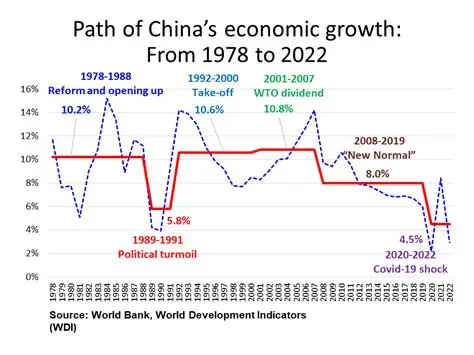
China has lowered its annual economic growth target to 4.5%-5%, the slowest expansion goal since 1991. This reflects challenges at home and abroad, including weak domestic demand, a shrinking population, and global trade tensions.
It is the first time the target has been reduced since 2023, when it was set at “around 5%.” No target was set in 2020 due to the pandemic.
The announcement came during China’s major political gathering, the “two sessions,” alongside partial details of the 15th Five Year Plan for the world’s second-largest economy.
Beijing aims to reshape its economy amid a property crisis and an energy crunch worsened by the Iran war.
In January, China reported achieving its 5% growth target for 2025 overall, but growth slowed to 4.5% in the final quarter due to weak domestic spending and ongoing property market issues.
More than two-thirds of provinces have scaled back their growth goals, either lowering targets or using more cautious language, aiming “around” rather than “above” a specific rate.
Zhou Zheng, policy analyst at China Macro Group, said the revised target shows Beijing is being realistic in addressing complex domestic challenges and a difficult global trade environment.
Zhou added that China’s growth still represents a “great achievement” given the interlinked challenges that require time to resolve.
However, Ning Leng cautioned that official growth figures may not fully reflect economic weakness. She noted that the property sector’s struggles have reduced consumption and caused layoffs and pay cuts.
The real estate market once contributed nearly a third of China’s economy and was a key revenue source for local governments, many of which now carry significant debt.