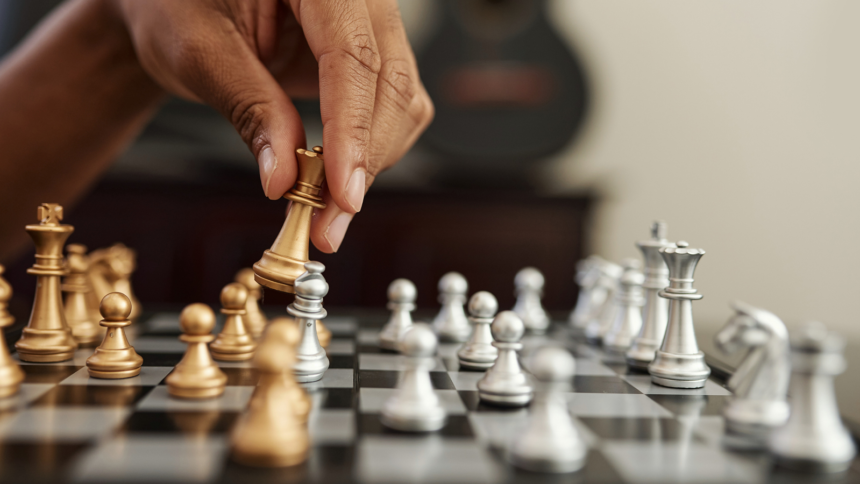
Chess has survived for centuries because it is both simple and endlessly complex. Two players sit across a board containing 64 squares. Each begins with 16 pieces. The objective appears straightforward: protect your king while placing your opponent’s king under an attack that cannot be escaped.
Yet no two serious chess games feel exactly the same.
A single pawn move can change the structure of the entire board. One careless decision can expose a king. A quiet move can create a threat several turns later. A player who appears to be losing may suddenly discover a tactical combination that reverses the result.
This chess guide explains the game clearly from the beginning. It covers the board, pieces, legal moves, checkmate, draws, notation, time controls, strategy, tournament formats, ratings and major competitions. The aim is not to overwhelm a new reader with theory. It is to provide a strong foundation that makes watching and playing chess more enjoyable.
Chess is often described as a board game, but competitive chess also belongs naturally in the world of sport. Players prepare seriously, manage pressure, study opponents, travel to tournaments and make difficult decisions under time limits. Mental endurance matters. So does recovery. The concentration required during long events connects chess with the broader habits explored in our article on training secrets.
Chess Guide: What Is Chess?
Chess is a two-player strategy game played on a square board divided into 64 smaller squares. The squares alternate between light and dark colors.
Each player begins with:
| Piece | Number per player |
|---|---|
| King | 1 |
| Queen | 1 |
| Rooks | 2 |
| Bishops | 2 |
| Knights | 2 |
| Pawns | 8 |
| Total | 16 |
One player controls the white pieces. The other controls the black pieces. White moves first, after which the players alternate turns.
The goal is not simply to capture the most pieces. The true objective is checkmate.
A player achieves checkmate when the opponent’s king is under attack and no legal move can remove that threat. The game ends immediately.
The official FIDE Laws of Chess govern competitive play. Beginners do not need to memorize every technical rule before starting. However, learning the basic structure prevents confusion and makes improvement much easier.
Understanding the Chessboard
A chessboard contains eight horizontal rows and eight vertical columns.
The vertical columns are called files and are labeled:
a, b, c, d, e, f, g, h
The horizontal rows are called ranks and are numbered:
1, 2, 3, 4, 5, 6, 7, 8
Each square therefore has a unique name.
For example:
- The bottom-left square from White’s perspective is
a1. - The square in the center-left area may be called
d4. - The square near Black’s king at the beginning of a standard game is
e8.
This coordinate system allows players to record moves and study positions.
How to Place the Board Correctly
Before arranging the pieces, make sure that the bottom-right corner from each player’s perspective is a light square.
A simple phrase helps beginners remember:
Light square on the right.
The queen also has a simple placement rule:
Queen on her own color.
White’s queen begins on the light square d1. Black’s queen begins on the dark square d8.
The kings begin beside the queens. The bishops stand next to the king and queen. The knights stand beside the bishops. The rooks occupy the corners. The pawns fill the row immediately in front of the major pieces.
Chess Guide: How Every Piece Moves
Each chess piece has its own movement pattern. Learning these patterns is the first major step for any beginner.
| Piece | How it moves | Important restriction |
|---|---|---|
| King | One square in any direction | Cannot move into check |
| Queen | Any number of squares vertically, horizontally or diagonally | Cannot jump over pieces |
| Rook | Any number of squares vertically or horizontally | Cannot jump over pieces |
| Bishop | Any number of squares diagonally | Cannot jump over pieces |
| Knight | In an L-shape: two squares in one direction and one to the side | Can jump over pieces |
| Pawn | Usually one square forward; captures one square diagonally | Cannot move backward |
The King
The king is the most important piece because checkmate ends the game.
A king may move one square in any direction:
- Forward
- Backward
- Sideways
- Diagonally
However, a king cannot move onto a square attacked by an opposing piece.
The king may appear less powerful than the queen, but it becomes extremely important in the endgame. Once fewer pieces remain on the board, an active king can help promote pawns and attack weaknesses.
The Queen
The queen is the most mobile piece.
It can move any number of squares:
- Along a rank
- Along a file
- Along a diagonal
The queen combines the movement abilities of a rook and bishop. Its power makes it valuable, but bringing the queen out too early can expose it to attacks and waste time.
A strong chess player uses the queen carefully rather than aggressively moving it without purpose.
The Rook
A rook moves horizontally or vertically across any number of open squares.
Rooks are particularly effective on open files because they can attack deep into the opponent’s position. They also become more powerful when connected, meaning no pieces stand between them.
Rooks play a major role in endgames. A common beginner mistake is leaving them trapped in the corners for too long.
The Bishop
A bishop moves diagonally.
One bishop begins on a light square and remains on light squares throughout the game. The other begins on a dark square and always moves across dark squares.
Bishops can become powerful when the board opens. Long diagonals allow them to influence distant areas.
A bishop blocked behind its own pawns may struggle to contribute. Pawn structure therefore affects the strength of bishops.
The Knight
The knight moves in an L-shape:
- Two squares in one direction
- Then one square sideways
It is the only piece that can jump over other pieces.
Knights are unusual because their attacks can be difficult for beginners to notice. They become especially dangerous near the center, where they control more squares.
A knight on the edge of the board often has fewer useful moves. Players sometimes remember this with the phrase:
A knight on the rim is dim.
The Pawn
Pawns appear simple but create much of the structure and strategy in chess.
A pawn normally moves one square forward. On its first move, it may move two squares forward if both squares are clear.
Pawns capture diagonally rather than straight ahead.
White pawns move toward the eighth rank. Black pawns move toward the first rank.
A pawn cannot move backward. Every pawn move therefore creates a lasting change. That is why experienced players think carefully before pushing pawns.
Chess Guide: Captures, Check, and Checkmate
A piece captures an opposing piece by moving onto its square. The captured piece is removed from the board.
The king is treated differently. It is never physically captured in a properly completed game. Instead, the game ends at checkmate.
What Is Check?
A king is in check when attacked by an opposing piece.
When this happens, the player must respond immediately.
There are three common ways to escape check:
| Response | Explanation |
|---|---|
| Move the king | Place the king on a safe square |
| Capture the attacking piece | Remove the piece delivering check |
| Block the attack | Place a piece between the attacker and the king when possible |
Blocking does not work against every kind of check. For example, a knight attack cannot be blocked because knights jump directly to their target squares.
What Is Checkmate?
Checkmate occurs when the king is under attack and no legal response exists.
A checkmated player loses the game.
The difference between check and checkmate is essential. A king in check may still escape. A checkmated king cannot.
What Is Stalemate?
Stalemate occurs when a player has no legal move but the king is not in check.
A stalemate is a draw.
This rule surprises many beginners. A player with a winning position can accidentally allow stalemate by removing every legal move from the opponent without delivering checkmate.
Careful endgame technique matters.
Special Chess Rules Every Player Should Know
Basic movement rules are only the beginning. Chess includes several special moves that can affect the outcome of a game.
Castling
Castling is a move involving the king and one rook.
It allows the king to move two squares toward the rook, after which the rook crosses to the square beside the king.
There are two types:
| Type | Common notation | Direction |
|---|---|---|
| Kingside castling | O-O |
Toward the h-file rook |
| Queenside castling | O-O-O |
Toward the a-file rook |
Castling is permitted only when several conditions are met:
- The king has not moved.
- The chosen rook has not moved.
- No pieces stand between the king and rook.
- The king is not currently in check.
- The king does not cross an attacked square.
- The king does not finish on an attacked square.
Castling is important because it often improves king safety while bringing a rook closer to the center.
Pawn Promotion
When a pawn reaches the final rank, it must be promoted.
The player may replace it with:
- A queen
- A rook
- A bishop
- A knight
A pawn does not have to become a queen, although queen promotion is the most common choice.
Promoting to a knight, rook or bishop is called underpromotion. In certain positions, underpromotion can avoid stalemate or create a tactical advantage.
En Passant
En passant is a special pawn capture.
Suppose a pawn moves two squares forward from its starting position and lands beside an opposing pawn. If that two-square move passed through a square the opposing pawn could have captured, the opposing pawn may capture as though the pawn had moved only one square.
The capture must occur immediately on the next move. If the opportunity is not used, it disappears.
This rule prevents a pawn from escaping an enemy pawn’s control merely by using its initial two-square move.
Chess Guide: How a Game Can End
Checkmate is the most famous conclusion, but chess games can end in several ways.
| Result | Meaning |
|---|---|
| Checkmate | One king is attacked with no legal escape |
| Resignation | A player voluntarily accepts defeat |
| Draw by agreement | Both players agree to a draw |
| Stalemate | A player has no legal move but is not in check |
| Insufficient material | Neither side can realistically checkmate under the laws |
| Repetition | A qualifying position occurs repeatedly |
| Move-count rule | A qualifying number of moves occur without a pawn move or capture |
| Time loss | A player’s clock expires, subject to the rules governing whether checkmate is possible |
The official FIDE Laws of Chess explain the exact technical requirements.
Why Players Resign
In casual games, beginners may continue until checkmate appears on the board.
Experienced players often resign earlier when defeat becomes unavoidable. They may recognize that they are losing material, facing forced checkmate or unable to stop a pawn from promoting.
Resignation is not disrespectful. It is a normal part of competitive chess.
However, beginners should not resign too quickly. Continuing a difficult game can provide useful practice and occasionally reveal opportunities.
Chess Notation Explained
Chess notation records moves so that games can be studied later.
Modern algebraic notation uses letters for pieces:
| Piece | Letter |
|---|---|
| King | K |
| Queen | Q |
| Rook | R |
| Bishop | B |
| Knight | N |
| Pawn | No letter |
A move such as Nf3 means that a knight moves to the f3 square.
A move such as Qxd5 means that the queen captures a piece on d5.
Common notation symbols include:
| Symbol | Meaning |
|---|---|
x |
Capture |
+ |
Check |
# |
Checkmate |
O-O |
Kingside castling |
O-O-O |
Queenside castling |
= |
Promotion in contexts such as e8=Q |
Pawn moves use only the destination square. For example, e4 means a pawn moves to e4.
Learning notation helps readers follow written analysis, online lessons and tournament coverage. It also allows players to review their own games rather than relying only on memory.
Chess Guide: Understanding the Chess Clock
Competitive chess is played with a chess clock.
A chess clock contains two connected displays. When one player’s time runs, the other player’s time remains paused.
After making a move, a player presses the clock. This stops the player’s own timer and starts the opponent’s timer.
Under the official FIDE clock rules, the time between making a move and pressing the clock remains part of the player’s allotted time. The rules also state that a player must press the clock with the same hand used to make the move.
Time changes the character of chess.
A position that feels manageable with 30 minutes remaining can become extremely difficult with only a few seconds left. Strong players must balance calculation with practical decision-making.
Increment and Delay
Many time controls add time after each move.
For example:
10+5
This usually means:
- 10 minutes of starting time
- 5 additional seconds per move
Increment rewards players for moving efficiently and reduces the likelihood that a technically winning endgame will be lost purely because the clock expires.
Some events use delay rather than increment. A short delay allows a player to move before the main clock begins decreasing.
Chess Guide: Classical, Rapid, and Blitz Formats
Chess is played at different speeds.
Each format rewards different skills.
| Format | General character | What matters most |
|---|---|---|
| Classical chess | Long games with substantial thinking time | Deep calculation, preparation and endurance |
| Rapid chess | Faster games with limited time | Accurate decisions under pressure |
| Blitz chess | Very fast games | Instinct, pattern recognition and clock management |
| Bullet chess | Extremely fast online format | Speed and practical reactions |
For FIDE-rated play, the official rapid-and-blitz regulations define rapid chess as a game in which each player has more than 10 but less than 60 minutes, accounting for the relevant increment calculation. Blitz chess gives each player more than 3 but not more than 10 minutes under the corresponding calculation.
Classical chess time controls vary according to competition regulations.
Classical Chess
Classical chess gives players time to think deeply.
A classical game may last several hours. Players calculate variations, manage energy and prepare psychologically for long periods of concentration.
Classical chess is central to traditional elite competition. The Candidates Tournament and World Chess Championship rely on classical games because they are designed to test players thoroughly.
Rapid Chess
Rapid chess occupies the middle ground.
Players have enough time to think carefully but not enough to analyze every possibility in detail.
Rapid chess is accessible for spectators because games move more quickly. Mistakes are more common, but the quality can remain high.
Blitz Chess
Blitz chess is fast and intense.
Players rely heavily on intuition, opening familiarity and tactical awareness. Clock management becomes critical.
A strong classical player may still struggle in blitz if decisions take too long. A strong blitz player must remain calm while moving quickly.
Bullet Chess
Bullet chess is especially popular online.
It is usually faster than official blitz formats. A player may have only one or two minutes for the entire game.
Bullet can be entertaining, but it should not replace slower games for beginners. Fast play can reinforce bad habits if a player never pauses to analyze mistakes.
Tournament Formats in Chess
Chess tournaments do not all use the same structure.
The right format depends on the number of players, available time and purpose of the event.
Round-Robin Tournaments
In a round-robin event, every participant faces every other participant.
If each player meets every opponent once, the event is a single round robin.
If each player faces every opponent twice, usually once with White and once with Black, the event is a double round robin.
Round-robin tournaments are useful when the field is relatively small. They provide a thorough comparison because players face the same opponents.
The 2026 FIDE Candidates Tournament uses a double round-robin structure. The official Candidates event page explains that eight players compete across 14 rounds of classical chess to determine a challenger for the World Championship cycle.
Swiss-System Tournaments
A Swiss-system event is suitable for larger fields.
Players do not face everyone. Instead, they are paired according to score and tournament rules across a fixed number of rounds.
FIDE’s updated Swiss-system rules, effective from February 1, 2026, state that the number of rounds must be declared in advance and two participants cannot play each other more than once. Players are generally paired against others with the same score.
A simple example:
- Winners from Round 1 usually face other winners in Round 2.
- Players with draws usually meet players with similar scores.
- Players who lose usually face others with comparable scores.
The structure becomes increasingly competitive as the tournament progresses.
Swiss systems allow hundreds of players to participate without requiring everyone to play everyone else.
Knockout Tournaments
A knockout event eliminates players after they lose a match or mini-match.
Knockouts create tension because one poor performance can end a tournament run.
To reduce the risk of one unusual result deciding everything, many chess knockouts use multiple games and tiebreak procedures.
Team Events
Chess can also be played in teams.
A team match may involve several boards. Each player faces an opponent on the corresponding board. The combined results determine the match outcome.
The Chess Olympiad is one of the best-known team competitions. FIDE publishes separate Chess Olympiad regulations for the event.
Team chess changes the atmosphere. A player must think about individual performance while remaining aware that every half-point affects the wider result.
Scoring and Tie-Breaks
The standard scoring system is simple.
| Result | Points |
|---|---|
| Win | 1 |
| Draw | 0.5 |
| Loss | 0 |
In team events, match scoring may also be used according to the event regulations.
When players finish with the same score, tournament organizers apply tie-break methods.
FIDE’s tie-break regulations explain that specific tournament rules should state whether tied participants share a place or are ranked using additional methods.
Common tie-break approaches include:
- Direct encounter results
- Opponents’ scores
- Sonneborn-Berger calculations
- Play-off games
- Rapid or blitz tiebreaks
- Additional event-specific methods
The exact method matters. Players and spectators should always read the tournament regulations rather than assume that every event resolves ties the same way.
Chess Ratings Explained
Ratings provide an estimate of competitive strength.
A rating changes according to results and the strength of opponents. Beating a stronger player may produce a larger increase than defeating a weaker player. Losing to a lower-rated opponent may have a greater effect than losing to an elite player.
Ratings are useful but imperfect.
They do not measure:
- Confidence
- Fatigue
- Recent preparation
- Match-up styles
- Time-management skills
- Performance under pressure
- Improvement not yet reflected in results
A rating is best understood as a competitive indicator, not a complete description of a player.
Online Ratings and FIDE Ratings
An online platform rating is not automatically the same as a FIDE rating.
Different platforms use different pools of players and rating systems. A player may have separate ratings for classical, rapid, blitz and online formats.
This is normal.
The most useful comparison is with players competing under similar conditions on the same platform or rating list.
Chess Titles Explained
FIDE awards titles based on achievement.
Some titles remain valid for life once awarded.
| Title | Abbreviation | General meaning |
|---|---|---|
| Grandmaster | GM | Highest widely recognized open title |
| International Master | IM | Major international title below GM |
| FIDE Master | FM | Strong competitive title |
| Candidate Master | CM | Recognized title for accomplished players |
| Woman Grandmaster | WGM | Women’s title |
| Woman International Master | WIM | Women’s title |
| Woman FIDE Master | WFM | Women’s title |
| Woman Candidate Master | WCM | Women’s title |
The official FIDE title regulations explain the requirements in detail. Some titles may be achieved through ratings, while titles such as GM and IM typically involve norms and rating requirements under the regulations.
FIDE’s rules state that the FM title can be gained by reaching a qualifying rating of at least 2300 after the necessary rated-game conditions, while CM can be gained at 2200. The full requirements should always be checked through the official handbook because direct-title pathways and detailed rules can change.
Titles are valuable achievements, but chess remains open to players at every level. A beginner does not need to chase ratings immediately. Regular practice and thoughtful review matter more than status.
Chess Guide: The World Championship Cycle
The World Chess Championship is one of the most prestigious events in the game.
The pathway to the match includes major qualifying events and the Candidates Tournament.
A simplified route looks like this:
| Stage | Purpose |
|---|---|
| Qualifying events and pathways | Determine who reaches the Candidates Tournament |
| Candidates Tournament | Selects the challenger |
| World Championship Match | Challenger faces the reigning world champion |
The official FIDE World Championship cycle states that the 2026 World Championship match consists of 14 games. A player who reaches 7.5 points wins the match. If the score is level after 14 games, a tiebreak decides the winner.
The Candidates Tournament is often described as one of the most demanding competitions in chess. It brings together elite players under sustained pressure.
Your website already has a relevant article about Sindarov’s Candidates victory. Link that article naturally where appropriate and add a return link to this chess guide.
Major Chess Tournaments Fans Should Know
Chess has a rich international calendar.
Some events determine world-championship pathways. Others celebrate fast formats, national-team competition or elite invitational fields.
| Tournament or event | Why it matters |
|---|---|
| World Chess Championship | Determines the world champion |
| Candidates Tournament | Selects the challenger for the world title |
| Chess Olympiad | Major international team competition |
| FIDE World Cup | Large knockout event with qualification significance |
| FIDE Grand Swiss | Important Swiss-system event |
| World Rapid Championship | Tests elite fast-chess ability |
| World Blitz Championship | Features high-speed competitive chess |
| National championships | Determine leading players within individual countries |
| Open tournaments | Allow wider participation and create pathways for emerging players |
Tournament formats shape strategy.
A player in a long round-robin event must recover from setbacks because many rounds remain. A player in a knockout faces immediate danger. A Swiss-system competitor must adapt quickly to opponents with similar scores. A blitz specialist must make practical decisions almost instantly.
This variety is one reason chess remains compelling.
Your broader guide to sports tournaments shows how different competitive structures shape the audience experience across sport.
Chess Guide: Opening, Middlegame, and Endgame
A chess game is commonly divided into three phases.
The Opening
The opening begins from the starting position.
Players usually focus on:
- Developing pieces
- Controlling central squares
- Protecting the king
- Creating a stable structure
- Avoiding unnecessary weaknesses
Beginners sometimes try to memorize many opening moves. A better starting point is understanding principles.
Develop knights and bishops. Avoid moving the same piece repeatedly without a reason. Castle when appropriate. Do not launch the queen into danger too early. Pay attention to the opponent’s threats.
An opening advantage matters only if the player understands what to do next.
The Middlegame
The middlegame usually begins after development.
This phase contains many tactical and strategic battles:
- Attacking the king
- Improving weak pieces
- Controlling open files
- Creating pawn breaks
- Exploiting weak squares
- Trading pieces
- Building pressure
- Calculating combinations
The middlegame is where players must balance immediate threats with long-term plans.
The Endgame
The endgame begins when fewer pieces remain.
Kings become active. Pawns become increasingly important. One small mistake can transform a draw into a loss.
Useful endgame knowledge includes:
- King and pawn endings
- Basic checkmates
- Rook endings
- Opposition
- Passed pawns
- Promotion races
- Converting material advantages
Many players spend too much time studying openings and too little time understanding endings. Strong endgame knowledge improves confidence throughout the game.
Chess Strategy: Think Beyond Captures
A beginner often looks first for captures.
That is understandable, but strong chess involves much more.
Before making a move, ask:
- What is my opponent threatening?
- Is my king safe?
- Are any pieces undefended?
- Can I improve my least active piece?
- Does the move create a weakness?
- What changes after the move?
- What would my opponent play next?
This habit reduces avoidable mistakes.
Material, Activity, and King Safety
Material matters because each piece has practical value.
A traditional beginner-friendly estimate is:
| Piece | Approximate value |
|---|---|
| Pawn | 1 |
| Knight | 3 |
| Bishop | 3 |
| Rook | 5 |
| Queen | 9 |
The king is not assigned a numerical value because losing the king ends the game.
These numbers are guidelines rather than absolute truths. A trapped rook may be less useful than an active bishop. A dangerous passed pawn may become extremely valuable. A queen cannot compensate for checkmate.
Players should evaluate:
- Material
- King safety
- Piece activity
- Pawn structure
- Space
- Initiative
- Time
- Opponent threats
Chess becomes more interesting when evaluation moves beyond counting pieces.
Common Tactical Patterns
Tactics are short sequences that exploit immediate opportunities.
| Tactical pattern | Simple explanation |
|---|---|
| Fork | One piece attacks two or more targets |
| Pin | A piece cannot move safely because something behind it would be exposed |
| Skewer | A valuable piece moves away, exposing a less valuable piece behind it |
| Discovered attack | Moving one piece reveals an attack from another |
| Double attack | One move creates multiple threats |
| Deflection | A defending piece is forced away |
| Decoy | A piece is lured onto an unfavorable square |
| Back-rank mate | A king is trapped behind its own pawns |
| Zwischenzug | An unexpected in-between move changes the sequence |
| Sacrifice | Material is deliberately given up for compensation |
Tactics improve through pattern recognition.
Solve puzzles regularly. Review mistakes. Look for forcing moves:
- Checks
- Captures
- Threats
Do not assume that the first tactical idea is correct. Calculate the opponent’s best reply.
Chess Guide: How to Improve Without Becoming Overwhelmed
Chess has a huge amount of theory. Beginners can easily feel lost.
Improvement becomes easier with a balanced routine.
| Area | Practical habit |
|---|---|
| Tactics | Solve a small number of puzzles carefully |
| Slow games | Play games with enough time to think |
| Analysis | Review mistakes before checking computer suggestions |
| Openings | Learn principles before memorizing long variations |
| Endgames | Study basic checkmates and pawn endings |
| Notation | Record or review moves |
| Mindset | Treat losses as information |
| Physical routine | Sleep well and take breaks during long events |
A simple weekly approach may include two slower games, several short puzzle sessions and one focused endgame lesson.
Analyze Your Games in the Right Order
After a game, ask:
- Where did the position change?
- Which move felt difficult?
- Did I miss a threat?
- Was I playing too quickly?
- Did I misunderstand the plan?
- Was the opening unfamiliar?
- Did time pressure affect the result?
Only after thinking independently should you use computer analysis.
Engines are valuable, but they can become a shortcut. The goal is not merely to discover that a move was inaccurate. The goal is to understand why.
Online Chess and Fair Play
Online chess makes the game accessible.
Players can find opponents quickly, study openings, solve puzzles and watch tournaments from anywhere.
However, online play requires fair-play awareness.
Do not use:
- Chess engines during games
- Outside assistance
- Opening databases when prohibited
- Another person’s advice
- Multiple accounts to manipulate ratings
- Deliberate disconnects to avoid results
Fair play protects the value of competition.
Online chess should also remain healthy. Fast games can be addictive. A player who becomes frustrated may keep playing without learning anything.
Take breaks. Avoid playing when angry. Review mistakes calmly. Use online chess as a tool rather than a source of stress.
Chess Stories and Wider Sports Coverage
Chess can create memorable stories because competitive pressure reveals unusual situations.
The News Ink has covered the remarkable story of Firouzja playing while injured. Moments like these remind readers that chess performance is not purely abstract. Physical discomfort, travel, preparation and endurance can influence the board.
Chess also belongs naturally beside broader sports coverage. Explore our Sports section for tournament updates, analysis and guides across football, cricket, motorsport and other competitions.
Frequently Asked Questions About Chess
How many squares are on a chessboard?
A chessboard has 64 squares arranged in eight ranks and eight files.
How many pieces does each player begin with?
Each player starts with 16 pieces: one king, one queen, two rooks, two bishops, two knights and eight pawns.
Which player moves first?
White always moves first.
What is checkmate?
Checkmate occurs when the king is attacked and no legal move can remove the threat.
What is stalemate?
Stalemate occurs when a player has no legal move but is not in check. The game is drawn.
Can a pawn move backward?
No. Pawns move forward and capture diagonally forward.
Can a knight jump over pieces?
Yes. The knight is the only piece that can jump over other pieces.
What is castling?
Castling is a special move involving the king and a rook. It improves king safety and helps activate the rook.
What happens when a pawn reaches the other side of the board?
The pawn is promoted to a queen, rook, bishop or knight.
What is en passant?
En passant is a special pawn capture available immediately after an opposing pawn advances two squares past a square controlled by your pawn.
What is classical chess?
Classical chess uses longer time controls and allows deeper calculation.
What is rapid chess?
For FIDE-rated rapid chess, each player has more than 10 but less than 60 minutes under the official calculation.
What is blitz chess?
For FIDE-rated blitz chess, each player has more than 3 but not more than 10 minutes under the official calculation.
What is a Swiss-system chess tournament?
A Swiss-system tournament pairs players with similar scores across a fixed number of rounds. Players do not need to face everyone in the event.
What is a chess rating?
A chess rating estimates competitive strength based on results against rated opponents.
What is the Candidates Tournament?
The Candidates Tournament is the final qualifying stage that selects the challenger for the World Chess Championship.
Why Chess Continues to Matter
Chess remains popular because it rewards curiosity.
A beginner can learn the movement rules in one sitting and immediately begin playing. At the same time, elite players can spend years studying subtle positions and still encounter new problems.
Every game asks questions.
Should you attack or defend? Trade pieces or keep tension? Move quickly or calculate longer? Protect a weakness or create a threat? Choose safety or accept risk?
This chess guide provides the foundation, but the real learning begins at the board.
Play slower games. Review your mistakes. Learn from losses. Study a few essential patterns. Follow major tournaments. Notice how top players manage time and pressure.
Chess does not require expensive equipment or a large playing field. It requires attention.
That simplicity is part of its power.
Follow The News Ink for More Sports Guides
Explore more explainers, analysis and tournament stories in our Sports section. Join The News Ink on Threads for new articles, short updates and practical guides.