


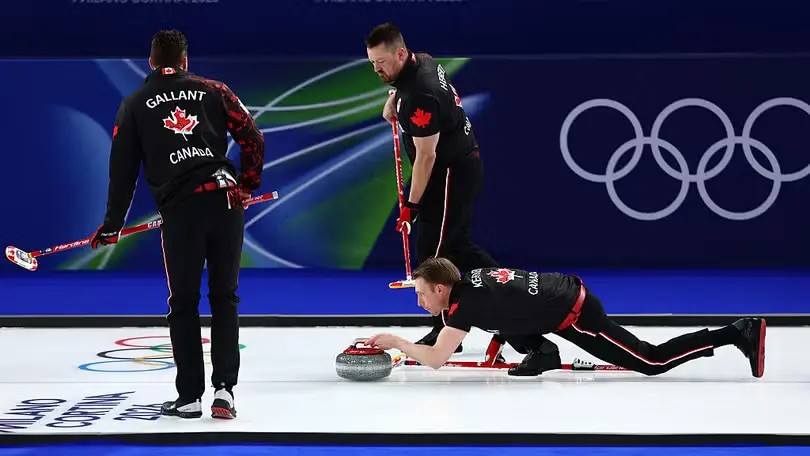
Curling became one of the most compelling stories of the Milano Cortina 2026 Winter Olympics when Canada defeated Great Britain 9-6 in a tense men’s final at the Cortina Curling Olympic Stadium. The scoreline looks clear on paper. The match itself was anything but straightforward.
For eight ends, Bruce Mouat’s Team GB rink appeared close to ending a wait that had lasted more than a century. The British quartet repeatedly forced Canada into difficult positions and held a 6-5 lead late in the contest. Then the ninth end changed everything. Brad Jacobs and his Canadian teammates scored three points, moving 8-6 ahead before stealing one more in the tenth to secure gold.
The final showed why curling deserves more attention than the familiar description of “chess on ice.” Strategy is central, but the sport also demands control, teamwork, physical endurance and the ability to make precise decisions while a medal hangs on the movement of a 20-kilogram granite stone.
The 2026 tournament had all the ingredients of a memorable sporting story: a 102-year British wait for men’s gold, a Canadian comeback, vocal Scottish support, bagpipes in the stands, a venue linked to James Bond and a controversy that brought curling rules into the spotlight.
Curling Final: Key Details at a Glance
| Detail | Information |
|---|---|
| Event | Milano Cortina 2026 men’s curling final |
| Venue | Cortina Curling Olympic Stadium |
| Date | 21 February 2026 |
| Result | Canada 9-6 Great Britain |
| Gold-medal skip | Brad Jacobs |
| Team GB skip | Bruce Mouat |
| Decisive moment | Canada scored three points in the ninth end |
| British result | Second consecutive Olympic silver in the men’s event |
| Historical context | Britain’s last men’s Olympic curling gold remains the 1924 Chamonix title |
The official World Curling report provides the end-by-end account of the final, while Team GB’s report captures the disappointment felt by Mouat’s rink after coming so close.
Why the Final Became Such a Powerful Sporting Story
Curling can appear simple to a new viewer. Two teams take turns sliding polished granite stones toward a target known as the house. Sweepers brush the ice. Players shout instructions. The stones move slowly enough for every decision to remain visible.
That apparent simplicity is part of the appeal.
In many sports, decisive moments happen in a fraction of a second. In curling, tension builds gradually. A viewer can see a problem developing, understand the options and wait as the stone travels down the sheet. A delivery that looks harmless at first can alter the geometry of an entire end.
The men’s final captured that tension perfectly. Great Britain spent much of the match in a strong position without ever creating a comfortable gap. Canada stayed close enough to punish a sequence of mistakes. When the ninth end arrived, the game turned quickly.
The result was painful for Team GB, but it created the kind of drama that explains why curling attracts a larger audience during the Winter Olympics.
Curling Explained for New Viewers
The sport becomes more enjoyable once a few basic terms are clear. World Curling’s official introduction explains that traditional teams contain four players. Each player delivers two stones in an end, meaning each team uses eight stones.
| Term | Meaning |
|---|---|
| House | The circular target area at the end of the sheet |
| Button | The centre of the house |
| End | One round of play, similar to an inning |
| Hammer | The advantage of delivering the final stone in an end |
| Blank end | An end in which neither team scores |
| Draw | A controlled shot intended to stop inside the house |
| Take-out | A shot designed to remove another stone |
| Freeze | A stone played close against another stone |
| Skip | The team captain who directs strategy |
| Sweeping | Brushing the ice to influence a stone’s distance and path |
Only one team can score in an end. It receives one point for each stone closer to the button than the opponent’s nearest stone. Team matches are normally played over 10 ends.
The hammer is especially important. The team holding it plays the final stone of an end and can often use that advantage to score more than one point. A team may deliberately blank an end so it can keep the hammer for the next round.
That mix of risk and patience gives curling its tactical depth. A team is not always trying to score immediately. It may be building pressure, limiting damage or preparing a more favourable situation later.
How Canada Beat Great Britain 9-6
The final developed into a close tactical battle.
Canada started with the hammer and scored one in the opening end. Great Britain responded with two in the second. The teams continued exchanging small advantages, reaching the halfway break with Canada 4-3 ahead.
Mouat produced one of Team GB’s strongest moments in the sixth end. His double take-out allowed Britain to score two and move 5-4 ahead. Jacobs answered with a single point in the seventh, tying the contest at 5-5.
Britain then scored one in the eighth end to lead 6-5. With two ends remaining, Team GB were in a position to make history.
| End | Match development |
|---|---|
| 1 | Canada scored one with the hammer |
| 2 | Great Britain responded with two |
| 3 | Canada scored two to lead 3-2 |
| 4 | Britain levelled the final at 3-3 |
| 5 | Canada moved 4-3 ahead |
| 6 | Mouat’s double take-out gave Britain a 5-4 lead |
| 7 | Canada drew level at 5-5 |
| 8 | Britain scored one and led 6-5 |
| 9 | Canada scored three and took control at 8-6 |
| 10 | Canada stole one to complete a 9-6 victory |
The decisive ninth end showed how quickly curling can change. Canada built a strong position with three counting stones. Mouat attempted a freeze with his final delivery, but the placement left Jacobs an opportunity. The Canadian skip removed the British stone and secured three points.
Team GB still had the hammer in the tenth and needed two to force an extra end. Mouat’s final attempt was too straight, leaving one Canadian stone in scoring position. Canada stole one and won gold.
The Ninth End Was a Lesson in Fine Margins
The final was not decided because Great Britain played badly for two hours. It was decided because a small number of missed shots arrived at the worst possible moment.
Team GB’s official report described the ninth end as the turning point. Bobby Lammie said Canada’s stone placement was strong and that Britain missed several doubles. He also explained how a small difference in the final freeze could have reduced the damage and preserved a realistic chance in the last end.
This is what makes curling so absorbing. A mistake may be measured in inches, but its consequences can be enormous. One stone changes the path available for the next. One missed take-out creates a guard. One slightly imperfect freeze allows an opponent to convert a difficult position into a multiple score.
The sport rewards accuracy, but it also rewards emotional control. Players must make decisions while reading angles, weight, ice conditions and the intentions of the opposing skip.
Bruce Mouat’s Team GB Rink Fell Short Again
The silver medal carried a complicated meaning for Great Britain.
Mouat, Grant Hardie, Bobby Lammie and Hammy McMillan reached a second consecutive Olympic men’s final. They had already won silver at Beijing 2022 after losing to Sweden in an extra end. At Milano Cortina 2026, they again came within touching distance of gold.
Their wider record explains why the result hurt. Team Mouat entered the Games as world champions and had already established themselves among the strongest rinks in the sport. Olympic gold remained the major prize missing from their collection.
After the final, Mouat acknowledged the achievement of becoming a two-time Olympic medallist while also admitting that he wished the medal were a different colour. The disappointment was visible because the opportunity had been real.
The loss did not reduce the quality of the performance. It revealed the cruelty of elite sport. A team can prepare for years, play well for most of a final and still leave with silver because one end changes direction.
The route into the final had already tested Team GB. Mouat’s rink needed help from another result to reach the knockout stage, then defeated a previously unbeaten Switzerland team 8-5 in the semi-final. Mouat produced a remarkable runback triple take-out under pressure, removing three Swiss stones and changing the match. That comeback made the final feel less like a routine appearance and more like the climax of a difficult campaign.
Our article on the training secrets behind the world’s top athletes explores why preparation and mental control matter as much as physical talent in high-pressure competition.
Britain’s 102-Year Wait for Men’s Gold Continues
Curling appeared at the first Olympic Winter Games in Chamonix in 1924. Great Britain won the men’s competition, defeating France and Sweden. The event included only three teams.
The title was not always treated as an official Olympic gold. It was later formally recognised, giving Britain a historic place in the sport’s Olympic story.
The Olympics.com overview of Britain’s curling legacy explains that the country’s men won at the sport’s Olympic debut, while the women later added gold medals in 2002 and 2022.
The men have repeatedly come close in the modern era. David Murdoch’s rink took silver at Sochi 2014 after losing to a Canadian team skipped by Jacobs. Mouat’s rink earned silver in Beijing and again in Cortina.
The long wait adds weight to every Team GB medal match. Each new final is not only about four players and one tournament. It carries the hope of ending a story that began more than a century ago.
Brad Jacobs Added Another Chapter to Canadian History
Canada’s victory gave Jacobs a second Olympic gold as a skip, 12 years after his Sochi triumph.
His team included Marc Kennedy, Brett Gallant and Ben Hebert, with Tyler Tardi as alternate. Canada’s win was its fourth Olympic men’s curling gold and its first in the event since 2014.
The victory also completed a difficult tournament. Canada had not moved through the Games without pressure. It needed to overcome strong opponents, media attention and a controversy that followed the team through the round-robin stage.
In the final, the Canadian rink showed why experience matters. It stayed close when Britain appeared to have greater control. It then converted the ninth-end opportunity ruthlessly.
The Double-Touch Controversy Added Heat to the Ice
Canada’s route to gold included a dispute that attracted unusual attention for curling.
During a round-robin match against Sweden, Swedish players accused Kennedy of touching a stone after release beyond the hog line. Such contact would breach the rules if established. Kennedy denied deliberate wrongdoing, while the incident produced heated exchanges and widespread debate.
The controversy should be described carefully. An allegation is not the same as a proven act of cheating. The viral footage prompted discussion about officiating, trust and the traditional culture of curling, but Canada went on to compete in the final and win the title.
The Guardian’s report on the dispute described how organisers briefly added extra officials near the hog line before withdrawing the change after complaints from players.
The episode was uncomfortable for the sport, but it also brought attention. People who rarely watch curling began discussing stone delivery, rule enforcement and sportsmanship. That is not the ideal way to attract new viewers, yet it showed that the sport could generate genuine argument and emotion.
Bond, Bagpipes and a Venue With Character
The Cortina Curling Olympic Stadium gave the final a distinctive atmosphere.
The venue was originally built as an open-air arena for the 1956 Winter Games. It also appeared in scenes from the 1981 James Bond film For Your Eyes Only. During the 2026 Games, its older features sat inside a modern shell, creating a setting that felt different from a generic arena.
British supporters added another layer. The BBC reported that a fan brought bagpipes into the arena for the semi-final, apparently hidden inside a baby’s pram to avoid security attention. The pipes returned as part of the soundtrack surrounding Team GB’s medal push.
The details might seem minor, but they help explain why Olympic sport becomes memorable. Curling was not taking place in a silent laboratory. It was happening in a lively venue filled with chants, nerves, rivalry and visible emotion.
The contrast suited the sport. The stones moved with controlled precision while the atmosphere around the sheet became increasingly intense.
Why Sweeping Is More Important Than It Looks
To an unfamiliar viewer, sweeping can seem strange. In reality, it is one of the most demanding and influential parts of the game.
Sweepers brush the ice in front of a moving stone to affect how far it travels and how much it curls. They listen to the skip, judge the stone’s speed and react immediately. Effective sweeping depends on strength, endurance, coordination and communication.
Modern curling has also become more technical. Teams study equipment, ice conditions, delivery mechanics and marginal gains. The sport’s visual simplicity hides a highly developed performance environment.
That makes curling a useful example of the themes explored in our sports training and technology guide. Elite performance often depends on small improvements that casual viewers may not notice immediately.
Curling Works Because the Audience Can Learn While Watching
One reason curling becomes popular during the Olympics is that viewers can improve their understanding from match to match.
The rules are approachable. The deeper strategy takes longer to master. That creates an ideal viewing experience.
A new fan can quickly understand the basic goal: place stones closer to the button than the opponent. After a few ends, the same viewer begins to notice more:
- why guards are useful;
- when a team wants to blank an end;
- why keeping the hammer matters;
- how one take-out opens a path for another;
- when a skip chooses caution instead of aggression;
- how sweeping changes the outcome of a delivery;
- why a two-point end can matter more than an immediate single.
This learning curve makes the sport rewarding. The audience is not merely waiting for action. It is trying to solve the same puzzle as the players.
The interest was measurable. The BBC reported that its audience for Great Britain’s semi-final victory over Switzerland peaked at 3.4 million. That number challenged the idea that curling is merely background viewing during the Winter Olympics.
Curling Deserves Attention Beyond the Olympics
The Winter Games give the sport its largest mainstream platform, but curling does not disappear when the Olympic flame goes out.
International championships, national competitions and elite tours continue throughout the season. The challenge is turning Olympic curiosity into sustained interest.
That requires accessible coverage, strong storytelling and clear explanations for new viewers. It also requires respect for the sport’s character. Curling does not need to imitate football or ice hockey. Its tension comes from precision, silence, calculation and sudden shifts in momentum.
The Milano Cortina tournament showed that the audience will respond when the stakes are clear. A controversy may attract attention temporarily, but the quality of the competition is what keeps people watching.
Readers following the wider calendar can explore our guide to the major sports tournaments in 2026.
What the 2026 Final Ultimately Proved
Curling delivered one of the most memorable medal matches of the Milano Cortina Games because the final combined strategy with emotion.
Great Britain were chasing history. Canada carried experience and controversy. Mouat’s rink led after eight ends. Jacobs’ team found its opening in the ninth. The gold medal turned on a handful of stones and the smallest of margins.
The 9-6 result extended Britain’s wait for men’s Olympic gold, but it also strengthened the sport’s appeal. Viewers saw why a match can remain tense without constant speed. They saw how sweeping, geometry and tactical patience shape the contest. They saw athletes devastated by inches.
That is why curling is more than a novelty that returns every four years. At its best, it is a sport of visible decisions, accumulating pressure and dramatic consequences.
For more sports analysis and major-event coverage, follow The News Ink on Instagram and join our WhatsApp channel.