




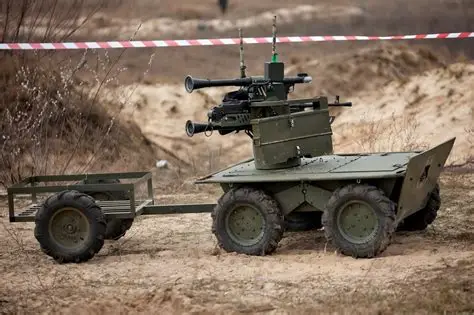
Since Russia launched its full-scale invasion, the Ukraine war has become a high-tech battlefield. Spy drones, killer drones, and uncrewed boats have already changed the way battles are fought. Now, Ukraine is turning to armed ground robots to strengthen its defenses.
Known as uncrewed ground vehicles (UGVs), these robots have already proven their effectiveness. Reports suggest that UGVs have repelled Russian attacks and even captured enemy soldiers. Some encounters between Russian and Ukrainian UGVs have occurred without human soldiers present.
“Robot wars are already happening,” says Oleksandr Afanasiev of Ukraine’s K2 brigade, which commands the world’s first UGV battalion. His team equips robots with Kalashnikov machine guns to perform tasks too dangerous for infantry soldiers.
Battery-powered kamikaze UGVs are also in use. These silent machines strike enemy positions without warning, increasing their tactical advantage. One UGV ambushed a Russian personnel carrier, while another defended a Ukrainian position for weeks, according to the deputy commander of the 33rd Detached Mechanized Brigade, known as Afghan.
While modern UGVs can operate independently, humans still control when they fire. “Robots can misidentify targets or hit civilians,” Afghan explains. Most armed UGVs are remote-controlled from safe locations, ensuring compliance with ethics and international law.
UGVs serve multiple roles on the battlefield. They carry grenades and machine guns, plant landmines, deliver supplies, and evacuate wounded soldiers. Former Ukrainian commander Valerii Zaluzhnyi predicts that armed robots will increasingly operate in AI-powered swarms, attacking from land, sea, and air simultaneously.
Manpower shortages make these robots essential. Infantry remains irreplaceable, but UGVs allow Ukraine to fight without risking human lives. Maj Afanasiev emphasizes, “Ukraine can afford to lose robots, but not trained soldiers.”
Russia is also deploying combat UGVs like the Kuryer and Lyagushka, armed with flamethrowers, machine guns, and explosives. CEO of Ukrainian UGV manufacturer Devdroid, Yuriy Poritsky, warns that clashes between strike UGVs are inevitable.
Companies like Devdroid and Tencore are advancing UGV technology. Tencore produced over 2,000 units in 2025 and expects demand to rise to 40,000 in 2026, with 10-15% armed for combat. Experts predict that armed UGVs will become an essential part of modern warfare, potentially even mimicking human combat behavior in the future.



 to support troops, repel attacks, and carry out high-risk missions. Explore how these machines are reshaping modern warfare.)