Armed Robots Transform Ukraine’s Battlefield Strategy
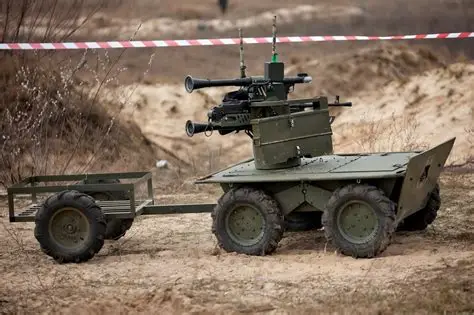
Armed robots are no longer a distant military concept in Ukraine. They are moving through mud, trenches and shattered roads, carrying machine guns, explosives, ammunition, food, water and wounded soldiers across a battlefield where human movement has become increasingly dangerous.
Since Russia’s full-scale invasion, Ukraine has turned the war into one of the world’s most intense testing grounds for uncrewed systems. First came mass use of reconnaissance drones. Then came first-person-view attack drones, long-range strike drones and uncrewed naval systems. Now, armed robots on the ground are becoming a serious part of Ukraine battlefield strategy.
These machines are known as uncrewed ground vehicles, or UGVs. Some are small tracked platforms built for supply runs. Some carry stretchers for casualty evacuation. Some plant mines, tow equipment or support assault groups. Others are armed robots fitted with machine guns, grenade launchers or explosive payloads.
The strategic idea is simple: Ukraine can replace some of the most dangerous human tasks with machines. That does not mean robots are replacing infantry. Soldiers still plan, command, hold ground and make life-or-death decisions. But armed robots can move into places where sending people would be almost suicidal.
The shift is happening because the front line has changed. Drones watch roads, treelines and trenches. Artillery, mines and electronic warfare make movement hazardous. Ukrainian commanders describe large areas near the front as “kill zones” where even bringing water or ammunition to troops can cost lives. In that environment, a robot that can be lost is sometimes better than a soldier who cannot be replaced.
Ukraine’s Robot War in One Snapshot
| Battlefield role | What UGVs can do | Why it matters |
|---|---|---|
| Logistics | Move ammunition, water, batteries and food | Reduces human exposure on dangerous supply routes |
| Casualty evacuation | Carry wounded troops from exposed positions | Gives injured soldiers a better chance of survival |
| Fire support | Use remote-controlled weapons | Keeps operators away from direct fire |
| Mine work | Lay, detect or help clear mines | Reduces risk for engineers and assault teams |
| Reconnaissance | Scout terrain and enemy positions | Gives commanders more information before moving troops |
| Assault support | Carry explosives or support attacks | Adds pressure without exposing infantry first |
The important point is that armed robots are part of a wider robotic ecosystem. Their biggest value may not always come from firing weapons. In many cases, the most life-saving role is carrying supplies or evacuating wounded soldiers under fire.
Ukraine’s Ministry of Defence said ground robotic systems carried out more than 9,000 frontline missions in March 2026 alone, with nearly 24,500 missions since the start of the year at that point. By July, reporting based on Ukrainian defence data said UGV missions had passed 66,000 in the first half of 2026. That rapid scale-up shows how quickly armed robots and support robots are moving from experiment to routine battlefield tool.
Why Ukraine Needs Armed Robots Now
The most immediate reason is manpower. Ukraine is fighting a larger enemy with deeper reserves. Every trained infantry soldier matters. Every casualty weakens a unit not only emotionally, but operationally. Replacing a destroyed robot is hard. Replacing a trained soldier is harder.
That is why Ukrainian officers often describe UGVs in brutally practical terms. Robots do not bleed. Robots do not have families. Robots can be repaired, rebuilt or abandoned if the alternative is sending humans into a drone-covered zone.
The second reason is surveillance. The Ukraine war has made concealment extremely difficult. A soldier walking across open ground can be spotted by a drone within minutes. Vehicles are vulnerable to mines, artillery and FPV drones. Even night movement is dangerous because thermal imaging and drones have improved.
Armed robots fit this environment because they are lower, smaller and more disposable than many crewed vehicles. They can crawl along routes too dangerous for humans. They can wait in a firing position. They can deliver a box of ammunition to a trench without exposing a driver. They can move slowly through a zone where speed is less important than survival.
The third reason is Ukraine’s defence-tech ecosystem. Platforms such as Brave1 have helped connect soldiers, engineers, manufacturers and government procurement. That feedback loop matters because battlefield robotics improves through constant use. A robot that works on a test range may fail in mud, snow, jamming, shellfire or broken urban terrain. Ukraine is learning those lessons in real time.
This links directly with The News Ink’s wider coverage of AI trends and cyber warfare. Modern conflict is no longer only about tanks and artillery. It is increasingly about sensors, software, electronic warfare, autonomy and how quickly armies can adapt.
The K2 Brigade and the Rise of Robot Units
One of the most striking claims from the front is that Ukraine’s K2 brigade has created what its commanders describe as a dedicated UGV battalion. Oleksandr Afanasiev, associated with the brigade, has been quoted saying that “robot wars are already happening.” His unit has used armed robots fitted with Kalashnikov-style machine guns and other payloads for missions considered too dangerous for infantry.
The exact shape of these robot units continues to evolve. Ukraine does not yet have a long-established doctrine for UGV battalions because no modern army has fought a war like this at such scale. Instead, doctrine is being written through practice: a unit tests a platform, sends feedback, improves the design, changes tactics, then repeats the cycle.
That is what makes Ukraine battlefield strategy so important for other militaries. NATO countries, Russia, China, Iran, Israel and many others are watching. The question is not whether armed robots will appear in future wars. They already have. The question is how armies will organise them.
A robot unit needs more than machines. It needs operators, technicians, batteries, spare parts, communications, electronic-warfare protection, recovery teams, software updates and rules for using force. A UGV that cannot communicate is a liability. A UGV that cannot be repaired is a short-lived asset. A UGV with a weapon but poor targeting discipline is a legal and moral risk.
That is why armed robots are changing more than tactics. They are forcing armies to rethink logistics, training and command.
The Most Useful Robots May Not Be the Most Dramatic
A machine-gun robot attracts attention because it looks futuristic. But Ukraine’s most important robot work may be less dramatic: moving supplies and evacuating casualties.
Ukraine’s Ministry of Defence has repeatedly emphasised logistics and medical evacuation missions. Defence News reported that Ukraine planned to contract 25,000 UGVs in the first half of 2026, more than double the 2025 total, as the Defence Ministry moved to shift frontline logistics away from soldiers and onto robots. Business Insider later reported that more than 22,000 ground drones had already been contracted for 2026.
That tells us something important. Armed robots make headlines, but the real revolution is the robotisation of dangerous routine work.
A supply run can be deadly. A wounded soldier may be trapped because any rescue attempt draws drone fire. A unit may need batteries for drones, ammunition for machine guns or water in a forward trench. In the past, soldiers had to carry those loads themselves or use vehicles that became obvious targets. UGVs offer another option.
The News Ink’s depleting weapons stockpiles coverage explains why logistics often decides wars as much as battlefield heroics. Ukraine’s UGV push fits that lesson. A robot that delivers ammunition at the right time can matter as much as a robot that fires a weapon.
How Armed Robots Fight
Most armed robots in Ukraine are remotely controlled. A human operator sees through cameras or supporting drones, moves the vehicle and decides whether to fire. This distinction is essential. The robots may have autonomous navigation features, target-assistance software or AI-supported detection, but human control remains central for weapon release.
This matters because a battlefield is full of ambiguity. A camera may misread a shadow. AI may confuse a civilian object with military equipment. A wounded soldier may surrender. A person may be carrying something that looks like a weapon but is not. Weather, smoke, mud, jamming and damaged sensors all make identification harder.
For that reason, Ukrainian commanders have stressed that humans decide when armed robots fire. That approach is not only ethical; it is practical. A robot that fires wrongly can kill civilians, violate international humanitarian law, waste ammunition or create propaganda damage.
The International Committee of the Red Cross has warned that autonomous weapon systems raise serious legal and humanitarian questions, especially around distinction, proportionality, precautions in attack and human control. Those concerns apply directly to the future of armed robots if they become more autonomous.
The safe line is clear: robots can assist, but humans must remain responsible for decisions to use lethal force.
What Ukrainian Companies Are Building
Ukraine’s UGV industry has expanded quickly because the battlefield demands it. Companies such as Tencore, DevDroid, Trinity Robotics and other domestic manufacturers are producing platforms for logistics, combat and support roles.
Tencore has been widely reported as one of the key Ukrainian UGV makers. Ukrainian Pravda reported that Tencore delivered more than 2,000 UGVs to frontline troops in 2025, citing the company’s CEO Maksym Vasylchenko. Other reporting has said the company expects demand to rise sharply in 2026, with only a portion of future platforms expected to be armed.
DevDroid presents its work as “remote battlefield control” and lists platforms such as Droid TW 12.7 and Droid NW 40 on its official site. Business Insider reported that Ukraine had approved a DevDroid ground robot adapted for automatic grenade launchers, while other reports described DevDroid systems being used for combat support and even prisoner-surrender situations.
Trinity Robotics is also scaling production. Defence News reported in July 2026 that the company planned to double production to about 2,200 units this year and was exploring manufacturing partnerships abroad.
The industry pattern is clear. Ukraine is not waiting for perfect systems. It is building practical platforms quickly, testing them under fire and improving them through soldier feedback.
That approach mirrors the broader speed of Ukraine’s wartime technology sector, also visible in The News Ink’s coverage of AI deepfakes and Russia’s online disinformation and the wider technology landscape.
Russia Is Building Robots Too
Ukraine is not alone. Russia has also deployed and tested UGVs, including systems reported under names such as Kuryer and Lyagushka. Russian platforms have been described with flamethrowers, machine guns, explosive payloads and logistics roles.
This matters because armed robots are not a one-sided advantage forever. Any successful battlefield adaptation is copied. Russia has already learned from Ukraine’s drone tactics and scaled its own systems. The same pattern is likely with ground robots.
A future clash between Ukrainian and Russian UGVs is not science fiction. Reports have already suggested encounters where uncrewed systems operated against each other with few or no soldiers immediately present. Even if some claims are difficult to verify independently, the direction of travel is obvious: machines are moving closer to the contact line.
The result could be a battlefield where drones in the air spot targets, UGVs on the ground deliver explosives or fire support, electronic-warfare units jam signals, and human soldiers command from farther back. That does not remove humans from war. It changes where humans are exposed.
The Limits of Armed Robots
Armed robots are useful, but they are not magic. Ukraine’s experience shows several limits.
First, terrain is brutal. Mud, rubble, shell holes, mines, snow and broken roads can stop small ground robots. Aerial drones fly over obstacles. UGVs must cross them.
Second, batteries matter. A robot that runs out of power in no-man’s-land may be lost. Longer endurance means more weight, which affects speed, cost and mobility.
Third, communications are vulnerable. Jamming, terrain, buildings and enemy electronic warfare can break the link between operator and robot. A UGV that loses connection may stop, return, continue a programmed route or become useless, depending on its design.
Fourth, recovery is difficult. A damaged robot in a dangerous area may be impossible to retrieve. That matters because even low-cost platforms are not free.
Fifth, armed robots still need human teams. Operators must be trained. Mechanics must repair them. Commanders must integrate them into plans. Infantry must still hold ground.
This is why claims that robots will “replace soldiers” should be treated carefully. Robots can reduce exposure. They can take over some tasks. They can change the timing and risk of operations. But infantry remains central because war is ultimately about control of territory, people and political outcomes.
AI Swarms and the Future of the Battlefield
Former Ukrainian commander Valerii Zaluzhnyi has warned that the next phase of war may involve coordinated swarms of aerial, ground and maritime drones attacking from multiple directions. That idea is already visible in Ukraine’s experimentation with uncrewed boats, aerial drones and ground robots.
Business Insider reported in July 2026 that Ukraine had launched what was described as a first-of-its-kind robotic amphibious assault, using a naval drone to transport an armed UGV to the Kinburn Spit before the ground robot deployed and opened fire. The report said the mission was remotely controlled and did not involve human soldiers in the combat zone.
That kind of operation points toward a new combined-arms model. Instead of tanks, infantry, artillery and aircraft alone, future attacks may combine:
- aerial drones for surveillance and strikes;
- UGVs for fire support, explosives or logistics;
- uncrewed boats for coastal access;
- electronic-warfare teams for protection and disruption;
- human operators coordinating from safer positions.
The danger is escalation of autonomy. As systems become faster, commanders may want AI to select routes, prioritise targets or coordinate swarms. That could increase speed, but it also raises legal and ethical risks. If a machine makes a lethal mistake, who is responsible? The operator? The commander? The software developer? The state?
That question is not theoretical. It is one of the central issues in the global debate over autonomous weapons.
Why the World Is Watching Ukraine
Ukraine’s use of armed robots is being studied because it is happening in real combat, not only in trials. Western armies have tested ground robots for years, but many programmes moved slowly because requirements were complex and budgets competed with traditional platforms. Ukraine’s war compressed that timeline.
A UGV in Ukraine is judged by whether it works under fire. If it fails, soldiers tell engineers quickly. If it succeeds, commanders order more. That feedback cycle is faster than normal peacetime defence procurement.
Other countries will learn several lessons from Ukraine:
| Lesson | Why it matters |
|---|---|
| Cheap systems can be valuable | Not every battlefield robot needs to be expensive |
| Logistics may be the first major use | Supply and evacuation are constant needs |
| Human control remains essential | Weapon decisions need judgement and accountability |
| Electronic warfare is decisive | Robots depend on communication and navigation |
| Modularity matters | Platforms must adapt to different missions |
| Production speed beats perfection | Wartime demand rewards rapid iteration |
This is why Ukraine’s armed robots are not only a local story. They are shaping global military planning.
The Ethical Line Ukraine Must Hold
Ukraine has strong reasons to use armed robots. It is defending itself against a larger invading force. It is trying to save soldiers’ lives. It is adapting because Russia has turned much of the front into a surveillance-and-strike zone.
But necessity does not remove responsibility. Armed robots must be used under international humanitarian law. That means distinguishing military targets from civilians, avoiding disproportionate attacks, taking precautions and maintaining accountability.
The ICRC’s work on autonomous weapon systems is especially relevant because the technology is moving faster than many legal debates. Even if today’s Ukrainian UGVs are mostly remote-controlled, tomorrow’s systems may have more autonomy. Rules and habits created now will shape what comes next.
A responsible approach should include:
- human authorisation for firing;
- clear rules of engagement;
- recording and review of strikes where possible;
- training operators in law of armed conflict;
- safeguards against civilian misidentification;
- limits on fully autonomous lethal decisions.
The goal should be simple: use machines to reduce risk to soldiers and civilians, not to make killing easier or less accountable.
A Defining Shift, Not a Complete Replacement
Armed robots are transforming Ukraine battlefield strategy because they solve a real problem: how to keep fighting when the front is watched constantly and every movement can be targeted. They allow Ukraine to move supplies, evacuate wounded soldiers, defend positions and strike enemy forces while reducing some direct human exposure.
But they do not end the need for soldiers. They do not remove the fog of war. They do not solve ammunition shortages, air-defence gaps, manpower pressure or the political difficulty of a long war. They are tools, not miracles.
Their importance lies in how they change the balance of risk. A soldier carrying supplies across a drone-covered road is a human life exposed to enormous danger. A UGV carrying the same supplies may be damaged or destroyed, but the soldier lives. That is why commanders keep asking for more.
The News Ink has covered how technology is reshaping war through stories on Russian drone attacks on Ukraine, Ukraine strikes on Russian oil facilities and cybersecurity. Armed robots belong in the same pattern: war is becoming more automated, more connected and more dependent on rapid innovation.
The Bottom Line
Armed robots have moved from experimental promise to battlefield reality in Ukraine. They carry weapons, supplies and wounded soldiers. They reduce risk on dangerous routes. They support positions that would otherwise require more infantry. They also raise hard questions about autonomy, accountability and how far machines should be allowed to go in combat.
Ukraine’s advantage is not only that it has armed robots. It is that it is learning how to use them under the pressure of real war. Russia is adapting too, which means the robot arms race on the ground is likely to accelerate.
The future battlefield will not be empty of humans. It will be full of human decisions made through machines: aerial drones above, armed robots below, electronic warfare across the spectrum and commanders trying to move faster than the enemy can respond.
For Ukraine, the logic is painfully clear. A robot can be replaced. A trained soldier cannot. That is why armed robots are becoming one of the defining technologies of Ukraine battlefield strategy.
For more technology and conflict analysis, follow The News Ink on Medium or read our guide to AI trends.