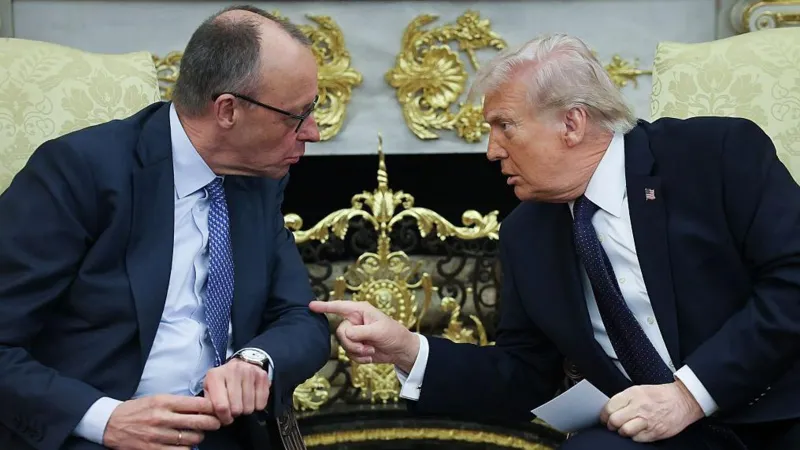
US cuts troops in Germany amid Trump–Merz spat
The decision that US cuts troops in Germany by around 5,000 personnel has triggered fresh geopolitical tension between Washington and Berlin. The move comes amid a growing diplomatic dispute between US President Donald Trump and German Chancellor Friedrich Merz over strategy in the Iran conflict and wider NATO responsibilities.
With more than 36,000 US troops previously stationed across Germany, this decision marks a significant shift in American military posture in Europe.
Below are the 5 key reasons why US cuts troops in Germany, explained in detail.
1. Rising political tensions between Trump and Merz
The most visible reason behind US cuts troops in Germany is the escalating political clash between Trump and Chancellor Friedrich Merz.
The dispute intensified after Merz suggested the US had been “humiliated” in negotiations related to Iran. Trump responded sharply, criticising Germany’s leadership and accusing it of poor strategic judgment.
This exchange deepened mistrust and contributed directly to the decision to reduce troop presence in Germany.
2. US frustration over NATO burden-sharing
Another major factor behind US cuts troops in Germany is long-standing frustration over NATO burden-sharing.
Trump has repeatedly argued that European allies are not contributing enough to collective defence spending. Although Germany has recently increased its defence budget significantly, earlier disagreements shaped US policy direction.
The issue has been a recurring point of tension within NATO discussions, influencing troop redeployment strategies.
For background on NATO defence commitments, see official details at NATO’s defence spending framework.
3. Shift in US military focus toward other regions
A strategic reason behind US cuts troops in Germany is the US shift toward the Indo-Pacific region.
Washington has increasingly focused on countering rising influence in Asia, leading to reassessments of European deployments.
Officials have indicated that force restructuring is part of a broader global realignment rather than a complete withdrawal from Europe.
This shift reflects changing global priorities in US defence strategy.
4. Disagreements over Iran war strategy
The Iran conflict has also played a role in US cuts troops in Germany. Trump and European leaders, including Merz, have differed on how to approach negotiations and military pressure.
Merz publicly criticised the US approach, suggesting a lack of clear strategy. Trump responded by accusing Germany of misunderstanding the situation and undermining US efforts.
These disagreements added strain to already fragile diplomatic relations, accelerating the troop reduction decision.
5. Long-term US-Europe defence restructuring
The final reason behind US cuts troops in Germany is long-term restructuring of US forces in Europe.
The Pentagon stated the move follows a “force posture review,” aimed at aligning troop deployments with current global requirements.
The withdrawal of 5,000 troops is expected to take place over 6–12 months, indicating a gradual rather than immediate pullback.
Experts suggest this is part of a broader reassessment of US overseas military commitments.
US troop presence in Europe (overview)
| Location | Estimated Troops |
|---|---|
| Germany | 36,000+ |
| Italy | ~12,000 |
| United Kingdom | ~10,000 |
Germany remains the largest US military hub in Europe, with key bases such as Ramstein Air Base playing a central role in operations.
European reaction and concerns
European officials have expressed concern that US cuts troops in Germany could weaken NATO deterrence, especially amid ongoing global conflicts.
German Defence Minister Boris Pistorius acknowledged the decision was expected but stressed that US presence remains strategically important for both sides.
He emphasized that cooperation between the US and Europe is still essential for regional stability.
What happens next
The troop reduction will be monitored closely over the next year. While the US insists this is a strategic adjustment rather than a withdrawal, European allies are reassessing their own defence readiness.
Further announcements on troop realignment may follow as Washington continues to review its global military footprint.
Conclusion
The decision that US cuts troops in Germany reflects a mix of political tensions, strategic realignment, and NATO disputes. The Trump–Merz spat over Iran acted as a trigger, but deeper structural issues in US–Europe defence relations have been building for years.
As global security priorities shift, this move signals a new phase in transatlantic relations—one defined by uncertainty, recalibration, and growing geopolitical complexity.
For more global conflict, economy, and geopolitical updates, you can explore detailed coverage on The News Ink, where major world events are explained with clarity and depth.