South Korean police have raided the transport ministry as scrutiny grows over the handling of the country’s deadliest aviation disaster.
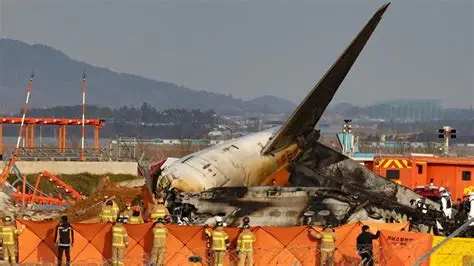
The raid is linked to the investigation into the crash of Jeju Air Flight 2216. The aircraft overshot the runway at Muan International Airport on 29 December 2024. The accident killed 179 of the 181 people on board.
Authorities searched the Ministry of Land, Infrastructure and Transport offices in Sejong on Friday. Investigators are looking for new evidence about the cause of the crash and whether officials handled the investigation properly.
Bird Strike and Runway Structure Under Scrutiny
Early findings showed that the Boeing 737-800 suffered a bird strike before landing. The pilots managed to land the plane on its belly and slide along the runway.
However, the aircraft struck a concrete mound that supported a navigation antenna system. The impact caused the plane to explode into a fireball, which increased the number of casualties.
Investigators say a flock of migratory ducks likely caused the bird strike that damaged the engine.
Discovery of Remains Sparks Public Anger
The investigation faced fresh criticism after authorities discovered additional body parts and victims’ belongings months after the crash.
Officials had stored sacks of debris from the crash site. Investigators later found human remains and personal items mixed with the rubble.
Families of the victims had repeatedly asked officials to re-examine the debris. The discovery triggered public outrage and renewed calls for accountability.
President Orders Inquiry
South Korean President Lee Jae Myung ordered a new inquiry into why the remains were not discovered earlier.
He also demanded disciplinary action against those responsible for delays in recovering victims’ remains.
The transport ministry issued an apology, but victims’ families rejected it. A representative said the apology came too late and felt deeply disrespectful to those who died.
Concrete Structure Built to Cut Costs
A separate investigation by the Board of Audit revealed that the concrete mound was built as a cost-saving measure.
The airport sits on sloping terrain. Instead of flattening the ground to install the navigation antenna system, authorities mounted it on a raised concrete structure near the runway.
Aviation safety guidelines recommend that such structures break easily if an aircraft hits them. However, the concrete mound at the airport was rigid.
Simulations suggest that all passengers might have survived if the aircraft had not collided with the structure.
Safety Changes After the Disaster
Following the crash, aviation authorities removed similar concrete navigation structures at seven airports across the country.
Officials expect the main investigation results to be released by mid-2025.