


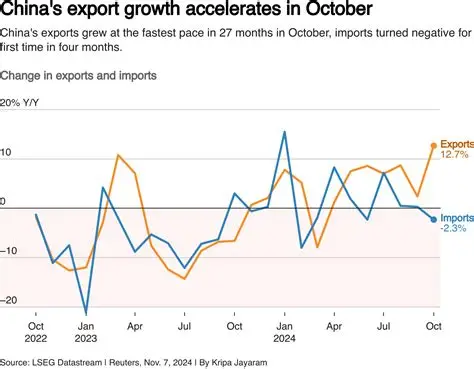
China’s exports recorded a strong rise during the first two months of 2026, despite ongoing trade tensions with the United States.
Official data showed exports increased by more than 20% in January and February. Economists had predicted a much smaller increase. The strong growth puts the country on track to exceed the record trade surplus it achieved in 2025.
The announcement comes ahead of a possible meeting between Donald Trump and Xi Jinping, which is expected to take place in early April.
Exports Remain Key for China’s Economy
China’s economy continues to rely heavily on exports. Domestic challenges such as weak consumer spending, a shrinking population and a struggling property market have slowed internal growth.
Despite these problems, strong global demand for Chinese goods has supported the economy of China.
Lunar New Year Data Adjustment
Chinese authorities usually combine trade data for January and February. This method helps avoid distortions caused by the Lunar New Year holiday, which falls on different dates each year and affects production schedules.
Electronics and Manufacturing Lead Growth
China’s export growth was driven mainly by strong demand for electronics. Shipments of agricultural products and manufactured goods also increased during the same period.
Trade with Europe grew by 27.8%, showing strong demand from European markets.
Exports to countries in ASEAN also rose significantly. Trade with Southeast Asian nations such as Thailand, Singapore and Philippines climbed by nearly 30%.
Exports to the United States Decline
While trade expanded with many regions, exports to the United States dropped by more than 10%.
The decline follows tariffs and trade measures introduced by the US government to reduce the trade imbalance between the two countries.
Lower Economic Growth Target
Earlier this month, China announced a new economic growth target of 4.5% to 5% for 2026. This target is slightly lower than the 5% goal set in 2025, which the country achieved largely due to export performance.
Exports have played a major role in supporting China’s economy during a period of weak domestic demand and a prolonged property market slowdown.
Global Factors Affect Trade
China and several other Asian economies are also feeling the effects of global instability. The ongoing conflict linked to the US-Israeli war with Iran has disrupted global energy markets and added uncertainty to international trade.
Despite these challenges, China’s strong export performance shows its continued influence in global manufacturing and trade.