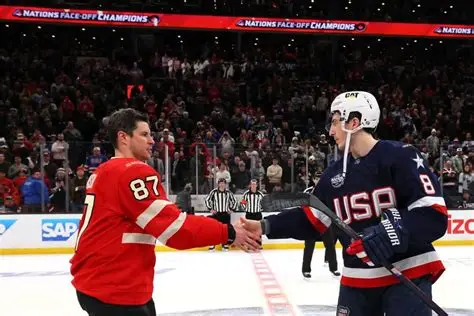
Canada vs USA Ice Hockey Final: How a Thrilling 2-1 Overtime Win Made U.S. History
The Canada vs USA ice hockey final became one of the defining events of the Milano Cortina 2026 Winter Olympics. The United States defeated Canada 2-1 in overtime at Milano Santagiulia Arena on 22 February 2026, ending a 46-year wait for an Olympic men’s ice hockey gold medal. Jack Hughes scored the decisive goal only 1:41 into overtime, completing a fast counterattack and giving the Americans their first men’s Olympic title since the 1980 “Miracle on Ice” Games.
The result transformed the Canada vs USA ice hockey final from a highly anticipated preview into a historic retrospective. The Canada vs USA ice hockey final ultimately became a test of finishing, goaltending and composure rather than a simple contest between star-studded line-ups. Canada entered the contest seeking a record-extending 10th men’s Olympic hockey gold. The United States arrived determined to reverse the pain of previous final defeats against its great rival. After more than 60 minutes of intense, high-speed hockey, the Americans finally created a new Olympic memory of their own.
Canada controlled long stretches of the game and finished with a 42-28 advantage in shots. However, United States goaltender Connor Hellebuyck delivered a remarkable performance under pressure. Matt Boldy opened the scoring for the Americans, Cale Makar equalised for Canada late in the second period, and Hughes ended the Canada vs USA ice hockey final with a low overtime shot that beat Jordan Binnington.
Canada vs USA Ice Hockey Final Match Summary
The Canada vs USA ice hockey final began with urgency. The United States produced a confident opening shift and took the lead at 6:00 in the first period. Boldy collected the puck, moved through the Canadian defence and finished the attack with composure to put the Americans ahead.
Canada responded by increasing its possession and forcing the United States deeper. The game became a test of Hellebuyck’s concentration. Canada generated opportunities through its star forwards, but the American goaltender repeatedly protected the lead. The United States also survived a five-on-three Canadian power play during the second period.
Makar finally found the equaliser at 18:16 of the second period. After receiving the puck from Devon Toews inside the offensive zone, the defenceman moved forward and fired a shot under Hellebuyck’s blocker. The Canada vs USA ice hockey final reached the third period level at 1-1.
Canada pressed hardest after the break. Mitch Marner created a dangerous chance for Toews near the crease, while Macklin Celebrini broke forward after blocking a shot. Hellebuyck remained difficult to beat. Regulation ended without another goal, sending the Canada vs USA ice hockey final into overtime.
| Match detail | Confirmed information |
|---|---|
| Fixture | Canada 1-2 United States |
| Competition | Milano Cortina 2026 men’s Olympic ice hockey |
| Stage | Gold-medal game |
| Date | 22 February 2026 |
| Venue | Milano Santagiulia Arena |
| United States scorers | Matt Boldy, Jack Hughes |
| Canada scorer | Cale Makar |
| Decisive moment | Jack Hughes scored 1:41 into overtime |
| Shots on goal | Canada 42-28 United States |
The official IIHF gold-medal recap confirms that the winning goal began after the Americans capitalised on a turnover and created a three-on-one rush. Hughes completed the move with a low shot under Binnington’s left pad.
Jack Hughes Created a New American Olympic Moment
The decisive play in the Canada vs USA ice hockey final lasted only seconds, but it ended decades of disappointment. Canada had applied heavy pressure and looked capable of finding a winner. Instead, the United States turned defence into attack immediately after a Canadian turnover.
Hughes recognised the opportunity, joined the rush and finished accurately. The goal gave the United States its third Olympic men’s ice hockey gold after earlier triumphs in 1960 and 1980. It was also the country’s first best-on-best men’s hockey championship since the 1996 World Cup of Hockey.
The comparison with 1980 is unavoidable, but the contexts are different. The “Miracle on Ice” team became famous for its victory over the Soviet Union before winning gold. The 2026 roster included established NHL stars competing against another elite NHL-based team. The Canada vs USA ice hockey final did not recreate the past. It gave American hockey a modern achievement with its own meaning.
The Hughes family also shaped the tournament. Quinn Hughes scored the overtime winner against Sweden in the quarter-finals. Jack Hughes scored twice against Slovakia in the semi-final and then delivered the golden goal against Canada. The United States needed contributions from across a deep roster, but the brothers produced decisive moments when elimination and gold were at stake.
Connor Hellebuyck Was the Foundation of the Victory
A winning overtime goal attracts the headlines, but the Canada vs USA ice hockey final was also defined by Hellebuyck. Canada outshot the United States 42-28 and created several dangerous chances. The American goaltender kept the game within reach until Hughes could settle it.
Hellebuyck denied Connor McDavid on a breakaway in the second period. He then helped the United States survive Canada’s five-on-three advantage. In the third, he made important saves as Canada searched for a go-ahead goal. His performance allowed the Americans to absorb pressure without losing their structure completely.
The Canada vs USA ice hockey final demonstrated why goaltending can reshape a tournament. The Canada vs USA ice hockey final also showed why one exceptional goaltender can influence the emotional rhythm of an entire gold-medal game. A team can produce strong possession numbers, generate more shots and still leave without gold if the opposing netminder controls the decisive moments. Hellebuyck did exactly that.
Elite tournament performances depend on far more than raw talent. Preparation, recovery, tactical study and pressure management all contribute. The News Ink’s verified sports training guide explains how athletes and teams prepare for the moments that decide major competitions.
Canada’s Route to the Final Required Two Dramatic Recoveries
Canada reached the Canada vs USA ice hockey final through a difficult knockout path. The team had looked dominant during group play, but the quarter-final against Czechia exposed how quickly Olympic pressure can change a match.
Czechia led 3-2 late in regulation before Nick Suzuki equalised. Mitch Marner then scored the overtime winner only 1:22 into the extra period, giving Canada a 4-3 victory. The official IIHF quarter-final report records another major development: Canadian captain Sidney Crosby left the game after suffering an injury.
Canada faced Finland in the semi-final without Crosby. The defending Olympic champions moved 2-0 ahead, but Canada fought back. Sam Reinhart started the response, Shea Theodore equalised and Nathan MacKinnon scored the power-play winner with only 35 seconds remaining. The official IIHF semi-final recap confirms the 3-2 comeback.
| Canada knockout match | Outcome | Defining moment |
|---|---|---|
| Quarter-final vs Czechia | Canada won 4-3 in overtime | Marner scored after Canada recovered from a late deficit |
| Semi-final vs Finland | Canada won 3-2 | MacKinnon scored with 35 seconds remaining |
| Gold-medal game vs United States | Canada lost 2-1 in overtime | Jack Hughes scored 1:41 into overtime |
The Canada vs USA ice hockey final was therefore the third consecutive Canadian knockout match settled by a one-goal margin. The Canada vs USA ice hockey final asked Canada to solve one more narrow contest after two exhausting recoveries. Canada had repeatedly found a solution under pressure. In the final, the last decisive moment belonged to its rival.
Sidney Crosby’s Absence Changed the Canadian Story
One of the central questions before the Canada vs USA ice hockey final involved Crosby. The Canadian captain had suffered a lower-body injury against Czechia and missed the Finland semi-final. He practised before the gold-medal game, but Canada ultimately decided that he could not play.
The NHL’s injury update confirms that Crosby missed his second consecutive game and that McDavid served as captain in his absence. Crosby had recorded six points in four tournament appearances before the injury.
It would be too simplistic to claim that Crosby’s absence alone decided the Canada vs USA ice hockey final. Canada still had an exceptional roster, controlled much of the game and created enough chances to win. However, losing an experienced captain matters. Crosby had scored the famous overtime winner against the United States in the Vancouver 2010 final and remained an important leader in 2026.
The decision not to play also reflected responsibility. Crosby said he could not contribute at the level required to help the team. In a gold-medal game, reputation cannot replace readiness.
The United States Built Momentum Through the Knockout Stage
The United States faced its own difficult path to the Canada vs USA ice hockey final. Sweden pushed the Americans to the edge in the quarter-finals. Mika Zibanejad equalised with 91 seconds remaining in regulation, but Quinn Hughes scored at 3:27 of overtime to secure a 2-1 victory. The IIHF quarter-final recap also records Hellebuyck’s 28-save performance.
The semi-final was more comfortable. The United States defeated Slovakia 6-2 after establishing control early. Dylan Larkin, Tage Thompson, Jack Hughes, Jack Eichel and Brady Tkachuk contributed to the scoring, while Hughes finished with two goals. The official IIHF semi-final report confirms that the result created a third Canada-USA Olympic men’s gold-medal meeting in the NHL era.
The contrast between the two knockout games helped the Americans. They proved that they could survive a tense overtime contest and then showed enough offensive depth to control a semi-final. By the time the Canada vs USA ice hockey final arrived, the team had experienced both forms of pressure.
Why the Rivalry Made the Final So Significant
The Canada vs USA ice hockey final carried weight because the two countries share one of the sport’s most recognisable rivalries. Canada beat the United States 5-2 in the Salt Lake City 2002 final. Eight years later, Crosby’s overtime goal gave Canada a 3-2 victory in Vancouver.
Those defeats remained part of the American story entering 2026. The United States had not defeated Canada in an Olympic men’s gold-medal game since 1960. Canada, meanwhile, had won nine Olympic men’s titles and was seeking to become the first nation to reach 10.
The final also arrived one year after another memorable confrontation. McDavid scored in overtime as Canada defeated the United States in the championship game of the 4 Nations Face-Off in February 2025. The Olympic rematch gave the Americans an opportunity to answer that loss on an even larger stage.
The Canada vs USA ice hockey final therefore combined history, national rivalry and elite modern talent. The names changed across generations, but the stakes remained familiar.
Macklin Celebrini Emerged as a Major Canadian Story
Canada left Milan with silver, but Celebrini produced one of the tournament’s most notable individual performances. The 19-year-old forward finished with five goals and 10 points, placing second in total points behind McDavid. His official Team Canada profile records that he led the men’s tournament in goals.
Celebrini’s role became especially important after Crosby’s injury. He contributed three points against Czechia, played major minutes during the comeback against Finland and generated chances in the Canada vs USA ice hockey final. His composure stood out because he was competing alongside established stars while still a teenager.
The responsible way to describe his record is precise. Celebrini set notable teenage benchmarks at an Olympic tournament involving NHL players. He also became the youngest member of Canada’s men’s Olympic hockey team at Milano Cortina 2026. His performance suggested that Canadian hockey had found another major talent, even though the team missed gold.
Milano Cortina produced remarkable achievements across several sports. Readers can also explore how Johannes Klaebo completed a six-gold Winter Olympics sweep in cross-country skiing.
Canada Played Well Enough to Win but Could Not Finish
The Canada vs USA ice hockey final resists simplistic analysis. Canada was not overwhelmed. It generated the stronger shot total, spent long periods attacking and created opportunities that could have changed the outcome.
However, tournaments are decided by execution rather than deserved outcomes. The United States defended well enough, Hellebuyck produced the saves required and Hughes converted the most important chance of overtime. Canada’s pressure was real, but pressure without a decisive finish was not enough.
Makar’s equaliser showed Canada’s quality. McDavid, MacKinnon, Marner and Celebrini repeatedly forced the American defence to react. Still, the United States protected the centre of the ice, survived penalties and trusted its goaltender.
The Canada vs USA ice hockey final was a reminder that small margins become enormous at the Olympic Games. One blocked shot, one turnover or one well-timed counterattack can separate gold from silver.
What the 2026 Result Means for American Hockey
The United States had waited since 1980 for another Olympic men’s hockey gold. That gap gave the Canada vs USA ice hockey final unusual emotional weight. The 2026 team did not need to imitate the Miracle on Ice roster. It needed to win in its own era.
The achievement carried additional importance because the Americans defeated Canada in a best-on-best environment. NHL players returned to the Olympic men’s tournament for Milano Cortina after their absence from the 2018 and 2022 Games. The final brought many of the sport’s leading players onto one ice surface.
The United States showed depth, discipline and resilience. Hellebuyck gave the team confidence. Boldy scored the opening goal. Hughes delivered the winner. The broader roster survived Canada’s pressure and created the transition opportunity that decided the gold medal.
The Canada vs USA ice hockey final did not settle every future debate about which country is stronger. The Canada vs USA ice hockey final did, however, provide the United States with the result its modern generation had been chasing. Rivalries are not settled permanently by one game. It did give the United States a result that will shape its hockey identity for years.
Frequently Asked Questions
Who won the Canada vs USA ice hockey final?
The United States defeated Canada 2-1 in overtime in the Milano Cortina 2026 men’s Olympic gold-medal game.
Who scored the winning goal?
Jack Hughes scored 1:41 into overtime after the United States created a three-on-one counterattack.
Who scored in regulation?
Matt Boldy scored for the United States in the first period. Cale Makar equalised for Canada late in the second period.
Did Sidney Crosby play in the final?
No. Crosby missed the Canada vs USA ice hockey final after suffering a lower-body injury in Canada’s quarter-final victory over Czechia.
How many saves did Connor Hellebuyck make?
Canada recorded 42 shots on goal and scored once, meaning Hellebuyck stopped 41 shots during the American victory.
When had the United States last won Olympic men’s ice hockey gold?
The previous American men’s Olympic title came in 1980. The United States also won gold in 1960.
How many Olympic men’s hockey gold medals does Canada have?
Canada remains the record holder with nine Olympic men’s ice hockey gold medals. The team entered the 2026 final seeking a 10th.
Canada vs USA Ice Hockey Final Delivered a Historic Ending
The Canada vs USA ice hockey final lived up to its billing. It brought together two outstanding rosters, a deep international rivalry and a gold medal that remained undecided until overtime. Canada controlled significant stretches of the contest, but Hellebuyck kept the Americans alive and Hughes delivered the decisive finish.
For Canada, the defeat ended an ambitious attempt to reach 10 men’s Olympic hockey gold medals. For the United States, the Canada vs USA ice hockey final ended a 46-year wait and created a new generation of Olympic heroes.
The tournament will be remembered for several dramatic moments, including Canada’s comeback against Finland and the United States’ overtime survival against Sweden. Yet the final image belongs to Hughes. His goal transformed a rapid counterattack into one of the most important moments in modern American hockey history.
For more sports analysis and major-event coverage, follow The News Ink on Instagram.