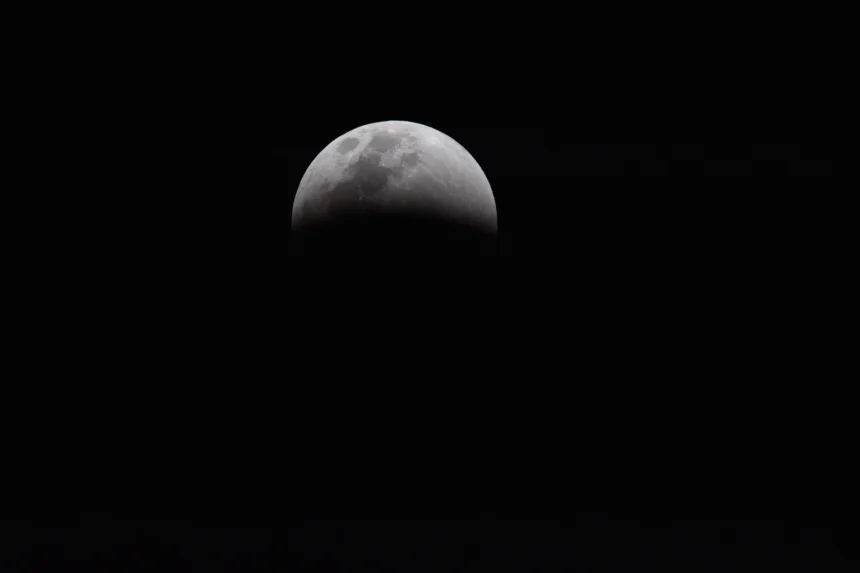
What Would Happen If the Moon Suddenly Disappeared?
Imagine looking into the night sky and discovering that the Moon is gone.
Not hidden by clouds.
Not a new moon.
Not destroyed into visible pieces.
Simply gone.
What would happen next?
Popular versions of this thought experiment often become apocalyptic very quickly. Some claim Earth’s oceans would immediately flood continents, the planet would tumble chaotically through space, seasons would disappear and life would collapse almost overnight.
The real physics is both less immediately catastrophic and more interesting.
If the Moon disappeared, Earth would not suddenly stop orbiting the Sun. The planet would not instantly tip sideways. Our 24-hour day would not immediately become dramatically shorter, and the oceans would not simply fall flat in one enormous global wave.
But the Moon is far more than a decorative object in the night sky.
Its gravity is a major driver of Earth’s tides. Its long-term gravitational influence helps moderate variations in Earth’s rotational axis. It has gradually slowed Earth’s rotation for billions of years. Moonlight and lunar cycles influence the behavior and reproduction of many organisms.
And, of course, without the Moon there would never be another lunar or solar eclipse.
NASA itself says Earth would be a substantially different planet without its natural satellite: the Moon plays a major role in ocean tides and helps prevent Earth’s rotational axis from wobbling as much as it otherwise could. NASA Science
So what really happens if the Moon disappeared?
To answer that properly, we need to consider several different timescales—from the first seconds to millions of years.
If the Moon Disappeared: What Changes and When?
| Time After Disappearance | Likely Effect |
|---|---|
| Seconds | Moon vanishes from the sky and its gravitational influence disappears |
| Hours to days | Oceans begin adjusting to the loss of the lunar tidal force |
| Days onward | Solar tides remain, but ordinary tidal patterns become much weaker |
| Immediately | No more moonlight |
| Immediately | Lunar eclipses and Moon-caused solar eclipses become impossible |
| Weeks to years | Lunar-dependent animal behavior and marine rhythms are disrupted |
| Years to centuries | Earth’s current day length remains nearly unchanged, but lunar tidal braking is gone |
| Thousands to millions of years | Earth’s rotational-axis behavior gradually becomes less stable |
| Long geological timescales | Climate and seasonal patterns could become more variable |
The biggest mistake is assuming every consequence happens at once.
Some would be obvious the first night.
Others would take millions of years.
First, We Need One Rule for the Thought Experiment
A Moon cannot realistically just vanish.
Matter does not disappear from the universe without violating basic physical principles.
So for this thought experiment, assume the Moon is magically removed without:
- exploding;
- becoming debris;
- hitting Earth;
- transferring additional energy to Earth;
- changing Earth’s current velocity.
That matters.
If someone physically destroyed the Moon instead, the resulting fragments could create an entirely different and potentially disastrous scenario.
We are asking only what happens if the Moon disappeared cleanly.
1. Earth Would Not Fly Away From the Sun
One of the most common misconceptions is that the Moon somehow keeps Earth in its orbit around the Sun.
It does not.
The Sun’s gravity is overwhelmingly responsible for Earth’s solar orbit.
NASA explains that Earth’s motion around the Sun results from its forward motion combined with the Sun’s gravitational attraction. NASA Science
The Moon does influence Earth’s exact motion.
Earth and the Moon actually orbit their shared center of mass, called a barycenter.
That Earth-Moon barycenter lies inside Earth, approximately 4,670 kilometers from Earth’s center, according to NASA/JPL lunar models. JPL Solar System Dynamics
So Earth performs a small monthly motion around that barycenter while the entire Earth-Moon system travels around the Sun.
If the Moon disappeared, that monthly Earth-Moon wobble would vanish.
But Earth would continue orbiting the Sun.
It would not:
- fall into the Sun;
- be thrown toward Mars;
- drift into interstellar space.
The change in Earth’s solar trajectory would be relatively small compared with Earth’s enormous annual orbit.
So the first answer is reassuring:
If the Moon disappeared, Earth would remain a planet orbiting the Sun.
2. Earth’s Tides Would Become Much Weaker
This would be one of the fastest and most dramatic physical changes.
The Moon is the largest contributor to Earth’s tides.
Its gravity does not simply lift an isolated wall of ocean water directly beneath it. Instead, differences in the Moon’s gravitational pull across Earth redistribute ocean water, helping produce tidal bulges.
As Earth rotates through these patterns, coastlines experience changing water levels.
NASA explains that most coastlines experience approximately two high tides and two low tides each day, although actual local tides are complicated by continents, seafloor depth, coastlines, weather and many other factors. NASA Science
If the Moon disappeared, that lunar forcing would disappear with it.
But the oceans would not become completely tideless.
Why?
Because the Sun also produces tides.
NASA estimates that the Sun has a little less than half the Moon’s tide-generating force, while NOAA similarly describes solar tides as roughly half as strong as lunar tides. NASA Science
So Earth would still experience solar tides.
They would simply be substantially weaker than today’s combined lunar-solar system.
Today’s Tides
Moon + Sun + ocean-basin geography + coastline shape + weather.
Without the Moon
Sun + ocean-basin geography + coastline shape + weather.
The familiar pattern of spring and neap tides would also disappear because those cycles depend on changing alignment between the Sun and Moon.
3. Would the Oceans Immediately Cause Giant Tsunamis?
Probably not in the dramatic movie sense.
The existing oceans would not instantly become perfectly level the moment the Moon disappeared.
Water has inertia.
Earth’s ocean tides are already complicated systems of moving waves interacting with continents and ocean basins. NASA visualizations show that real tides behave as networks of rotating and trapped waves rather than two simple bulges following the Moon. NASA Science
Removing the lunar forcing suddenly would therefore leave the existing ocean system out of equilibrium.
Water would continue moving.
Coastal currents and water levels would adjust.
Complicated oscillations could temporarily occur as the ocean settled into a new system dominated by solar tides.
But the scientifically defensible conclusion is not:
“A planet-wide mega-tsunami instantly destroys civilization.”
The detailed result would depend heavily on local ocean depth, coastlines and the exact lunar tidal state at the moment of disappearance.
Eventually, the familiar lunar tidal rhythm would be gone.
4. Coastal Ecosystems Would Change Dramatically
For humans, weaker tides might initially seem convenient.
Less extreme coastal water movement.
Perhaps easier harbor management in some locations.
But ecologically, the change could be enormous.
Tidal zones are entire ecosystems.
Rock pools, mudflats, salt marshes, mangroves and intertidal habitats experience regular periods of flooding and exposure.
Animals living there have evolved around those rhythms.
Many marine organisms use tidal or lunar cycles to coordinate:
- feeding;
- migration;
- spawning;
- larval release;
- predator avoidance.
Scientific reviews show that marine life contains numerous tidal, semilunar and lunar biological rhythms. Some intertidal animals even time reproduction to particular tidal amplitudes. PubMed Central (PMC)
If the Moon disappeared, organisms would not necessarily die overnight.
But one of the environmental clocks that shaped their evolution would suddenly be altered.
Over time, some ecosystems could reorganize significantly.
5. Nights Would Become Much Darker
The next change would be impossible to miss.
There would never again be:
- a crescent Moon;
- a half Moon;
- a harvest Moon;
- a supermoon;
- a full Moon.
Moonlight is simply sunlight reflected from the lunar surface. NASA Science
Without the Moon, natural nighttime illumination would come mainly from stars, planets, atmospheric effects and occasional events such as meteors.
The difference could be substantial in places without artificial lighting.
A bright full Moon can produce roughly 0.05 to 0.3 lux under typical conditions, whereas moonless natural-night illumination can fall far lower. PubMed Central (PMC)
Humans living in modern cities might notice surprisingly little because artificial lights frequently overwhelm natural moonlight.
But in wilderness areas, deserts, oceans and pre-electric societies, the difference would be obvious.
A full-moon night can illuminate landscapes.
Without the Moon, those naturally bright nights disappear permanently.
Readers interested in the wider night sky can explore The News Ink’s Astronomy Explained guide, which covers the Moon, planets, stars and other objects visible from Earth.
6. Some Animals Would Lose an Important Biological Clock
Moonlight is not merely useful to humans walking at night.
It affects living organisms.
Scientific research has documented lunar influences on:
- animal foraging;
- predator avoidance;
- reproductive timing;
- migration;
- coral spawning;
- marine biological clocks.
A major review of lunar biology notes that moonlight can influence terrestrial predator-prey behavior, while marine organisms often use lunar cycles to synchronize reproduction. PubMed Central (PMC)
Corals provide one remarkable example.
In several reef systems, huge numbers of corals can release eggs and sperm during synchronized spawning events linked partly to lunar timing.
Other organisms—including worms, fishes and marine invertebrates—also show monthly or semimonthly biological rhythms. PubMed Central (PMC)
Recent research continues to show how deeply moonlight can influence animal life. A 2026 study of red-necked nightjars found that lunar illumination affected foraging success, energy balance and aspects of the birds’ annual cycle. PubMed Central (PMC)
So if the Moon disappeared, ecosystems would not merely become darker.
For some species, a timing signal that existed throughout their evolutionary history would suddenly disappear.
7. Total Solar Eclipses Would End Forever
One of nature’s most spectacular sights would immediately become history.
A solar eclipse happens because the Moon moves between Earth and the Sun.
Total eclipses are possible because of a remarkable geometric coincidence: the Sun is roughly 400 times wider than the Moon but also about 400 times farther from Earth, causing both to appear almost the same size in our sky. NASA Science
Without the Moon there is nothing large enough and close enough to cross the solar disk in the same way.
No more:
- total solar eclipses;
- annular solar eclipses;
- partial solar eclipses caused by our Moon.
There would also be no lunar eclipses, because there would be no Moon to pass through Earth’s shadow.
NASA explains that today’s Earth-Moon-Sun geometry produces between several eclipse opportunities each year. NASA Science
If the Moon disappeared, that entire astronomical phenomenon disappears with it.
For a broader look at humanity’s continuing relationship with the Moon, see The News Ink’s NASA Artemis Program guide.
8. Earth’s Day Would Not Suddenly Become Shorter
Another common claim says:
“Without the Moon, Earth would start spinning dramatically faster.”
That confuses past evolution with an immediate change.
The Moon has indeed been slowing Earth’s rotation.
Earth rotates faster than the Moon orbits. Because tidal bulges do not line up perfectly with the Moon, the gravitational interaction transfers angular momentum.
Earth’s rotation gradually slows.
The Moon gradually moves outward.
NASA measures the Moon’s current recession at roughly 4 centimeters per year. NASA Science
But if the Moon vanished tomorrow, Earth’s accumulated rotational state would not magically reverse.
A day would remain approximately 24 hours.
What changes is the future rate of rotational slowing.
The major lunar component of tidal braking would disappear.
Solar tides would continue producing some tidal friction, but the long-term evolution of Earth’s rotation would be different.
So if the Moon disappeared, clocks would not suddenly need a new 15-hour day.
The difference would emerge gradually across extremely long timescales.
9. Earth’s Axial Tilt Would Become Less Stable
This is potentially the most important long-term consequence.
Earth currently rotates with its axis tilted approximately 23.4 degrees relative to its orbital plane.
That tilt produces our seasons. NASA Science
The Moon’s gravity helps stabilize Earth’s rotational orientation.
NASA commonly explains that without the Moon, Earth’s axis could wobble substantially more, potentially causing greater long-term climate variation. NASA Science
But this topic needs an important correction.
You may have seen claims that without the Moon, Earth’s tilt would randomly swing from 0 to 85 degrees, repeatedly producing catastrophic climates.
Earlier dynamical studies did identify extremely broad theoretical ranges.
Later simulations found something more nuanced.
A NASA-supported study of a hypothetical Moonless Earth found that obliquity variations would indeed become larger than they are today, but realistic integrations frequently kept the total range much more constrained—often spanning around 20–25 degrees of variation over hundreds of millions of years rather than necessarily exploring the full 0–85-degree theoretical range. NASA Technical Reports Server
So the scientifically careful conclusion is:
The Moon helps stabilize Earth’s axial tilt, but losing it does not guarantee immediate chaotic flipping or an uninhabitable planet.
10. Earth’s Climate Would Not Collapse the Next Morning
If the Moon disappeared tonight, tomorrow’s seasons would still exist.
Earth’s axial tilt would not instantly vanish.
The Sun would still rise.
Atmospheric circulation would continue.
The greenhouse effect would continue.
Oceans would continue storing and transporting heat.
Climate systems have enormous inertia.
The potentially serious climate consequence comes over very long periods if Earth’s axial orientation begins wandering through a larger range.
Imagine Earth’s tilt becoming significantly greater.
Higher latitudes could experience much stronger seasonal contrasts.
A smaller tilt could reduce seasonal contrasts.
Changing obliquity can alter:
- where sunlight is concentrated;
- ice-sheet stability;
- seasonal temperature differences;
- long-term atmospheric circulation;
- precipitation patterns.
But these are long-timescale consequences.
They should not be confused with modern human-caused climate change, which is driven primarily by greenhouse-gas emissions.
The News Ink’s Climate Change Explained guide covers that very different process.
11. Ocean Mixing Would Change
Tides do more than move water up and down beaches.
Tidal currents contribute to ocean mixing.
They move water through:
- narrow channels;
- continental shelves;
- shallow seas;
- coastal estuaries;
- deep-ocean regions.
Mixing affects temperature, nutrients and marine ecosystems.
Without most lunar tidal forcing, some of this mixing would weaken.
That does not mean the ocean would stop circulating.
Ocean currents are also powered by:
winds,
temperature differences,
salinity differences,
Earth’s rotation,
and interactions with seafloor geography.
But removing one major energy source from the ocean system would alter circulation patterns.
NASA Earth-observation missions study these interconnected ocean and climate processes today. The News Ink’s NASA Earth Science guide explains how satellites monitor oceans, atmosphere, ice and other parts of the planet.
12. Human Civilization Would Lose Its Oldest Natural Calendar
The Moon has influenced humanity for thousands of years.
Its phases provided an obvious repeating cycle long before mechanical clocks.
A lunar month lasts approximately 29.5 days, and lunar cycles shaped calendars, navigation, agriculture, religious observances and cultural traditions around the world. PubMed Central (PMC)
If the Moon disappeared, our modern calendar would not stop functioning.
A year depends on Earth’s orbit around the Sun.
A day depends on Earth’s rotation.
But many traditional lunar calendars and religious practices would suddenly lose their astronomical reference.
Human language would also retain strange historical remnants.
“Month” itself is etymologically connected to Moon.
Full-moon festivals would become historical memories.
Future generations might know moonlight the way we know extinct animals—from photographs and records.
13. Every Lunar Space Mission Would Instantly Lose Its Destination
There is also a very modern consequence.
Humanity is currently investing heavily in lunar exploration.
NASA’s Artemis program, robotic landers, scientific observatories and international missions all treat the Moon as an important destination for science and exploration.
The News Ink’s NASA Explained complete guide shows how lunar exploration is tied to NASA’s broader plans for deep-space operations and eventual Mars preparation.
If the Moon disappeared:
- lunar spacecraft already in orbit would lose the body they were orbiting;
- lunar landers would disappear with the Moon under our magical assumption;
- Artemis surface plans would instantly become irrelevant;
- decades of lunar infrastructure planning would end.
But the Moon’s disappearance would create one of the greatest scientific mysteries in history—assuming humanity somehow understood that it had vanished rather than been destroyed.
Would Earth’s Gravity Become Much Weaker?
No.
You would not suddenly become noticeably lighter.
Your weight depends mainly on Earth’s gravity, not the Moon’s.
The Moon does exert gravitational force on you, but its effect is tiny compared with Earth’s local gravitational pull.
What matters for tides is not simply the Moon pulling upward on individual objects.
It is the difference in lunar gravitational attraction across Earth’s diameter.
That gradient redistributes oceans and even causes small solid-Earth tides.
If the Moon disappeared, that tidal contribution vanishes.
But Earth’s own surface gravity remains essentially the same.
You would not start floating.
Buildings would not lift from their foundations.
The atmosphere would remain gravitationally bound to Earth.
Would Earth’s Oceans Disappear?
No.
The Moon does not hold Earth’s oceans onto the planet.
Earth’s gravity does.
The Moon only redistributes ocean water enough to make an important contribution to tides.
Remove the Moon and essentially the same total quantity of ocean water remains on Earth.
It simply follows a different tidal system.
This distinction is critical.
The Moon moves oceans.
It does not keep them from escaping into space.
Would Seasons Disappear?
No.
Seasons come primarily from Earth’s axial tilt as Earth moves around the Sun.
Because Earth would initially retain almost the same tilt if the Moon disappeared, the seasonal cycle would continue.
The concern is long-term stability.
Without the Moon moderating Earth’s axial motion, the tilt could undergo larger variations over immense periods, potentially changing the severity of future seasons.
So:
Day one without the Moon: normal seasonal pattern.
Millions of years without the Moon: potentially much more variable axial behavior and climate.
Would Humans Survive If the Moon Disappeared?
Almost certainly in the immediate sense.
There is no established physical reason that removing the Moon cleanly would cause humanity to become extinct within hours, days or years.
The greatest immediate disruptions would involve:
- altered tides;
- coastal environments;
- navigation and marine operations;
- ecosystems dependent on lunar cycles;
- loss of moonlight.
Modern civilization could adapt to those changes.
The longer-term question is more complicated.
If axial-tilt variation eventually caused large climate shifts, ecosystems, agriculture and human settlements would have to adapt repeatedly.
But those changes would unfold on timescales long enough for evolution, migration and technology to matter.
So if the Moon disappeared, Earth would remain habitable initially.
The planet would simply begin evolving along a different physical path.
Moon vs No Moon
| Earth Today | Earth Without the Moon |
|---|---|
| Strong lunar + solar tides | Much weaker solar-dominated tides |
| Full moons illuminate nights | Permanently moonless nights |
| Solar and lunar eclipses | No lunar-caused eclipses |
| Lunar cycles guide many organisms | Biological rhythms disrupted |
| Moon contributes to axial stability | Larger long-term tilt variations possible |
| Lunar tides slow Earth’s rotation | Much weaker future tidal braking |
| Earth moves around Earth-Moon barycenter | Monthly barycentric motion largely gone |
| Lunar exploration possible | No Moon to explore |
| Cultural lunar calendars | Astronomical basis disappears |
Frequently Asked Questions
What would happen immediately if the Moon disappeared?
The Moon would vanish from the sky, its gravitational influence on Earth’s tides would disappear, and the oceans would begin adjusting to a new tidal equilibrium. Earth would continue rotating and orbiting the Sun.
Would Earth survive without the Moon?
Yes. Earth would not immediately be destroyed. It would continue orbiting the Sun and could remain habitable, although tides, ecosystems and long-term axial stability would change substantially.
Would there still be tides without the Moon?
Yes. The Sun also produces tides. NASA says the Sun’s tide-generating force is somewhat less than half the Moon’s. Tides would therefore become much weaker but would not disappear. NASA Science
Would Earth spin faster without the Moon?
Not suddenly. Earth’s current rotation would continue. What would disappear is much of the tidal braking that is gradually slowing Earth’s rotation today.
Would a day become shorter?
Not immediately. A day would remain approximately 24 hours. Over geological timescales, Earth’s rotational evolution would differ because lunar tidal friction would be gone.
Would Earth lose its seasons?
No. Earth’s current axial tilt would remain initially, so seasons would continue. Over very long periods, however, the absence of the Moon could permit larger variations in axial tilt.
Would the oceans flood Earth?
There is no scientific basis for saying the Moon’s disappearance would instantly send all oceans across the continents. Existing tidal waters would readjust dynamically, and solar tides would continue.
Would Earth fall into the Sun without the Moon?
No. The Sun’s gravity controls Earth’s orbit. Removing the Moon changes Earth’s precise motion slightly but does not eliminate its solar orbit.
Would there still be solar eclipses?
Not the solar eclipses we know today. Those require the Moon to move between Earth and the Sun. Without the Moon, total, annular and partial lunar-caused solar eclipses disappear. NASA Science
Would nights become completely black?
No. Stars, planets, airglow and artificial light would remain. But natural nights would become substantially darker because moonlight would no longer exist.
Does the Moon protect Earth’s climate?
The Moon helps stabilize Earth’s axial orientation, which contributes to long-term climate stability. However, modern modeling suggests a Moonless Earth does not automatically experience the most extreme possible axial swings sometimes claimed online. NASA Technical Reports Server
The Moon Matters Far More Than It Looks
From Earth, the Moon can appear almost passive.
It rises.
It changes phase.
It illuminates the landscape.
Then it disappears below the horizon.
But physically, the Moon has been interacting with Earth throughout almost the planet’s entire history.
It pulls on our oceans.
Those oceans pull back.
That exchange gradually changes Earth’s rotation and the Moon’s orbit.
Its gravity helps moderate Earth’s rotational wobble.
Its phases and tides structure biological rhythms.
Its light changes animal behavior.
Its movement creates eclipses.
And its presence has influenced human calendars, navigation, science, religion and culture for thousands of years.
So if the Moon disappeared, Earth would not explode.
It would not instantly fly away from the Sun.
Humans would not suddenly float off the ground.
And every ocean would not crash across the continents in one gigantic wave.
The first changes would be quieter.
The night sky would become permanently moonless.
The familiar lunar tide would weaken dramatically.
Eclipses would end.
Coastal and marine ecosystems would begin adapting to altered rhythms.
Earth would continue rotating almost exactly as before—but the long-term tidal braking caused by the Moon would be largely gone.
Then the truly enormous consequences would begin unfolding over geological time.
Without the Moon helping moderate Earth’s rotational axis, our planet could experience larger variations in its tilt. Those changes could reshape seasons and climate patterns over millions of years, although modern modeling shows that the result would be more nuanced than the catastrophic axial flipping often portrayed online. NASA Technical Reports Server
That is the most surprising answer to what happens if the Moon disappeared.
The Moon is not keeping Earth alive from one day to the next.
Its influence is subtler.
It has helped shape the long-term physical environment in which life evolved.
Remove it and Earth would still be Earth tomorrow.
But over enough time, it would become a noticeably different world.
Follow The News Ink
For more research-driven explainers, science coverage and global stories, follow The News Ink on X, Instagram, Threads, Medium, Substack, Bluesky, Pinterest, TikTok, Quora and Mastodon.