Beyond the Night Sky: How Astronomy Reveals the Universe
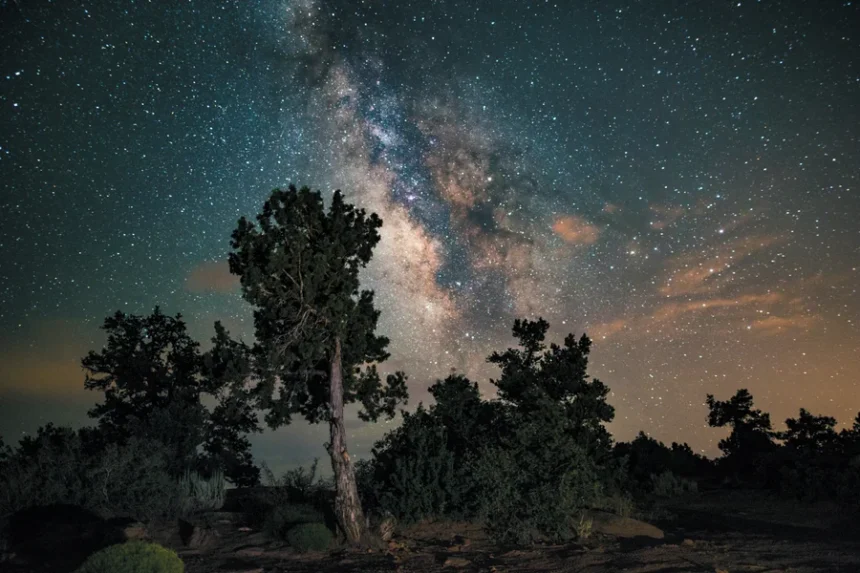
Look at the night sky for a few minutes and the first impression is usually simplicity.
A handful of bright points appear above us. The Moon may glow over a rooftop. A planet may look like an unusually steady star. A faint band of the Milky Way may become visible far from city lights.
The reality is far more extraordinary.
Astronomy reveals that the night sky is not a flat collection of lights. It is a view into an enormous universe filled with stars, planets, moons, galaxies, black holes, gas clouds, asteroids, comets and mysteries that researchers are still trying to understand.
The light reaching our eyes may have traveled for minutes, years or billions of years. When astronomers study distant objects, they are not only looking across space. They are also looking into the past.
Astronomy is the science of studying objects and events beyond Earth. It helps researchers understand where planets come from, how stars are born, why galaxies change and whether life may exist elsewhere.
Space exploration adds another layer. Telescopes observe from Earth and orbit. Robotic spacecraft travel to distant worlds. Astronauts test the limits of human exploration. Scientific instruments collect information that no ordinary photograph could reveal.
This article explains astronomy clearly from the beginning. It covers the solar system, planets, stars, galaxies, black holes, exoplanets, telescopes, Moon missions, Mars exploration and simple ways to begin observing the sky.
Astronomy is not only for scientists.
It begins with curiosity.
What Astronomy Really Means
Astronomy is the scientific study of the universe beyond Earth.
It examines objects such as:
| Object or topic | What astronomy tries to understand |
|---|---|
| The Sun | How our star produces energy and affects Earth |
| Planets | How worlds form, evolve and differ from one another |
| Moons | How natural satellites shape planetary systems |
| Asteroids and comets | What smaller objects reveal about the early solar system |
| Stars | How stars are born, live and die |
| Nebulae | How clouds of gas and dust create or reflect cosmic activity |
| Galaxies | How enormous systems of stars form and evolve |
| Black holes | How extreme gravity affects matter and light |
| Exoplanets | Whether planets beyond the solar system may resemble Earth |
| The universe | How everything began, changed and may develop in the distant future |
Astronomy is related to astrophysics.
The terms often overlap, but astrophysics places particular emphasis on using physics to explain astronomical objects and processes. It examines gravity, radiation, energy, matter and the forces shaping the universe.
Astronomy should not be confused with astrology.
| Astronomy | Astrology |
|---|---|
| Scientific study of the universe | Belief system linking celestial positions with personal events |
| Uses observation, evidence and testing | Does not follow the scientific method |
| Studies real physical objects | Makes claims not supported by scientific evidence |
| Develops through research and measurement | Should not be treated as a scientific field |
Astronomy asks questions that can be investigated.
How old is a star? What gases exist in a planet’s atmosphere? How far away is a galaxy? What happens near a black hole? Could a distant world support life?
Each answer creates new questions.
That is part of the appeal.
Astronomy Begins With Scale
The universe is difficult to imagine because ordinary distances stop being useful.
Driving across a city may take an hour. Flying between countries may take several hours. Reaching the Moon requires a completely different scale. Traveling to another star would require a scale far beyond ordinary human experience.
Astronomy uses several units to make these distances easier to discuss.
| Unit | Simple meaning |
|---|---|
| Kilometer | Useful for distances on Earth and some nearby objects |
| Astronomical unit | Average distance between Earth and the Sun |
| Light-year | Distance light travels in one year |
| Parsec | Another distance unit commonly used in astronomy |
A light-year measures distance, not time.
Light travels at approximately 300,000 kilometers per second. Even at that astonishing speed, light from the Sun takes a little over eight minutes to reach Earth.
When you look at the Sun safely through proper scientific equipment, you see it as it appeared several minutes earlier.
The farther away an object is, the farther into the past astronomy can look.
Light from nearby stars may take years to reach us. Light from distant galaxies may have traveled for billions of years.
The universe becomes a kind of historical record.
The Observable Universe
Astronomers refer to the observable universe because there is a limit to what we can currently see.
The universe may extend far beyond the visible region. However, light from extremely distant areas may not have had enough time to reach us.
NASA explains that ordinary matter, including stars, planets and living things, accounts for less than five percent of the universe. Dark matter and dark energy make up much of the remainder, but they are still not fully understood.
That fact alone shows why astronomy remains an active science.
Humanity has learned a great deal.
We are still at the beginning.
Our Solar System: The Local Neighborhood
The solar system is our immediate cosmic neighborhood.
NASA describes it as a system containing the Sun, eight planets, five officially named dwarf planets, hundreds of moons and thousands of asteroids and comets.
The Sun sits at the center.
Its gravity holds the system together.
The eight planets orbit the Sun in the following order:
| Planet | Position from the Sun | Basic character |
|---|---|---|
| Mercury | 1 | Small rocky world closest to the Sun |
| Venus | 2 | Hot rocky planet with a thick atmosphere |
| Earth | 3 | Home planet and only world known to support life |
| Mars | 4 | Rocky planet explored extensively by robotic missions |
| Jupiter | 5 | Largest planet and a gas giant |
| Saturn | 6 | Gas giant famous for its rings |
| Uranus | 7 | Ice giant rotating at an unusual tilt |
| Neptune | 8 | Distant ice giant with powerful winds |
The first four planets are rocky worlds.
The outer four are much larger. Jupiter and Saturn are gas giants. Uranus and Neptune are commonly described as ice giants.
Dwarf Planets
The solar system also contains officially recognized dwarf planets:
| Dwarf planet | Useful fact |
|---|---|
| Ceres | Located in the asteroid belt |
| Pluto | Located beyond Neptune in the Kuiper Belt |
| Haumea | Distant object with an unusual elongated shape |
| Makemake | Kuiper Belt dwarf planet |
| Eris | Distant object whose discovery influenced the debate about Pluto |
Pluto was once widely taught as the ninth planet.
The International Astronomical Union changed the classification in 2006. The IAU states that it has not changed the definition of a planet in the solar system since then.
Pluto remains scientifically interesting.
Changing its classification did not make it less fascinating.
Asteroids and Comets
Asteroids are generally rocky or metallic objects.
Comets contain ice, dust and rocky material. When some comets approach the Sun, heat causes material to stream outward, producing a visible tail.
These smaller objects matter because they preserve clues about the early solar system.
They are not merely leftover debris.
They are evidence.
Earth: A Planet Viewed From Space
Earth feels ordinary because it is home.
Astronomy shows how unusual it is.
NASA describes Earth as the third planet from the Sun and the only world currently known to be inhabited by living things.
Earth has liquid water, an atmosphere, a magnetic field and conditions that support a vast range of life.
From space, the planet also appears fragile.
Its atmosphere is thin compared with the size of the planet. Its oceans, forests and weather systems form an interconnected environment.
Astronomy and Earth science often overlap.
Satellites help monitor:
- Weather
- Climate
- Oceans
- Ice
- Wildfires
- Agriculture
- Air quality
- Natural disasters
- Land use
Studying space can therefore improve life on Earth.
Astronomy is not an escape from our planet.
It can deepen appreciation for it.
The Moon: Our Closest Celestial Neighbor
The Moon is the most familiar object in the night sky.
It affects tides, shapes calendars and appears across cultures, stories and traditions.
The Moon does not produce its own visible light. It reflects sunlight.
Its appearance changes as it moves around Earth.
These changing views are called lunar phases.
| Phase | What we see |
|---|---|
| New Moon | Moon appears dark from Earth |
| Crescent | Small curved illuminated section |
| First Quarter | Half of the visible face appears illuminated |
| Gibbous | More than half appears illuminated |
| Full Moon | Visible face appears fully illuminated |
| Last Quarter | Half appears illuminated again |
A Blue Moon does not normally appear blue in color. The phrase usually refers to a calendar-related occurrence involving an additional full Moon.
The Moon also experiences eclipses.
A lunar eclipse occurs when Earth moves between the Sun and Moon, causing Earth’s shadow to fall across the Moon.
A solar eclipse occurs when the Moon moves between Earth and the Sun.
Never look directly at the Sun without proper certified eclipse protection.
The Return to the Moon
Human spaceflight returned to the Moon’s vicinity in a major way in 2026.
NASA reported that Artemis II completed a nearly 10-day journey and brought astronauts safely back to Earth after a historic lunar flyby.
The mission marked the first crewed journey toward the Moon in more than half a century.
The News Ink covered the Artemis II return and the role of NASA mission control.
Astronomy and human exploration are related but distinct.
Astronomy helps us understand the Moon scientifically.
Space missions allow people and robotic systems to investigate it directly.
The Artemis II crew also observed unusual lunar activity during the flyby, which The News Ink covered in its report on Moon impact flashes.
Mars: The Planet of Questions
Mars has captured human imagination for generations.
It is the fourth planet from the Sun and one of the most explored worlds beyond Earth.
NASA notes that Mars is the only planet where robotic rovers have traveled across the surface.
Mars appears reddish because iron minerals in its soil oxidize, or rust.
The planet has:
- Mountains
- Valleys
- Craters
- Dust storms
- Polar ice caps
- Ancient river channels
- Evidence of a wetter past
NASA missions have found evidence that Mars was warmer and wetter billions of years ago.
That does not prove that life existed there.
It does make Mars a valuable place to study.
Why Explore Mars?
Mars exploration asks several major questions:
| Question | Why it matters |
|---|---|
| Did Mars once have habitable conditions? | Helps researchers understand the possibility of past life |
| How did the planet lose much of its atmosphere? | Reveals how planets evolve |
| Is water still present? | Important for science and future missions |
| Can humans eventually travel there safely? | Tests the limits of exploration |
| What can Mars teach us about Earth? | Comparative planetary science improves understanding |
Robotic missions such as Perseverance and Curiosity have helped scientists study the surface.
Perseverance searches for signs of ancient microbial life and collects samples for possible future return.
Curiosity has examined whether Mars once had conditions suitable for microbial life.
The News Ink has also covered research into a possible faster Mars route.
Mars exploration remains difficult.
Distance, radiation, life-support systems, communication delays and human health all create challenges.
Astronomy reveals the destination.
Engineering determines whether we can reach it.
Stars: The Engines of the Universe
Stars are not tiny lights attached to the sky.
They are enormous spheres of hot gas, mainly hydrogen and helium.
NASA explains that stars have life cycles. Their properties change as they age.
Our Sun is a star.
It feels different only because it is much closer than the others.
How Stars Form
Stars form inside clouds of gas and dust.
Gravity pulls material together. As the region becomes denser and hotter, nuclear fusion can begin.
Fusion releases energy.
That energy allows stars to shine.
Astronomy studies these stellar nurseries through visible light, infrared observations and other wavelengths.
A star’s mass strongly influences its future.
| Star type | General outcome |
|---|---|
| Lower-mass star | Long life and relatively gradual evolution |
| Sun-like star | Expands later in life and eventually leaves behind a dense remnant |
| Massive star | Shorter life, dramatic death and possible supernova |
| Extremely massive stellar remnant | May collapse into a black hole |
Why Stars Matter
Stars create and distribute many elements.
The carbon in living organisms, oxygen we breathe and iron in the planet are connected to earlier generations of stars.
Astronomy therefore links cosmic history with everyday existence.
We are not separate from the universe.
We are made from material shaped by it.
Nebulae: Clouds of Gas, Dust, and Change
Nebulae are clouds of gas and dust in space.
Some are regions where stars form.
Others are connected to the final stages of stellar evolution.
Nebulae are among the most visually striking objects in astronomy because telescopes reveal extraordinary structures and colors.
| Nebula type | Basic meaning |
|---|---|
| Star-forming nebula | Region where new stars may develop |
| Planetary nebula | Material released by a dying Sun-like star |
| Supernova remnant | Expanding material left after a stellar explosion |
| Dark nebula | Dense cloud obscuring light behind it |
| Reflection nebula | Dust reflecting nearby starlight |
The term planetary nebula can be misleading.
These objects do not necessarily involve planets. The name developed historically because early observers thought some appeared planet-like through telescopes.
Astronomy often contains names shaped by earlier observations.
Science improves as instruments improve.
Galaxies: Islands of Stars
A galaxy is a vast collection of stars, planets, gas and dust held together by gravity.
NASA explains that the largest galaxies can contain trillions of stars and extend across more than a million light-years. Smaller galaxies may contain only a few thousand stars.
Earth belongs to the Milky Way galaxy.
The Sun is one star among the Milky Way’s enormous population.
Main Galaxy Shapes
| Galaxy type | Appearance |
|---|---|
| Spiral | Rotating disk with curved arms |
| Elliptical | Rounded or stretched shape |
| Irregular | Less organized structure |
| Lenticular | Disk-like shape without prominent spiral arms |
The Milky Way is a barred spiral galaxy.
Our solar system sits within a smaller region sometimes called the Orion Spur.
Astronomy studies galaxies because they reveal how the universe changes over time.
Galaxies can interact.
They can merge.
They can form new stars.
They can contain enormous black holes near their centers.
Looking Into the Past
When telescopes observe a galaxy billions of light-years away, they see ancient light.
That galaxy may have changed significantly by now.
Astronomy provides a time machine created by distance.
We cannot travel into the past.
We can observe light that began its journey long ago.
Black Holes: Extreme Gravity Without the Science Fiction
Black holes are among the most misunderstood objects in astronomy.
NASA explains that black holes are not empty holes. They are concentrations of matter packed into extremely small spaces.
Their gravity becomes so strong that nothing, including light, can escape from within the event horizon.
The event horizon is a boundary.
It is not a hard physical surface like the ground on Earth.
Main Black Hole Categories
| Black hole category | Basic description |
|---|---|
| Stellar-mass black hole | Often associated with the collapse of a massive star |
| Intermediate-mass black hole | Middle range still actively studied |
| Supermassive black hole | Enormous object found near the centers of many large galaxies |
| Primordial black hole | Hypothetical type that may have formed early in the universe |
Black holes do not wander through space automatically swallowing everything nearby.
Objects can orbit black holes.
The danger depends on distance.
A black hole with the same mass as the Sun would exert the same gravitational pull from the same distance. The difference is that the mass would be compressed into a far smaller region.
Astronomy studies black holes indirectly because they do not emit light from within the event horizon.
Researchers examine:
- Movement of nearby stars
- Hot material surrounding the black hole
- X-rays
- Gravitational effects
- Gravitational waves
- Jets from active regions
Black holes challenge intuition.
That makes them valuable scientific laboratories.
Exoplanets: Worlds Beyond the Solar System
An exoplanet is a planet beyond our solar system.
NASA’s confirmed exoplanet count has reached 6,000, with additional candidates still awaiting confirmation.
This has transformed astronomy.
For much of human history, the planets orbiting the Sun were the only known worlds.
Now astronomers study thousands of distant planets.
Some orbit stars similar to the Sun. Others move around smaller stars. Some are larger than Jupiter. Some are rocky. Some orbit extremely close to their stars. Others drift without a star.
How Astronomers Find Exoplanets
Exoplanets are difficult to observe directly because stars are bright and planets are relatively faint.
Astronomy uses several methods.
| Method | What astronomers look for |
|---|---|
| Transit method | Slight dip in starlight when a planet crosses in front of its star |
| Radial velocity | Small wobble in a star caused by an orbiting planet |
| Direct imaging | Rare images of planets separated from the glare of their stars |
| Gravitational microlensing | Temporary brightening caused by gravity |
| Astrometry | Tiny changes in a star’s position |
ESA explains that exoplanet-detection techniques often identify a planet through its effect on the parent star.
Could Another Earth Exist?
Astronomy has not yet confirmed life beyond Earth.
That is important.
A planet located in a habitable zone is not automatically inhabited.
Habitability depends on many factors:
- Atmosphere
- Temperature
- Water
- Star activity
- Planetary history
- Chemistry
- Magnetic environment
- Geological conditions
Astronomy searches carefully.
It does not replace evidence with hope.
The discovery of exoplanets has still changed the question.
We now know planets are common.
The next challenge is understanding them.
Searching for Life Without Jumping to Conclusions
The possibility of life beyond Earth is one of astronomy’s biggest questions.
Researchers study Mars, icy moons and exoplanets because some environments may contain or once have contained conditions associated with habitability.
A serious astronomy article must distinguish several ideas:
| Term | Meaning |
|---|---|
| Habitable | Conditions may allow life under certain assumptions |
| Biosignature | Possible sign connected to biological activity |
| Candidate evidence | Finding requiring further investigation |
| Confirmed life | Evidence strong enough to establish life beyond Earth |
No confirmed extraterrestrial life has been discovered.
That should not make the search feel disappointing.
Science moves carefully because extraordinary claims need strong evidence.
Public interest in unidentified aerial phenomena can also create confusion. The News Ink covered newly released UFO files, but unexplained observations should not automatically be interpreted as proof of extraterrestrial visitors.
Unexplained means unanswered.
Astronomy asks what the evidence supports.
How Astronomy Uses Light
Much of astronomy depends on light.
Human eyes detect only a narrow part of the electromagnetic spectrum.
Astronomers also study:
- Radio waves
- Microwaves
- Infrared light
- Visible light
- Ultraviolet light
- X-rays
- Gamma rays
Different wavelengths reveal different information.
| Type of observation | What it may reveal |
|---|---|
| Visible light | Stars, galaxies and familiar structures |
| Infrared | Cooler objects and regions obscured by dust |
| Radio | Gas, pulsars and cosmic structures |
| Ultraviolet | Hot stars and energetic processes |
| X-rays | Extreme environments such as hot gas and black-hole surroundings |
| Gamma rays | Highly energetic events |
ESA explains that Earth’s atmosphere blocks certain types of radiation, including X-rays from space. This makes space telescopes essential for studying some phenomena.
Astronomy does not depend on one perfect telescope.
It depends on combining evidence.
Spectroscopy
Spectroscopy breaks light into its component wavelengths.
This allows astronomers to examine the chemical fingerprints of distant objects.
Astronomy can use spectroscopy to investigate:
- Chemical composition
- Temperature
- Motion
- Atmospheres
- Star formation
- Galaxy evolution
A distant object may appear as a tiny point.
Its light can still carry a remarkable amount of information.
Ground Telescopes and Space Telescopes
Astronomy uses telescopes on Earth and in space.
Both matter.
Ground-based telescopes can be large, upgraded and maintained more easily. They may be built in dry, high-altitude areas with dark skies.
Space telescopes operate above Earth’s atmosphere.
ESA explains that the atmosphere can blur fine details and filter certain wavelengths. Placing a telescope in space avoids many of those limitations.
| Ground telescope advantage | Space telescope advantage |
|---|---|
| Easier maintenance | Avoids atmospheric distortion |
| Can be built very large | Observes wavelengths blocked by atmosphere |
| More accessible upgrades | Receives clearer views for some purposes |
| Lower cost than many space missions | Can study space from a stable observing environment |
Astronomy works best when observations complement one another.
Hubble and Webb: Different Windows Into the Universe
The Hubble Space Telescope changed astronomy.
Since its launch in 1990, Hubble has collected an enormous archive of observations. NASA states that Hubble has captured more than 1.7 million observations of the universe.
The James Webb Space Telescope expanded the picture.
Webb is designed to observe primarily in infrared wavelengths. NASA explains that its sensitivity allows it to study early galaxies, star formation and planetary atmospheres.
Hubble and Webb are not simple rivals.
NASA emphasizes that their observations complement one another.
| Hubble | Webb |
|---|---|
| Strong visible and ultraviolet capabilities | Strong infrared focus |
| Long scientific history | Designed for deeper infrared observations |
| Major archive of images and data | Studies early universe, stars and planetary systems |
| Continues contributing valuable observations | Adds a new view of hidden or distant regions |
Infrared astronomy is especially useful because dust can block visible light.
Webb can peer into regions where stars and planets are forming.
Astronomy advances when new instruments reveal what older instruments could not see clearly.
Space Exploration: Astronomy Meets Engineering
Astronomy studies the universe.
Space exploration sends instruments, spacecraft and humans beyond Earth.
The two fields support one another.
A telescope may identify a question. A robotic mission may investigate directly. A crewed mission may test systems for future exploration.
Robotic Exploration
Robotic missions can travel where humans cannot yet go safely.
They study:
- Mars
- The Moon
- Asteroids
- Comets
- Outer planets
- The Sun
- Distant regions of the solar system
Robots operate under difficult conditions.
They may survive extreme temperatures, radiation and long communication delays.
Human Spaceflight
Human missions test another set of limits.
Astronauts conduct experiments, evaluate systems and demonstrate whether people can live and work beyond Earth.
NASA states that the Artemis campaign is intended to support lunar exploration and prepare for future Mars missions.
The News Ink has explored how the latest Moon mission revived the space race.
The modern space race differs from the twentieth-century competition.
Governments remain central, but commercial companies, international partnerships and new launch locations also matter.
The News Ink has reported on the Arctic space race, reflecting how access to space has become a wider strategic and economic issue.
Why Satellites Matter to Everyday Life
Space science can feel distant.
Satellites make it practical.
Modern societies depend on satellites for:
| Satellite use | Everyday effect |
|---|---|
| Weather observation | Better forecasting and storm tracking |
| Navigation | Maps, transport and logistics |
| Communication | Connectivity and broadcasting |
| Earth observation | Climate, agriculture and disaster response |
| Science | Studying the Sun, Earth and universe |
| Emergency response | Tracking fires, floods and changing conditions |
| Research | Monitoring long-term environmental patterns |
Astronomy is only one part of the space ecosystem.
Satellites affect daily life even when people rarely think about them.
The Universe May Have a Distant Ending
Astronomy does not only study how the universe began.
It also asks what may happen in the distant future.
Researchers examine possibilities based on expansion, gravity, dark energy and the behavior of matter.
The News Ink explored several ideas in its article on how the universe could end.
Possible scenarios discussed by scientists include:
| Idea | Basic concept |
|---|---|
| Big Freeze | Expansion continues and the universe becomes colder and darker |
| Big Crunch | Expansion eventually reverses under certain conditions |
| Big Rip | Expansion accelerates dramatically |
| Vacuum decay | A theoretical transition changes the universe fundamentally |
| Long-term stellar decline | Stars gradually stop forming and existing stars fade |
These ideas involve timescales far beyond human experience.
Astronomy allows people to ask enormous questions while remaining honest about uncertainty.
The purpose is not to predict tomorrow.
It is to understand the universe as carefully as possible.
How to Begin Stargazing Without Expensive Equipment
Astronomy does not require an advanced telescope.
NASA’s skywatching guidance explains that several planets can be observed without a telescope, including Mercury, Venus, Mars, Jupiter and Saturn under suitable conditions.
Start simply.
Choose a Darker Location
City lights hide faint objects.
NASA recommends darker skies away from city lights for seeing more stars and improving the chance of viewing the Milky Way.
Let Your Eyes Adjust
Avoid bright screens for a while.
Your eyes need time to adapt to darkness.
Begin With Familiar Objects
Look for:
- The Moon
- Bright planets
- Major constellations
- Meteor showers
- Star clusters
- The Milky Way under dark skies
Use Binoculars Before Buying a Telescope
Binoculars are easier to use than many beginner telescopes.
They can reveal:
- Moon details
- Star clusters
- Some bright deep-sky objects
- Jupiter’s larger moons under suitable conditions
Use Reliable Sky Maps
A printed star map, planisphere or reputable app can help identify objects.
Do not expect to learn the entire sky in one evening.
Astronomy rewards patience.
Astronomy for Beginners: A Simple Observation Table
| What to observe | Equipment needed | What to notice |
|---|---|---|
| Moon | Eyes or binoculars | Phases, shadows and surface detail |
| Venus | Eyes | Brightness near sunrise or sunset |
| Mars | Eyes | Reddish appearance |
| Jupiter | Eyes or binoculars | Bright point and major moons with suitable equipment |
| Saturn | Small telescope | Rings under suitable conditions |
| Meteor shower | Eyes | Dark sky and patience |
| Milky Way | Eyes | Dark location away from city lights |
| Star clusters | Binoculars or telescope | Groupings of stars |
| Nebulae | Telescope or astrophotography | Faint structures |
| Galaxies | Telescope and dark skies | Distant light beyond the Milky Way |
Skywatching should remain safe.
Do not enter isolated locations without planning. Respect private property. Check weather. Carry suitable clothing. Tell someone where you are going.
Never observe the Sun through ordinary binoculars or a telescope without appropriate solar filters and expert guidance.
Astronomy Is Open to Ordinary People
You do not need a PhD to contribute to science.
NASA’s citizen-science projects invite volunteers to participate in real research. NASA states that dozens of projects are open to the public and that citizen scientists have contributed to important discoveries.
Projects may involve:
- Reviewing images
- Searching for unusual objects
- Classifying galaxies
- Studying exoplanet data
- Tracking solar activity
- Exploring planetary information
- Supporting Earth science
Astronomy has always benefited from careful observation.
Technology has expanded the ways people can participate.
A laptop and curiosity may be enough to begin.
Common Astronomy Myths
Astronomy becomes clearer when common myths are corrected.
| Myth | Reality |
|---|---|
| A light-year measures time | It measures distance |
| Pluto disappeared when it became a dwarf planet | Pluto still exists and remains scientifically important |
| Black holes automatically swallow everything nearby | Gravity depends on distance and mass |
| Every bright object in the sky is a star | Some are planets, satellites or aircraft |
| The Moon has a permanently dark side | Both sides receive sunlight over time |
| A habitable exoplanet definitely has life | Habitability does not prove biology |
| Astronomy and astrology are the same | Astronomy is science; astrology is not |
| Space telescopes make ground telescopes unnecessary | Both provide valuable observations |
| Unexplained aerial sightings prove alien visitors | Unexplained evidence requires further investigation |
| Space exploration has no effect on daily life | Satellites support weather, navigation, communication and research |
Good science does not remove wonder.
It makes wonder more accurate.
Related Science and Space Articles From The News Ink
The News Ink already covers several topics that connect naturally with astronomy and space exploration.
| Related article | Why it is useful |
|---|---|
| Artemis II return | Covers the historic crewed lunar flyby and return |
| NASA mission control | Explains the coordination behind a major Moon mission |
| Moon impact flashes | Explores an unusual lunar observation |
| Blue Moon | Explains a familiar astronomy term |
| Mars route | Looks at the technology behind faster journeys |
| Space race | Examines the political dimension of modern exploration |
| Arctic space race | Covers the changing launch landscape |
| Universe endings | Explores scientific theories about the distant future |
| UFO files | Provides context for unexplained aerial phenomena |
These related articles should link back to this pillar page using short anchors such as astronomy, space and astronomy, solar system or space exploration.
Frequently Asked Questions About Astronomy
What is astronomy?
Astronomy is the scientific study of objects and events beyond Earth, including planets, stars, galaxies, black holes and the wider universe.
Is astronomy the same as astrology?
No. Astronomy is a science based on evidence and observation. Astrology is not a scientific field.
How many planets are in the solar system?
The solar system has eight planets: Mercury, Venus, Earth, Mars, Jupiter, Saturn, Uranus and Neptune.
Is Pluto a planet?
Pluto is classified as a dwarf planet. It was reclassified by the International Astronomical Union in 2006.
What is a light-year?
A light-year is the distance light travels in one year.
What is a galaxy?
A galaxy is a large collection of stars, planets, gas and dust held together by gravity.
Which galaxy contains Earth?
Earth is located in the Milky Way galaxy.
What is a black hole?
A black hole is a concentration of matter so dense that gravity prevents light from escaping beyond the event horizon.
What is an exoplanet?
An exoplanet is a planet beyond our solar system.
Have scientists discovered life beyond Earth?
No confirmed evidence of extraterrestrial life has been discovered.
Why are space telescopes useful?
Space telescopes operate above Earth’s atmosphere, avoiding some distortion and allowing observations at wavelengths blocked or filtered by the atmosphere.
What is the difference between Hubble and Webb?
Hubble has major visible and ultraviolet capabilities, while Webb focuses strongly on infrared observations. Their work complements one another.
Can I see planets without a telescope?
Yes. Mercury, Venus, Mars, Jupiter and Saturn can be observed without a telescope under suitable conditions.
Is the Moon’s far side always dark?
No. The far side also receives sunlight. It is more accurate to call it the far side rather than the dark side.
Why do astronomers study Mars?
Mars provides evidence about planetary history, water, habitability and the challenges involved in future human exploration.
What is citizen science?
Citizen science allows members of the public to contribute to research projects, including astronomy projects involving real scientific data.
Why Astronomy Still Matters
Astronomy changes perspective.
It shows that Earth is part of a much larger system. The solar system belongs to the Milky Way. The Milky Way is one galaxy among an enormous number of galaxies. The visible universe contains structures shaped across billions of years.
Astronomy also teaches patience.
A telescope may require years of planning. A spacecraft may travel for decades. A scientific claim may need repeated observations. A mystery may remain unsolved for generations.
That patience is valuable.
Astronomy does not promise that every question has an immediate answer.
It shows that careful observation can gradually transform understanding.
The night sky may appear quiet.
It is not empty.
Stars are being born. Other stars are dying. Galaxies are changing. Planets are orbiting distant suns. Black holes are shaping their surroundings. Robots are exploring Mars. Astronauts are returning to lunar space. Telescopes are collecting ancient light.
The universe is not a distant background.
It is the larger story in which Earth exists.
Discover More Science With The News Ink
Explore more discoveries, explanations and major developments in our Science section. Follow The News Ink on Medium for new articles, clear explanations and fresh perspectives.