



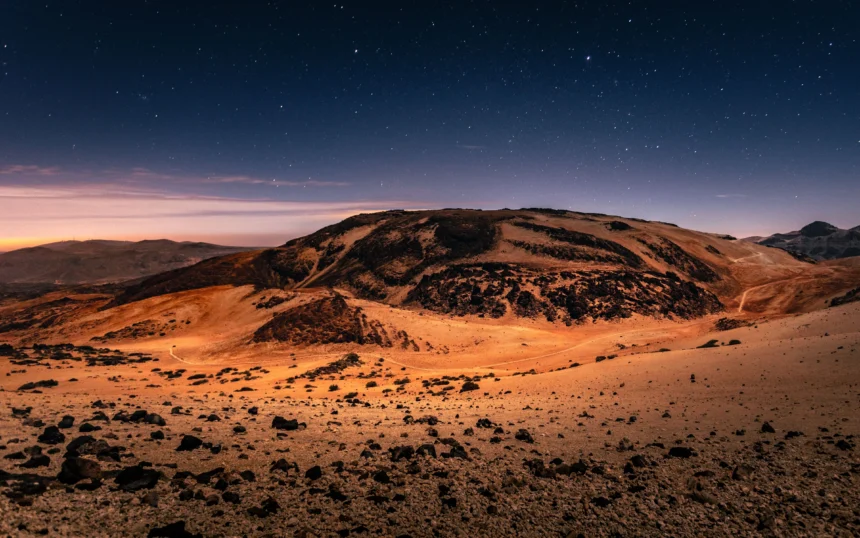
Is Mars Still Volcanically Active? The New Evidence Beneath the Red Planet
Mars is famous for its enormous volcanoes, ancient lava plains and landscapes shaped by billions of years of geological change. Yet for decades, scientists have struggled with a fundamental question: is the Red Planet still volcanically active, or did its internal fires disappear long ago?
New discoveries suggest the answer may be more surprising than previously believed.
On November 4, 2026, scientists reported unusual hydrogen chloride gas detections above volcanic fissures near Alba Mons, one of the largest volcanoes on Mars. Researchers believe the gas may be escaping from underground magma, providing new evidence that the planet’s volcanic systems are not completely extinct.
The discovery follows another important study published in April 2026, which identified seismic evidence consistent with partially molten material deep beneath Elysium Planitia.
Together, these findings have strengthened the scientific case for ongoing Mars volcanic activity.
However, there is an important distinction between identifying signs of underground volcanic processes and observing an actual eruption. No spacecraft has confirmed flowing lava, an erupting volcano or a newly formed volcanic eruption on Mars in modern times.
According to the European Space Agency, the latest atmospheric observations suggest that Mars may retain enough internal heat to sustain volcanic activity in isolated regions.
The implications extend beyond geology. Underground heat could influence buried water, reshape the Martian crust and potentially create environments relevant to the search for microbial life.
Understanding these discoveries requires examining how Mars developed its enormous volcanoes, what its seismic activity reveals and why scientists are increasingly reconsidering the planet’s geological future.
Is Mars Still Volcanically Active Today?
The most scientifically accurate answer is that Mars shows increasingly convincing evidence of ongoing internal magmatic activity, but scientists have not directly observed a modern volcanic eruption.
This distinction matters.
On Earth, volcanic activity can involve visible lava flows, explosive eruptions, underground magma movement or gases escaping through volcanic vents.
A volcano does not need to erupt continuously to remain geologically active.
Some terrestrial volcanoes spend centuries or thousands of years without erupting while molten material remains beneath the surface.
Mars may contain similar systems.
For many years, planetary scientists believed most major Martian volcanoes had become inactive as the planet gradually lost internal heat.
However, evidence from orbiters, geological mapping and NASA’s InSight lander has challenged the idea that Mars is entirely geologically dead.
The strongest evidence includes young volcanic deposits, clustered marsquakes, possible mantle plumes, underground melting and newly detected atmospheric gases.
| Evidence | Scientific finding | What it suggests |
|---|---|---|
| Young volcanic deposits | Some material may be only 53,000–210,000 years old | Volcanic eruptions occurred recently in geological terms |
| Marsquakes | Repeated seismic activity near Cerberus Fossae | The crust remains active, potentially involving magma |
| Mantle plume research | Possible hot upwelling beneath Elysium Planitia | Internal heat may sustain magmatic processes |
| 2026 seismic study | Evidence consistent with partial melting at depths of 70–100 km | Some mantle material may remain partially molten |
| November 2026 gas discovery | Unusual hydrogen chloride near Alba Mons fissures | Gas may be escaping from underground volcanic systems |
These findings do not carry equal levels of certainty.
Some are direct measurements, while others involve interpretations of geological or seismic data.
Nevertheless, the combined evidence makes continued Mars volcanic activity a serious scientific possibility rather than an entirely speculative idea.
Mars Once Had Some of the Largest Volcanoes in the Solar System
To understand whether Mars could still erupt, it helps to examine the enormous volcanic structures that cover its surface.
Mars experienced extensive volcanism during its early history.
Molten rock rose through the planet’s crust, spreading across enormous areas and gradually constructing huge volcanic mountains.
Much of this activity occurred billions of years ago, when Mars retained more internal heat.
Unlike Earth, Mars does not have a global system of moving tectonic plates comparable to modern terrestrial plate tectonics.
On Earth, tectonic plate movement can carry the crust across volcanic hotspots.
On Mars, long-lived volcanic centers could remain beneath approximately the same surface region, allowing repeated eruptions to build enormous volcanic structures.
Mars also has lower surface gravity than Earth, which influenced the development of its volcanic landscapes.
The result is a planet containing some of the most impressive volcanic features anywhere in the solar system.
Our Space & Astronomy guide explains how scientists investigate planetary formation, geological evolution and the physical processes shaping worlds beyond Earth.
Olympus Mons: The Largest Volcano on Mars
Olympus Mons is among the most recognizable geological landmarks in the solar system.
It rises approximately 22 kilometers above its surrounding terrain, making it nearly three times the height of Mount Everest when measured by commonly cited elevations.
Its broad structure formed through repeated eruptions of relatively fluid lava.
Olympus Mons is a shield volcano, a type characterized by extensive, gently sloping lava flows rather than the steep profile associated with many explosive volcanoes.
The scale is extraordinary.
The volcano covers an enormous area, with a base hundreds of kilometers across.
Its summit contains overlapping volcanic depressions formed through the collapse of underlying magma chambers.
The NASA Earth Observatory explains how Martian shield volcanoes developed through large volumes of basaltic lava.
Despite its immense size, Olympus Mons is not known to be erupting today.
It is also important not to confuse Olympus Mons with the location of the latest volcanic gas discovery.
That discovery occurred near Alba Mons, another enormous volcano within the broader Tharsis region.
Alba Mons: The Volcano Behind the November 2026 Discovery
Alba Mons is a vast shield volcano in the northern portion of the Tharsis volcanic province.
Although Olympus Mons is taller, Alba Mons covers an exceptionally large area and has a broad, gently sloping structure.
Its size makes it one of the most distinctive volcanic features on Mars.
The November 2026 discovery has brought renewed scientific attention to this region.
Researchers studying data from the European Space Agency’s ExoMars Trace Gas Orbiter detected unusual concentrations of hydrogen chloride gas above parts of Alba Mons.
Hydrogen chloride, or HCl, can be released by volcanic systems on Earth.
Scientists have known that small quantities of the gas can exist in the Martian atmosphere, but determining its source has been difficult.
Some hydrogen chloride may result from chemical interactions involving airborne dust, water and chlorine-containing materials.
The latest findings are significant because certain gas detections repeatedly appeared in an unexpected location and season.
Why the Hydrogen Chloride Discovery Matters
The ExoMars Trace Gas Orbiter carries sensitive instruments designed to study gases present in extremely small concentrations.
Researchers examined observations spanning multiple Martian years and identified recurring hydrogen chloride signals during early northern summer.
These concentrations were unusual because the broader Martian hydrogen chloride cycle often produces higher readings during northern winter.
The unusual signals appeared near volcanic fissures on the northern flanks of Alba Mons.
According to the University of Oxford, researchers combined atmospheric observations with detailed images of the surrounding landscape.
They identified relatively fresh-looking cracks, some extending hundreds of meters, along with surface color differences that could be associated with gas release.
The researchers proposed that underground volcanic gases may move upward through these fractures.
During colder periods, ice could restrict the movement of gases through near-surface pathways.
As temperatures increase and ice sublimates, trapped gases may escape into the atmosphere.
This could help explain why the unusual hydrogen chloride readings appear seasonally.
The findings were published in Science Advances on November 4, 2026.
The study, titled Enigmatic HCl Detections as a Potential Signature of Igneous Activity on Mars, offers an important new explanation for previously puzzling atmospheric observations.
University of Oxford Department of Physics+1
Does the Gas Prove That Magma Exists Beneath Alba Mons?
Not conclusively.
Hydrogen chloride can be associated with volcanic gases, but it can also have non-volcanic sources.
The spatial and seasonal patterns strengthen the researchers’ proposed volcanic explanation, yet they do not provide direct images of an underground magma chamber.
The team suggested that a dormant volcanic system could still release gases from beneath the Martian surface.
This would represent continuing geological activity even without visible lava.
Independent researchers have emphasized that the interpretation remains open to further investigation.
The discovery therefore provides a substantial new clue about Mars volcanic activity, but it should not be described as proof that Alba Mons is preparing to erupt.
Elysium Planitia: Another Region That May Still Contain Magma
While the latest atmospheric evidence comes from Alba Mons, some of the strongest previous evidence for Mars volcanic activity has emerged from Elysium Planitia.
This broad volcanic plain lies in a different part of the planet.
It contains extensive lava flows, fissures and geological structures that appear younger than many of Mars’s ancient volcanic formations.
Scientists have paid particular attention to Cerberus Fossae, a system of fractures extending across the region.
The terrain provides evidence of both volcanic and tectonic processes.
Some lava flows in Elysium Planitia formed only a few million years ago, an extraordinarily recent period when compared with the planet’s roughly 4.5-billion-year history.
However, an even younger geological feature attracted scientific attention in 2021.
Evidence of an Eruption Around 53,000–210,000 Years Ago
Researchers identified a dark deposit surrounding part of the Cerberus Fossae fracture system.
Its appearance differed from ordinary windblown material and nearby lava flows.
The deposit appeared consistent with material produced during an explosive volcanic eruption.
Such deposits can form when gases rapidly expand within rising magma, fragmenting molten rock and spreading volcanic material over the surrounding landscape.
Researchers estimated that the deposit could be between approximately 53,000 and 210,000 years old.
The study, published in Icarus, suggested that this may be the youngest volcanic deposit identified on Mars.
These dates are based on geological modeling, crater counting and assumptions about the surface’s exposure history.
They are not equivalent to directly observing or precisely dating an eruption.
Nevertheless, the deposit matters because it suggests that volcanic activity may have continued much later than once expected.
For a planet billions of years old, an eruption tens of thousands of years ago is relatively recent.
If the interpretation is correct, it raises the possibility that the underground processes responsible may not have completely ended.
NASA’s InSight Mission Revealed That Mars Still Shakes
One of the most important developments in understanding Mars volcanic activity came from NASA’s InSight lander.
InSight arrived on Mars in November 2018.
Unlike rovers designed to travel across the surface, the stationary spacecraft focused on studying the planet’s interior.
Its scientific instruments measured seismic waves, temperature-related conditions and other properties relevant to the structure of Mars.
The mission collected information until December 2022, when dust accumulation and declining power ended operations.
During its lifetime, InSight detected more than 1,300 seismic events.
According to NASA’s mission results, some of the clearest marsquakes originated from the Cerberus Fossae region.
These discoveries demonstrated that Mars remains seismically active.
What Causes Marsquakes?
Marsquakes are vibrations traveling through the planet’s interior.
They can occur when rocks fracture or faults move under accumulated stress.
Some events are caused by meteorites striking the surface.
Others may result from cooling, contraction or movement within the crust.
Potential magmatic processes provide another possible explanation.
If magma moves underground, it can deform surrounding rock and create seismic activity.
However, detecting a marsquake does not automatically mean magma is moving.
Scientists must examine the seismic signal, its location and the geological environment to determine the most likely cause.
This distinction became especially important as researchers revisited InSight’s data.
A NASA study in 2025 showed that seismic waves from meteoroid impacts could travel through deeper parts of Mars than previously understood.
The finding demonstrated why some earlier interpretations required reassessment.
Not every marsquake near a volcanic region is necessarily volcanic in origin.
Nevertheless, the repeated activity around Cerberus Fossae remains an important part of the evidence for ongoing internal processes.
Our NASA Mars missions guide explains how InSight, Mars Reconnaissance Orbiter, Curiosity and other spacecraft have transformed scientific understanding of the Red Planet.
The April 2026 Discovery: Evidence of Partially Molten Rock
A major advance arrived on April 21, 2026.
Researchers published a study in Nature Communications reporting seismic evidence consistent with partially melted material beneath Elysium Planitia.
The scientists reanalyzed data from NASA’s InSight mission.
Rather than simply examining whether Mars experiences earthquakes, they investigated how seismic waves travel through deeper layers of the planet.
Different materials transmit seismic waves at different speeds.
Solid, cool rock generally behaves differently from hotter rock containing partial melt.
The researchers identified regions where seismic waves traveled unusually slowly.
These low-velocity zones were located approximately 70–100 kilometers beneath the surface.
The analysis suggested that the regions could contain partially molten material.
Estimated melt fractions ranged from approximately 2% to 12%, depending on the modeled conditions.
The 2026 research paper interpreted these findings as evidence that parts of the Martian upper mantle remain thermally active.
This is significant because it suggests that the interior has not cooled into a completely inactive state.
Nature Communications
Does Partially Molten Rock Mean an Eruption Is Coming?
No.
Partial melting deep underground does not automatically produce a surface eruption.
Magma must accumulate, move upward and overcome the surrounding rock’s resistance before it can reach the surface.
Some molten material may remain trapped underground for extremely long periods.
Other regions may experience limited melting without developing large magma chambers.
The 2026 study therefore strengthens the case for continued Mars volcanic activity but does not establish that an eruption is imminent.
It also applies specifically to Elysium Planitia.
The results should not be used to claim that every major Martian volcano remains active.
Could a Giant Mantle Plume Be Heating Mars From Below?
Scientists have proposed that a large mantle plume may exist beneath Elysium Planitia.
A mantle plume is a region where relatively hot material rises through a planet’s mantle.
On Earth, mantle plumes are associated with certain volcanic provinces and hotspots, although the exact mechanisms can be debated.
A similar process could help explain why parts of Mars remain geologically active despite the planet’s smaller size and long history of cooling.
In December 2022, researchers published a study in Nature Astronomy proposing that Elysium Planitia is underlain by an enormous active mantle plume.
Their modeling suggested a plume head approximately 4,000 kilometers across.
The researchers used geological observations, gravity measurements and surface deformation to support their interpretation.
According to the mantle plume study, the proposed structure could explain regional uplift, crustal extension, recent volcanism and clustered seismic activity.
This offered a possible explanation for why geological activity remains concentrated in the region.
Why the Mantle Plume Theory Is Important
Mars has gradually lost internal heat since its formation.
Because it is smaller than Earth, it has a greater surface-area-to-volume ratio, which affects its long-term cooling.
Scientists therefore expect less widespread internal activity today than during the planet’s early history.
A localized mantle plume could provide an explanation for how certain regions remain warmer than their surroundings.
However, the plume model remains a scientific interpretation rather than an object directly photographed beneath Mars.
Other processes, including different forms of mantle convection and crustal stress, have also been considered.
The April 2026 partial-melting study provides additional evidence compatible with a hot mantle region, but researchers continue investigating the precise structure and origin of the anomaly.
Why Mars Volcanic Activity Is Different From Earth’s
Earth is an unusually geologically dynamic planet.
Its tectonic plates move, oceanic crust is continually created and recycled, and volcanoes erupt across different geological settings. the scientific case for ongoing Mars volcanic activity.
Mars operates differently.
There is no established global system of modern plate tectonics comparable to Earth’s.
Consequently, many Martian volcanic structures developed through repeated eruptions concentrated around long-lived volcanic centers.
Mars also has a much thinner atmosphere and colder surface conditions.
These differences affect the way volcanic gases, lava and erupted material behave.
For example, low atmospheric pressure can influence how gases escape from magma.
Martian gravity also affects the movement and distribution of volcanic material.
The planet’s long geological history has preserved extensive volcanic landscapes that would be more heavily modified by tectonic recycling on Earth. the scientific case for ongoing Mars volcanic activity.
Is Mars Geologically Dead?
No.
Even without an observed eruption, Mars remains geologically active through several processes.
Researchers have documented recent impact craters, shifting dunes, seasonal frost-related changes, slope movements and marsquakes.
A scientific review published through the US Geological Survey explains how the Martian surface continues to evolve.
However, geological activity should not be confused with volcanism.
Wind moving sand is geological activity, but it does not indicate magma.
Similarly, faults can move because of stresses unrelated to volcanic processes.
The important question is whether Mars retains enough internal heat and molten material to support future eruptions.
Recent research increasingly suggests that some regions may.
The October 2026 Marsquake Discovery Adds Another Clue
Additional evidence of Mars’s continuing geological activity emerged in October 2026.
Researchers studying seismic data identified a marsquake originating beneath Valles Marineris, the enormous canyon system stretching across the Martian surface.
The event occurred approximately 20–40 kilometers beneath the surface.
Scientists interpreted the seismic signals as evidence of movement along a fault.
According to Columbia University, the finding shows that ancient Martian faults can remain active billions of years after they formed.
This expands understanding of the planet’s present-day internal dynamics.
However, the discovery is evidence of tectonic activity, not a confirmed volcanic event.
That distinction is essential when assessing Mars volcanic activity.
The findings collectively show that Mars is not a completely static world, while the exact relationship between crustal faulting and underground magma remains an area of research.
Could Mars Erupt Again in the Future?
It is scientifically possible that Mars could experience another volcanic eruption.
However, researchers cannot currently predict when or where one might occur.
The presence of partially molten material does not mean sufficient magma is accumulating to reach the surface.
A volcanic system may remain dormant for extremely long periods.
On Earth, some volcanoes reactivate after long intervals, while others eventually become extinct.
Determining which category best describes particular Martian volcanic systems is difficult because direct observations cover only a small fraction of the planet’s geological history.
Spacecraft have examined Mars for decades, but this is an extremely short observation period compared with volcanic cycles lasting tens of thousands or millions of years.
A lack of observed eruptions therefore does not prove that all Martian volcanoes are permanently inactive.
Likewise, new evidence of gas release or underground melting does not justify predicting an eruption in the near future.
For now, the most defensible conclusion is that Mars may retain localized magmatic systems capable of future activity.
Could Underground Volcanoes Create Liquid Water on Mars?
One of the most interesting implications of Mars volcanic activity concerns water.
The Martian surface is extremely cold and experiences low atmospheric pressure.
Under typical present-day surface conditions, stable liquid water is difficult to maintain.
However, underground environments can be different.
Heat from magma can warm surrounding rock.
If that heat reaches ice-rich material or subsurface water, it may potentially create liquid-water environments.
On Earth, interactions between magma, rock and groundwater form hydrothermal systems.
Such environments can support complex chemical reactions and provide energy for microorganisms.
Researchers therefore consider hydrothermal environments important when investigating the possibility of life beyond Earth.
Why Hydrothermal Systems Matter
A hydrothermal system involves heated water interacting with surrounding geological materials.
These interactions can produce chemical compounds and energy gradients potentially useful to certain forms of life.
On Earth, microorganisms survive in environments that are extremely hot, dark or chemically unusual.
Scientists study these organisms because they demonstrate that life does not always require sunlight.
The November 2026 Alba Mons research raises the possibility that similar underground environments might exist on Mars. the scientific case for ongoing Mars volcanic activity.
However, there is no confirmed evidence that such environments currently contain liquid water or living organisms.
A volcanic gas signal does not establish the presence of an active hydrothermal system.
It provides a reason for further investigation.
Does Mars Volcanic Activity Increase the Chance of Finding Life?
Potentially, but the connection must be understood carefully.
Mars has not been confirmed to contain life, either in the present or in its ancient past.
Scientists have discovered evidence that liquid water once existed on the surface.
Rovers have also identified minerals, organic compounds and geological conditions relevant to habitability.
However, organic molecules can form through non-biological processes.
The presence of organic material therefore does not demonstrate that organisms once lived on Mars.
Active or recently active volcanic systems could be important because they might supply heat and chemical energy.
If underground water is present, some environments could potentially remain habitable despite harsh surface conditions.
The ESA’s scientific discussion highlights why researchers are interested in volcanic fissures as possible targets for future life-detection missions.
The broader challenge is establishing whether those environments exist, how long they have remained stable and whether they contain evidence of biology.
Our NASA guide examines how robotic spacecraft, scientific instruments and exploration programs contribute to the search for habitable environments beyond Earth.
Why NASA and ESA Need Better Instruments to Study Mars Volcanoes
Much of the current evidence for Mars volcanic activity comes from remote observations and indirect measurements.
Orbiters photograph the surface and examine atmospheric gases.
Seismometers record vibrations traveling through the interior.
Spectrometers identify minerals and chemical compounds.
Each instrument provides valuable information, but none reveals the complete picture independently.
For example, a camera can identify a young-looking lava flow without determining whether magma remains beneath it.
A seismometer can detect unusual wave speeds without directly observing molten rock.
An atmospheric instrument can identify hydrogen chloride without proving that the gas originated from a volcanic chamber.
Future missions could combine these observations more effectively.
What Future Mars Missions Should Investigate
Several capabilities would be particularly useful:
-
Expanded seismic networks: Multiple seismometers could locate marsquakes more precisely and help identify possible magma movement.
-
High-resolution imaging: Repeated photographs could reveal changes near volcanic fissures.
-
Atmospheric monitoring: Sensitive instruments could track volcanic gases and distinguish them from chemical processes involving dust and water.
-
Heat measurements: Improved thermal observations could identify unusual underground or surface temperatures.
-
Subsurface investigations: Radar and other geophysical instruments could help characterize buried geological structures.
These approaches could improve the distinction between dormant volcanoes, active magma systems and ordinary tectonic processes.
NASA’s history of planetary exploration demonstrates why combining instruments is so effective.
From Viking to modern Mars orbiters and rovers, each mission has revealed information that earlier spacecraft could not measure.
Our NASA history guide examines how these technological advances transformed planetary science.
What Would a New Martian Eruption Look Like?
An eruption on Mars could resemble some volcanic processes seen on Earth, but the environmental conditions would make important differences. the scientific case for ongoing Mars volcanic activity.
Many large Martian volcanoes formed through extensive flows of basaltic lava.
Basaltic magma is commonly associated with relatively fluid lava, although its behavior depends on temperature, composition, dissolved gases and surrounding conditions.
If magma reached the surface through a fissure, it could spread across nearby terrain.
An eruption involving rapid gas expansion or interaction with ice-rich material might become more explosive.
Researchers have identified geological features suggesting that explosive eruptions occurred on Mars in the past.
A 2021 study in Earth and Planetary Science Letters examined whether dissolved volcanic gases, ground ice and impacts could have influenced a young explosive event near Cerberus Fossae.
The research findings illustrate how interactions between magma and surrounding material could potentially produce more energetic eruptions.
Nevertheless, any description of a future Martian eruption remains hypothetical.
Scientists do not currently know whether the planet will experience another surface eruption during the coming centuries, millennia or much longer.
Would Active Mars Volcanoes Threaten Future Astronauts?
Potential volcanic hazards would be an additional consideration for future human missions, but current evidence does not establish an immediate danger.
Mars already presents serious challenges to astronauts.
These include radiation exposure, extreme temperatures, dust, limited atmospheric pressure and the difficulty of transporting supplies across interplanetary distances.
If future exploration identifies active magma systems, mission planners may need to avoid particular geological regions. the scientific case for ongoing Mars volcanic activity.
Possible hazards could include unstable ground, gas release or local seismic activity.
However, these risks would depend on the actual level of activity and the location of future landing sites.
The latest findings do not imply that Mars is experiencing widespread eruptions or that the planet is becoming generally more dangerous.
Some volcanic regions could also be scientifically valuable.
Astronauts or robotic explorers might investigate recently altered rocks, heat-related processes and preserved geological materials.
Our NASA space technology guide explores technologies relevant to future robotic and human exploration.
What Scientists Still Need to Prove
Despite substantial advances, several important questions remain unresolved.
Researchers need stronger evidence connecting particular atmospheric gas signals to underground magma.
They must also determine whether partial melting detected through seismic analysis represents a stable long-lived system or a more limited geological phenomenon.
The locations, temperatures and sizes of potential magma reservoirs remain uncertain.
Scientists also need to understand how much molten material would be required to produce another surface eruption. the scientific case for ongoing Mars volcanic activity.
The November 2026 Alba Mons discovery provides an important opportunity to investigate a possible connection between atmospheric chemistry and Martian volcanism.
Meanwhile, the Elysium Planitia research offers a different line of evidence involving the planet’s interior.
These findings are complementary, but they concern different geographical regions and different scientific measurements.
A convincing explanation of present-day Mars volcanic activity will require researchers to connect observations across multiple disciplines.
Frequently Asked Questions About Mars Volcanic Activity
Is Mars still volcanically active in 2026?
Research published in 2026 provides evidence consistent with ongoing underground magmatic processes. Scientists have detected unusual volcanic gas signals and seismic indications of partial melting, but no present-day surface eruption has been confirmed. the scientific case for ongoing Mars volcanic activity.
When was the last volcanic eruption on Mars?
Researchers have identified a possible volcanic deposit in Elysium Planitia estimated to be approximately 53,000–210,000 years old. Its interpretation and dating remain subject to scientific uncertainty, and it may not represent the planet’s actual most recent eruption. the scientific case for ongoing Mars volcanic activity.
Is Olympus Mons still active?
No eruption has been observed at Olympus Mons in modern times. It is generally regarded as dormant or inactive, although scientists cannot establish that every part of its underlying volcanic system is permanently extinct.
What is the biggest volcano on Mars?
Olympus Mons is the tallest known volcano on Mars and among the largest volcanic structures in the solar system. Alba Mons, another enormous shield volcano, is especially extensive in surface area.
Can Mars volcanoes erupt again?
Another eruption is scientifically possible if sufficient magma remains and reaches the surface. However, no reliable prediction exists for the timing or location of a future Martian eruption.
Does volcanic activity mean life exists on Mars?
No. Volcanic activity could potentially create underground environments containing heat and chemical energy, but scientists have not confirmed living organisms on Mars. the scientific case for ongoing Mars volcanic activity.
Is Mars Still Volcanically Active? What the Evidence Really Means
For decades, Mars appeared to be a planet whose most dramatic geological events belonged to the distant past.
Its giant volcanoes were silent.
Its vast lava plains were ancient.
Its atmosphere was thin, and its surface seemed far removed from the dynamic geological conditions found on Earth.
Modern spacecraft have gradually complicated that picture.
NASA’s InSight mission demonstrated that Mars continues to experience seismic activity.
Orbital observations revealed volcanic deposits that may be surprisingly young.
Geophysical modeling suggested a large mantle plume beneath Elysium Planitia.
Then, in April 2026, researchers reported seismic evidence consistent with partially molten material beneath the region. the scientific case for ongoing Mars volcanic activity.
The November 2026 discovery added another important clue: unusual hydrogen chloride gas signals near volcanic fissures at Alba Mons.
Together, these findings suggest that the planet’s internal geological systems may not have completely shut down.
However, the scientific evidence must be interpreted carefully.
No spacecraft has directly observed a Martian volcanic eruption in modern times.
The existence of underground heat or possible magma does not prove that lava is approaching the surface.
Nor does volcanic activity establish that Mars contains life.
What the evidence does reveal is a planet that remains more geologically complex than its quiet surface might suggest.
That complexity matters for understanding how rocky planets evolve.
It also matters for investigating underground water, possible habitable environments and the geological conditions future explorers may encounter.
The most important lesson from recent Mars volcanic activity research is that a planet can appear inactive at the surface while retaining dynamic processes deep below.
Mars may not be erupting today. the scientific case for ongoing Mars volcanic activity.
But the growing evidence suggests that its volcanic history has not necessarily reached its final chapter.
For more research-driven explainers, science coverage and global stories, follow The News Ink on X, Instagram, Threads, Medium, Substack, Bluesky, Pinterst, TikTok, Quora and Mastodon.