Venezuela Mining Reform: Why the Alarming 2026 Resource Gamble Matters
Venezuela mining reform has moved from a promise made at Miraflores Palace into a new law designed to reopen one of South America’s most controversial resource sectors to private and foreign investment.
The original story focused on Delcy Rodriguez and U.S. Interior Secretary Doug Burgum saying Venezuela and the United States would cooperate on mining. That was the right immediate angle. But the story has now moved further. Venezuela’s National Assembly has approved a new mining law, the U.S. has issued a license authorising certain dealings with state gold company Minerven, and Washington is openly trying to pull Venezuela’s minerals into a U.S.-aligned supply chain.
That makes Venezuela mining reform more than a business story. It is also a geopolitical story, an environmental story and a test of whether a country damaged by nationalisation, sanctions, illegal mining and weak institutions can attract investment without repeating old mistakes.
Rodriguez has framed the changes as the mining version of Venezuela’s oil-sector opening. Her message is simple: reduce red tape, give companies legal guarantees, promise security and let foreign capital help rebuild a collapsed economy. Burgum’s message has been similar. He said U.S. companies see billions of dollars of opportunity and thousands of potential high-paying jobs.
The promise is large. Venezuela has gold, diamonds, nickel, iron ore, bauxite, coltan, copper and other strategic minerals. It also has the world’s largest proven oil reserves and decades of lost production. A serious investment revival could bring revenue, jobs, infrastructure and foreign exchange.
But Venezuela mining reform also carries serious risks. Venezuela’s mineral zones have long been linked to illegal gold mining, armed groups, unsafe working conditions, environmental destruction and unclear state control. Reuters has also warned that the country’s rare earth potential is not confirmed by proper exploration, even though rare earths have become part of the political sales pitch.
For readers following The News Ink’s wider economy coverage, this is the key point: Venezuela mining reform could become a recovery tool, but only if transparency, security, environmental standards and credible contracts are stronger than the country’s recent history.
What changed after the Burgum visit
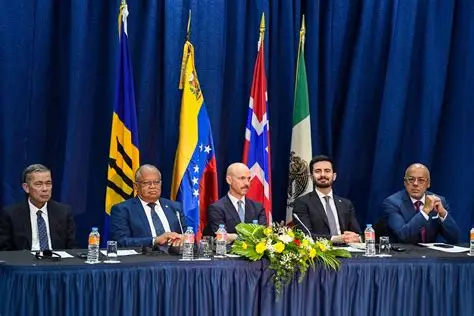
Venezuela mining reform began with a high-profile political signal. Burgum travelled to Caracas in March with representatives of more than two dozen U.S. mining and minerals companies. He met Rodriguez at the Miraflores presidential palace and praised the scale of potential cooperation.
Rodriguez then said she would send a mining-law proposal to the National Assembly in the coming days. She said the government wanted the successful model of the hydrocarbons law to be reflected in the mining sector. That mattered because lawmakers had already approved oil reforms in January, and Rodriguez later signed regulations implementing those oil and gas changes in July.
By April, the mining law had passed. Reuters reported that the new framework repealed older mining rules from 1999 and 2015, opened gold and strategic minerals to domestic and foreign companies, and allowed concessions lasting up to 30 years, with possible extensions.
This means Venezuela mining reform is no longer only a diplomatic statement. It is now a legal framework. Companies may still need U.S. licenses, security guarantees, geological data and contracts that satisfy investors, but the legal door is open wider than before.
What the new mining law allows
The new law keeps mineral deposits as state property, but it allows private, state-owned, domestic and foreign companies or consortiums to exploit gold and strategic minerals. That structure is important because it gives Venezuela a way to claim national control while still inviting outside capital.
Reuters reported that concessions can last up to 30 years and may be extended by up to two 10-year periods. The law also allows disputes to be resolved through arbitration. That is a major feature for foreign investors because many companies remain wary after Venezuela’s history of expropriations and nationalisations.
Venezuela mining reform also creates a royalty tax of up to 13% of gross production value and a tax of up to 6% on companies carrying out primary mining activities. Gold sales will be overseen by the central bank.
Those details matter because mining investment is capital-intensive. Companies need to know how long they can operate, how disputes will be handled, who controls sales, what taxes apply and whether contracts can survive political change.
The law answers some of those questions on paper. The harder test is implementation. Venezuela has passed ambitious resource rules before. Investors will judge this one by whether licences are issued clearly, contracts are honoured, security is real and environmental obligations are enforced.
Why the United States wants a role
The U.S. interest in Venezuela mining reform is tied to energy security, critical minerals and geopolitical competition. Washington wants supply chains that are less dependent on China, especially for minerals used in batteries, electronics, defence systems and clean-energy technologies.
Burgum heads Trump’s National Energy Dominance Council, and his visit was part of a broader push to expand U.S. access to Venezuelan oil, gas and minerals. AP reported that the U.S. also issued a license authorising dealings with Minerven, Venezuela’s state-owned gold company, after Burgum’s visit.
The political message is obvious. The Trump administration wants Venezuela’s resource recovery to move through U.S.-aligned companies, financial channels and contracts rather than through China, Russia, Iran or other rivals. The Minerven license excludes companies and people from Russia, Iran, North Korea and Cuba from contracts under the arrangement.
That makes Venezuela mining reform part of a larger resource-security strategy. It is not only about Venezuelan development. It is about where future gold, coltan, nickel and strategic minerals go, who finances extraction, and which political bloc controls the supply chain.
For Venezuela, the U.S. role offers access to capital and markets. For Washington, it offers influence over a resource-rich country that spent years aligned with U.S. rivals.
Why China is part of the background
Venezuela mining reform also sits inside the larger U.S.-China minerals contest. China dominates processing for several critical minerals and rare earth supply chains, while the United States has been trying to build alternative sources through allies and friendly governments. Venezuela gives Washington a nearby resource opportunity in the Western Hemisphere, even if some of the most attractive mineral claims still need stronger geological proof.
That strategic background explains the speed of the diplomacy. U.S. officials are not only looking at gold revenue. They are looking at industrial inputs, supply-chain control and political influence. If Venezuela mining reform succeeds, Washington could argue that it has turned a former adversarial oil state into a resource partner.
For Caracas, the China question is more complicated. Venezuela relied on China, Russia and Iran during earlier periods of confrontation with Washington. A sudden U.S.-led investment push may bring capital, but it also changes the country’s diplomatic balance. Venezuela mining reform could therefore redraw not only mining contracts, but also the country’s foreign-policy relationships.
Why transparency will decide credibility
Venezuela mining reform will need public transparency if it is to avoid becoming another closed-door resource bargain. Citizens should know which companies receive concessions, what royalties they pay, how environmental permits are approved, and how local communities are consulted. Without that information, the reform will be easy for critics to describe as a sell-off of national wealth.
Transparency also matters for investors. Clean contracts are easier to finance. Clear ownership rules reduce legal disputes. Public reporting on production and royalties helps lenders and buyers understand whether minerals are entering legitimate supply chains.
This is especially important for gold. Gold is easy to move, easy to disguise and often used in illicit finance. If Venezuela mining reform expands gold exports without strict traceability, it could strengthen exactly the black-market networks the new law claims to replace.
The rare earth claim needs caution
One of the most important corrections is about rare earths. Politicians often use the phrase “rare earths” because it sounds strategically valuable. But Reuters reported that exploration has not yet confirmed Venezuela’s rare earth reserves, and that government documents have used mining terms such as “reserve” and “resource” imprecisely.
That is why Venezuela mining reform should not be oversold as a guaranteed rare earth breakthrough. The country clearly has minerals. It has reported gold, iron ore, nickel, bauxite, coltan and other resources. But rare earths require serious exploration, processing expertise and commercially viable deposits.
Reuters reported that Venezuela does not appear to have sizeable rare earth reserves, based on available information. That does not mean none exist. It means investors should treat claims carefully until geological work proves them.
This distinction matters for credibility. A mining law can attract attention, but geology decides what is real. If Venezuela sells the reform as a rare earth revolution and exploration disappoints, investors may lose confidence quickly. The smarter message is broader: Venezuela has mineral potential, but the resource base must be verified, measured and developed responsibly.
Illegal mining is the hardest problem
The biggest obstacle to Venezuela mining reform may not be the law. It may be control on the ground. Venezuela’s southern mining areas have long been shaped by illegal gold extraction, armed groups, criminal networks and unsafe working conditions.
AP reported that Burgum said Venezuela had given security assurances to companies interested in mining, in areas where guerrilla members, gangs and other illegal groups have long held influence. Al Jazeera also noted that informal mining developed under poor economic conditions and that unsafe mines have caused deadly collapses.
This is not a side issue. A formal mining sector cannot succeed if informal or criminal actors control access roads, labour, fuel, equipment, river routes or local communities. Companies need security, but communities need protection from militarised extraction and private violence.
Venezuela mining reform therefore requires more than foreign investment. It requires state capacity. The government must prove it can replace illegal mining with lawful operations without simply transferring control from one abusive network to another.
Environmental damage is another major concern. Illegal gold mining often uses mercury, destroys forest, pollutes rivers and affects Indigenous communities. If legal mining expands without strong oversight, it could repeat some of the same harms at a larger scale.
The oil reform model has limits
Rodriguez has repeatedly linked Venezuela mining reform to the country’s oil-law changes. That comparison is useful but incomplete. Oil and mining both require capital, technology and long-term contracts. Both sectors were damaged by nationalisation, sanctions and infrastructure decline. Both need outside expertise.
But mining is more fragmented. Oil fields have clear operators, pipelines, ports and production systems. Mining can involve remote regions, small-scale extraction, criminal economies, Indigenous territories and environmental risks that are harder to monitor.
The oil model also depends on whether Venezuela can rebuild trust. Reuters reported in July that Rodriguez signed regulations implementing the oil-law reform after 20 years of strict nationalisation and expropriation of assets previously owned by foreign companies. That history still matters. Companies remember Crystallex, Gold Reserve, Rusoro and other disputes.
Venezuela mining reform will be judged against that past. Investors may like the new law, but they will ask whether a future government could rewrite terms, seize assets or block arbitration. Long concession periods mean little if institutions are weak.
What investors will demand
Mining companies will not commit billions only because Burgum and Rodriguez smiled for cameras. They will demand data, licences, security, infrastructure, currency rules, environmental permits, labour clarity and a path for profits to leave the country.
They will also need protection from sanctions risk. Even if the Trump administration supports the current opening, U.S. policy can change. A future administration could restore restrictions if Venezuela’s political transition stalls, corruption allegations grow or human rights concerns deepen.
Venezuela mining reform must therefore create confidence across political cycles. That is hard in a country where institutions have been battered and where the current political settlement remains controversial.
Companies will also watch infrastructure. Reuters reported that electricity problems have repeatedly hampered Venezuela’s oil and mining operations. Mines need power, roads, rail, ports, water management and secure logistics. If those systems are weak, mineral deposits stay theoretical.
The investment case depends on more than rocks in the ground. It depends on whether Venezuela can operate like a predictable mining jurisdiction.
What Venezuelans could gain
Supporters of Venezuela mining reform argue that the country needs jobs, revenue and legal investment after years of economic collapse. If managed properly, mining could create employment, rebuild supply chains, generate taxes, improve infrastructure and reduce dependence on informal extraction.
That argument should not be dismissed. Venezuela’s economy has been damaged by mismanagement, sanctions, institutional breakdown and underinvestment. People need work. The state needs revenue. Communities in mining zones need safer alternatives to illegal pits and criminal control.
A legal mining sector could help if it comes with labour standards, environmental rules, local consultation and transparent public revenue. It could also create training opportunities and high-paying technical jobs, as Burgum suggested.
But the word “if” is essential. Resource wealth does not automatically improve lives. Venezuela already knows that from oil. Minerals can enrich a country, or they can enrich a small circle of officials, contractors and armed groups while leaving communities polluted and poor.
Venezuela mining reform will be judged by whether ordinary Venezuelans see benefits beyond speeches and foreign-company announcements.
What could go wrong
There are several risks.
First, the reform could become extractive without being developmental. Foreign companies could take profits while local communities receive little more than damaged land and low-wage work.
Second, illegal groups could remain embedded in mineral regions. Formal concessions may not remove criminal power if enforcement is corrupt or selective.
Third, environmental safeguards could be weak. Mining in forested and riverine areas can cause long-term harm if regulation is poor.
Fourth, resource claims could be exaggerated. If rare earth expectations are not supported by exploration, the sector may disappoint investors.
Fifth, political legitimacy could remain fragile. Al Jazeera has reported criticism that U.S. pressure and Venezuela’s new resource opening raise questions about exploitation, sovereignty and self-determination.
That is why Venezuela mining reform cannot be covered only as an investment opportunity. It is a high-risk experiment in resource governance.
For market readers, the issue also connects with wider resource volatility covered in The News Ink’s report on stock markets and oil prices. Energy, minerals and geopolitics are increasingly part of the same investment story.
What success would look like
Success would not be measured only by the first contract signing. Venezuela mining reform would be credible if legal mines displace illegal pits, if communities receive visible benefits, if rivers are protected, and if royalty income is reported clearly. It would also require companies to prove that supply chains are traceable from mine site to buyer.
A weaker version of Venezuela mining reform would produce headlines and photo opportunities but little institutional change. That would leave criminal mining networks intact and make foreign investors cautious after the first wave of enthusiasm fades.
A stronger version of Venezuela mining reform would combine investment with enforcement, environmental repair and public accountability. That is the version Venezuela needs, and it is the version U.S. officials should demand if they want secure mineral supply chains rather than another unstable resource rush.
Key facts at a glance
| Issue | Detail |
|---|---|
| Main policy | New mining law to open the sector to private and foreign investment |
| Political driver | Acting President Delcy Rodriguez and U.S. Interior Secretary Doug Burgum |
| U.S. goal | Greater access to Venezuelan oil, gold and critical mineral supply chains |
| Law approved | April 2026 |
| Main resources | Gold, diamonds, nickel, iron ore, bauxite, coltan and strategic minerals |
| Rare earths | Potential remains unconfirmed by full exploration |
| Concession length | Up to 30 years, with possible extensions |
| Gold sales | Central bank oversight |
| Main risks | Illegal mining, environmental damage, security, sanctions and rule-of-law concerns |
| U.S. license | Certain dealings with Minerven authorised after Burgum’s visit |
The careful takeaway
Venezuela mining reform could become one of the most important resource-policy changes in Latin America this year. It opens the door for U.S. and foreign companies to enter a sector long shaped by state control, illegal extraction and weak investment. It also gives Washington a chance to strengthen critical-mineral supply chains while limiting the influence of rivals.
But the reform is not a guaranteed success. Venezuela’s rare earth potential is still uncertain. Its mining regions face serious security and environmental challenges. Its history of nationalisations makes investors cautious. Its political transition remains contested. Its infrastructure is fragile.
The promise is real, but so are the warnings. Venezuela mining reform can help rebuild the economy only if the new law is backed by credible contracts, transparent licences, environmental enforcement, community protection and genuine security. Otherwise, it risks becoming another resource boom that benefits powerful outsiders while leaving ordinary Venezuelans with the costs.
Rodriguez and Burgum have described an opportunity. The law has created a framework. The next test is whether Venezuela can prove that legal mining will be cleaner, safer and more accountable than the informal economy it is supposed to replace.
For more business, energy and global politics coverage, follow The News Ink on Medium.