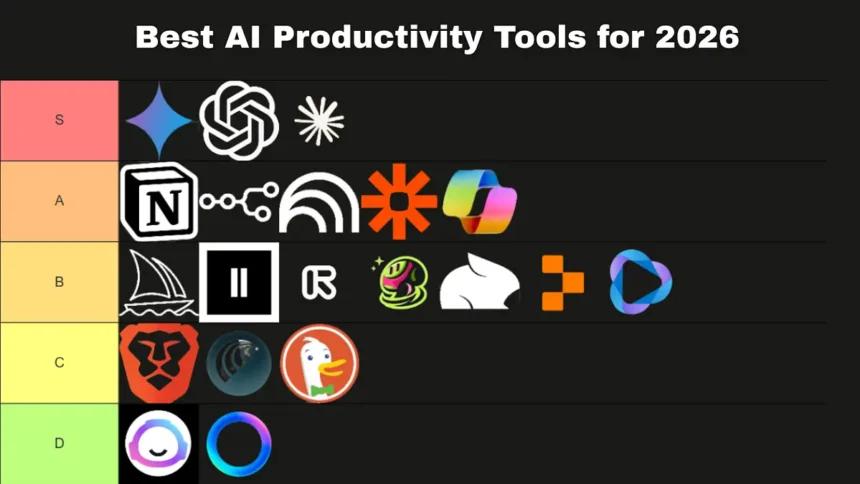
AI Tools for Productivity 2026: Unlocking Productivity with Smart Technology
Introduction
Productivity is no longer just about working harder—it’s about working smarter. As digital demands continue to grow, individuals and businesses are constantly searching for ways to manage time, reduce workload, and improve efficiency. This is where AI tools for productivity 2026 are making a real difference. These tools are not only automating repetitive tasks but also helping users make better decisions, stay organized, and focus on meaningful work. With artificial intelligence becoming more accessible, productivity is entering a new era where smart technology acts as a reliable partner in everyday tasks.
What Are AI Tools for Productivity 2026?
AI tools for productivity are advanced software solutions that use artificial intelligence to simplify and enhance everyday work processes. They rely on technologies such as machine learning, automation, and natural language processing to understand user needs and perform tasks efficiently.
To understand how these technologies function, you can explore IBM’s detailed explanation of artificial intelligence, which highlights how AI systems learn from data and improve over time.
These tools are widely used across industries, from education and marketing to business management and software development.
Why AI Tools for Productivity 2026 Are Important
The growing popularity of AI tools for productivity 2026 is driven by the need for efficiency in a fast-paced environment. These tools help users:
- Automate repetitive and time-consuming tasks
- Improve accuracy and reduce human error
- Enhance creativity and idea generation
- Manage time and schedules effectively
- Improve collaboration across teams
According to insights from McKinsey’s research on AI adoption, organizations using AI technologies report significant improvements in productivity and operational efficiency.
Top AI Tools for Productivity 2026
1. ChatGPT – Intelligent Writing and Task Assistance
ChatGPT has become one of the most widely used AI tools for productivity. It helps users write content, generate ideas, answer questions, and even assist with coding tasks.
ChatGPT is widely used for writing, research, and problem-solving, with its capabilities outlined on the OpenAI platform.
It is especially useful for:
- Writing emails and reports
- Brainstorming ideas
- Solving complex problems
By reducing the time spent on writing and research, ChatGPT significantly boosts productivity.
2. Notion AI – All-in-One Productivity Workspace
Notion AI combines note-taking, project management, and AI assistance into a single platform.
It helps users:
- Summarize long documents
- Generate content quickly
- Organize tasks and workflows
This makes it ideal for teams and individuals managing multiple projects.
Learn more about it here.
3. Grammarly – AI-Powered Writing Assistant
Grammarly is a powerful tool that improves writing quality by correcting grammar, enhancing clarity, and adjusting tone.
It is particularly useful for:
- Professional communication
- Academic writing
- Content creation
By ensuring clear and effective communication, Grammarly helps users save time and avoid errors.
Visit Grammarly here.
4. Jasper AI – Advanced Content Generation
Jasper AI is designed for marketers and content creators who need to produce high-quality content quickly.
You can explore it here.
It helps in:
- Writing blog posts
- Creating marketing copy
- Generating social media content
Its ability to produce engaging content at scale makes it a valuable productivity tool.
5. Otter.ai – Smart Meeting Assistant
This AI improves productivity during meetings by providing real-time transcription and summaries.
Otter.ai provides real-time transcription and meeting summaries using AI, with its functionality detailed on its platform.
Key features include:
- Automatic note-taking
- Voice-to-text transcription
- Highlighting important points
This allows users to focus on discussions instead of taking notes.
6. Trello with AI – Visual Task Management
Trello is a popular project management tool that integrates AI features to enhance workflow automation.
It allows users to:
- Organize tasks visually
- Automate repetitive processes
- Collaborate with teams efficiently
Explore Trello here.
7. Motion – AI Scheduling and Time Management
Motion is an advanced AI scheduling tool that helps users plan their day more effectively. It uses artificial intelligence to automatically prioritize tasks and organize schedules, as outlined on its official platform.
It automatically:
- Prioritizes tasks
- Schedules meetings
- Adjusts plans in real-time
This reduces the stress of manual scheduling and improves time management.
How AI Tools for Productivity 2026 Are Transforming Work
The impact of AI tools for productivity 2026 goes beyond automation. These tools are changing how people approach work by allowing them to focus on high-value activities.
For example:
- Professionals can automate routine tasks and focus on strategy
- Creators can generate ideas faster and improve output quality
- Teams can collaborate more effectively using AI-powered tools
A detailed analysis of how AI is shaping the future of work can be found on the World Economic Forum, which highlights the growing role of AI in modern workplaces.
Challenges and Limitations
Despite their benefits, AI tools come with certain challenges:
- Over-dependence on automation
- Concerns about data privacy and security
- Initial learning curve for new users
It is important to use AI tools responsibly and combine them with human judgment.
The Future of AI Tools for Productivity 2026
The future of AI tools for productivity 2026 looks promising. As technology advances, these tools will become more personalized, intuitive, and efficient.
We can expect:
- Smarter automation systems
- Better integration across platforms
- More advanced decision-making capabilities
Furthermore, AI tools are becoming more accessible to individuals and small businesses. AI will continue to evolve as a powerful partner in improving productivity across industries. Additionally, AI tools are helping users reduce manual effort and improve efficiency. For example, tools like ChatGPT and Notion AI allow users to complete tasks faster than traditional methods.
Conclusion
The rise of AI tools for productivity 2026 marks a significant shift in how we work and manage our time. These tools are not just about saving time—they are about working smarter, improving efficiency, and unlocking new levels of potential.
When used effectively, AI can enhance creativity, streamline workflows, and help individuals achieve more with less effort. However, the key lies in balancing technology with human insight. As a result, users should balance automation with human judgment. Ultimately, the success of these tools depends on how effectively they are used.
If you want to explore more insightful content on technology, productivity, and emerging trends, make sure to check out more articles on The News Ink and stay informed in this rapidly evolving digital world.