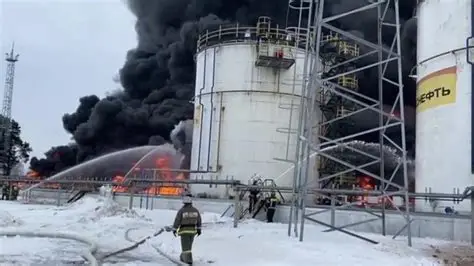
Satellite images and verified footage confirm that Ukraine has launched multiple strikes on key oil facilities in Russia over the past week. These attacks have triggered large fires and disrupted critical export operations near the Baltic Sea.
The targeted locations include major oil ports such as Ust-Luga and Primorsk, along with the inland Kirishi refinery. Reports indicate that fires at these sites continued burning for several days.
Ukrainian drone commander Robert Brovdi stated that forces struck Ust-Luga again to sustain the damage. Meanwhile, Leningrad region governor Alexander Drozdenko confirmed injuries during the attacks, although air defenses intercepted dozens of drones.
These facilities play a crucial role in Russia’s energy exports. Data from the Centre for Research on Energy and Clean Air shows that Ust-Luga handles about 20% of Russia’s oil exports, while Primorsk accounts for roughly 22%.
Recent shipping data highlights the impact. For the first time since the 2022 escalation of the Russia-Ukraine war, no oil shipments left Russia’s Baltic ports for two consecutive days.
Satellite analysis reveals extensive destruction:
- Primorsk: at least eight storage tanks damaged or destroyed
- Ust-Luga: at least eight tanks affected
- Kirishi: at least two tanks damaged
Heat-detection systems also confirmed that fires remained active for days after the strikes, with massive smoke plumes visible from space.
Ukraine has stated that these attacks aim to weaken Russia’s oil infrastructure and reduce revenue used to support military operations. The Kirishi refinery, one of Russia’s largest processing plants, produces fuel critical for military use.
Estimates suggest that the strikes temporarily halted up to 40% of Russia’s oil export capacity. Despite this, rising global oil prices have still generated significant revenue for Moscow in recent weeks.
Volodymyr Zelensky noted that some international partners have urged Ukraine to limit attacks on energy targets due to concerns about global fuel markets. He added that such strikes would stop only if Russia halts attacks on Ukraine’s energy infrastructure.
Analysts believe Ukraine is trying to counter Russia’s growing oil income. However, continued disruption may draw pressure from allies seeking to stabilize global energy prices.