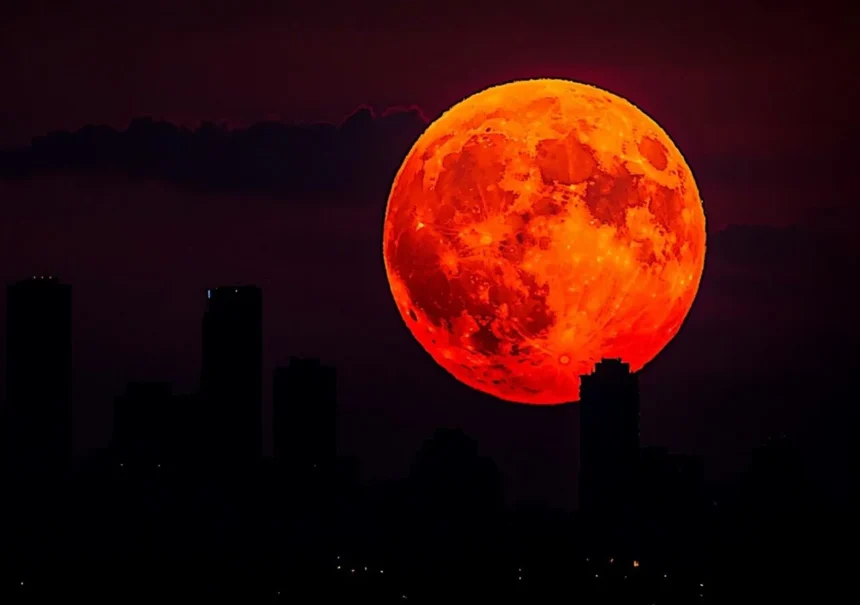
A total lunar eclipse is turning the moon a deep reddish-orange, creating what many call a blood moon. Sky-watchers across Asia, Australia, the Pacific Islands and the Americas can witness the rare celestial event.
A blood moon occurs when Earth moves directly between the sun and the moon. During this alignment, Earth’s shadow covers the moon and filters sunlight through the planet’s atmosphere. This process gives the moon its striking red color, according to NASA.
This eclipse marks the third and final total lunar eclipse in a recent series, said Dr. C. Alex Young from NASA’s Goddard Space Flight Center. The first took place in March 2025, followed by another in September 2025.
If you miss this event, you may need to wait a while. The next total lunar eclipse will occur on December 31, 2028.
When and How to Watch the Eclipse
Many people around the world can watch the eclipse without special equipment. According to experts, you only need to step outside and look up.
However, binoculars or a small telescope can enhance the experience. These tools reveal more detail on the moon’s surface during the eclipse.
Weather conditions may affect visibility. Cloudy skies can block the view, so clear skies offer the best chance to enjoy the event.
The eclipse unfolds in several stages:
-
Penumbral eclipse: Begins at 3:44 a.m. ET as the moon enters Earth’s faint outer shadow.
-
Partial eclipse: Starts at 4:50 a.m. ET when Earth’s shadow begins covering the moon.
-
Total eclipse: Begins at 6:04 a.m. ET as the moon moves completely into the shadow.
-
Peak eclipse: Occurs at 6:34 a.m. ET when the moon shows its deepest red color.
-
Total eclipse ends: At 7:03 a.m. ET as the moon starts leaving the shadow.
-
Final stages end: Around 9:23 a.m. ET.
The peak stage offers the best view of the red moon.
Why the March Full Moon Has Many Names
Even without an eclipse, the March full moon carries several traditional names. Many cultures named full moons based on seasonal changes or natural events.
One common name is the Worm Moon. Early spring warmth causes worms and insects to emerge from the soil. This seasonal change inspired the name.
The Ojibwe (Chippewa) tribes around the Great Lakes call it the Snow Crust Moon. During this time, snow melts during the day but freezes again at night, creating a hard crust.
Some Native American tribes, including the Sioux, Lakota and Assiniboine, refer to it as the Sore Eye Moon. Sunlight reflecting off the snow can cause glare and discomfort to the eyes.
More Full Moons in 2026
Sky watchers will also see an unusual event later in the year. May 2026 will feature two full moons, bringing the yearly total to 13.
This happens because a full moon occurs roughly every 29.5 days, while most months last longer than that. When two full moons occur within one month, the second one is often called a Blue Moon. This phenomenon appears about once every two and a half years.
Astronomy enthusiasts can look forward to several more full moon events throughout 2026.