




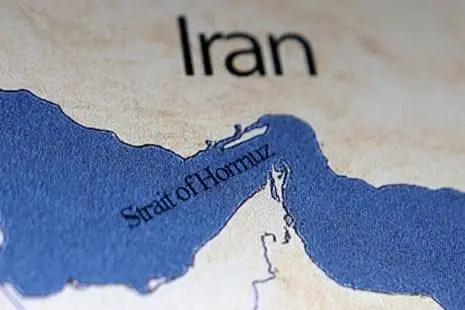
Strait of Hormuz Crisis Deepens as Iran Threatens Offensive Shift
The Strait of Hormuz crisis entered a more dangerous phase on August 17, 2026, after a senior Iranian official told Reuters that Tehran was shifting from a defensive posture to a “fully offensive” one as efforts to secure a permanent agreement with the United States stalled. The official said Iran was prepared to escalate in the Strait of Hormuz and the wider region and could take military action against the U.S. naval blockade if diplomacy failed. The warning came as the 60-day window attached to a June interim agreement expired without a broader settlement.
This does not mean Iran has announced an immediate full closure of the waterway. The more important development is that Tehran is signaling a lower threshold for military escalation at a chokepoint essential to global energy trade. Shipping is already heavily restricted. Kpler data cited by Reuters showed only five commodity vessels transiting the strait on Saturday, August 15, and none registered on Sunday, compared with 31 during the previous weekend.
The Strait of Hormuz crisis matters far beyond Iran and the United States. The International Energy Agency says nearly 20 million barrels per day of crude oil and petroleum products moved through the strait in 2025, equal to about 25% of world seaborne oil trade. Almost 20% of global liquefied natural gas trade also passed through the waterway. A deeper military escalation could affect oil, gas, electricity, shipping, inflation and economic growth across Asia, Europe and beyond.
Strait of Hormuz Crisis: Key Facts
| Issue | Current picture |
|---|---|
| Iranian position | Senior official says policy is shifting from defensive to “fully offensive” |
| Immediate trigger | Deadlock over implementation of June U.S.-Iran interim agreement |
| Current shipping | Five commodity vessels on Aug. 15, none registered Aug. 16, versus 31 the previous weekend |
| Oil through Hormuz in 2025 | About 20 million barrels per day |
| Share of seaborne oil trade | Around 25% |
| LNG through Hormuz | Almost 20% of global LNG trade |
| Oil bypass capacity | Roughly 3.5 to 5.5 million barrels per day |
| Brent crude on Aug. 17 | Around $89 per barrel |
| Brent wartime peak | About $126 per barrel |
The latest Strait of Hormuz crisis is not simply a threat to close a narrow channel. It is a contest over military access, shipping rules, political leverage and the terms under which one of the world’s most important trade routes can operate.
1. Iran’s Offensive Shift Raises the Risk of Direct Military Escalation
The immediate reason the Strait of Hormuz crisis has deepened is Iran’s change in rhetoric and stated posture.
A senior Iranian official told Reuters that Iranian entities should prepare for escalating tensions in the strait and wider region. The official also said Tehran could carry out a military attack intended to break the U.S. naval blockade if Washington does not implement the interim agreement within a period of weeks.
It is a conditional threat, tied publicly to diplomacy. But in a crowded waterway where Iranian, U.S. and Gulf forces operate near commercial shipping, a declared shift toward offensive action increases the chance that coercion could move into direct combat.
The dispute grew out of a memorandum of understanding signed on June 17. Reuters says the agreement called for an end to military operations and established a 60-day period for negotiations over Iran’s nuclear program and U.S. sanctions. It quickly unraveled over competing interpretations of who could manage shipping through Hormuz.
Tehran argues that the agreement supports an Iranian role in managing the strait, which it shares geographically with Oman. Washington rejects that interpretation. Hostilities resumed after Iran fired on vessels it said were using unauthorized routes, while the United States continued using naval pressure and economic measures.
The Strait of Hormuz crisis is therefore about more than whether ships can physically pass. It is also about who determines the conditions under which they pass.
2. Shipping Is Already Far Below Normal Levels
A mistake in assessing the Strait of Hormuz crisis is treating the waterway as either fully open or fully closed.
A chokepoint can remain technically open while commercial traffic collapses because shipowners, charterers, insurers and crews judge the risk too high. Reuters reported that Kpler recorded five commodity vessels crossing on Saturday and none on Sunday, compared with 31 the previous weekend.
Tanker operators have to consider missile or drone attack, seizure, naval interception, port delays, higher insurance premiums and whether cargo can be delivered on schedule.
This means the Strait of Hormuz crisis can damage energy supply without a formal closure.
Reuters also reported on August 17 that Abu Dhabi National Oil Company had sold at least 14 million barrels of spot crude to Asian refiners, while Saudi Aramco was offering some customers crude outside the strait.
The News Ink has previously examined how Hormuz disruption can raise the cost of food, medicines and electronics. Energy is embedded throughout the global economy, so restricted shipping can eventually affect far more than petrol stations.
3. There Is No Easy Replacement for 20 Million Barrels a Day
The scale of the Strait of Hormuz crisis becomes clearer when alternative routes are compared with normal traffic.
The IEA estimates that almost 20 million barrels per day of crude oil and oil products passed through Hormuz in 2025. Roughly 15 million barrels per day were crude and condensates, while close to 5 million barrels per day were refined products. Around 80% of the total oil flow was destined for Asia.
By contrast, the IEA estimates that only about 3.5 to 5.5 million barrels per day of available pipeline capacity could potentially redirect crude around the strait.
Saudi Arabia has the largest alternative system through its East-West pipeline to the Red Sea. The United Arab Emirates can move some crude through the Abu Dhabi Crude Oil Pipeline to Fujairah, outside Hormuz.
Other Gulf exporters are even more exposed. Iraq, Kuwait, Qatar, Bahrain and Iran itself depend heavily on Hormuz for oil exports.
The Strait of Hormuz crisis also creates an unusual problem for emergency supply. Much of the world’s spare crude production capacity sits in the Gulf. If the route for exporting that oil is restricted, simply pumping more crude does not solve the problem. The IEA says prolonged disruption could therefore remove both existing exports and access to much of the spare capacity normally used to cushion an oil shock.
That is why a relatively small change in the Strait of Hormuz crisis can move global oil prices quickly.
4. The LNG Shock Could Be Even Harder to Replace
Oil gets most of the attention during the Strait of Hormuz crisis, but liquefied natural gas may be even harder to reroute.
The IEA says just over 112 billion cubic metres of LNG passed through Hormuz in 2025, equal to almost 20% of global LNG trade. About 93% of Qatar’s LNG exports and 96% of the UAE’s LNG exports used the strait.
Unlike crude oil, Qatari LNG has no equivalent large-capacity pipeline that can redirect exports to another ocean terminal. The IEA says there are no alternative routes capable of replacing LNG exports from Qatar and the UAE at short notice. A prolonged interruption could remove more than 300 million cubic metres of gas per day from the global LNG market.
Asia has the most direct exposure. Almost 90% of LNG exported through Hormuz in 2025 went to Asian markets. Bangladesh, India and Pakistan obtained almost two-thirds of their LNG supplies through the strait.
That makes the Strait of Hormuz crisis particularly important for South Asia. The IEA says gas-fired generation represented about 25% of Pakistan’s electricity mix in 2024, while gas also supports fertilizer and other industries. A prolonged LNG shortage could therefore mean more expensive electricity and industrial disruption.
Europe would feel the shock too because LNG is globally traded. If Asian buyers bid aggressively for replacement cargoes, European importers may face higher prices even with lower direct dependence. The IEA says a loss approaching one-fifth of global LNG supply would drive major price volatility.
5. Oil Prices Have Fallen From Their Peak, but the Risk Has Not Disappeared
The Strait of Hormuz crisis has already produced extreme oil-price volatility in 2026.
Reuters reported that Brent crude reached a wartime peak of about $126 per barrel, roughly 75% above pre-war levels. By August 17, Brent was trading at around $89 per barrel.
That decline does not mean markets believe the crisis is over. Traders are balancing two possibilities: renewed escalation that further restricts Gulf exports, and a diplomatic agreement that allows shipping to normalize and pushes oil prices lower.
The danger is a new event that changes physical supply.
An actual halt to remaining crude movements, major damage to export infrastructure, a prolonged confrontation in Hormuz or simultaneous disruption around Bab el-Mandeb could trigger another sharp repricing. An analyst cited by Reuters said a complete halt to current crude flows or closure of Bab el-Mandeb would be among the developments capable of driving prices materially higher.
The News Ink has followed the oil-price response to U.S.-Iran negotiations. Diplomacy itself has become an energy-market variable.
The wider economic risk from the Strait of Hormuz crisis is also significant. The News Ink previously covered a warning that $150 oil could threaten global growth. A return toward those levels would raise transport, manufacturing and consumer costs when many economies are already sensitive to inflation.
6. The Military Risk Extends Beyond Hormuz
The Strait of Hormuz crisis cannot be separated from the wider regional conflict.
Reuters reports that thousands of people have been killed since U.S. and Israeli attacks on Iran began on February 28, with most casualties occurring in Iran and Lebanon. Iran has also struck U.S. assets and infrastructure across several regional states.
A deterioration at both Hormuz and Bab el-Mandeb would make the Strait of Hormuz crisis much harder for global shipping to absorb. Reuters reported on August 17 that Iran-backed Houthis had claimed attacks against a Saudi military ship and escort vessels in the Bab el-Mandeb area, although Saudi authorities had not immediately confirmed the claim.
The military environment also creates a risk of miscalculation. Naval patrols, drones, missiles, commercial convoys and armed forces from several countries operate in overlapping areas. An attack intended as a limited warning can be interpreted as the start of a wider offensive.
For that reason, the Strait of Hormuz crisis should not be reduced to whether Iran can keep the waterway closed indefinitely. A sequence of limited attacks, seizures and confrontations could be economically disruptive even if some commercial traffic continues.
The News Ink has also covered the UK and France defensive Hormuz mission, reflecting how security around the waterway has become an international concern.
7. Diplomacy Is Still the Most Important Variable
The most important variable in the Strait of Hormuz crisis is whether diplomacy can create shipping and security rules that the parties will actually observe.
The June memorandum was intended to end hostilities and create time for negotiations. Instead, the parties disagreed over Hormuz and the arrangement unraveled.
Iran has separately been negotiating with Oman over management of the strait. Iranian officials say those talks are close to an agreement but have moved slowly because of the number of actors and the complexity of the issue.
Oman matters because it sits on the southern side of the waterway and has traditionally served as a mediator between Iran and Western governments. The Strait of Hormuz crisis became more volatile on August 17 when U.S. President Donald Trump threatened Oman if it obstructed American efforts, adding pressure to a mediator already trying to bridge sharply different positions.
For Iran, influence over Hormuz provides strategic leverage against a stronger U.S. military and against sanctions. For Washington and its partners, reliable commercial navigation is treated as essential to energy security.
The Strait of Hormuz crisis is unlikely to become stable until there is a workable arrangement covering shipping routes, military activity and the wider sanctions and nuclear disputes driving the confrontation.
What Does “Fully Offensive” Actually Mean?
Iran has not publicly provided a detailed operational definition of its new posture.
“Fully offensive” could mean more aggressive action against military assets, greater pressure on commercial ships, expanded drone and missile operations, attempts to challenge the U.S. blockade or action elsewhere in the region. Those are possible interpretations of the stated posture, not confirmed operational plans.
Iran also has reasons not to make Hormuz permanently unusable. It depends on Gulf trade and oil revenues, while a total closure would hurt major Asian customers as well as adversaries and could provoke a larger military response. The IEA’s data show that Iran itself exported around 2.4 million barrels per day of crude and petroleum products through Hormuz in 2025.
The more plausible near-term risk in the Strait of Hormuz crisis may therefore be intermittent coercion rather than a permanent blockade: attacks, selective restrictions, seizures, disputed transit rules and periods of sharply reduced shipping.
The Strait of Hormuz crisis can still be highly damaging because energy markets price uncertainty as well as physical shortages.
Could the Strait Be Completely Closed?
A total closure is possible if warfare makes commercial navigation temporarily impossible. Keeping the route closed for a long period would be much harder.
The IEA says the Strait of Hormuz is only 29 nautical miles, or about 54 km, wide at its narrowest point. Inbound and outbound commercial traffic moves through separate two-mile-wide navigable channels with a two-mile buffer between them.
At the same time, maintaining a closure against sustained U.S. and regional military efforts would be dangerous for Iran and costly for Gulf economies. The IEA assessed that lasting disruptions were unlikely while warning that even short interruptions would have substantial oil-market consequences.
The better question is whether military action can reduce traffic enough, for long enough, to create an energy shock.
The 2026 Strait of Hormuz crisis has already demonstrated that severe disruption does not require every ship to stop moving. Reuters’ latest shipping data show how dramatically traffic can fall even while the route remains technically passable.
What Happens Next
Five developments will show whether the Strait of Hormuz crisis is moving toward containment or deeper escalation:
- Iran’s deadline: Tehran says the United States has only weeks to implement provisions of the interim agreement before further decisions are taken.
- Shipping volumes: A sustained recovery in tanker and commodity traffic would be one of the clearest signs that risk is easing.
- Iran-Oman talks: A practical agreement over management of the waterway could support a wider diplomatic settlement.
- U.S. military policy: A broader blockade or new strikes could increase the likelihood of the offensive response Iran is threatening.
- Oil and LNG prices: Energy markets will continue reacting rapidly to changes in physical supply and diplomatic prospects.
The Strait of Hormuz crisis is dangerous because diplomacy, military action and energy markets now reinforce each other. A statement can change shipping behavior. A shipping incident can change oil prices. Higher prices can then alter domestic politics and negotiating positions.
Frequently Asked Questions
What did Iran threaten to do in the Strait of Hormuz?
A senior Iranian official told Reuters on August 17 that Iran was shifting from a defensive to a “fully offensive” posture and could escalate in the Strait of Hormuz and wider region if the United States did not implement the June interim agreement. The official also threatened military action aimed at breaking the U.S. naval blockade if diplomacy failed.
Is the Strait of Hormuz currently closed?
Not completely, but shipping is heavily restricted. Reuters reported that Kpler recorded five commodity-vessel transits on August 15 and none on August 16, compared with 31 during the previous weekend. Ship-tracking data may not capture every vessel, particularly when transponders are switched off.
How much oil normally passes through Hormuz?
The IEA estimates that nearly 20 million barrels per day of crude oil and petroleum products passed through the strait in 2025, around 25% of global seaborne oil trade.
How much LNG passes through the Strait of Hormuz?
Almost 20% of global LNG trade passed through Hormuz in 2025, mostly from Qatar. The IEA says those exports cannot be readily replaced through alternative routes.
Can pipelines replace the Strait of Hormuz?
Only partly. The IEA estimates Saudi Arabia and the UAE have roughly 3.5 to 5.5 million barrels per day of available capacity that could potentially bypass Hormuz, far below normal oil flows through the waterway.
Conclusion
The Strait of Hormuz crisis has entered a more dangerous phase because Iran is no longer describing its posture as purely defensive. Tehran is warning that it may escalate military pressure if diplomacy fails, while shipping remains severely restricted and the June interim agreement has not produced a permanent settlement.
That does not mean a full-scale attack or total closure is inevitable. Iran’s threat is conditional, and all sides have powerful economic reasons to avoid uncontrolled escalation.
But the exposure is enormous. Nearly 20 million barrels per day of oil and oil products moved through Hormuz in 2025. Almost one-fifth of global LNG trade also relied on the same narrow passage. Alternative oil pipelines can replace only a fraction of that volume, while Qatari LNG has no comparable route around the strait.
The Strait of Hormuz crisis therefore does not need to end in a complete blockade to hurt the global economy. Restricted shipping, insurance costs, selective attacks and uncertain navigation rules can reduce supply and raise prices.
The most important dispute may ultimately be over rules rather than territory: who can transit, who can enforce those rules and what military presence each side will tolerate.
Until Washington, Tehran and regional mediators find an arrangement that answers those questions, the Strait of Hormuz crisis will remain one of the world’s most economically consequential flashpoints.
For consumers and businesses far from the Gulf, the consequences can still arrive through fuel bills, electricity prices, shipping costs and inflation.
Follow The News Ink
Stay connected with The News Ink for world news, geopolitics, business, technology, health and sports coverage.
Follow us on X, Instagram, Threads, TikTok, Bluesky and Mastodon.
For longer-form reporting and analysis, follow The News Ink on Medium, Substack and Quora, or discover visual stories on Pinterest.


