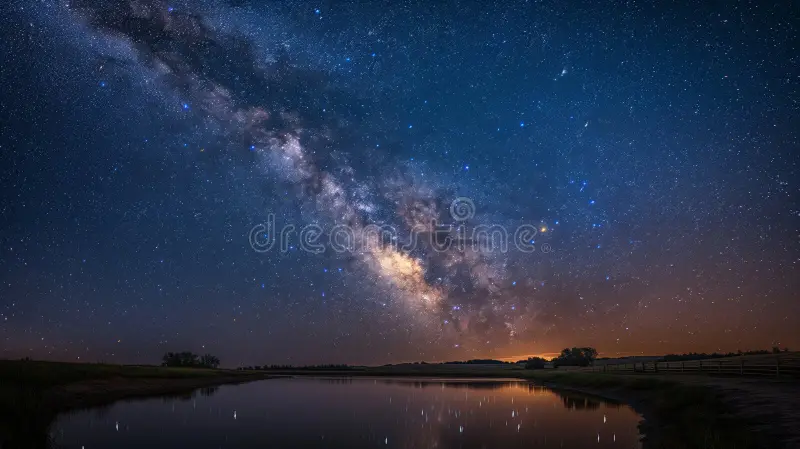
Star Bathing in Rural Wales: A Magical Night Under the Milky Way
Star bathing begins with darkness. Not the thin darkness of a city street, broken by headlights, shop signs and bedroom windows, but the old kind of darkness that makes the first star feel like an event. In rural Wales, that darkness is part of the journey. You leave the main roads, pass through small villages, wait for the clouds to move, and then the sky seems to open.
Near Llanddewi-Brefi in Ceredigion, star bathing feels less like a tourist activity and more like a quiet reset. At first, thick cloud can hide everything. The fields, hills and lanes sit under a flat grey lid. Then, sometimes suddenly, the cover breaks. Jupiter appears first, bright and steady. Orion’s Belt becomes visible, three stars in a line that even nervous beginners recognise. Then the whole sky arrives at once: scattered stars, faint misty bands, darker patches, and the deep suggestion that the night is much larger than daily life allows us to remember.
That is the real appeal of star bathing. It is not only astronomy. It is astrotourism, wellness, landscape, silence and imagination joined together. A guide may point out constellations with a laser, tell stories from Welsh skies or explain why a star’s light has travelled across impossible distances. But the point is not to pass an exam. The point is to lie back, breathe slowly and feel what a dark sky does to the body.
What Star Bathing Means
Star bathing is often described as the night-sky cousin of forest bathing, the Japanese-inspired practice of slowing down in woodland and paying attention to the senses. Instead of trees, leaves and birdsong, star bathing uses darkness, cold air, open space and celestial light. Participants usually gather in a low-light location, wrap up warm, lie on blankets or reclining chairs, and spend time looking upward without rushing.
A normal stargazing event can be heavily scientific. That can be wonderful for people who want telescope detail, star charts and technical language. Star bathing is different. It welcomes people who may not know the difference between a planet and a star but still feel drawn to the sky. It asks visitors to notice how the night sounds, how the air feels, how the eyes slowly adjust and how the mind changes when the phone stays in a pocket.
In Mid Wales, Serydda offers guided dark-sky experiences in the Cambrian Mountains. Its founder, Dafydd Wyn Morgan, is described by Serydda as one of Wales’ leading night-sky photographers and guides, based around Tregaron, and the company says its sessions are open to people with no prior astronomy knowledge. That matters because star bathing is strongest when it feels accessible. The sky is not reserved for experts.
Why Rural Wales Is Made for Dark-Sky Travel
Star bathing works best where artificial light is limited, and Wales has become one of Britain’s strongest dark-sky destinations. Its mountains, reservoirs, coastal edges, moorland and farming landscapes create pockets of darkness that are increasingly rare in urban Britain. The Cambrian Mountains, stretching through Mid Wales, are especially suited to slow night travel because they combine low population density with dramatic horizons and quiet roads.
The Cambrian Mountains Astro Trail links nine Dark Sky Discovery Sites, including locations around Ceredigion, Powys and Carmarthenshire. Visit Wales lists sites such as Coed Y Bont, Hostel Dolgoch, Hostel Ty’n y Cornel near Llanddewi-Brefi, Pont ar Elan and Llyn Brianne Reservoir. For visitors, that means star bathing can become part of a wider rural trip rather than a single isolated event.
Wales also has internationally recognised dark-sky areas. Bannau Brycheiniog National Park became Wales’ first International Dark Sky Reserve in 2013, while Eryri, also known as Snowdonia, was designated in 2015. Elan Valley is recognised as a Dark Sky Park. These designations matter because they protect something modern life is rapidly losing: a night sky that still looks like night.
For travel readers, the experience connects naturally with The News Ink’s wider coverage of unusual and reflective trips, from spring getaways to the aurora guide. This belongs in the same slow-travel world, where the point is not to tick off attractions but to feel a place differently.
The Moment the Sky Opens
One reason star bathing in rural Wales is so memorable is that the weather makes no promises. A visitor can arrive under heavy cloud and wonder whether the whole plan has failed. The guide may tell people to wait. Blankets are spread out. Flasks come open. Eyes adjust to the dim outline of fields and hills. For a while, the sky is only darkness.
Then a gap appears. One star becomes five. Five become hundreds. The cloud thins, the horizon brightens with points of light, and the mood changes immediately. People who were chatting quietly fall silent. Someone recognises Jupiter. Someone else sees Orion. A shooting star may cut across the sky so quickly that half the group misses it and the other half gasps like children.
That emotional shift is central to star bathing. The experience asks for patience, which makes the reward feel earned. Unlike a museum, a performance or a screen, the sky cannot be fully scheduled. Clouds may arrive. Moonlight may brighten the view. A meteor may appear when nobody is ready. The lack of control is part of the appeal.
It also gives visitors a sense of scale that is hard to find in daily life. A constellation is not just a pattern. It is a reminder that human history has unfolded under the same sky. Farmers, sailors, poets, shepherds, astronomers and children have looked up for navigation, weather, myth, worship, science and comfort. Star bathing turns that shared inheritance into a present-moment experience.
Astrotourism Is Becoming a Serious Travel Trend
Star bathing is part of a wider rise in astrotourism and noctourism. Travellers are increasingly looking for darker destinations, cooler night-time activities and experiences that feel restorative rather than crowded. Booking.com’s 2025 travel predictions reported that 62% of travellers showed interest in darker-sky destinations, reflecting a wider appetite for stargazing, star tracking and night-based travel.
The trend makes sense. Many people live in overlit cities, spend long hours on screens and rarely see more than a handful of stars. A weekend under dark skies can feel surprisingly emotional because it restores something people did not realise they were missing. In that sense, star bathing is not only a travel trend; it is a reaction against overstimulation.
Astrotourism also helps rural areas. A night-sky visitor may book accommodation, eat locally, hire a guide, buy warm clothing, visit during the off-season and explore nearby villages during the day. Dark skies can extend tourism beyond summer and encourage people to value landscapes after sunset, not only in daylight.
That opportunity must be handled carefully. Rural darkness is fragile. Too many cars, bright security lights, poorly managed accommodation or irresponsible visitors can damage the very experience people came to enjoy. Successful star bathing depends on low-impact tourism: small groups, careful parking, respect for residents, dim red lights, and guides who understand both astronomy and place.
The Light Pollution Problem
The value of star bathing becomes clearer when set against the scale of light pollution. The New World Atlas of Artificial Night Sky Brightness found that more than 80% of the world’s population, and more than 99% of people in the United States and Europe, live under light-polluted skies. It also found that the Milky Way is hidden from more than one-third of humanity, including about 60% of Europeans.
In the UK, CPRE’s Star Count 2023 found that only 5% of people could enjoy a truly dark starry sky, while three-quarters had their view of the night sky obscured. Those figures explain why a clear night in rural Wales can feel almost shocking. The stars were never rare; access to darkness became rare.
Light pollution is not only an inconvenience for amateur astronomers. DarkSky International notes that artificial light at night can disrupt natural rhythms, with consequences for sleep quality and wider wellbeing. It can also affect wildlife, migration, insects and ecosystems. The National Park Service explains that light pollution includes glare, light trespass and skyglow, all of which reduce visibility and alter the night environment.
This is where star bathing becomes more than a wellness activity. It can make people care about darkness. Once someone has seen the Milky Way from a field in Wales, street lighting no longer feels like a small issue. The visitor understands what has been lost and why protected dark places matter.
What You Might See During a Star Bathing Session
A good star bathing session does not require expensive equipment, but it helps to know what the sky might offer. In winter and early spring, Orion is one of the easiest constellations to identify, with Orion’s Belt forming a clear three-star line. Jupiter, Venus, Mars and Saturn can be visible at different times depending on the season and planetary positions. The Moon can be spectacular through binoculars, although a bright Moon can reduce the number of faint stars visible.
On dark, moonless nights, visitors may see the Milky Way as a cloudy band across the sky. Meteor showers, such as the Perseids in August or the Geminids in December, can add sudden drama. The Pleiades star cluster, the Great Plough, Cassiopeia and the North Star are also popular targets for beginner stargazers in Britain.
| What to look for | Best conditions | Why it matters |
|---|---|---|
| Milky Way | Clear, moonless, very dark skies | Shows what city skies usually hide |
| Orion’s Belt | Winter evenings | Easy first constellation marker |
| Jupiter or Venus | Depends on season | Bright planets build confidence |
| Meteor showers | Peak shower dates, patient viewing | Adds excitement to the night |
| Pleiades | Autumn and winter | Beautiful cluster visible to the naked eye |
| Moon details | Crescent or partial phases | Good for binoculars and beginners |
Guided star bathing helps because the guide can translate the sky without overwhelming the group. A green laser can point out patterns, but the best guides also know when to stop talking. Silence is part of the experience.
The Wellness Side: Calm Without Overclaiming
It would be wrong to claim that this practice cures anxiety, fixes insomnia or solves the health effects of modern life. That would turn a beautiful experience into marketing nonsense. Still, it is reasonable to say that spending quiet time under a dark sky can feel calming, reflective and restorative.
Part of that comes from attention. Looking at the stars requires a different pace. The eyes take time to adjust. The body notices cold air. The ear catches small sounds in the grass or trees. The mind has fewer visual distractions. For people used to phones, traffic and constant brightness, star bathing creates a rare pause.
There is also a humility effect. Under a wide sky, personal worries may not disappear, but they often change size. The distance of stars and planets is hard to comprehend, and that difficulty can be comforting. Human problems remain real, but the night places them inside a larger frame.
This connects with The News Ink’s coverage of balanced lifestyle and sleep quality. Star bathing should not replace healthy routines, but it can support a slower relationship with evening, darkness and rest. It reminds people that night does not have to be only screen time, work catch-up or artificial light.
How to Plan a Star Bathing Trip in Wales
Planning matters because dark-sky travel depends on weather, timing and comfort. The first rule is to check the Moon. A full Moon is beautiful, but it can wash out faint stars and the Milky Way. A new Moon or thin crescent usually gives darker conditions. The second rule is to check cloud forecasts, but not to give up too early. Rural Wales can change quickly, and a cloudy evening may still clear later.
Warm clothing is essential. Even in mild seasons, lying still at night can become cold. Layers, hats, gloves, thick socks, waterproof shoes, a blanket and a hot drink can decide whether the experience feels magical or miserable. A reclining chair or insulated mat can help. Binoculars are useful but not required.
Use a red-light torch rather than a bright white phone light. White light ruins night vision and can disturb others. Download maps before travelling, because rural signal can be unreliable. Tell someone where you are going if exploring independently, and avoid trespassing. Better still, start with a guided session.
| Planning factor | Better choice | Why it helps |
|---|---|---|
| Moon phase | New Moon or thin crescent | Darker sky for faint stars |
| Clothing | Layers, hat, gloves, waterproof footwear | Wales can feel cold at night |
| Light | Red torch or dimmed red phone mode | Protects night vision |
| Location | Official dark-sky sites or guided sessions | Safer and more respectful |
| Timing | Arrive before full darkness | Easier to settle in safely |
| Group size | Small, quiet groups | Better atmosphere and less disruption |
Visitors should also think about daytime plans. A star bathing trip to Ceredigion or the Cambrian Mountains can pair well with walking, local food, reservoirs, village stays and slow rural touring. The best night-sky trips are not rushed.
Why Guides Matter
Anyone can look up, but a good guide changes the experience. Dafydd Wyn Morgan’s Serydda sessions, for example, combine practical sky knowledge with landscape awareness. The guide knows where to stand, where light pollution is lowest, where cars can safely stop, how cloud is moving, and what a beginner is likely to recognise first.
Guides also make star bathing feel less intimidating. Some visitors worry that astronomy is too technical. Others worry about being in remote places after dark. A guided session gives structure without removing wonder. It turns the sky into a shared experience rather than a solitary guess.
There is also a storytelling role. Welsh landscapes carry myth, language and history. A guide can connect constellations to older sky stories, local place names, farming rhythms and the human habit of reading meaning into the stars. That cultural layer makes star bathing richer than simply spotting bright objects.
For people who later want more science, the experience can be a doorway. They may begin with Orion and Jupiter, then move toward telescopes, lunar photography, meteor showers, eclipses or astronomy apps. The News Ink’s space and astronomy coverage is a natural next step for readers who leave a dark-sky night wanting to understand more.
The Emotional Power of True Darkness
Many people do not realise how rarely they experience real darkness. Urban night is usually orange, blue-white or grey. There is always a lamp, a window, a sign, a car, a screen. In rural Wales, the absence of light can feel strange at first. Then it begins to feel protective.
That darkness changes how people behave. Voices lower. Movements slow. The group becomes aware of small things: breath in cold air, distant water, boots on wet ground, a sheep moving somewhere beyond sight. When the stars appear, the scene feels earned because the darkness prepared the mind for it.
This is why visitors sometimes become emotional during star bathing. A shooting star can feel like a private gift, even though it is a natural event. The Milky Way can make a person feel small in the best possible way. Seeing a child or adult witness a truly dark sky for the first time reminds us that wonder is not childish. It is human.
The Future of Star Bathing in Wales
Star bathing has strong growth potential in Wales, but its future depends on protecting the conditions that make it special. Better lighting design, shielded fixtures, warmer-coloured bulbs, reduced unnecessary overnight lighting and community awareness can all help. Tourism businesses can support dark skies by avoiding floodlights, guiding visitors responsibly and treating darkness as an asset rather than a problem.
There is also room for more accessible experiences. Not everyone can lie on the ground or walk far in the dark. Some visitors need seated sessions, accessible parking, shorter events, warmer indoor breaks or family-friendly formats. The more inclusive star bathing becomes, the more people can understand why dark skies matter.
The strongest version of Welsh astrotourism will not be the loudest or most commercial. It will be careful, local and respectful. Small groups under a large sky. Good guides. Quiet accommodation. Clean lighting. Clear information. A sense that the night belongs not only to tourists, but to residents, wildlife and future generations.
A Night Under the Milky Way
Star bathing in rural Wales is magical because it restores scale. It takes people away from bright cities and places them under a sky that feels ancient, alive and shared. It does not require deep astronomy knowledge. It asks only for patience, warm clothes and a willingness to look up.
Near Llanddewi-Brefi, when the clouds clear and the stars stretch across the Cambrian Mountains, the experience becomes difficult to reduce to a travel trend. It is quieter than that. A bright planet, a familiar constellation, a streaking meteor and the pale band of the Milky Way can make the night feel newly discovered.
That is what star bathing offers: not escape from the world, but a better way of standing inside it. For a few hours, the noise drops away, the sky expands, and darkness becomes something to treasure.
For more travel, culture and nature stories, follow The News Ink on Instagram or explore our wider travel coverage.