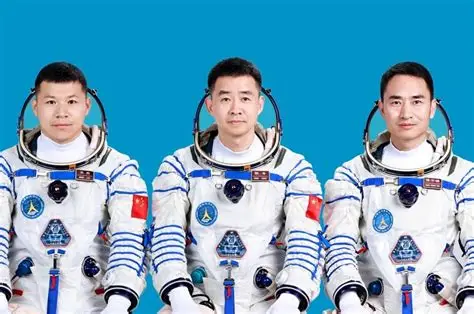
Hong Kong astronaut Li Jiaying Shenzhou-23 2026 has made history after the 43-year-old police officer and mother of three became the first person from Hong Kong ever to reach space. Li launched aboard China’s Shenzhou-23 spacecraft on Sunday night from the Jiuquan Satellite Launch Center in the north-west Gobi desert, lifting off at 23:08 local time on the Long March 2-F rocket before docking at China’s Tiangong space station a few hours later. Large crowds waved Chinese flags as the rocket carried her and two fellow astronauts toward orbit.
Li serves as the payload scientist in the three-member crew — a role that places her at the centre of the scientific experiments the mission is designed to conduct. The mission represents not only a personal milestone for Li but a historic moment for Hong Kong, for China’s space programme, and for the accelerating race between China and the United States to return humans to the surface of the moon.
Hong Kong Astronaut Li Jiaying Shenzhou-23 2026: Who Is Li Jiaying?
The Hong Kong astronaut Li Jiaying Shenzhou-23 2026 story begins with a woman whose life before space was already extraordinary by any conventional measure. Li is 43 years old, a serving Hong Kong police officer, and the mother of three children — a combination that makes her selection as China’s first Hong Kong-born astronaut all the more remarkable and resonant.
Her role aboard Shenzhou-23 is that of payload scientist — the crew member responsible for overseeing and conducting the scientific experiments that form the core of the mission’s research objectives. That designation reflects both her scientific training and the broader purpose of a mission explicitly designed to push the boundaries of human knowledge about long-duration spaceflight.
Li has spoken about her motivation for pursuing space with characteristic directness. She cited Yang Liwei — the first person ever sent to space by China’s space programme — as her inspiration. When asked about her decision to apply, her response was simple and compelling. “This is a rare chance. Why not try?” she said.
As she made her way to the launch pad on Sunday, Li delivered a statement that captured both personal pride and national sentiment simultaneously. “How high our Chinese spacecraft flies, that’s how high we can hold our heads high,” she said — words that resonated across Hong Kong and mainland China as the launch countdown proceeded.
Li Jiaying — key profile facts:
- Age: 43 years old
- Hometown: Hong Kong
- Profession before astronaut selection: Police officer
- Family: Mother of three children
- Role on Shenzhou-23: Payload scientist
- Historic distinction: First person from Hong Kong to reach space
- Inspiration: Yang Liwei — the first Chinese person to reach space
- Mission: Shenzhou-23 to China’s Tiangong space station
Hong Kong Chief Executive John Lee described Li’s inclusion in the mission as a “historic” moment for the city — an assessment that few would dispute. Her selection and successful launch places Hong Kong at the centre of one of the most significant moments in China’s expanding space programme.
Hong Kong Astronaut Li Jiaying Shenzhou-23 2026: The Full Crew
The Hong Kong astronaut Li Jiaying Shenzhou-23 2026 mission carries a three-person crew whose combined backgrounds reflect the diversity of expertise required for a complex long-duration spaceflight mission.
The Shenzhou-23 crew:
| Astronaut | Age | Background | Role |
|---|---|---|---|
| Li Jiaying | 43 | Hong Kong police officer | Payload scientist |
| Zhu Yangzhu | 39 | Space engineer | Mission specialist |
| Zhang Zhiyuan | 39 | Former air force pilot | Mission commander |
Zhang Zhiyuan’s background as a former air force pilot places him in the tradition of military aviators who have dominated space programme selections across both Chinese and American programmes since the earliest days of human spaceflight. Zhu Yangzhu’s engineering background gives the crew technical depth for the hardware and systems challenges that long-duration spaceflight inevitably presents. Li’s scientific role ensures the mission’s research objectives are managed by a dedicated specialist.
Hong Kong Astronaut Li Jiaying Shenzhou-23 2026: The Year-Long Mission
The Hong Kong astronaut Li Jiaying Shenzhou-23 2026 mission includes one of the most ambitious elements of China’s human spaceflight programme to date — a planned full year in orbit for at least one member of the crew. Authorities have stated they will determine which crew member undertakes the year-long stay at a later date.
If completed, the year-long stay will rank among the longest continuous human presences in space in recorded history. It falls just short of the all-time record — a remarkable 14-month stay completed by Russian cosmonaut Valery Polyakov in 1995 — but would represent an extraordinary achievement for China’s space programme and a significant advance in its capability to support long-duration human presence beyond Earth.
Richard de Grijs, an astrophysicist and professor at Macquarie University in Australia, provided expert context on the significance of the planned duration. “A year in orbit pushes both hardware and humans into a different operational regime compared with the shorter Shenzhou missions of the programme’s earlier phases,” he said — an assessment that captures both the technical and human dimensions of what the mission is attempting.
The year-long stay — key facts and context:
- At least one crew member will spend a full year in orbit — which crew member to be determined later
- Would be among the longest continuous stays in space in human history
- Falls just short of the 14-month record set by Russian cosmonaut Valery Polyakov in 1995
- Previous Shenzhou missions have operated on six-month rotation cycles since 2021
- The extended duration pushes both human physiology and spacecraft hardware into new territory
- China has been building expertise in long-duration spaceflight systematically since Tiangong became operational
- The year-long mission directly supports China’s goal of sending humans to the moon by 2030
- Data gathered will inform planning for the extended durations required by deep space exploration
The shift from six-month to twelve-month missions represents a qualitative leap in operational complexity — not merely an extension of existing practices but an entry into a different category of human spaceflight challenge that only a handful of missions in history have attempted.
Hong Kong Astronaut Li Jiaying Shenzhou-23 2026: Scientific Objectives
The Hong Kong astronaut Li Jiaying Shenzhou-23 2026 mission carries a substantial scientific research agenda centred on understanding the effects of the space environment on the human body — knowledge that is essential for any future attempt to send humans on the extended journeys required for lunar or deep space missions.
The study of microgravity’s effects on the human body is the primary scientific focus. Extended exposure to microgravity produces well-documented physiological changes across multiple body systems — bone density loss, muscle atrophy, cardiovascular changes, fluid shifts, and effects on vision and cognitive function. Understanding how these changes manifest and progress over a full year — rather than the six-month standard — will generate data of significant scientific and operational value.
Shenzhou-23 scientific objectives:
- Studying the effects of microgravity on the human body — the mission’s primary research focus
- Collecting data on physiological changes across a full year rather than the standard six months
- Bone density, muscle mass, cardiovascular function, and vision among the key monitored parameters
- The data will directly inform preparation for lunar missions requiring extended durations
- Li Jiaying as payload scientist will oversee and conduct the scientific experimental programme
- Multiple additional experiments beyond human physiology research form part of the mission manifest
- The year-long duration itself is an experiment — testing both human and hardware endurance limits
The scientific data gathered by Shenzhou-23 will feed directly into China’s preparations for lunar missions — where astronauts will face extended periods of isolation, radiation exposure, and physiological stress that require thorough advance understanding and countermeasure development.
Hong Kong Astronaut Li Jiaying Shenzhou-23 2026: China’s Space Race With the US
The Hong Kong astronaut Li Jiaying Shenzhou-23 2026 launch takes place within the context of an accelerating competition between China and the United States to return humans to the surface of the moon — a race whose intensity has grown significantly in recent years as both programmes have made concrete progress toward their respective lunar goals.
China has set 2030 as its target for a crewed lunar landing — an ambitious but increasingly credible timeline given the progress its space programme has demonstrated across recent years. The United States is targeting a crewed lunar return by 2028 through the Artemis programme — a two-year head start that the Americans hope to maintain despite significant technical and budgetary challenges.
The Shenzhou-23 mission contributes directly to China’s lunar timeline by building the human spaceflight expertise and physiological data that any credible lunar programme requires. A year-long mission in orbit provides the kind of operational experience and scientific foundation that cannot be acquired any other way.
China’s space programme — recent achievements and upcoming milestones:
- 2021: Tiangong space station becomes operational — six-month crew rotations begin
- 2024: Chang’e-6 successfully recovers rock samples from the far side of the Moon — a world first
- 2026: Shenzhou-23 launches with first Hong Kong astronaut — year-long mission planned
- 2026: China plans an orbital test flight of the Mengzhou spacecraft — designed to carry astronauts to the moon
- 2030: China’s target date for a crewed lunar landing
- 2028: United States’ target date for a crewed lunar return through the Artemis programme
The 2024 Chang’e-6 mission — which recovered rock samples from the lunar far side for the first time in history — demonstrated China’s capability to conduct landmark space exploration missions. The upcoming Mengzhou orbital test flight will advance the lunar crewed mission programme directly.
Hong Kong Astronaut Li Jiaying Shenzhou-23 2026: The Political Significance
The Hong Kong astronaut Li Jiaying Shenzhou-23 2026 mission carries political dimensions that extend beyond pure science and exploration. Analysts speaking to media outlets noted that stories of successful Hong Kong figures like Li could help Chinese authorities cultivate patriotism — particularly among younger generations in Hong Kong — in ways that more overtly political messages cannot achieve.
Li’s selection as China’s first Hong Kong astronaut is not politically neutral — it is a deliberate and visible statement about Hong Kong’s place within China’s national narrative and its participation in the country’s most prestigious and inspiring achievements. A Hong Kong police officer — a figure whose institutional role carries its own political resonance in the post-2019 context — reaching space aboard a Chinese rocket sends a message that is simultaneously scientific, cultural, and political.
The political dimensions of Li’s mission:
- Hong Kong Chief Executive John Lee described the moment as “historic” for Hong Kong
- Li’s selection gives Hong Kong a direct and visible stake in China’s most celebrated national achievement
- Analysts suggest the story of a successful Hong Kong figure could strengthen patriotic feeling among Hong Kong youth
- Li’s profession — police officer — adds institutional resonance given Hong Kong’s post-2019 political context
- Her statement about how high Chinese spacecraft fly — and heads held high — carried obvious patriotic resonance
- The mission places Hong Kong within China’s national space narrative in a concrete and personal way
Final Word on Hong Kong Astronaut Li Jiaying Shenzhou-23 2026
The Hong Kong astronaut Li Jiaying Shenzhou-23 2026 story is ultimately about a 43-year-old woman who asked herself a simple question — “this is a rare chance, why not try?” — and then spent years doing the work required to make the answer matter.
She is a police officer. She is a mother of three. She is a scientist. And as of Sunday night, she is history — the first person from Hong Kong to look down at Earth from the darkness of space.
How high the spacecraft flies. How high the heads held high.
Up there, orbiting in the Tiangong station with her crewmates, Li Jiaying is not merely representing Hong Kong or China or any political narrative. She is representing the human capacity to reach beyond what seemed possible — and to answer the question of why not try with the only answer that truly satisfies.
Because it is worth it. And because she could.
MORE INFO ON THE NEWS INK SCIENCE.