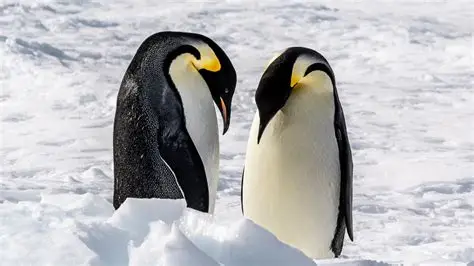
Emperor Penguins Face Danger During Annual Moult as Antarctic Sea Ice Breaks Apart
Emperor penguins face danger during one of the most important and least understood stages of their lives: the annual moult, when they must replace old feathers with new waterproof plumage before returning to the freezing Southern Ocean.
A new study led by British Antarctic Survey scientist Dr Peter Fretwell has revealed that emperor penguins face danger not only while raising chicks on sea ice, but also during the weeks after breeding when adults and older juveniles gather on floating ice platforms to shed and regrow their feathers. The finding broadens the climate-risk picture for one of Antarctica’s most iconic species.
Until now, much of the concern around emperor penguins focused on breeding failure. Chicks need stable fast ice until they develop waterproof feathers. If the ice breaks up too early, they can drown or freeze. But the new research, published in Communications Earth & Environment, shows that adults may also be highly vulnerable when sea ice disappears during the moulting season.
That matters because adult survival is central to the future of the species. Emperor penguins live for years, do not breed immediately, and invest heavily in each breeding attempt. If large numbers of adults die during moult, the long-term population impact could be even more serious than a single failed breeding season.
For wider background on how warming reshapes ecosystems, The News Ink’s climate change guide explains why polar regions are among the most sensitive parts of the planet.
Why emperor penguins face danger during moult
Emperor penguins face danger during moult because they cannot simply leave the ice and swim away whenever conditions change. Like other penguins, emperors undergo a “catastrophic moult,” meaning they replace all their feathers over a short period rather than gradually throughout the year.
During this process, the birds lose the waterproof protection that allows them to survive in Antarctic waters. They must remain out of the sea for around 30 to 40 days while their new plumage grows. They also fast, relying on stored body fat until the process is complete.
That makes stable ice essential. If the platform breaks apart before the birds are ready, they may be forced into the ocean while only partly moulted. At that point, emperor penguins face danger from hypothermia, exhaustion and predators. Even if some survive, they may return to the sea in poor condition and struggle to recover before the next breeding season.
The British Antarctic Survey said the discovery was made after researchers spotted brown patches in satellite imagery along the Marie Byrd Land coastline. Those markings, caused by guano, feathers and dirty ice around moulting groups, revealed where the birds were gathering.
This was a major breakthrough because scientists previously knew surprisingly little about where emperor penguins go to moult. Tracking a few individuals had shown that some Ross Sea birds travelled east to Marie Byrd Land, but satellite imagery now offers a much broader view of the hidden phase.
What the satellites revealed
The study analysed seven years of satellite imagery from 2019 to 2025, focusing on a remote stretch of West Antarctica near the Saunders Coast in Marie Byrd Land. Researchers used medium-resolution Sentinel-2 imagery and higher-resolution WorldView2 imagery to identify moulting groups on fast ice.
The result was striking. Emperor penguins face danger because the same ice platforms that once supported moulting birds are becoming less reliable. In years with more sea ice, moulting groups were spread across wider areas. In low-ice years, the birds were pushed into smaller and more crowded patches.
The study found that between 2022 and 2024, reduced fast ice extent led to concentrated moulting groups and early break-up of the ice platform before the end of the moulting season. In 2023 and 2024, all or almost all penguins in the study area were affected by ice breaking up during moult.
The satellite record also showed a worrying decline in visible groups. In 2023, researchers identified 247 groups. In 2024, after early ice break-up, that number fell to 67. In 2025, despite better-looking ice conditions, only 25 small groups were visible.
That does not prove all missing penguins died. Some may have moved to new moulting sites. But it does show that emperor penguins face danger in a way scientists could not previously measure.
Key facts from the new emperor penguin moult study
| Finding | Why it matters |
|---|---|
| Study period | Satellite images from 2019 to 2025 tracked moulting groups across seven seasons |
| Main region | Marie Byrd Land, West Antarctica, used by Ross Sea emperor penguins |
| Ice type | Birds were mainly seen on fast ice attached to the coast |
| Moult duration | The annual moult takes around 30 to 40 days |
| Highest number of groups | 247 groups were recorded in 2023 |
| Lowest number of groups | Only 25 small groups were visible in 2025 |
| Main risk | Early ice break-up may force partly moulted penguins into the ocean |
| Wider concern | Adult mortality may have deeper long-term effects than a single breeding failure |
This table shows why emperor penguins face danger during a life stage that was once hidden from regular observation. The risk is not only that chicks fail to survive. It is that adults may be losing safe places to complete a process they cannot avoid.
Why Marie Byrd Land matters
Emperor penguins face danger in Marie Byrd Land because the region has historically been a crucial moulting refuge. Each summer, birds from the Ross Sea can travel as much as 1,000km to find stable sea ice. The Ross Sea population is especially important because its seven breeding colonies account for roughly 30% to 40% of the global emperor penguin population.
Marie Byrd Land was once one of the areas where fast ice could remain through summer. That made it valuable when many other parts of Antarctica lost seasonal sea ice. For moulting birds, the difference between stable fast ice and broken pack ice can be a matter of survival.
The new research found that ice conditions have changed sharply. In the study region, February sea ice cover averaged roughly 500,000 sq km over the longer satellite record. In February 2023, only around 100,000 sq km remained, and fast ice near the coast was reduced to around 2,000 sq km.
That is why the discovery matters beyond one remote coastline. If a traditional refuge becomes unstable, birds may have to travel farther, crowd into smaller areas, or risk moulting on ice that may not last long enough.
The News Ink’s space and astronomy coverage often explains how satellites reveal changes humans cannot easily observe from the ground. This emperor penguin study is a clear example: remote sensing allowed scientists to track animals in one of the hardest places on Earth to reach.
The annual moult is not a small biological detail
Emperor penguins face danger because moult is not optional. Worn feathers cannot protect them forever. Their plumage is one of their most important survival tools, trapping air and insulating the body against extreme cold. Once feathers wear down, the bird must replace them.
During moult, the old feathers loosen and the new waterproof layer grows in. Until that new coat is complete, the penguin cannot safely return to the water to feed. The bird must stand on ice, burn stored fat and wait.
This means the timing of sea ice matters. If the ice lasts long enough, the bird can complete moult and return to the ocean. If the ice disappears too soon, emperor penguins face danger at the exact moment they are least able to respond.
Scientists have long suspected that moult may be one of the highest-risk periods for adult emperor penguins. The new satellite observations make that concern more concrete by showing where birds gather and how those gathering sites change when sea ice fails.
How climate change changes the risk
Emperor penguins face danger from sea ice loss because their life cycle is built around ice timing. They breed on sea ice, raise chicks on sea ice, moult on sea ice and forage around ice edges. When the timing shifts, every stage becomes more uncertain.
Antarctic sea ice is complex. For many years, the continent’s sea ice record did not show the same simple downward pattern seen in the Arctic. But since 2016, scientists have documented a sharp change, with several record or near-record lows. The National Snow and Ice Data Center reported that the 2022, 2023, 2024 and 2025 Antarctic summer minimums were the four lowest in the 47-year satellite record.
The moulting study fits into that larger shift. It does not claim that every individual ice break-up event is solely caused by climate change. Instead, it shows how lower sea ice extent and shorter ice duration can create immediate pressure on animals that depend on stable platforms.
For emperor penguins, the danger is not only warmer air. It is the loss of reliable habitat at the right time of year.
From breeding failure to adult survival
Emperor penguins face danger at several life stages, but adult survival is especially important. Breeding failure can be devastating, especially when thousands of chicks are lost. Yet emperor penguins are long-lived birds. A colony can sometimes recover from a bad breeding year if enough adults survive and suitable habitat remains.
Adult mortality is different. If many mature birds die, the breeding population itself shrinks. Fewer adults return to colonies. Fewer eggs are laid. Fewer chicks can be raised in later years. The loss compounds over time.
That is why Dr Fretwell’s warning is so serious. The British Antarctic Survey said the missing penguins may have moved elsewhere, but it is also possible that large numbers died after being forced into the Southern Ocean before their waterproof feathers returned.
The uncertainty is important. Scientists are not claiming to have counted bodies in the water. They are saying the satellite record shows a sharp disappearance of moulting groups after repeated ice failures, and that the possible explanations include both relocation and mortality.
Good science often sounds cautious. But cautious does not mean comforting.
Earlier breeding failures already showed the warning signs
The new moult findings build on earlier work showing that emperor penguins face danger when sea ice breaks before chicks are ready. In 2022, a separate study in Communications Earth & Environment found widespread breeding failure in the Bellingshausen Sea region after early sea ice loss. Four of five breeding sites in that area were affected before chicks could fledge.
In 2023, Reuters reported that record low sea ice contributed to breeding failures in 14 of Antarctica’s 66 emperor penguin colonies, with tens of thousands of chicks likely lost. That report also noted that some colonies moved to more stable ice, showing a limited ability to adapt.
The new moult study adds a more troubling layer. Moving a breeding colony may help if nearby stable habitat exists. But moulting birds may already be travelling long distances to the best available ice. If those refuges fail, their options become narrower.
This is why emperor penguins face danger in a warming Antarctic system even if they can adapt in some places. Adaptation has limits when the habitat itself is disappearing at a regional scale.
Why crowded moulting groups can be risky
When sea ice shrinks, emperor penguins face danger not only from water but also from crowding. The satellite study found that in low-ice years, moulting groups were pushed closer together. In 2023, mean distances between groups were far smaller than in years with wider ice availability.
Crowding may make sense as a short-term response. Birds gather on the remaining stable ice. But concentrated groups can create problems. A single break-up event can affect more individuals at once. Birds may have less room to move if cracks develop. Large groups may also indicate that safer alternatives are scarce.
Some penguins were observed moving into rifts or onto parts of ice shelves as the fast ice broke up. That suggests the birds were attempting to avoid dangerous conditions. But in one example described by the study, even a small shelf area broke away, again putting birds at risk.
The pattern is deeply concerning because it suggests the birds are not simply choosing crowded sites. They may be running out of safer choices.
The role of satellite science
Emperor penguins face danger in places humans rarely visit, which makes satellite monitoring essential. The study’s value lies not only in what it found but in the method it proved.
Sentinel-2 imagery has a resolution of about 10m per pixel, which is not enough to count individual penguins clearly. But brown patches on the ice can reveal groups. Higher-resolution WorldView2 imagery, at about 50cm resolution, confirmed that those brown patches matched groups of moulting penguins.
In one comparison, researchers matched Sentinel-2 detections with very high-resolution imagery taken on the same day. The method showed strong accuracy for detecting larger groups, although smaller groups could still be missed.
This matters because Antarctica is enormous, remote and harsh. Regular ground surveys are expensive and difficult. Satellite imagery allows scientists to monitor broad areas repeatedly, giving conservation researchers a way to detect sudden changes before they would otherwise be visible.
Conservation status is becoming more urgent
Emperor penguins face danger at a time when their conservation status is already worsening. In 2022, the US Fish and Wildlife Service listed the emperor penguin as threatened under the Endangered Species Act, citing climate change as the most substantial threat facing the species.
In April 2026, the IUCN Red List moved the emperor penguin to Endangered, saying climate-driven sea ice change could halve the population by the 2080s. The same update also listed the Antarctic fur seal as Endangered, showing that emperor penguins are part of a wider Antarctic ecosystem warning.
These designations do not solve the problem by themselves. Emperor penguins live in a region governed by international agreements, and their main threat is global greenhouse gas emissions rather than local hunting or habitat destruction. But conservation status matters because it can strengthen pressure for action, monitoring and protection of key habitats.
It also changes the language. Emperor penguins are no longer only a symbol of Antarctic wilderness. They are a species whose future is directly tied to climate decisions made far from the ice.
What scientists still do not know
Emperor penguins face danger, but several important questions remain unanswered. The biggest is what happened to the missing moulting groups after repeated ice failures.
Some may have died. Some may have moved to other moulting sites outside the study area. Some may have dispersed in smaller groups that were harder for satellites to detect. Some may have delayed or altered movement patterns in ways scientists have not yet tracked.
Researchers also still need better estimates of how many individual birds are represented by the satellite groups. The current imagery can identify groups, but it cannot reliably count every penguin. Higher-resolution satellites, aerial surveys or drone work could improve estimates, although such work is difficult in remote Antarctica.
Another unanswered question is how moult disruption affects breeding. If adults survive but return late, thin or exhausted, they may skip breeding or fail to raise chicks successfully. That could create indirect effects that are not visible immediately.
The next stage of research will need to connect moulting sites, adult survival and breeding-colony numbers across the Ross Sea.
What this means for the wider Antarctic ecosystem
Emperor penguins face danger, but they are not alone. Sea ice supports a web of life above and below the surface. Krill, fish, seals, seabirds and whales are all connected to Antarctic ice conditions in different ways.
The moulting study also found seals visible in very high-resolution imagery, suggesting the same fast-ice areas may be important moulting habitat for other marine predators. If those platforms are shrinking, the ecological consequences may extend beyond penguins.
This is why emperor penguins are often described as an indicator species. They are large, visible and detectable from space. Their movements and breeding outcomes can offer clues about broader changes in the Antarctic marine environment.
When emperor penguins face danger, scientists are not only watching one bird species. They are watching a warning signal from an ecosystem that helps regulate the planet’s climate and supports some of the world’s most important marine food webs.
What can actually protect emperor penguins?
The strongest protection for emperor penguins is not a fence, a rescue mission or a single protected area. It is reducing the climate pressure that is undermining sea ice. That means cutting greenhouse gas emissions fast enough to limit the worst warming scenarios.
Local and regional conservation still matters. Scientists can identify important moulting and breeding areas, strengthen monitoring, reduce disturbance, manage fisheries carefully and support international protection through the Antarctic Treaty system. But those steps cannot fully compensate for large-scale loss of sea ice.
The most honest answer is also the hardest one: emperor penguins face danger because their habitat depends on a stable climate system. Protecting them requires both better Antarctic conservation and stronger global climate action.
For readers interested in responsible travel and environmental awareness, The News Ink’s smart travel guide can help explain why fragile destinations need careful planning and lower-impact choices.
FAQ: emperor penguins and annual moult
Why do emperor penguins moult?
Emperor penguins moult to replace worn feathers with a new waterproof coat. Without this process, they cannot remain properly insulated or swim safely in freezing Antarctic waters.
Why can’t emperor penguins swim during moult?
During moult, their waterproof feather layer is incomplete. If they enter the ocean too early, emperor penguins face danger from cold exposure, exhaustion and reduced swimming ability.
Where do Ross Sea emperor penguins moult?
The new study shows that many Ross Sea emperor penguins moult on fast ice off Marie Byrd Land in West Antarctica, after travelling long distances from breeding colonies.
Did scientists prove that thousands of emperor penguins died?
No. Scientists do not yet know exactly what happened to all missing birds. Some may have moved to new sites. But the satellite evidence shows a sharp drop in visible moulting groups after early sea ice break-up, and mortality is a serious possibility.
Why does adult mortality matter so much?
Adult emperor penguins are essential to long-term population stability. Chicks can be lost in bad breeding years, but if many adults die, future breeding numbers can fall for years.
Emperor penguins face danger, but the warning is bigger than one species
Emperor penguins face danger during annual moult because the frozen platform they depend on is no longer as reliable as it once was. The discovery is alarming because it reveals risk in a life stage that was largely hidden from science.
For years, the focus was on chicks. That concern remains urgent. But the new satellite evidence shows that adults may also be exposed during the weeks when they are fasting, grounded on ice and unable to swim safely. If the ice breaks at that moment, survival becomes uncertain.
The story is not over. Scientists still need to know whether the missing penguins died, moved or changed their moulting behaviour. But the direction of the evidence is clear enough to matter. Antarctic sea ice has reached repeated record or near-record lows, and a species built around stable ice is being forced to adjust quickly.
Emperor penguins face danger now because climate change is turning a natural survival strategy into a vulnerability. The moult that once renewed their protection may become a deadly trap if the ice fails too soon.
For more environmental analysis and science coverage, follow The News Ink on X as we continue tracking climate, wildlife and Antarctic research.