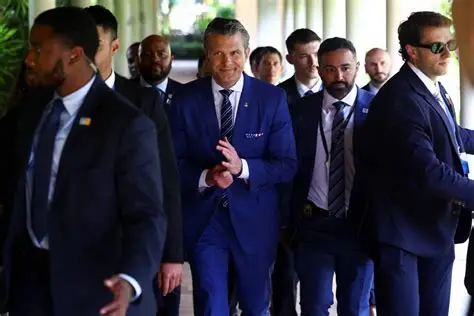
Pete Hegseth Asia defence Shangri-La Dialogue 2026 statements delivered on Saturday in Singapore sought to reassure America’s Asia-Pacific allies that the United States has not abandoned its regional commitments despite the demands of the ongoing Iran war — while simultaneously demanding those same allies spend more on their own defence and insisting that what the region needs is not dialogue but ships, submarines, and hard military power. The US Defense Secretary addressed the premier regional defence forum with a message that balanced reassurance with expectation — and that placed the Pacific firmly within America’s strategic vision even as it acknowledged the competing demands of global obligations.
Hegseth told the assembled defence ministers and security officials that the US was working “quietly but very strongly” with regional allies — denying that America’s military engagement in Iran represented a turning of its back on the Asia-Pacific. “People want to conflate that we have global obligations with the turning of our backs to this region,” he said. “We can do two things at one time.”
The speech and its surrounding exchanges covered ground ranging from the Taiwan arms deal suspension to China’s military build-up, from the 3.5% GDP defence spending target to a pointed dismissal of rules-based international order rhetoric — and produced one of the forum’s most memorable lines in a direct challenge to the event at which it was delivered: “We don’t need more conferences, we need more combat power… less Shangri-La Dialogue, more ships and more subs.”
Pete Hegseth Asia Defence Shangri-La Dialogue 2026: The Core Reassurance
The Pete Hegseth Asia Defence Shangri-La Dialogue 2026 appearance was explicitly framed around reassurance — an acknowledgement that American allies in the region have genuine concerns about the depth and durability of US commitment in a period when Iran has commanded significant American military attention and resources.
Japan’s Defence Minister Shinjiro Koizumi raised the concern directly when he asked Hegseth to address the question of US commitment — noting that “some countries might underestimate” that commitment and may seek to “drive a wedge” between the US and its allies. The framing was diplomatic but the underlying anxiety was clear — if adversaries can successfully characterise the Iran war as evidence of US strategic distraction, they gain leverage in the Pacific that America’s allies cannot afford to concede.
Hegseth’s response addressed the concern head-on. He insisted that US power projection in the Pacific remained central to the national defence strategy and that the demands of the Iran conflict did not diminish that commitment. His language — “quietly but very strongly” — was designed to signal sustained engagement without the public declarations that might themselves become strategic liabilities.
The reassurance messages Hegseth delivered:
- The US is not “turning our backs” on Asia-Pacific allies despite global obligations
- Power projection in the Pacific remains central to US national defence strategy
- The US is working “quietly but very strongly” with regional allies — a substantive, serious approach
- America can “do two things at one time” — manage Iran and maintain Pacific commitments simultaneously
- The US maintains “global obligations to ensure that, say, Iran doesn’t get a nuclear weapon”
- Arms deals with Pacific partners will be fulfilled — decoupled from the Iran-related Taiwan suspension
- The US is in a “very good place, very strong position” on munitions stockpile and production capacity
- Working with allies includes both bilateral relationships and the broader regional security architecture
The specific reassurance about arms deals — prompted by a dialogue participant’s question about the suspended $14 billion Taiwan weapons package — was among the most practically significant elements of the speech. Hegseth’s insistence that the Taiwan suspension was a specific and isolated decision — not a signal of broader US willingness to deprioritise Pacific arms commitments — was designed to prevent the Taiwan decision from becoming a template that allies feared would be applied to their own defence agreements.
Pete Hegseth Asia Defence Shangri-La Dialogue 2026: The Taiwan Arms Deal Question
The Pete Hegseth Asia Defence Shangri-La Dialogue 2026 appearance could not avoid the Taiwan question — specifically the suspension of a $14 billion weapons package to Taiwan that the US made in order to conserve munitions for its operations in Iran. That decision, and its implications for US reliability as an arms supplier to Pacific allies, generated concern across the region that the forum provided a platform to raise directly.
A dialogue participant raised the issue explicitly, questioning whether the US could fulfil its arms commitments to partners given the Iran-related munitions conservation decision. Hegseth’s response was to “very much decouple the two” issues — insisting that the Taiwan suspension was a specific operational decision driven by specific circumstances rather than a signal of reduced willingness or capacity to arm Pacific partners.
His claim that the US was in a “very good place, very strong position” on munitions stockpile and production capacity was designed to address the underlying concern — that the Iran war had depleted American military resources to the point where Pacific commitments could not be maintained simultaneously.
The Taiwan arms deal context:
- The US suspended a $14 billion weapons package to Taiwan to conserve munitions for the Iran war
- The suspension generated concern across the Asia-Pacific about US reliability as an arms supplier
- Hegseth explicitly decoupled the Taiwan decision from broader Pacific arms commitments
- He insisted the US munitions stockpile remains in a “very good place” and “very strong position”
- Production capacity to replenish and expand stockpiles was also cited as strong
- The reassurance was addressed to all Pacific allies — not just Taiwan
- The suspension follows weeks after Trump held positive talks with China’s President Xi Jinping in Beijing
- The timing of those Xi talks and the Taiwan suspension has drawn attention from regional observers
The proximity of Trump’s positive Beijing summit and the Taiwan arms suspension — both occurring in the weeks before the Shangri-La Dialogue — created a context in which Hegseth’s reassurances about US commitment to the region were particularly necessary and particularly scrutinised.
Pete Hegseth Asia Defence Shangri-La Dialogue 2026: Hard Power Over Rules
The Pete Hegseth Asia Defence Shangri-La Dialogue 2026 speech delivered one of its most memorable and philosophically revealing passages when Hegseth addressed the concept of the rules-based international order — a framework that has been central to Western security discourse for decades and that Hegseth explicitly dismissed as insufficient without military backing.
“Rules are great, but if you can’t back them up with hard power, the rules are not worth the paper they are written on,” he said — a statement that captured the Trump administration’s consistent prioritisation of military and economic power over multilateral institutional frameworks as the foundation of international security.
His most pointed formulation of this philosophy came in the line that generated the most immediate reaction across the forum: “We don’t need more conferences, we need more combat power… less Shangri-La Dialogue, more ships and more subs.” The irony of delivering this line at the Shangri-La Dialogue — one of the region’s most prestigious annual defence conferences — was not lost on attendees.
Hegseth’s hard power philosophy — key statements:
- “Rules are great, but if you can’t back them up with hard power, the rules are not worth the paper they are written on”
- Dismissed “empty globalist rhetoric about the rules-based international order”
- Called for “more weapons” instead of international order rhetoric
- Described the US approach as wielding a “big stick” while speaking “softly”
- “We don’t need more conferences, we need more combat power”
- “Less Shangri-La Dialogue, more ships and more subs” — delivered at the Shangri-La Dialogue
- Emphasised the US’s “strong, quiet and clear” approach to the region
- The speech framed military capacity as the ultimate guarantor of regional security
The contrast with Vietnam’s President To Lam — who delivered the forum’s keynote speech hours earlier calling for more dialogue to resolve regional tensions — illustrated the fundamental philosophical gap between different regional actors’ approaches to security in the Asia-Pacific.
Pete Hegseth Asia Defence Shangri-La Dialogue 2026: The 3.5% Spending Demand
The Pete Hegseth Asia Defence Shangri-La Dialogue 2026 speech reiterated a demand that Hegseth had made at the previous year’s forum — that Asian allies should increase their defence spending to 3.5% of GDP. The target — higher than NATO’s established 2% guideline — reflects the Trump administration’s consistent position that American allies across all regions should bear a greater share of the collective defence burden.
Hegseth praised allies who had responded positively to this pressure in recent months, specifically naming South Korea, Japan, Australia, and the Philippines among those who had increased military spending and deepened cooperation with the United States. The praise was itself a form of pressure — publicly rewarding compliance while implicitly highlighting those who had not yet met the target.
The 3.5% GDP defence spending demand:
- Hegseth reiterated the demand first made at the previous year’s Shangri-La Dialogue
- The 3.5% target exceeds NATO’s established 2% of GDP guideline
- Reflects the Trump administration’s consistent burden-sharing demands across all alliances
- South Korea, Japan, Australia, and the Philippines specifically praised for increasing spending
- Public praise functions as implicit pressure on those who have not yet reached the target
- The demand is consistent with the broader Trump administration approach to allied relationships
- Allies who meet the target are rewarded with public affirmation and stronger bilateral relationships
- Those who do not face the implicit suggestion that US commitment may be calibrated accordingly
The 3.5% target — ambitious by international standards — signals that the Trump administration views current allied spending levels as genuinely inadequate rather than merely below an aspirational benchmark. Whether that target produces sustained increases across the region will significantly shape the practical depth of the alliances Hegseth was simultaneously reassuring.
Pete Hegseth Asia Defence Shangri-La Dialogue 2026: The China Question
The Pete Hegseth Asia Defence Shangri-La Dialogue 2026 speech addressed the region’s defining strategic challenge — China’s military build-up and the management of US-China tensions — with a combination of acknowledgement and restraint that reflected the complex diplomatic moment.
Hegseth noted the threat posed by China’s expanding military capabilities — a recognition that has been consistent across US administrations and that underpins much of the alliance-building and military investment that his speech promoted. However, he also explicitly stated that the US wanted to avoid “needless confrontation” with China — a formulation that signals a desire for managed competition rather than open conflict.
The use of the word “needless” is significant. It implies that some confrontation may be necessary or inevitable while seeking to avoid confrontation that serves no strategic purpose. That distinction — between necessary and needless confrontation — leaves considerable interpretive space about where the line falls in specific scenarios.
The China dimension of Hegseth’s speech:
- Acknowledged the threat of China’s military build-up in the region
- Stated the US wanted to avoid “needless confrontation” with China
- The distinction between necessary and needless confrontation leaves interpretive flexibility
- Trump held positive talks with China’s President Xi Jinping in Beijing in the weeks before the forum
- The positive Xi summit provides diplomatic context for the “avoid needless confrontation” framing
- US power projection in the Pacific is framed as deterrence rather than provocation
- The “big stick, speak softly” formulation attempts to balance deterrence with de-escalation signalling
- China’s response to Hegseth’s speech has not been detailed in available information
Final Word on Pete Hegseth Asia Defence Shangri-La Dialogue 2026
The Pete Hegseth Asia Defence Shangri-La Dialogue 2026 appearance delivered a message that was simultaneously reassuring and demanding — telling Asia-Pacific allies that America stands with them while insisting they must do more to stand with themselves. The combination of “we’re not turning our backs” and “spend 3.5% of GDP” reflects a transactional approach to alliance management that rewards burden-sharing and calibrates commitment accordingly.
His dismissal of rules-based order rhetoric in favour of hard power — delivered at a dialogue he simultaneously dismissed as less useful than ships and submarines — was vintage Trump administration philosophy applied to the world’s most strategically consequential region.
Whether the reassurance lands, whether the spending demands are met, and whether the distinction between necessary and needless confrontation with China holds in practice will determine whether the alliances Hegseth described as strong and substantive remain so through the challenges that lie ahead.
The big stick has been shown. The soft words have been spoken. The region will now decide how much to believe of both.
MORE YOU GET ON THE NEWS INK BUSINESS AND FINANCE.