



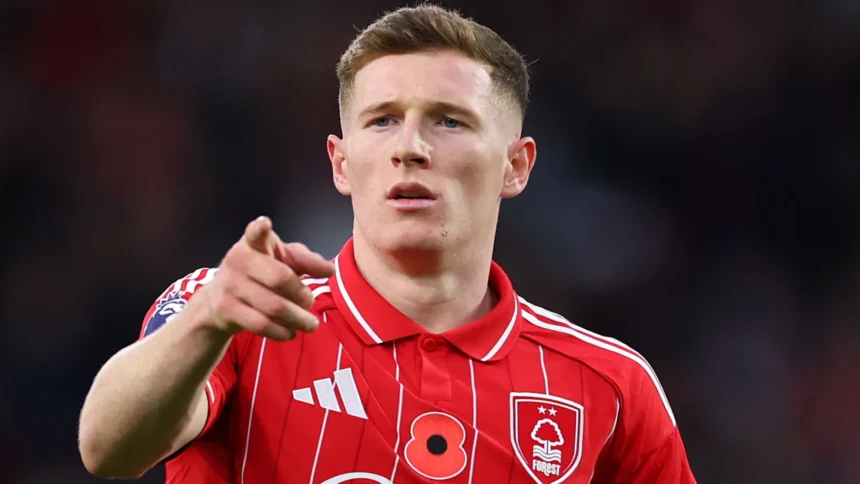
Man City Elliot Anderson Transfer Turns Gossip Into Record £116m Deal
Man City Elliot Anderson transfer talk has moved from Friday gossip to one of the biggest confirmed deals of the 2026 summer window, with Manchester City completing a record-breaking £116m move for the England midfielder from Nottingham Forest.
When the rumour first appeared in early March, the story was framed as a race between Manchester City and Manchester United. Anderson was said to prefer City, while Forest valued him at more than £70m. Four months later, the numbers have changed dramatically. City have now announced an agreement for the 23-year-old, and Sky Sports says the deal makes Anderson the most expensive British player ever.
The transfer is not only about one midfielder. It shows where the Premier League market has gone. Anderson moved from Newcastle United to Nottingham Forest in 2024 for £35m during a Profit and Sustainability Rules scramble. Two seasons later, after becoming an England international and one of the league’s most complete midfielders, he has joined City for more than three times that amount.
Man City Elliot Anderson is now the headline example of how quickly player value can explode when age, nationality, Premier League experience, tactical versatility and elite-club demand all meet at once.
For more football context, The News Ink’s football guide explains how tactics, squad building and elite-club recruitment shape the modern game.
Why Man City Elliot Anderson became the window’s biggest story
Man City Elliot Anderson became the window’s biggest story because City needed a midfield reset and Anderson had become one of the most complete players available.
City’s midfield has been changing. Bernardo Silva’s departure created a gap in control, pressing and flexibility. Rodri’s future has also been a talking point, with only one year left on his contract heading into the new season. City also have a new managerial chapter under Enzo Maresca after Pep Guardiola’s exit. That combination made midfield reinforcement urgent.
Anderson fits the profile. He can play as a single pivot, operate alongside another holding midfielder, press aggressively, carry the ball, win duels and break lines. Sky Sports’ analysis described him as a player who could fit into either Maresca’s system or Guardiola’s because of that versatility.
The fee is huge, but City have not paid for potential alone. They have paid for a player who has already shown Premier League output, physical intensity and tactical intelligence. He played every Premier League game for Forest last season, made 37 starts, scored four goals and provided four assists. He also ranked among the league’s top players for tackles and passes, which helps explain why City viewed him as more than a simple box-to-box runner.
Man City Elliot Anderson is therefore a tactical signing as much as a financial statement.
Key facts at a glance
| Detail | Current status |
|---|---|
| Player | Elliot Anderson |
| Age | 23 |
| Selling club | Nottingham Forest |
| Buying club | Manchester City |
| Reported fee | £116m |
| Record | Most expensive British player |
| Original gossip value | Forest valued him at more than £70m |
| Rival interest | Manchester United were also interested |
| Player preference | Anderson chose Manchester City |
| Former club | Newcastle United |
| Newcastle sale to Forest | £35m in 2024 |
| City manager | Enzo Maresca |
| Main role | All-action central midfielder |
This table shows how quickly the story changed. What started as a £70m-plus rumour became a British-record transfer.
The original gossip was right on direction, wrong on scale
The early transfer gossip got the main direction right. Anderson did prefer Manchester City over Manchester United, and City were serious. But the scale of the final deal went far beyond the original valuation.
Sky Sports’ March paper talk reported that Anderson favoured City, while Forest valued him at more than £70m. At that stage, it sounded like a big Premier League transfer. By late June and early July, it had become a record deal. The Guardian reported City agreed a £116m fee with Forest, and Sky later reported the transfer had been announced.
Man City Elliot Anderson therefore shows why transfer gossip needs updating carefully. Rumours can be accurate in one sense and incomplete in another. The player may want the move. The clubs may be in contact. But the fee, timing and market context can change completely.
Forest’s final position was stronger than early estimates suggested. Anderson’s England rise, his World Cup involvement and City’s need for midfield power pushed the price up. Manchester United’s interest also helped keep pressure on City, even though Anderson ultimately chose the Etihad.
A transfer window is not a straight line. This deal proves it.
Why City paid so much
City paid so much because Anderson solves several problems at once.
He gives them legs in midfield. He gives them duels. He gives them ball progression. He gives them a homegrown British player. He gives them a midfielder who can work with or without Rodri. He gives Maresca a player suited to positional rotations, pressing triggers and quick transitions.
Man City Elliot Anderson also carries resale logic despite the enormous fee. At 23, he is entering his prime rather than leaving it. If he becomes a long-term starter, City can spread the cost over several seasons and build around him. If the market keeps rising, even £116m may not look as extreme in three years.
That does not make the price risk-free. Very few midfielders can justify British-record money immediately. Anderson will be judged by his ability to influence title races, Champions League nights and matches against elite pressing teams. City have not bought him to be promising. They have bought him to matter now.
But the profile explains the aggression. In today’s market, clubs pay premiums for players who are young, Premier League-proven, tactically flexible and homegrown. Anderson checks every box.
Why Forest sold
Nottingham Forest did not want to look like a stepping-stone club, but the economics were powerful.
Forest bought Anderson from Newcastle for £35m in 2024. He helped them finish seventh in the Premier League and reach the Europa League semi-finals. He became one of the club’s best players and turned himself into an England international. Selling him for £116m gives Forest one of the biggest profits in recent Premier League transfer history.
Man City Elliot Anderson may hurt Forest supporters emotionally, but the money gives the club room to rebuild. The Guardian reported Forest were interested in Tottenham midfielder Lucas Bergvall as a potential replacement, with talks already held over a possible £45m move.
The challenge is not only replacing Anderson’s quality. It is replacing his role. He gave Forest intensity, carrying power, midfield control and defensive work. A club can buy two or three players with the fee, but it may still lose the unique balance Anderson provided.
That is why the sale is both rational and painful. Forest have maximised an asset. They have also lost the player who helped make their recent rise feel sustainable.
Newcastle’s painful mistake
Newcastle United may be the most frustrated club in the story. They sold Anderson to Forest in 2024 under PSR pressure, with goalkeeper Odysseas Vlachodimos moving in the opposite direction as part of the deal. The Guardian reported Newcastle will not benefit from Anderson’s transfer to City because they did not negotiate a sell-on clause.
That is a brutal outcome.
Man City Elliot Anderson has become a record signing, but Newcastle will not receive the kind of windfall that would normally soften the blow. Eddie Howe later admitted Anderson’s sale was one of the most reluctant transfers he had ever experienced, saying Newcastle had no choice at the time.
This is what PSR pressure can do. Clubs make short-term financial decisions that later look terrible in sporting terms. Anderson was a homegrown midfielder with elite potential. Newcastle needed money quickly. Forest moved smartly. City are now paying the premium.
The transfer is a reminder that academy products are no longer just squad options. They are financial assets. Selling one too early can reshape a club’s future.
The News Ink has also covered the pressure of Premier League survival and squad planning in winning the relegation battle.
Manchester United lost another midfield race
Manchester United were interested, but Anderson chose City. That matters because United have been trying to rebuild their midfield under Michael Carrick after Casemiro’s departure and Manuel Ugarte’s injury concerns.
The situation has moved on quickly. Reuters reported United have signed Andrey Santos from Chelsea in a deal until 2031, with an initial fee of £48m plus £2m in possible add-ons. The Guardian also reported United are in advanced talks to sign Youri Tielemans from Aston Villa after their move for Atalanta’s Éderson fell through.
Man City Elliot Anderson therefore tells two stories at once. City landed the premium target. United had to pivot.
That does not automatically mean United’s business is poor. Santos is younger and cheaper than Anderson. Tielemans would bring Premier League experience. But losing out on Anderson to City adds to the perception that United are still chasing while City dictate the market.
For supporters, that hurts. For recruiters, it is a practical problem. United cannot keep entering races where the player prefers a rival and the fee rises beyond comfort.
How Anderson fits under Enzo Maresca
Maresca’s City will likely value Anderson for his ability to operate in several midfield structures. He can play as a No.6, a No.8, or part of a double pivot. That matters because City’s midfield has to control games while also protecting against counter-attacks.
Man City Elliot Anderson gives Maresca a player who can press forward, recover backward and carry through pressure. Those traits are essential when teams try to disrupt City through man-to-man pressing or quick transitions.
He also gives City tactical insurance. If Rodri stays, Anderson can play alongside him and add mobility. If Rodri leaves or misses games, Anderson can help cover deeper zones. If Maresca wants more energy in big away matches, Anderson can start. If City need late control, he can shift roles.
The biggest question is whether Anderson can adapt to City’s positional demands. At Forest, he had more freedom to drive and duel. At City, spacing is stricter. Every movement affects the structure. He will need discipline as well as energy.
That is the challenge. The talent is obvious. The adaptation will decide whether the fee becomes justified.
The wider transfer gossip picture
The Anderson deal was the headline, but the original Friday gossip included several other major lines.
Liverpool were linked with RB Leipzig winger Yan Diomande as a possible Mohamed Salah replacement. Arsenal were expected to make Piero Hincapie’s move from Bayer Leverkusen permanent. Tottenham were looking at managerial options during a crisis period. Manchester United were planning talks around Bruno Fernandes and chasing midfield alternatives. Chelsea and City were linked with Bayern Munich midfielder Aleksandar Pavlovic.
Some of those stories have aged differently.
Arsenal have now completed the permanent Hincapie move. Liverpool are under a new manager, Andoni Iraola, after Arne Slot’s exit, and Reuters reports Iraola wants more signings after the arrivals of Jeremy Jacquet and Victor Munoz. United have already signed Santos and are chasing Tielemans. Tottenham eventually moved into a Roberto De Zerbi rebuild after a near-relegation scare.
Man City Elliot Anderson is the cleanest example of gossip becoming reality. Many of the other lines remain moving parts or have shifted completely.
That is why transfer articles need live updates. The market changes faster than the first rumour cycle.
Updated rumour tracker
| Original gossip line | Current update |
|---|---|
| Anderson favours City over United | Confirmed: City have announced a £116m deal |
| Forest value Anderson above £70m | Final fee became far higher at £116m |
| Liverpool identify Yan Diomande as Salah option | Still a live but complicated pursuit, with PSG interest and no early Sky-reported offer |
| Arsenal to sign Piero Hincapie permanently | Confirmed by Arsenal, Leverkusen and Reuters |
| Tottenham consider Pochettino / De Zerbi / Keane | De Zerbi later became the key Spurs figure |
| Arne Slot could face scrutiny at Liverpool | Slot has since gone, and Iraola is now Liverpool manager |
| United plan Bruno Fernandes talks | United’s more urgent work has shifted to midfield signings such as Santos and Tielemans |
| Chelsea and City admire Aleksandar Pavlovic | No confirmed move from the original gossip line |
This table helps separate old rumour from current reality. Man City Elliot Anderson is now fact, not speculation.
Liverpool’s Salah replacement problem
Liverpool’s winger search remains one of the biggest transfer stories of the summer. Sky Sports reported in June that Liverpool had made contact with RB Leipzig over Yan Diomande, but no formal offer had been made at that time. PSG and Bayern Munich were also interested, and Diomande had spoken warmly about the idea of playing for PSG.
Reuters has since reported that new Liverpool boss Andoni Iraola wants more signings before the season. Liverpool have already signed Jeremy Jacquet and Victor Munoz, but replacing Mohamed Salah’s output remains a far bigger challenge than simply adding a winger.
Man City Elliot Anderson may be City’s midfield statement. Liverpool still need their attacking one.
Diomande is exciting because of his pace, unpredictability and rapid rise after joining RB Leipzig from Leganes. But he is still young, expensive and wanted by other elite clubs. Liverpool also have to manage injuries and adapt to Iraola’s pressing style.
That makes the Salah succession problem one of the hardest recruitment tasks in Europe. The player who replaces Salah does not only need talent. He needs personality, durability and immediate end product.
Arsenal’s quieter business looks smart
Arsenal’s permanent signing of Piero Hincapie is the opposite of the Anderson deal in tone. It is not the window’s loudest transfer, but it is sensible.
Reuters reported Arsenal made Hincapie’s loan move from Bayer Leverkusen permanent after the Ecuador defender spent the previous season with the club. Bayer Leverkusen also confirmed the purchase option had been activated and that Hincapie would join Arsenal permanently on 1 July 2026.
Man City Elliot Anderson dominates the headlines because of the fee, but Arsenal’s move shows another way to work. Hincapie had already settled into the squad. Mikel Arteta already knew his strengths. The club avoided a new adaptation gamble and secured defensive continuity.
That matters because Arsenal are now defending a Premier League title. They do not need chaos. They need targeted additions, squad stability and smart rotation. Hincapie gives them left-sided defensive cover and tactical flexibility.
The News Ink has tracked Arsenal’s pressure in pieces such as Arteta warns Arsenal players and the Premier League season review.
Tottenham’s rebuild became bigger than gossip
Tottenham’s managerial rumours from early March reflected a club in crisis. Pochettino, De Zerbi and Robbie Keane were all discussed at different points because Spurs were sliding dangerously close to relegation.
By the summer, De Zerbi had become the central figure in a major rebuild. TalkSPORT reported Tottenham were preparing for the 2026-27 season under De Zerbi after he kept the club in the Premier League and began a huge squad overhaul.
Man City Elliot Anderson is a City story, but it also shows the contrast between clubs. City are adding a record signing to a team that finished near the top. Tottenham are rebuilding after a survival scare. Both are spending, but the reasons are different.
City are trying to stay elite. Spurs are trying to recover identity and competitiveness.
That difference matters because transfer fees alone do not tell the full story. A £100m signing at City may be the final piece of a title plan. A £100m signing at Spurs may be part of a rescue mission.
Why the Premier League market keeps rising
The Anderson fee feels extreme, but it fits the direction of the Premier League market.
Clubs pay more for proven domestic talent because the risk feels lower. They pay more for young players because resale value matters. They pay more for midfielders because the position is central to pressing, control and transitions. They pay more when multiple elite clubs are interested.
Man City Elliot Anderson sits at the centre of all those forces.
He is English. He is 23. He is Premier League-proven. He has international status. He plays in a high-demand position. He has the athletic profile modern teams want. He was wanted by City and United. Forest did not need to sell cheaply.
That is how a £70m-plus rumour becomes a £116m transfer.
Supporters may still ask whether any midfielder with two seasons at Forest should cost that much. That is fair. But clubs do not buy only past achievements. They buy future control, scarcity and tactical fit. City clearly believe Anderson’s future value justifies the present cost.
The pressure now moves to the player.
What Anderson must prove
Anderson must prove he can handle the jump from being Forest’s star midfielder to being one of City’s most expensive signings.
At Forest, his intensity stood out. At City, intensity is expected. At Forest, his progressive carries and duels helped define the team. At City, he must add those qualities without disrupting the rhythm of a possession-heavy side. At Forest, supporters celebrated his rise. At City, every mistake will be judged through the price tag.
Man City Elliot Anderson also has to manage World Cup fatigue. He has been involved with England, completed his medical in Kansas, and will join City after international duty. That is a lot of emotional and physical transition before a new Premier League season.
His first months will matter. If he starts well, the fee may fade into the background. If he struggles, the record will follow him into every match report.
That is the burden of a British-record transfer. Talent gets a player there. Mental strength decides what happens next.
What it means for the title race
City’s signing raises the level of the title race immediately. Arsenal ended their long wait for the Premier League title, and City now look determined to respond. Adding Anderson gives them midfield power and freshness as Maresca begins his reign.
Man City Elliot Anderson could become one of the players who decides whether City regain the title or whether Arsenal hold them off again. Midfield battles between City and Arsenal are likely to be crucial, especially if Declan Rice, Martin Odegaard, Hincapie and Arsenal’s defensive core remain strong.
Liverpool’s rebuild under Iraola is another variable. Manchester United’s midfield overhaul could make them more competitive. Tottenham’s spending may change the top-four race. Newcastle’s sales could weaken them unless their young signings hit quickly.
The Premier League is not standing still. Anderson’s move is part of a wider reshuffle at the top.
The News Ink’s report on Man City dropping points against Nottingham Forest showed how small margins shaped last season. City are now spending to change those margins.
FAQ: Man City Elliot Anderson
Has Man City signed Elliot Anderson?
Yes. Man City Elliot Anderson transfer has been announced as a £116m move from Nottingham Forest, with formalities to be completed after his England World Cup duty.
How much did Manchester City pay for Elliot Anderson?
Manchester City agreed a £116m deal with Nottingham Forest, making Anderson the most expensive British player.
Did Elliot Anderson choose City over Manchester United?
Yes. Reports from Sky Sports and The Guardian say Anderson preferred Manchester City despite Manchester United interest.
Why did Nottingham Forest sell Elliot Anderson?
Forest received a record fee for a player they bought from Newcastle for £35m in 2024. The sale gives them major funds to rebuild, though replacing Anderson’s role will be difficult.
Why are Newcastle frustrated?
Newcastle sold Anderson to Forest under PSR pressure and did not negotiate a sell-on clause, meaning they will not benefit from his record move to Manchester City.
The bottom line
Man City Elliot Anderson transfer has become the clearest example of how quickly Premier League gossip can turn into record business.
The original Friday rumour said Anderson favoured Manchester City over Manchester United and that Nottingham Forest wanted more than £70m. The final reality was much bigger. City completed a £116m deal, making Anderson the most expensive British player and giving Enzo Maresca a major midfield signing at the start of a new era.
For City, Anderson brings energy, versatility, ball progression and tactical flexibility. For Forest, the sale brings enormous profit but creates a major sporting hole. For Newcastle, it is a painful reminder of a PSR-driven sale without a sell-on clause. For Manchester United, it is another missed midfield target during a summer of recalibration.
The wider gossip market has also shifted. Liverpool’s Salah replacement search continues under Iraola. Arsenal have made Hincapie permanent. United have signed Andrey Santos and are chasing Youri Tielemans. Tottenham are rebuilding under De Zerbi.
But the headline belongs to City. Man City Elliot Anderson is no longer a rumour. It is a record transfer, a tactical gamble and one of the defining deals of the 2026 summer window.
For more Premier League transfer news, football analysis and global sports coverage, follow The News Ink on Threads.