


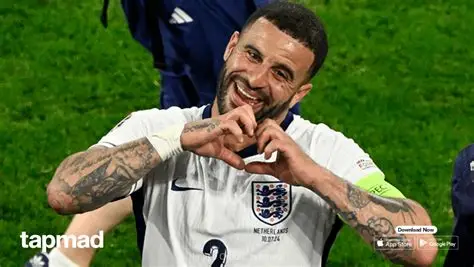
Kyle Walker Retirement Ends a Defining 96-Cap England Era
The Kyle Walker retirement brought one of England’s longest modern international careers to a close on 10 March 2026. Walker stepped away with 96 senior caps, one goal and appearances at five major tournaments, ending a 14-year association with the Three Lions only months before the FIFA World Cup. He was 35 when he made the announcement and was playing for Burnley after a club career shaped most visibly by Tottenham Hotspur and Manchester City.
The Kyle Walker retirement removed England’s most-capped right-back and one of the few players trusted throughout Gareth Southgate’s tournament era. Walker started two European Championship finals, played as a right-sided centre-back during the 2018 World Cup run and remained a senior figure as England became a regular presence in the latter stages of major competitions.
The Kyle Walker retirement statement described playing for England as the greatest honour of his career and thanked the managers, team-mates, staff, supporters and family members who had shared the journey. England head coach Thomas Tuchel called him one of the country’s greats, while Southgate noted that he had twice persuaded the defender not to retire earlier. The Kyle Walker retirement therefore felt less like a sudden exit than the formal closing of a chapter that had already survived several possible endings.
Kyle Walker Retirement at a Glance
The central facts show the scale of Walker’s contribution.
| Career detail | Confirmed record |
|---|---|
| Senior England debut | 12 November 2011 against Spain |
| Final appearance | 10 June 2025 against Senegal |
| Senior caps | 96 |
| Senior goals | 1 |
| Major tournaments | Five |
| World Cups | 2018 and 2022 |
| European Championships | 2016, 2020 and 2024 |
| Best World Cup finish | Semi-finals in 2018 |
| Best European Championship finishes | Runners-up in 2020 and 2024 |
| Individual recognition | UEFA Team of the Tournament at Euro 2020 and Euro 2024 |
The official England player profile records Walker’s 96 caps and single senior goal. England Football’s retirement announcement also confirms his five major tournaments, two European finals and final appearance against Senegal in Nottingham.
The Kyle Walker retirement left him four appearances short of the century that often separates highly decorated internationals from the small group of England centurions. That gap will always be part of the story, but longevity is not measured only by a round number. Walker remained relevant through tactical changes, injuries and intense competition in a position where England repeatedly produced elite alternatives.
From Sheffield to an England Debut Against Spain
Walker’s international path began before his senior breakthrough. The Sheffield-born defender represented England at under-19 and under-21 level, reaching the 2009 European Under-19 Championship final and earning selection in UEFA’s team of the tournament at the 2011 Under-21 European Championship.
Fabio Capello gave him his senior debut against Spain at Wembley on 12 November 2011. Walker replaced Scott Parker late in a 1-0 victory, beginning a senior career that would extend well beyond the players, managers and tactical assumptions surrounding that first appearance. His first start followed against Sweden, when he was named player of the match.
Long before the Kyle Walker retirement, the early years were less continuous than the final cap total suggests. Injury kept him out of Euro 2012, while competition and changing circumstances meant he did not play at the 2014 World Cup. Euro 2016 became his first senior tournament, but England’s defeat by Iceland ensured that the campaign was remembered for collective failure rather than the emergence of a long-term defensive leader.
The Kyle Walker retirement invites a neat summary of 96 appearances, yet his route was not simple. He recovered from missed tournaments, fought off competition and expanded his game beyond exceptional recovery speed.
For wider positional context, The News Ink’s football guide explains how modern full-backs defend wide spaces, support possession and influence central areas.
The 2018 Reinvention That Changed His England Career
The tactical roots of the Kyle Walker retirement legacy lie in his transformation before the 2018 World Cup. Southgate used him on the right of a back three, with Kieran Trippier operating as the wing-back. The decision took advantage of Walker’s pace in open space and his comfort carrying the ball, while giving England another defender capable of recovering when possession was lost.
Walker had to protect the channel beside John Stones, judge when to step into midfield and defend like a centre-back around his own penalty area. His speed reduced the risk created by England’s attacking wing-backs, but the role also demanded concentration.
England reached the World Cup semi-finals for the first time since 1990 before losing to Croatia after extra time. FIFA’s retirement tribute identifies Walker as a key member of that run, which changed expectations around the national team even though it did not end with a final.
The Kyle Walker retirement closed the career of a player whose versatility helped make that system possible. Southgate could have selected a conventional central defender, but Walker gave England a different balance: enough pace to cover wide transitions, enough passing quality to help the build-up and enough experience at full-back to understand what Trippier needed ahead of him.
That adaptability places Walker among England’s outstanding modern defenders. The News Ink’s feature on World Cup legends considers players defined by tournament moments; Walker’s contribution was the unfamiliar work that made England’s structure function.
Five Tournaments and Two Painful European Finals
To understand the Kyle Walker retirement, it helps to compare his five tournaments. At Euro 2016, he was an athletic attacking right-back in an England team that collapsed against Iceland. By the 2018 World Cup, he had become the right-sided defender in a back three. At Euro 2020, he moved between full-back and centre-back responsibilities as England reached a first men’s European Championship final.
Italy defeated England on penalties at Wembley, but Walker’s performances earned him a place in the official UEFA Euro 2020 Team of the Tournament. That recognition mattered because it reflected more than reputation. Walker had provided defensive control, recovery pace and tactical flexibility across England’s strongest European Championship run to that point.
The 2022 World Cup brought a race against fitness after groin surgery. Walker returned in time to feature during the knockout rounds, including England’s quarter-final against France. His individual contest with Kylian Mbappé dominated discussion before the match, yet the broader challenge involved France’s entire attack. England lost 2-1 despite a competitive performance, leaving another tournament with evidence of progress but no trophy.
Euro 2024 then produced a second final. Walker served as a senior leader, started throughout the knockout rounds and again entered UEFA’s official Team of the Tournament. Spain’s 2-1 victory in Berlin denied England, but Walker had become one of a select number of players to start two major senior finals for the country.
The Kyle Walker retirement means those final defeats now stand as the closest he came to an international trophy. They are painful, but they also show how far England travelled during his prime. Before 2018, reaching semi-finals and finals was treated as a distant historical memory. During Walker’s central years, it became a repeated expectation.
The Speed Everyone Saw and the Tactical Value Behind It
Any assessment of the Kyle Walker retirement begins with the attribute everyone recognised: pace. For much of his career, forwards who appeared to have escaped him discovered that the space vanished within seconds. Recovery runs became a form of insurance for both Manchester City and England, allowing team-mates to play more aggressively.
Yet describing him only as fast understates his importance. The Kyle Walker retirement removed a defender who could play in a back four, the outside position of a back three or a more conservative full-back role against elite wingers. He could advance high, remain deeper to protect transitions or step inside during possession depending on the manager’s plan. England and Manchester City’s official profiles both emphasised his physical qualities, passing range and ability to adapt to different positions.
His passing was rarely as celebrated as his athleticism, but England often trusted him to circulate the ball under pressure. He could switch play, find midfielders between lines and carry possession beyond the first press. Those actions were particularly valuable in tournament football, where opponents frequently defended compactly and waited for one poor pass.
Walker also offered emotional experience. He had played in title races, Champions League knockout ties and major finals. By Euro 2024, he was not simply a defender selected for a matchup; he was a senior player expected to manage difficult moments and help younger team-mates understand the pressure surrounding England.
The Kyle Walker retirement changes the dressing-room calculation as well as the team sheet. A younger right-back may offer greater attacking invention, but replacing the knowledge of 96 caps is a slower process.
One Goal, Scored After 76 Appearances
Walker was never defined by goals. His only England strike arrived in a 1-1 draw with Ukraine during Euro 2024 qualifying in September 2023. Harry Kane’s pass released him into the penalty area, and Walker finished calmly to equalise.
England Football’s match account noted that the goal came after 76 senior appearances without scoring. The rarity reflected the disciplined nature of his role. Walker usually protected attacks rather than completed them.
The Kyle Walker retirement leaves a statistical profile that cannot be judged like that of an attacking full-back. He was not selected to build large goal and assist totals. His value appeared in the situations that did not become chances: the counterattack he stopped, the winger he forced backwards or the space he covered when another defender stepped out.
That less visible contribution explains why successive England managers trusted him.
Why 96 Caps Matter More Than the Missing Four
The Kyle Walker retirement stopped four appearances short of placing him alongside England’s 100-cap players. He had openly valued the milestone, and later discussion around his decision showed that falling short still bothered him. However, the Kyle Walker retirement should not be viewed as an incomplete career merely because the number stopped at 96.
Walker finished among the ten most-capped England men’s players at the time the official appearances list was updated. More importantly, a high proportion of those appearances came during major tournaments, qualifiers and high-pressure matches rather than ceremonial selections near the end of his career.
The missing four caps also reflect timing. Walker’s final appearance came against Senegal on 10 June 2025. He remained active for Burnley during the following season but was left out of later England squads as Tuchel developed other options. Reuters reported that Walker had played 27 Premier League matches for Burnley by the time he announced his decision, so the retirement was not caused by an immediate end to club football.
The Kyle Walker retirement was instead a choice shaped by selection reality, family sacrifice, age and the desire for closure. Walker spoke about summers away and the demands that follow deep tournament runs. Those costs do not appear in a caps table, but they accumulate across 14 years.
Tuchel’s England and the Right-Back Succession
Tuchel praised Walker’s dedication but had already begun moving towards different right-back options. Reece James offered technical quality and crossing, while players such as Tino Livramento, Trent Alexander-Arnold and Djed Spence represented different tactical possibilities depending on fitness, availability and form.
This was not a simple search for a younger Walker. A full-back asked to move into midfield needs a different profile from one expected to defend elite wingers in open space, and no successor carried the same international experience.
The News Ink’s report on Phil Foden and Cole Palmer showed how Tuchel’s England selection debates extended beyond defence. The manager was assessing not only individual quality but also how established players fitted a revised structure before the World Cup.
The Kyle Walker retirement simplified one decision by making him unavailable, but it also removed an emergency solution. That became more noticeable when injuries affected England’s right-back pool around the World Cup. Experience can appear expendable when a squad is healthy and suddenly valuable when tournament pressure exposes its depth.
The Burnley Chapter and a Decorated Club Career
Walker joined Burnley from Manchester City in July 2025 on a two-year contract. The Premier League announcement described him as a six-time league champion and confirmed that he reunited with Scott Parker, whom he had known as a Tottenham team-mate.
His club achievements strengthened his authority with England. Manchester City’s official account of his 2025 loan move to AC Milan credited him with 319 appearances and 17 major honours, including six Premier League titles, the Champions League, two FA Cups and four League Cups. He had also captained City during a period of historic domestic success.
Those trophies do not define his England legacy, but they explain his comfort in pressurised fixtures after years defending high lines and adapting to Pep Guardiola’s demands.
The Kyle Walker retirement separated his international future from his club career rather than ending both. At Burnley, he could focus on weekly football without qualifiers, international camps or another summer tournament. The News Ink’s coverage of Manchester City’s title pressure offers wider context for the demanding environment in which Walker built the reputation that followed him into England duty.
Later Regret Added a Complicated Final Chapter
The original retirement announcement presented a firm decision. Walker said the book was closed and looked forward to supporting England as a fan at the World Cup. Months later, the Kyle Walker retirement appeared less emotionally simple.
During the World Cup in July 2026, Walker said he could still see a possible place for himself after injuries affected England’s right-back options. He also acknowledged disappointment at not reaching 100 caps and questioned whether there could have been clearer communication about his prospects. Those comments did not amount to a formal reversal, but they showed that a player can accept a decision and still wonder how events might have unfolded differently.
The timing made those feelings understandable. England progressed deep into the tournament, including a dramatic quarter-final against Norway, while Walker experienced the competition from outside the squad after appearing at every major tournament since 2016. England’s official results recorded a 2-1 victory over Norway.
The Kyle Walker retirement therefore has two emotional truths. In March, closure made sense after months outside the team. In July, injuries and the sight of England competing on the biggest stage made the missing opportunity feel more immediate. Neither reaction invalidates the other.
What matters is that the official record remained unchanged unless Walker and England made a future announcement. He retired with 96 caps, and later regret should be reported as reflection rather than treated as confirmation of a comeback.
How England Should Remember Kyle Walker
The Kyle Walker retirement deserves to be remembered through more than pace, caps or the frustration of stopping four appearances short of 100. Walker’s international career crossed two different England eras: the uncertainty that ended at Euro 2016 and the sustained tournament competitiveness that followed under Southgate.
He helped make the transition possible. In 2018, he accepted a position that was not his usual club role. In 2020 and 2024, he performed well enough to earn UEFA tournament recognition. In 2022, he recovered in time to face one of the world’s most dangerous attacking teams. Across those campaigns, he gave England tactical flexibility that few defenders could match.
The Kyle Walker retirement also illustrates the limits of judging international careers only by trophies. England did not win a major title during his 96 appearances. That fact cannot be removed, and the two European final defeats will remain painful. Yet Walker was part of a group that normalised deep runs, reduced fear around knockout football and gave supporters repeated reasons to believe.
His own hope was that the generation changed how people viewed England and eased some of the pressure players carried. The team did not complete the journey with a trophy while he was involved, but the cultural change was real enough to shape the squads that followed.
The Kyle Walker retirement closes one of the defining individual stories of that period. He began as an explosive Sheffield full-back, became a tactically sophisticated defender, served as a leader for club and country, and left international football as England’s leading right-back by appearances.
Ninety-six caps were not an unfinished achievement. They were the record of a player who remained useful for 14 years, crossed five tournaments and adapted whenever England required something different.
For more football analysis and major international stories, follow The News Ink on X.