Industrial Robots Explained: How Factory Automation Is Transforming Manufacturing
Industrial robots have become one of the most important technologies behind modern manufacturing.
Inside automobile plants, electronics factories, metalworking facilities, food-processing operations and warehouses, industrial robots weld components, move heavy materials, assemble products, apply coatings, inspect parts and repeat precise movements thousands of times.
The technology is no longer limited to the largest car manufacturers.
Better sensors, machine vision, artificial intelligence, easier programming and more flexible automation systems are allowing industrial robots to move into industries that once depended almost entirely on manual labor.
The scale of adoption is already enormous. The International Federation of Robotics reported that approximately 542,000 industrial robots were installed worldwide in 2024, while the global operational stock reached about 4.664 million units. Annual installations have remained above half a million for four consecutive years.
Industrial automation is also continuing to spread geographically and across industries. Preliminary IFR data released in June 2026 showed that the United States installed approximately 38,000 industrial robots in 2025, an increase of 11% from the previous year.
But an industrial robot is much more than a mechanical arm moving inside a factory.
Modern industrial robotics combines mechanical engineering, control systems, sensors, software, safety systems, computer vision and increasingly artificial intelligence. Understanding how those technologies work together explains why robots have become so important to manufacturing.
This guide explores what industrial robots are, how they work, the main types, where they are used, their benefits and limitations, their safety requirements and how AI may change the next generation of factory automation.
For the broader technology behind robots, autonomous machines and automation, read The News Ink’s Robotics Explained: Complete Guide.
What Are Industrial Robots?
Industrial robots are programmable machines designed to perform physical tasks in industrial environments.
The current ISO robotics vocabulary standard, ISO 8373:2021, establishes terminology used across robotics, while industrial robot safety is addressed through newer standards including ISO 10218-1:2025 and ISO 10218-2:2025.
In practical terms, industrial robots normally combine several major components:
- a mechanical manipulator;
- joints and actuators;
- a robot controller;
- sensors;
- an end effector;
- programming software;
- safety equipment;
- communication interfaces.
The mechanical arm provides movement, while the controller determines where and how that movement occurs.
An end effector performs the actual task.
For example, the same basic industrial robot arm could theoretically use a welding gun in one application, a vacuum gripper in another or a specialized inspection tool somewhere else.
That flexibility is one reason industrial robots are described as reprogrammable machines rather than single-purpose mechanical devices.
Industrial Robots in 2026: Key Numbers
The latest available global statistics show how deeply robotics has entered manufacturing.
| Indicator | Latest Reported Figure |
|---|---|
| Industrial robots installed globally in 2024 | 542,000 |
| Industrial robots operating globally in 2024 | 4.664 million |
| Asia’s share of new global installations in 2024 | 74% |
| China’s installations in 2024 | 295,000 |
| U.S. installations in 2025 | About 38,000 |
| U.S. installation growth in 2025 | 11% |
| Global industrial robot installation market value | About $16.7 billion |
| U.S. manufacturing robot density | 307 robots per 10,000 employees |
The global market value of industrial robot installations has reached approximately $16.7 billion, according to the IFR’s 2026 robotics trends assessment.
Robot density also illustrates how automation differs between economies.
In 2024, Western Europe averaged 267 industrial robots for every 10,000 manufacturing employees, compared with 204 in North America and 131 in Asia.
These numbers do not mean every factory has become fully automated.
Instead, they show that industrial robots are becoming part of the basic production infrastructure of advanced manufacturing.
How Do Industrial Robots Work?
Most industrial robots operate through a continuous interaction between software and physical hardware.
A simplified process looks like this:
Program → Sense → Calculate → Move → Perform Task → Verify → Repeat
The exact process depends on the application.
A welding robot may follow highly repeatable programmed paths.
A vision-guided picking system may first identify a randomly positioned component before calculating how to grasp it.
A modern inspection robot may analyze images while components move along a production line.
Robot Controller
The controller acts as the central computing system.
It stores programs, calculates movement and sends commands to the motors controlling the robot’s joints.
Precise motion requires the controller to coordinate several axes simultaneously.
A six-axis industrial robot, for example, may need to calculate the position and speed of six different joints while ensuring the tool follows an exact path through three-dimensional space.
Actuators and Motors
Actuators create physical movement.
Electric servo motors are common in modern industrial robots because they provide accurate positioning and controllable movement.
Heavy industrial systems can generate substantial force while maintaining extremely repeatable motion.
Sensors
Sensors allow industrial robots to measure their own state or gather information about their environment.
Common sensors include:
- joint encoders;
- proximity sensors;
- force sensors;
- torque sensors;
- cameras;
- laser scanners;
- temperature sensors;
- pressure sensors.
Encoders can measure joint position, while cameras can help identify objects.
Force-torque sensing can allow a robot to detect physical resistance during assembly or manipulation.
End Effectors
The end effector is the part of the industrial robot that interacts directly with the workpiece.
Common examples include:
- mechanical grippers;
- vacuum grippers;
- welding guns;
- paint sprayers;
- screwdrivers;
- cutting tools;
- polishing tools;
- dispensing systems;
- inspection equipment.
A powerful robotic arm is useful only when its tooling matches the task.
This is why industrial automation has to be designed as a complete system rather than simply purchasing a robot arm.
The Main Types of Industrial Robots
Industrial robots come in several mechanical configurations.
Each design offers different combinations of reach, speed, payload, flexibility and precision.
| Robot Type | Main Strength | Common Uses |
|---|---|---|
| Articulated robot | High flexibility | Welding, assembly, handling |
| SCARA robot | Fast horizontal movement | Electronics, assembly |
| Cartesian robot | Simple precise linear motion | CNC, handling, dispensing |
| Delta robot | Extremely high speed | Food, packaging, sorting |
| Cylindrical robot | Compact working envelope | Machine tending, handling |
| Collaborative robot | Human-robot interaction | Flexible manufacturing |
Articulated Robots
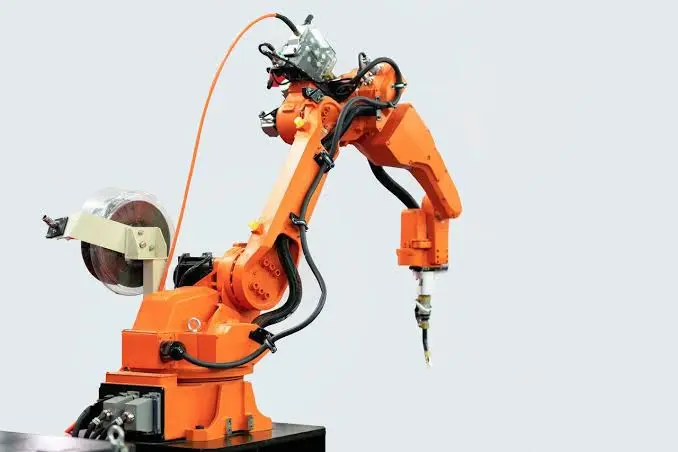
Articulated industrial robots are probably the machines most people imagine when they think about factory robotics.
They resemble a mechanical arm with several rotary joints.
Six-axis models are particularly common because they can move a tool through complex positions and orientations.
Articulated industrial robots are widely used for:
- automotive welding;
- material handling;
- machine tending;
- painting;
- assembly;
- palletizing;
- grinding.
Their flexibility makes them useful when the robot has to approach a component from multiple angles.
SCARA Robots
SCARA stands for Selective Compliance Assembly Robot Arm.
These industrial robots are particularly useful for fast assembly and pick-and-place operations.
SCARA systems generally excel at repetitive movements across a horizontal plane and are frequently found in electronics manufacturing.
They can perform tasks such as inserting parts, moving small components and assembling products at high speed.
Cartesian Robots
Cartesian robots move along straight linear axes, normally X, Y and Z.
Their structure can resemble a gantry positioned above machinery or production equipment.
These industrial robots are commonly used where predictable linear motion and large rectangular work areas are required.
Applications include:
- CNC machine loading;
- 3D printing;
- material handling;
- dispensing;
- packaging;
- palletizing.
Delta Robots
Delta robots use lightweight arms connected to a common platform.
Their low moving mass allows extremely fast movement.
They are widely used for high-speed picking and sorting, particularly where products are relatively lightweight.
Food processing is one important application.
A delta industrial robot can identify items moving on a conveyor, pick them rapidly and place them into packaging.
Where Are Industrial Robots Used?
Automotive manufacturing remains one of the most recognizable applications, but industrial robot adoption is becoming much broader.
IFR’s 2024 installation data showed approximately:
- 128,899 installations in electrical and electronics manufacturing;
- 126,088 installations in automotive manufacturing;
- 88,777 installations in metal and machinery;
- 26,491 installations in plastics and chemicals;
- 20,792 installations in food production.
That distribution demonstrates how industrial robots have moved well beyond automobile assembly lines.
Automotive Manufacturing
The automotive industry was one of the earliest large-scale adopters of industrial robots.
Vehicle production contains many operations suited to automation because components are produced at high volumes and manufacturing processes require repeatability.
Industrial robots can perform:
- spot welding;
- arc welding;
- painting;
- sealing;
- material handling;
- part placement;
- assembly;
- quality inspection.
Robots can also handle heavy body panels and operate around heat, sparks, chemicals and other hazards.
Electronics Manufacturing
Electronics production has become one of the largest markets for industrial robots.
Manufacturing smartphones, computers, batteries, semiconductors and electronic components requires precision at extremely small scales.
SCARA robots, articulated arms and specialized automation can:
- place components;
- assemble connectors;
- handle delicate parts;
- test products;
- inspect surfaces;
- package finished devices.
Machine vision is particularly important because electronic components can be small and defects difficult for traditional sensors to identify.
Metal and Machinery
Metalworking creates another major market.
Industrial robots can load machine tools, move heavy metal parts, weld components, grind surfaces and perform repetitive fabrication processes.
Machine tending is especially important.
Instead of a worker repeatedly loading and unloading a CNC machine, an industrial robot can move parts into position, wait for machining to finish and remove completed components.
This can reduce repetitive manual handling while allowing machinery to operate for longer periods.
Food and Beverage Manufacturing
Industrial robots are increasingly appearing in food manufacturing.
The sector has traditionally presented challenges because food can vary in shape, texture and orientation.
Better sensing and vision systems are changing that.
Industrial robots can now be used for:
- sorting;
- packaging;
- palletizing;
- cutting;
- decorating;
- handling packaged goods.
The United States provides a recent example of this shift. IFR preliminary data showed industrial robot installations in the U.S. food sector increased by approximately 30% in 2025, reaching around 3,000 units.
Clothing and Garment Manufacturing
Textiles demonstrate the limits—and future potential—of factory robotics.
Fabric bends, folds and changes shape when touched, making it significantly harder for machines to manipulate than rigid metal or plastic components.
However, advances in computer vision, gripping systems and AI are gradually opening new possibilities.
The News Ink has examined this challenge in its report on garment manufacturing robots and automated clothing production.
It is a useful example of why the next generation of industrial robots may need greater adaptability rather than simply greater speed.
Why Manufacturers Use Industrial Robots
Companies normally invest in industrial robots because automation can improve several parts of a production process at the same time.
Repetition
Humans can perform repetitive work, but attention and physical endurance change during long shifts.
Industrial robots can repeat programmed movements continuously when the production environment remains within their operating conditions.
Precision
Processes such as welding, dispensing, assembly and machining can require extremely consistent movements.
Industrial robots can repeatedly position tools and components within tightly controlled tolerances.
Dangerous Work
Robotics can move workers away from certain hazardous tasks.
Industrial robots may operate around:
- extreme heat;
- welding arcs;
- heavy components;
- sharp materials;
- paint fumes;
- repetitive lifting;
- machinery.
OSHA notes that robots are commonly used for unsafe, hazardous, repetitive and unpleasant tasks including welding, material handling, assembly, painting and machine loading.
Production Throughput
A well-designed automated cell can operate repeatedly with predictable cycle times.
This can increase throughput, particularly in high-volume manufacturing.
However, faster production is not automatically guaranteed.
Poor integration can simply move the bottleneck somewhere else in the production line.
Labor Availability
Manufacturers in some regions struggle to recruit workers for repetitive, physically demanding or highly specialized jobs.
Industrial robots can automate parts of these processes while workers move toward supervision, quality control, maintenance, programming and other roles.
This broader employment shift is closely connected to the changes explored in The News Ink’s article on how AI is changing jobs faster than expected.
Industrial Robots Do Not Automatically Mean Full Automation
A common misconception is that installing robots means removing people from a factory.
Real production environments are more complicated.
A robotic manufacturing system may still require humans to:
- load materials;
- solve unexpected faults;
- maintain machinery;
- inspect difficult defects;
- change tooling;
- program new products;
- manage production;
- repair equipment.
Automation often changes the structure of work rather than immediately eliminating the entire process.
NIST has also highlighted how difficult robotic integration can be because automated systems need to communicate with sensors, machines and other equipment, while humans remain much better at many subtle manipulation and assembly tasks.
This explains why some seemingly simple manufacturing activities remain difficult to automate.
Industrial Robots and Artificial Intelligence
Traditional industrial robots do not necessarily use artificial intelligence.
A robot can follow the same programmed movement for years without machine learning.
That distinction is important.
Traditional automation works best when:
- the environment is controlled;
- objects appear in known positions;
- the task rarely changes;
- movements can be programmed in advance.
Artificial intelligence becomes useful when the industrial robot has to deal with more variation.
AI can support:
- object recognition;
- visual inspection;
- anomaly detection;
- predictive maintenance;
- adaptive gripping;
- path planning;
- natural-language programming;
- production optimization.
The relationship between these technologies is explained more broadly in The News Ink’s Artificial Intelligence Explained guide.
IFR identified AI and increasing robot autonomy as one of the most important robotics trends for 2026. Analytical AI can help identify patterns and predict failures, while generative and agentic approaches are being explored for more flexible robot interaction and task planning.
The result could gradually move industrial robots from machines that repeat fixed motions toward machines that can adapt to greater variation.
That transition should not be overstated.
Factory reliability requirements are extremely demanding. A system that works correctly 90% of the time may appear impressive in a laboratory but be commercially unacceptable on a production line where thousands of products are manufactured every day.
Industrial Robot Safety
Industrial robots can move quickly and generate forces capable of causing serious injury.
Safety therefore has to be designed into the complete automation system.
The current international framework includes ISO 10218-1:2025, which addresses safety requirements for industrial robots themselves, and ISO 10218-2:2025, which covers industrial robot applications and robot cells.
Typical safety measures can include:
- physical guarding;
- interlocked doors;
- emergency stops;
- safety-rated sensors;
- restricted operating zones;
- controlled speeds;
- safe programming procedures;
- lockout procedures;
- worker training;
- risk assessment.
One important point is that accidents may happen not only during normal production.
OSHA notes that many robotic incidents occur during non-routine activities such as programming, maintenance, testing, setup and adjustment, when workers may need to enter the robot’s working envelope.
This means businesses should not judge robot safety only by what happens while the production line is running normally.
Maintenance and fault recovery are equally important.
As industrial robots become more connected to factory networks, cybersecurity also becomes part of operational safety.
Compromised controllers, insecure remote access or manipulated production systems can create business and potentially physical risks.
For broader protection concepts, see The News Ink’s Cybersecurity Explained: Complete Guide and AI Safety Explained.
Industrial Robots vs Collaborative Robots
Traditional industrial robots and collaborative robots—or cobots—are related but should not be treated as identical.
| Industrial Robots | Collaborative Robots |
|---|---|
| Often optimized for speed and payload | Often optimized for flexible human interaction |
| Frequently operate behind guarding | Can be designed for collaborative applications |
| Common in high-volume production | Common in flexible or smaller-scale automation |
| Can handle large payloads | Many models handle lighter payloads |
| Programming may require specialist skills | Many systems emphasize easier programming |
| Best for repetitive optimized cells | Useful where tasks or products change frequently |
A collaborative robot is not automatically safe simply because it is marketed as a cobot.
The safety of the complete application still depends on the task, end effector, speed, payload and surrounding environment.
Because collaborative robotics is becoming an important field of its own, it deserves separate treatment rather than being reduced to one subsection of industrial automation.
The Cost of Industrial Robots
The purchase price of the robot arm is only one part of the cost of automation.
A complete system may also require:
- end effectors;
- safety fencing;
- cameras;
- sensors;
- conveyors;
- fixtures;
- controllers;
- programming;
- integration;
- electrical work;
- factory modifications;
- employee training;
- maintenance.
This is why businesses should calculate total system cost, not simply compare robot prices.
A relatively inexpensive robot that requires complex custom engineering could ultimately cost more than a higher-priced system that integrates easily.
Return on investment also depends heavily on the application.
Manufacturers should examine:
- current labor and production costs;
- product volume;
- cycle time;
- defect rate;
- downtime;
- changeover frequency;
- maintenance requirements;
- expected equipment life.
Industrial robots usually deliver the strongest economic case when the task is repetitive, measurable and sufficiently stable.
Limitations of Industrial Robots
Industrial robots are extremely capable, but they are not universal workers.
Integration Can Be Difficult
Factories contain older machines, different communication standards and processes developed over decades.
Making a new industrial robot work reliably with existing infrastructure may require substantial engineering.
Unstructured Tasks Remain Hard
Humans can recognize unusual situations and improvise.
Traditional industrial robots usually depend on more structured environments.
AI and machine vision are improving this limitation, but they do not eliminate it.
Maintenance Is Essential
Robotic systems contain motors, gearboxes, cables, sensors and tooling that can wear or fail.
Unexpected downtime can become expensive when the robot is connected to a critical production process.
Product Changes Can Reduce ROI
An automation system designed for one product may become less useful when the design changes.
Flexible tooling and software can reduce this problem, but flexibility often increases system complexity.
The Future of Industrial Robots
Industrial robots are moving toward greater flexibility, connectivity and intelligence.
The International Federation of Robotics identifies AI, IT/OT integration, safety, humanoid experimentation and labor shortages among the major forces shaping robotics in 2026.
Several developments are particularly important.
AI-Powered Vision
Industrial robots will become better at recognizing components that are not presented in exactly the same orientation every time.
This could expand automation into tasks that are too variable for conventional robotic cells.
Easier Programming
Programming industrial robots has historically required specialized knowledge.
New interfaces increasingly use graphical tools, demonstrations and experimental natural-language systems.
Reducing programming complexity could make robotics more accessible to smaller manufacturers.
Connected Factories
Industrial robots are becoming part of larger smart manufacturing systems.
Production data can flow between robot controllers, manufacturing execution systems, sensors and enterprise software.
That connection can improve visibility but also increases the importance of cybersecurity.
Predictive Maintenance
Sensors and analytical AI can monitor equipment conditions and identify patterns associated with wear or failure.
Instead of waiting for a machine to fail, factories may increasingly schedule maintenance based on operational data.
Humanoid Robots
Humanoid robots are attracting substantial interest because factories are designed around human bodies, tools and workspaces.
However, they must compete with specialized industrial robots that are already highly efficient.
The News Ink has explored this emerging competition in Humanoid Robots Are No Longer Science Fiction and Humanoid Robots Could Have Their ChatGPT Moment.
Traditional industrial robots are unlikely to disappear simply because humanoid machines improve.
For many high-volume tasks, a specialized arm will remain cheaper, faster and more efficient than reproducing the entire human body.
Frequently Asked Questions About Industrial Robots
What are industrial robots?
Industrial robots are programmable machines designed to perform manufacturing and industrial automation tasks. They commonly handle welding, assembly, material handling, painting, packaging, palletizing, machine tending and inspection.
How many industrial robots are operating worldwide?
The International Federation of Robotics reported approximately 4.664 million industrial robots operating worldwide in 2024, with 542,000 new units installed during that year.
What are the main types of industrial robots?
The major types include articulated robots, SCARA robots, Cartesian robots, delta robots, cylindrical robots and collaborative robotic systems.
Which industry uses the most industrial robots?
Electronics and automotive manufacturing are currently the two largest industrial robot customer industries globally. IFR reported about 128,899 installations in electronics and 126,088 in automotive manufacturing during 2024.
Do industrial robots use artificial intelligence?
Not necessarily. Traditional industrial robots can operate using fixed programming and control systems without modern AI. Artificial intelligence is increasingly being added for machine vision, adaptive manipulation, inspection, predictive maintenance and planning.
Will industrial robots replace factory workers?
Industrial robots can automate individual tasks and may reduce the amount of human labor required for some processes. However, factories still need workers for maintenance, engineering, quality control, programming, supervision, troubleshooting and tasks that remain difficult to automate.
Are industrial robots dangerous?
Industrial robots can generate significant speed and force, so poorly designed or maintained systems can create serious hazards. Modern installations use risk assessments, guarding, safety-rated controls, sensors and international safety standards to reduce these risks.
What is the difference between an industrial robot and a cobot?
Traditional industrial robots are often optimized for high speed, payload and repetitive production, while collaborative robots are designed around applications where closer human-machine interaction may be required. The safety of either system depends on the entire application, not just the robot model.
Conclusion: Industrial Robots Are Becoming Core Manufacturing Infrastructure
Industrial robots have moved from specialized machines used primarily in automobile factories to one of the foundations of modern manufacturing.
More than 4.6 million industrial robots are already operating globally, and annual installations remain above half a million units.
Their value comes from combining speed, repeatability, precision and the ability to perform work that may be physically demanding, monotonous or hazardous for people.
But successful automation involves much more than placing a robot arm beside a production line.
Manufacturers must understand the task, tooling, sensors, software, safety requirements, system integration, maintenance and economics of the entire production process.
Artificial intelligence is now adding another layer.
Machine vision, predictive systems and more adaptable control could allow industrial robots to operate in environments that previously contained too much variation for traditional automation.
That does not mean factories are about to become completely human-free.
The more realistic future is one in which specialized industrial robots, collaborative systems, autonomous machines and human workers increasingly operate as parts of the same production environment.
Industrial robotics therefore represents both a mature technology and a field undergoing another major transformation.
For a wider understanding of how these systems connect with autonomous machines, AI, humanoids and the future of work, continue with The News Ink’s Robotics Explained: Complete Guide.
Follow The News Ink
X
Pinterest
Medium
Quora
TikTok
Instagram
Substack
Threads
Bluesky
Mastodon