Sign In
The News Ink
  • Technology
  • Anime
  • Sports
  • Business
  • Beauty & Fashion
  • Daily News
  • More
    • Lifestyle
    • Bizarre
    • Current Affairs
    • Entertainment
    • Health
    • Opinion
    • Science
    • Travel
Reading: Hubble Telescope Detects Possible “Dark Galaxy” 300 Million Light-Years Away
Share
The News InkThe News Ink
Font ResizerAa
  • Travel
  • Opinion
  • Science
  • Technology
  • Beauty & Fashion
Search
  • Home
    • Home 1
    • Home 2
    • Home 3
    • Home 4
    • Home 5
  • Categories
    • Technology
    • Opinion
    • Travel
    • Beauty & Fashion
    • Science
    • Health
  • Bookmarks
  • More Foxiz
    • Sitemap
Have an existing account? Sign In
Follow US
© 2022 Foxiz News Network. Ruby Design Company. All Rights Reserved.
The News Ink > Blog > Science > Hubble Telescope Detects Possible “Dark Galaxy” 300 Million Light-Years Away
Science

Hubble Telescope Detects Possible “Dark Galaxy” 300 Million Light-Years Away

Dowry Lane
Last updated: March 6, 2026 3:57 pm
Dowry Lane
Share
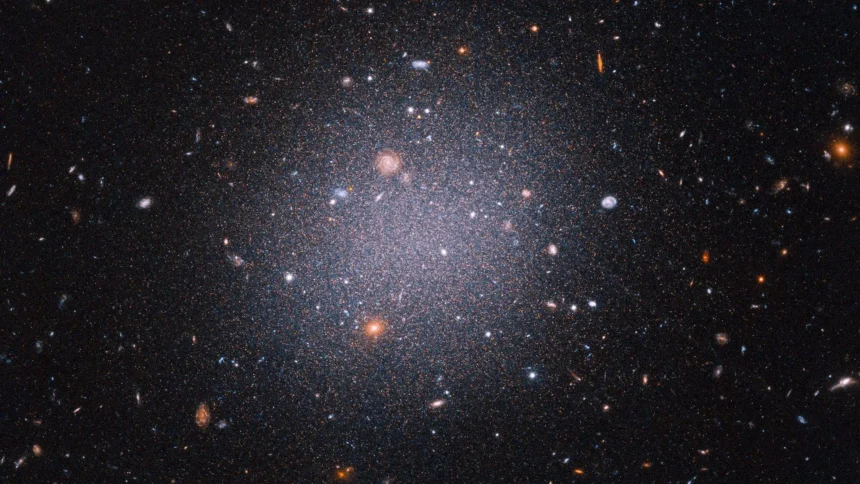
Hubble telescope image showing faint dark galaxy CDG-2 with globular clusters
The Hubble Space Telescope captured a faint glow around four globular clusters, revealing the possible dark galaxy CDG-2.
SHARE

Astronomers have identified a possible “dark galaxy” located about 300 million light-years from Earth. The object, known as CDG-2, appears to contain very few stars but a large amount of dark matter.

Contents
A Galaxy Dominated by Dark MatterScientists Found It Through Globular ClustersWhy the Galaxy Has So Few StarsA New Way to Find Hidden Galaxies

Researchers believe it could belong to a rare group of galaxies known as dark galaxies. These galaxies are extremely faint and may contain little visible light.

The discovery used observations from the Hubble Space Telescope, the Euclid Space Telescope, and the Subaru Telescope in Hawaii. Scientists published the findings in The Astrophysical Journal Letters.

A Galaxy Dominated by Dark Matter

CDG-2 lies inside the Perseus Cluster, a massive group that contains thousands of galaxies.

Scientists say the galaxy is extremely faint. Its brightness is only about 0.005% of the Milky Way’s brightness. In comparison, the Milky Way shines about 20 billion times brighter than the Sun.

Researchers believe most of the galaxy’s mass comes from Dark Matter, an invisible substance that does not emit light but influences objects through gravity.

Because CDG-2 contains very few stars, scientists describe it as an “almost-dark galaxy.”

Scientists Found It Through Globular Clusters

Astronomers used an unusual method to locate the faint galaxy. Instead of searching for bright stars, they looked for Globular Clusters.

Globular clusters are dense, spherical groups of very old stars. These clusters often remain visible even when the surrounding galaxy is extremely faint.

Researchers discovered four globular clusters grouped together in the Perseus Cluster. Further observations revealed a faint halo around them. This glow suggested the presence of a hidden galaxy.

Scientists believe the clusters remain bound together by gravity created by dark matter in the galaxy.

Why the Galaxy Has So Few Stars

Astronomers think CDG-2 once had the material needed to create more stars. However, nearby larger galaxies may have stripped away its hydrogen gas early in its history.

Without that gas, the galaxy could not continue forming new stars. It likely remained with only its dark matter halo and a few star clusters.

Scientists describe this result as the “skeleton” of a galaxy that failed to grow normally.

A New Way to Find Hidden Galaxies

Researchers say using globular clusters could become a new way to discover dark galaxies. Many more of these faint objects may exist across the universe.

Future observations with the James Webb Space Telescope could help confirm how much dark matter CDG-2 contains.

Studying such galaxies may help scientists understand how dark matter behaves in space. Because these galaxies contain little normal matter, they offer a clearer view of dark matter’s effects.
Subscribe to Our Newsletter

Subscribe to our newsletter to get our newest articles instantly!

[mc4wp_form]
TAGGED:Hubble Telescope Detects Possible “Dark Galaxy” 300 Million Light-Years Away
Share This Article
Twitter Email Copy Link Print
Previous Article High-resolution map of molecular gas at the center of the Milky Way Astronomers Reveal the Most Detailed Map of the Milky Way’s Center
Next Article Total lunar eclipse turning the moon red during the blood moon event Total Lunar Eclipse Turns Moon Red: How and When to Watch the Blood Moon
Leave a comment

Leave a Reply Cancel reply

You must be logged in to post a comment.

Editor's Pick

Hot News

Fuel pumps in the Philippines as government declares energy emergency

Philippines Declares Energy Emergency as Iran Conflict Drives Fuel Prices Higher

The Philippines has declared a national energy emergency, becoming the…

March 25, 2026

ABC Journalists Stage First Strike in Two Decades Over Pay and Working Conditions

Hundreds of journalists walked off the…

March 25, 2026

OpenAI Closes Sora AI Video App and Moves Away from Disney Collaboration

OpenAI has shut down its AI…

March 25, 2026

BlackRock CEO Warns $150 Oil Could Trigger Global Recession

BlackRock CEO Larry Fink has warned…

March 25, 2026

Oil Prices Fall Amid US-Iran Peace Talks and Strait of Hormuz Updates

Oil prices dropped sharply after US…

March 25, 2026

You Might Also Like

Uefa officials discussing Premier League financial rules at summit
Science

Uefa Warns Premier League Spending Rules Could Destabilize European Football

Uefa has raised concerns about the Premier League’s new financial rules, fearing they could disrupt European football’s financial balance. Next…

3 Min Read
Six planet parade visible in the night sky showing Mercury Venus Jupiter Saturn Uranus and Neptune alignment
Science

Six-Planet Parade Will Light Up the Night Sky This Saturday

Sky watchers will get a rare treat this Saturday as a six-planet parade appears in the night sky. If the…

4 Min Read
Total lunar eclipse turning the moon red during the blood moon event
Science

Total Lunar Eclipse Turns Moon Red: How and When to Watch the Blood Moon

A total lunar eclipse is turning the moon a deep reddish-orange, creating what many call a blood moon. Sky-watchers across…

4 Min Read
High-resolution map of molecular gas at the center of the Milky Way
Science

Astronomers Reveal the Most Detailed Map of the Milky Way’s Center

Astronomers have captured the most detailed map yet of the center of the Milky Way. The image shows cold gas…

4 Min Read
The News Ink

Categories

  • Anime
  • Beauty & Fashion
  • Bizarre
  • Business
  • Current Affairs

Explore

  • Daily News
  • Entertainment
  • Health
  • Lifestyle
  • Opinion

More

  • Science
  • Sports
  • Technology
  • Travel

Legal Docs

  • Home
  • About Us
  • Contact
  • Blog
  • Privacy Policy
  • Terms and Conditions

© The News Ink. All Rights Reserved.

Welcome Back!

Sign in to your account

Register Lost your password?