Hanoi’s Train Street: The Alarming Danger Behind Vietnam’s Instagram Sensation
Hanoi’s Train Street is one of Vietnam’s most photographed tourist spots, but behind the lanterns, coffee cups and viral Instagram videos is an active railway corridor where one mistake can turn a travel memory into a life-threatening incident.
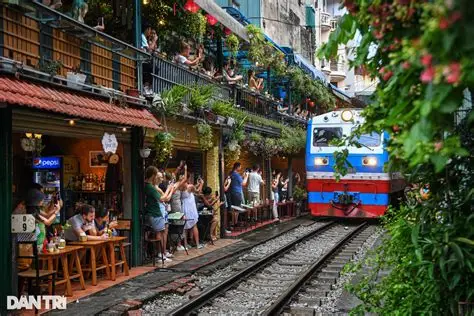
The scene is instantly recognisable. A train horn cuts through a narrow lane in Hanoi. Café owners pull stools back from the rails. Tourists lift phones. Tables, lanterns and walls sit so close to the track that the train appears to brush through the crowd. For a few seconds, the street becomes theatre: danger, noise, colour and social media spectacle in one shot.
That is the appeal. It is also the problem.
Hanoi’s Train Street was never designed as a tourist attraction. It began as part of a working railway built during the French colonial period. Families lived beside the track for decades, adjusting daily life around passing trains. Only later did cafés, travel guides, Instagram reels and global curiosity turn the alley into one of Hanoi’s most controversial landmarks.
The attraction now sits at the centre of a difficult debate. Travellers see a once-in-a-lifetime photo. Café owners see income. Local authorities see overcrowding, illegal encroachment and the risk of a serious rail accident. The result is a cycle of crackdowns, barricades, reopenings, informal access and fresh concern every time a video goes viral.
For readers planning safer trips, The News Ink’s smart travel coverage is a useful place to start before visiting any high-risk attraction.
Why Hanoi’s Train Street became famous
Hanoi’s Train Street became famous because it compresses everything social media loves into one narrow frame: danger, colour, local life, movement and a sense of being somewhere hidden. A train passing inches from café tables looks unreal on camera. That visual shock is what turned the railway corridor into a global attraction.
Before tourism transformed it, the street was an ordinary residential area. Homes sat beside the railway, and residents learned to move washing, furniture, children and pets away from the line when trains approached. The rhythm was practical, not performative.
The transformation accelerated in the 2010s. Travel photographers began leading visitors to the alley. International coverage followed. Instagram video made the passing trains even more shareable. Cafés appeared, lights and lanterns multiplied, and the once-ordinary rail corridor became a destination.
The problem is that viral fame changed the behaviour around the tracks. Residents knew the danger because they lived with it. Tourists often saw the same space as a backdrop. That difference matters. A local stepping aside early and a visitor posing until the last second are not doing the same thing.
Hanoi’s Train Street became famous because it looked thrilling. It became controversial because the thrill depends on standing near a real train.
The safety issue authorities cannot ignore
The central danger at Hanoi’s Train Street is simple: the railway is active. These are not abandoned tracks. Trains still run through the corridor, and the space between the train and nearby buildings is extremely narrow.
Reuters reported in 2019 that Hanoi ordered trackside cafés removed after a train had to make an emergency stop to avoid tourists. The order followed growing crowds gathering for selfies, drinks and videos along the railway. That early shutdown showed that authorities already considered the attraction a serious safety risk.
Since then, enforcement has come in waves. Police barriers appear. Cafés are told to close or sign safety pledges. Tour companies are warned not to bring visitors. Then, after attention fades, tourists return, cafés reopen or operate informally, and the cycle begins again.
Hanoi’s Train Street is difficult to regulate because it is not a normal fenced tourist site. It is a living neighbourhood, a business corridor and a working rail line at the same time. Closing it completely affects livelihoods. Leaving it unchecked risks injury or worse.
That tension explains why the street can look open one week and restricted the next. Access may depend on the exact section, police presence, café arrangements and current enforcement.
What changed in 2026
Hanoi’s Train Street entered a new phase in 2026 because local authorities considered a more dramatic solution: stopping passenger trains from running through the famous café stretch.
Vietnam News reported in January 2026 that Hanoi had proposed suspending passenger trains on the section of railway running through the “railway café street.” The proposal focused on the stretch between Hanoi Station and Long Bien Station, where cafés line both sides of the active track.
That idea matters because it would change the attraction itself. If trains no longer pass through, the street could become safer, but it would also lose the spectacle that made it famous. Tourists come for the train. Café owners depend on the train. Authorities worry about the train.
Hanoi’s Train Street therefore faces a paradox. The feature that makes it valuable is the same feature that makes it dangerous.
No responsible article should promise visitors that the attraction will be open in a particular form. Rules can shift. Enforcement can change. A safe viewing area may exist one day and be restricted the next. Anyone planning to visit should check current local guidance, follow police instructions and avoid any café or guide that encourages standing on the tracks.
Key facts visitors should know
| Issue | What it means |
|---|---|
| Location | A narrow active railway corridor in central Hanoi |
| Main appeal | Trains passing close to cafés, homes and visitors |
| Main danger | Crowds and tourists standing too close to moving trains |
| Official concern | Railway safety, crowd control and illegal encroachment |
| Enforcement pattern | Repeated crackdowns, barriers, café closures and warnings |
| 2026 development | Hanoi proposed suspending passenger trains through the café stretch |
| Responsible approach | Observe only from permitted areas and never pose on the rails |
| Best safety rule | If staff or police say move, move immediately |
Hanoi’s Train Street should be treated as a working transport corridor first and a tourist attraction second. That single mindset can prevent most reckless behaviour.
The Instagram problem
The danger behind Hanoi’s Train Street is not only physical. It is psychological. Social media rewards the most dramatic angle, the closest pose and the most intense reaction. That reward system can push tourists into taking risks they would normally avoid.
A photo from a safe distance may get attention. A video taken from the rails seconds before the train arrives may get more. That incentive is dangerous. It turns safety into content and makes people delay moving because the “perfect” shot has not happened yet.
The same pattern appears at cliffs, waterfalls, rooftops, wild-animal encounters and crowded pilgrimage sites. Travellers begin by wanting a memory. Then the camera changes the decision-making. Instead of asking, “Is this safe?” they ask, “Will this look good?”
Hanoi’s Train Street is especially vulnerable to this behaviour because the danger is predictable. People know the train is coming. They know the horn will sound. They know the shot will look dramatic. That makes the risk feel controlled, even though a moving train leaves no margin for error.
The lesson is not that travel photography is bad. The lesson is that no photograph is worth standing on an active rail line.
The local-business dilemma
It would be too easy to describe Hanoi’s Train Street only as a tourist problem. For local residents and café owners, the issue is more complicated.
Tourism brought money into an area that was once overlooked. Cafés, drinks, souvenirs and guiding services created income. Residents who had lived with the noise and danger of trains for decades suddenly found that the same railway could support their families.
That is why closures cause frustration. When authorities shut cafés, they are not only removing props from a tourist photo. They are affecting livelihoods. Some owners argue that they manage crowds carefully, pull chairs back before trains arrive and warn visitors to stay safe.
But public safety cannot depend only on informal discipline. A busy café owner cannot control every tourist, every phone, every child or every last-second pose. When a train enters a narrow space, one person’s mistake can endanger others.
Hanoi’s Train Street needs a balance that protects residents and visitors without pretending the risk does not exist. Regulated viewing zones, strict café licensing, clear barriers, real penalties for dangerous behaviour and better alternative attractions may all be part of that balance.
The history behind the tracks
Hanoi’s Train Street sits on railway infrastructure connected to Vietnam’s colonial-era rail development. The line is commonly dated to the early 20th century, with many accounts tracing the track to French colonial construction around 1902.
For decades, the railway was part of daily life rather than a tourist brand. Families lived close to the tracks because cities grow around infrastructure, especially in dense neighbourhoods where housing is scarce. Residents adapted. They knew train times. They cleared belongings. Children grew up understanding the rhythm of the rails.
By the 1970s and later decades, the area was often viewed as poor, cramped and undesirable. What tourists now see as atmospheric, locals experienced as noise, vibration, risk and limited living space.
That history matters because Hanoi’s Train Street should not be treated like a theme park. It is a community shaped by colonial infrastructure, urban density and economic survival. Visitors entering the street are entering someone’s neighbourhood, not just a backdrop.
For broader cultural travel context, The News Ink’s feature on how to enjoy a perfect weekend in Hong Kong shows how dense Asian cities often mix heritage, tourism and modern pressure in the same streets.
Why crackdowns keep failing
Authorities have repeatedly tried to control Hanoi’s Train Street, but the attraction keeps returning because demand remains strong.
There are four reasons.
First, the image is too powerful. Visitors see videos online and want the same experience.
Second, access is informal. A fully fenced official attraction is easier to manage. A residential railway lane is harder.
Third, local businesses have financial incentive to reopen or continue operating when possible.
Fourth, enforcement is inconsistent by nature. Police may clear one section, but tourists and cafés may shift to another.
TIME reported in 2023 that Hanoi wanted tourists to stop visiting the attraction because safety concerns continued despite measures such as penalising businesses, barricades and discouraging travel agencies from promoting the site. AFP reporting in 2025 described tourists still crowding railside cafés even after repeated shutdown attempts.
That pattern shows the problem clearly. Viral tourism does not disappear just because a government issues a warning. If the image remains online and access remains possible, visitors keep coming.
What responsible travellers should do
Hanoi’s Train Street can still be discussed as a travel attraction, but responsible travellers should treat it with caution. The aim should never be to get the closest possible shot. The aim should be to avoid becoming part of the safety problem.
Before visiting, check whether the area is currently restricted. Do not push past barricades. Do not follow guides who promise “secret” or illegal entry. Do not stand or sit on the rails. Do not place objects on the track. Do not encourage children to pose near the train. Do not delay moving because a camera is still recording.
If you enter a café that is operating legally and safely, follow staff instructions immediately. Move back before the train arrives, not when it is already in front of you. Keep bags, legs, tripods and selfie sticks away from the track. Avoid alcohol-heavy behaviour around train times.
Hanoi’s Train Street should be visited, if at all, as a place where people live and trains operate — not as a challenge.
The News Ink’s guide to public Wi-Fi safety while travelling covers a different kind of travel risk, but the principle is similar: good trips require awareness before something goes wrong.
Safer ways to experience Hanoi
Travellers do not need to risk a close-call train photo to enjoy Hanoi. The city has enough culture, food, architecture and history to fill several days without stepping onto active tracks.
The Old Quarter offers street food, markets, temples and traditional shop-house architecture. Hoàn Kiếm Lake gives visitors a calmer central landmark. The Temple of Literature, Ho Chi Minh Mausoleum area, French Quarter and Hoa Lo Prison Museum all provide deeper historical context. Hanoi’s café culture is also rich far beyond the train tracks, from egg coffee shops to quiet courtyards.
If visitors still want to see rail culture, they should look for regulated viewing points or safer railway-related experiences rather than entering restricted sections. Hanoi has enough texture that no one attraction should define the whole trip.
Hanoi’s Train Street is famous, but fame is not the same as importance. The best travel memories often come from staying longer, walking slowly, eating locally and respecting the city’s rhythm.
How social media changed travel behaviour
Hanoi’s Train Street is part of a wider global shift. Destinations are no longer shaped only by guidebooks, hotels and official tourism boards. They are shaped by TikTok, Instagram, YouTube Shorts and travel influencers.
That can help overlooked places gain income. It can also overwhelm spaces never designed for crowds. A small alley, café, beach, bridge or mountain viewpoint can become globally famous within weeks. Local infrastructure rarely adapts that quickly.
The danger is that social platforms flatten places into images. A working railway becomes “the train photo spot.” A residential neighbourhood becomes “the hidden café street.” The people who live there become background.
This is why Hanoi’s Train Street is such a useful case study. It shows both sides of viral tourism. Social media created opportunity and income, but it also created crowding, risk and pressure on local authorities.
Responsible travel in 2026 means asking not only “Can I go?” but “Should I go this way?”
Tourism, safety and the future of the street
The future of Hanoi’s Train Street may depend on whether authorities can create a controlled model that protects people without destroying local livelihoods.
One possibility is a regulated viewing system with licensed cafés, set capacity limits, enforced barriers and clear train-time protocols. Another is rerouting or suspending passenger trains through the stretch, turning the area into a safer tourism corridor but reducing the original spectacle. A stricter option is full closure and enforcement, though past experience suggests demand may simply move underground unless access is physically impossible.
Each option has trade-offs. Regulated tourism requires staffing and compliance. Rerouting trains affects transport planning. Closure affects businesses. Doing nothing risks injury.
The best outcome would treat safety as non-negotiable while recognising that residents need income and tourists need clear information. Confusion is dangerous. If a place appears closed but cafés still invite visitors in, tourists receive mixed signals. If rules are clear and enforced consistently, fewer people can claim they did not know.
Quick safety guide for visitors
| Do | Avoid |
|---|---|
| Check current local rules before going | Assuming old videos reflect today’s access |
| Stay behind barriers or café safety lines | Standing, sitting or dancing on the tracks |
| Move back before the train arrives | Waiting for the horn before stepping away |
| Follow police and café staff instructions | Arguing with staff for a better photo |
| Keep phones and selfie sticks away from the train | Leaning into the track for close-up videos |
| Respect residents and homes | Treating the street like a film set |
| Choose safer Hanoi attractions if access is restricted | Paying guides for illegal or risky entry |
Hanoi’s Train Street can only remain part of Hanoi’s tourism story if visitors stop treating risk as entertainment.
FAQ: Hanoi’s Train Street
Is Hanoi’s Train Street still open?
Access changes depending on enforcement, location and current safety rules. Some areas may appear open while others are restricted. Visitors should follow police instructions and avoid any café or guide encouraging unsafe access.
Why is Hanoi’s Train Street dangerous?
Hanoi’s Train Street is dangerous because trains pass through a very narrow active rail corridor close to cafés, walls and visitors. Crowding, selfies and delayed movement increase the risk of accidents.
Did Hanoi try to close Train Street?
Yes. Authorities have repeatedly tried to restrict or close trackside cafés because of safety concerns. Reuters reported a major 2019 shutdown after a train had to stop to avoid tourists, and Hanoi later considered suspending passenger trains through the café stretch.
Can tourists take photos there safely?
Photos should only be taken from permitted safe areas, away from the rails and without blocking the track. Standing on the rails, posing close to trains or ignoring staff instructions is unsafe.
What are better alternatives in Hanoi?
Visitors can explore the Old Quarter, Hoàn Kiếm Lake, the Temple of Literature, the French Quarter, Hoa Lo Prison Museum and Hanoi’s wider café culture without taking risks on active railway tracks.
The bottom line
Hanoi’s Train Street is unforgettable because it feels impossible: a train squeezing through a café-lined alley while tourists sit close enough to feel the rush of air. That image made it famous. That same image explains why authorities keep trying to control it.
The street is not fake danger. It is real danger turned into content. The railway remains active, the corridor is narrow and crowd behaviour can change in seconds. A visitor who waits too long for a selfie is not only risking themselves. They may also endanger café staff, other tourists, residents and railway workers.
Hanoi’s Train Street does not need to disappear from travel writing. It needs to be written about honestly. It is visually remarkable, historically layered and economically important to locals. It is also risky, unstable as a tourist experience and shaped by a social-media culture that often rewards the wrong behaviour.
The safest advice is simple. Do not stand on the tracks. Do not ignore barriers. Do not chase the closest shot. Respect residents. Follow current rules. If the area is restricted, choose another part of Hanoi.
A good trip should leave memories, not close calls.
For more travel features and responsible tourism stories, follow The News Ink on Instagram.