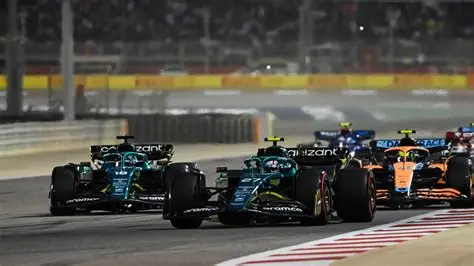
Bahrain and Saudi Arabia F1 Races Cancelled as Middle East Tensions Hit Formula One
Bahrain and Saudi Arabia F1 races have been cancelled from their April slots after Formula One, the FIA and local promoters decided the worsening Middle East security situation made the double-header too risky to stage as planned.
The Bahrain Grand Prix had been scheduled for 10-12 April at Sakhir, with the Saudi Arabian Grand Prix due to follow one week later in Jeddah from 17-19 April. Both events were expected to be major early-season races in the 2026 Formula One calendar. Instead, they became two of the biggest sporting casualties of the regional conflict involving the United States, Israel and Iran.
Formula One confirmed on 14 March that the races would not take place in April. The decision followed careful evaluations with the FIA and local organisers. The sport also confirmed that the Formula 2, Formula 3 and F1 Academy rounds scheduled to support the two race weekends would not go ahead at their original times.
Bahrain and Saudi Arabia F1 races were initially described as uncertain. That uncertainty has now become cancellation, although Bahrain has since held talks over a possible return later in the year if regional conditions improve.
For wider context on how the conflict has affected travel and logistics, The News Ink has also covered UK Middle East flights cancelled and the intercepted missile that fell into a residential area in Doha.
Why Bahrain and Saudi Arabia F1 races were cancelled
Bahrain and Saudi Arabia F1 races were cancelled because Formula One could not separate sporting logistics from regional security. A Grand Prix is not just a race. It is a travelling city involving teams, drivers, mechanics, engineers, broadcast crews, hospitality staff, medical units, support series, freight, aviation, hotels and thousands of fans.
The official Formula One statement said the Bahrain and Saudi Arabian Grands Prix would not take place in April because of the ongoing situation in the Middle East. F1 president and CEO Stefano Domenicali said the decision was difficult but the right one at that stage. FIA president Mohammed Ben Sulayem said the FIA would always place the safety and wellbeing of the community and colleagues first.
That language was careful, but the message was clear. Formula One could not ask teams and staff to move hundreds of tonnes of equipment into a region facing missile threats, airport disruption and uncertainty around airspace.
Bahrain and Saudi Arabia F1 races therefore became a test of whether F1 would prioritise safety over calendar size, hosting fees and commercial pressure. The sport chose not to race.
The calendar impact
The cancellation immediately reduced the 2026 season from 24 races to 22, at least for the April version of the calendar. The next event after the Japanese Grand Prix at Suzuka became the Miami Grand Prix in early May, creating a five-week gap.
| Original race | Planned date | Venue | Status |
|---|---|---|---|
| Bahrain Grand Prix | 10-12 April 2026 | Bahrain International Circuit, Sakhir | Cancelled from April |
| Saudi Arabian Grand Prix | 17-19 April 2026 | Jeddah Corniche Circuit | Cancelled from April |
| Miami Grand Prix | 1-3 May 2026 | Miami International Autodrome | Became next race after Japan |
| Support series | April double-header | F2, F3, F1 Academy | Also removed from scheduled slots |
This gap disrupted rhythm across the championship. Teams had prepared for a demanding early-season run from Australia to China, Japan, Bahrain, Saudi Arabia and Miami. Instead, they had an unexpected break after Suzuka.
Bahrain and Saudi Arabia F1 races being cancelled also affected junior drivers. Formula 2, Formula 3 and F1 Academy rely on support-race weekends for track time, exposure and championship momentum. When F1 removes a weekend, the impact is felt below the main grid too.
Freight deadlines made the decision urgent
Bahrain and Saudi Arabia F1 races could not be left undecided until the final week. Formula One’s logistics operation works far ahead of race day. Freight must be packed, transported, cleared through customs and assembled at the circuit before teams arrive.
Reuters reported that the freight deadline for Bahrain was approaching on 20 March. That meant F1 had to decide before the sport committed equipment, personnel and money to a region that might still be unsafe or inaccessible.
This is why F1 could not simply “wait and see” until April. A Grand Prix requires early certainty. If airspace closes, airports suspend operations, insurance conditions change or cargo routes become unreliable, the event can fail before the first practice session.
Bahrain and Saudi Arabia F1 races were therefore cancelled before the logistical machine fully moved into place. That reduced the risk of teams being stranded or equipment being trapped in a conflict zone.
The News Ink’s coverage of how the Iran conflict is disrupting global travel explains why airspace and airport uncertainty can quickly reshape international schedules.
Why Bahrain was a particular concern
Bahrain has long been central to Formula One’s Middle East strategy. The Bahrain International Circuit hosted the region’s first F1 race in 2004 and has often staged pre-season testing. The race is also important commercially because Bahrain is closely tied to F1 through investment and team ownership. Bahrain’s sovereign wealth fund Mumtalakat owns McLaren Racing.
But Bahrain’s location made the 2026 race hard to protect from the wider crisis. Reuters reported that Iranian drones and missiles had hit Middle Eastern capitals including Manama, where F1 team personnel would have been staying in hotels. Bahrain is also home to the US Navy’s Fifth Fleet headquarters, making it strategically sensitive during a US-Iran conflict.
That matters because F1 does not only evaluate the circuit. It must evaluate hotels, airports, transport routes, fan zones, medical support, emergency exits and staff accommodation. If personnel are staying in areas near potential military targets, the risk calculation changes dramatically.
Bahrain and Saudi Arabia F1 races were not cancelled because the tracks themselves could not function. They were cancelled because the wider operating environment had become too uncertain.
Why Jeddah carried its own history of risk
Saudi Arabia’s Jeddah race had already faced a major security scare in 2022, when a missile and drone attack by Yemen’s Houthis hit an oil depot near the Jeddah circuit during the Grand Prix weekend. Smoke was visible during practice, and drivers held long meetings before the event continued after safety assurances.
That history mattered in 2026. The Jeddah Corniche Circuit is a fast street track close to strategic energy infrastructure. When regional missile risk rises, memories of 2022 return quickly.
Bahrain and Saudi Arabia F1 races had different local risks, but both sat inside the same wider security problem: Formula One would have been moving people into Gulf states during a regional war involving missile exchanges, US-linked targets and threats to energy and transport infrastructure.
The 2022 Saudi race went ahead after discussions. The 2026 race did not. That difference shows how F1’s risk tolerance changed once the conflict became wider and more unpredictable.
The financial cost
Cancelling Bahrain and Saudi Arabia F1 races was not a small commercial decision. Both events are valuable to Formula One’s business model.
Reuters reported that Bahrain’s hosting fee alone is estimated at around $45 million a year and that Saudi Arabia’s fee is likely higher. Together, the two races represent a major revenue stream for F1, while also delivering tourism, hospitality and global exposure for the host countries.
The cost is not only the hosting fee. Local hotels lose bookings. Airlines lose premium travel. Circuits lose ticket revenue. Broadcasters lose race-weekend programming. Sponsors lose activation opportunities. Junior series lose exposure.
| Area affected | Likely impact |
|---|---|
| Formula One | Lost or delayed hosting-fee revenue |
| Promoters | Ticketing, hospitality and event-cost pressure |
| Teams | Calendar disruption and logistics changes |
| Support series | Lost race weekends and reduced track time |
| Fans | Travel, hotel and refund complications |
| Host economies | Lower tourism and global exposure |
| Sponsors | Lost on-site activation and hospitality value |
Bahrain and Saudi Arabia F1 races are part of the sport’s commercial backbone. Cancelling them shows how serious the risk assessment became.
Why the races were not replaced in April
Formula One considered alternatives but decided not to replace the April races. That was a practical decision.
A Grand Prix cannot be created at short notice simply because a circuit exists. A replacement venue needs operational staff, safety approval, marshals, medical facilities, ticketing, broadcast infrastructure, freight access, local permits, police support and commercial agreements. Even circuits that have recently hosted F1 may not be ready to step in within weeks.
Several venues were mentioned in speculation, including Portugal’s Algarve International Circuit, Imola in Italy and Istanbul Park in Turkey. A second Japanese race after Suzuka was also discussed by some fans and commentators. But every option carried problems: cost, timing, weather, logistics, ticket sales and team fatigue.
Bahrain and Saudi Arabia F1 races were therefore removed without an immediate substitute. That reduced pressure on teams and gave the sport a clean break between Japan and Miami.
It also avoided the risk of rushing into a poorly prepared replacement race that might have created its own problems.
Could Bahrain still return in 2026?
Bahrain and Saudi Arabia F1 races were cancelled from April, but the story may not be fully closed for Bahrain. Reuters reported on 9 July that Bahrain had held talks about getting its Grand Prix back onto the 2026 calendar, with the most likely possible slot being the weekend of 3-4 October between Baku and Singapore.
That remains uncertain. Bahrain’s Minister of Sustainable Development and Bahrain Economic Development Board chief Noor bint Ali Alkhulaif said there were talks about possibly plugging some cancelled races back into the calendar, but no confirmation. Reuters also reported that a decision would need to be made soon to give teams time for arrangements.
This is an important update. The original April double-header is gone, but F1 may still try to restore one Middle East event if security conditions allow. A Bahrain return would also be a positive signal for the season-ending Qatar and Abu Dhabi races.
Bahrain and Saudi Arabia F1 races therefore now sit in different positions. Bahrain has been linked with possible rescheduling. Saudi Arabia appears less likely to return in 2026 because finding space for both events would be much harder.
What about Qatar and Abu Dhabi?
The cancellation raised questions about the final two Middle East races of the 2026 season: Qatar and Abu Dhabi. Both are scheduled late in the year, and both countries have also faced regional security concerns during the conflict.
Sky Sports reported in July that Domenicali hoped the season’s final two races in Qatar and Abu Dhabi would go ahead as planned. He also said F1 was monitoring the situation and that holding races in the Middle East could send a positive message if the conflict was behind the region.
That is a delicate position. F1 wants stability and continuity, but it cannot guarantee conditions months in advance. If attacks resume, if airspace becomes unstable or if regional governments warn against major events, the final calendar may face more pressure.
Bahrain and Saudi Arabia F1 races showed that the sport is prepared to cancel major events when safety concerns become too strong. Qatar and Abu Dhabi will be judged by the same basic principle.
Why this is a sporting and geopolitical story
Bahrain and Saudi Arabia F1 races were cancelled because modern sport is deeply connected to geopolitics. Formula One does not operate in a neutral bubble. It depends on governments, airports, border control, police, military stability, energy infrastructure, investment and international travel.
The Middle East has become central to F1’s global expansion. Bahrain, Saudi Arabia, Qatar and Abu Dhabi all play major roles. Gulf money is also tied to teams, sponsors and wider motorsport investment. That makes the region commercially important, but also exposes the calendar to regional security shocks.
The same tension appears across other sports. Major events increasingly rely on host nations that use sport for tourism, diplomacy and soft power. When those countries face conflict or political pressure, sports bodies must decide whether to continue, postpone or cancel.
The News Ink’s coverage of Russia at the Winter Paralympics explores a different but related issue: how sport struggles when politics and international conflict enter the arena.
How teams may use the five-week break
For teams, the sudden five-week break after Japan created an unusual development window. In normal seasons, early races arrive quickly and teams have little time to respond. A long gap gives factories time to analyse data, prepare upgrades and rethink setup direction before Miami.
That may benefit teams that started the season badly. It may also frustrate teams with strong momentum. In F1, rhythm matters. Drivers prefer racing. Teams prefer predictable schedules. A forced pause can reset the competitive picture.
Bahrain and Saudi Arabia F1 races being cancelled therefore had sporting consequences beyond lost points. It changed development timelines, crew travel, simulator schedules and upgrade plans.
The effect was not the same for every team. A struggling team could treat the break as a gift. A leading team could see it as an interruption. Either way, the calendar changed the competitive rhythm of the championship.
The human side for fans and staff
The focus often falls on teams and promoters, but fans and staff were also affected. Many fans would have booked flights, hotels and tickets for Bahrain or Jeddah. Some may have been travelling from Europe, Asia or within the Gulf. Refunds and rebooking could be complicated, especially if flights were disrupted by the same conflict.
F1 staff also faced uncertainty. Mechanics, engineers, camera operators, hospitality workers, catering teams and logistics crews travel under demanding schedules. Sending them into an unstable region would have created moral and operational questions for the sport.
Bahrain and Saudi Arabia F1 races were therefore not just abstract calendar boxes. They involved thousands of people who needed clear decisions in time to avoid unsafe or unnecessary travel.
The earlier F1 waited, the more people would have been financially and personally exposed. Cancelling in mid-March gave teams and many fans more time to adjust.
What the decision says about F1’s risk tolerance
Formula One has raced through difficult circumstances before. Bahrain was cancelled in 2011 because of civil unrest. Saudi Arabia continued in 2022 despite the nearby oil-depot attack. The sport held races during the COVID-era under strict restrictions and has often dealt with political criticism around host countries.
But the 2026 Bahrain-Saudi decision suggests a line was crossed. The combination of missile attacks, airspace uncertainty, airport closures, US military facilities, energy targets and freight deadlines made the April double-header too risky.
Bahrain and Saudi Arabia F1 races became the point where F1 decided that assurances were not enough. The risk had to be reduced by removing the events from the schedule.
That matters for future events. Promoters now know that F1 may accept political controversy, but active regional conflict that threatens personnel movement and safety is a different category.
What happens next?
The next stage depends on security, logistics and commercial negotiation. Bahrain may still return if conditions improve and if F1 can fit the race into the calendar. Saudi Arabia is more difficult because there may be less room and less logistical appetite for restoring both cancelled events.
Formula One will also keep monitoring Qatar and Abu Dhabi. If those races go ahead safely, the Middle East section of the calendar will be partly restored. If fresh attacks occur, more disruption could follow.
Bahrain and Saudi Arabia F1 races also raise a longer-term question: should F1 continue clustering so much commercial and calendar value in regions vulnerable to the same security shock? The sport wants global growth, but a global calendar must be resilient.
The safest prediction is that F1 will not abandon the Gulf. The region is too commercially important. But the 2026 cancellations may force more contingency planning, earlier freight decisions and more transparent safety communication.
FAQ: Bahrain and Saudi Arabia F1 races
Why were Bahrain and Saudi Arabia F1 races cancelled?
Bahrain and Saudi Arabia F1 races were cancelled from their April 2026 slots because Formula One, the FIA and local promoters decided the Middle East security situation made staging the events unsafe and logistically uncertain.
Were the races replaced?
No. Formula One confirmed that no April replacement races would be added. The calendar was reduced from 24 planned races to 22, with Miami becoming the next round after Japan.
Could Bahrain return later in 2026?
Possibly. Reuters reported in July that Bahrain had held talks about returning to the calendar, with a possible October slot discussed, but no final confirmation had been made.
What happened to F2, F3 and F1 Academy?
The Formula 2, Formula 3 and F1 Academy rounds scheduled to support the Bahrain and Saudi Arabian Grands Prix were also removed from their scheduled April slots.
Why is Jeddah considered sensitive?
The Jeddah race has previous security history. In 2022, an oil depot near the circuit was attacked during the Saudi Arabian Grand Prix weekend, prompting long driver and team discussions before the race continued.
The bottom line
Bahrain and Saudi Arabia F1 races were cancelled because Formula One decided that safety, airspace certainty and logistics mattered more than protecting a full 24-race calendar.
The decision removed two important Gulf events, cut the April schedule, affected F2, F3 and F1 Academy, and created a five-week gap between Japan and Miami. It also showed how quickly regional conflict can reach global sport, even when the circuits themselves are ready to host.
Financially, the cancellation was painful. Bahrain and Saudi Arabia are major investors in Formula One’s calendar and commercial ecosystem. Politically, the decision was sensitive. Sport in the Gulf is never just sport. It is tourism, diplomacy, investment and national image.
But F1 had little room for hesitation once missile threats, airport disruption and freight deadlines collided. A Grand Prix needs confidence before it needs speed. In April 2026, that confidence was gone.
Bahrain may still return later in the year if talks succeed and security improves. Saudi Arabia’s 2026 race appears harder to restore. Either way, the cancellation of Bahrain and Saudi Arabia F1 races will stand as one of the clearest examples of how the Iran conflict reshaped the global sporting calendar.
For more Formula One, motorsport and global sports coverage, follow The News Ink on Threads.