Lionel Messi Ballon d’Or: All 8 Wins, Years, Records and Historic Rivalry
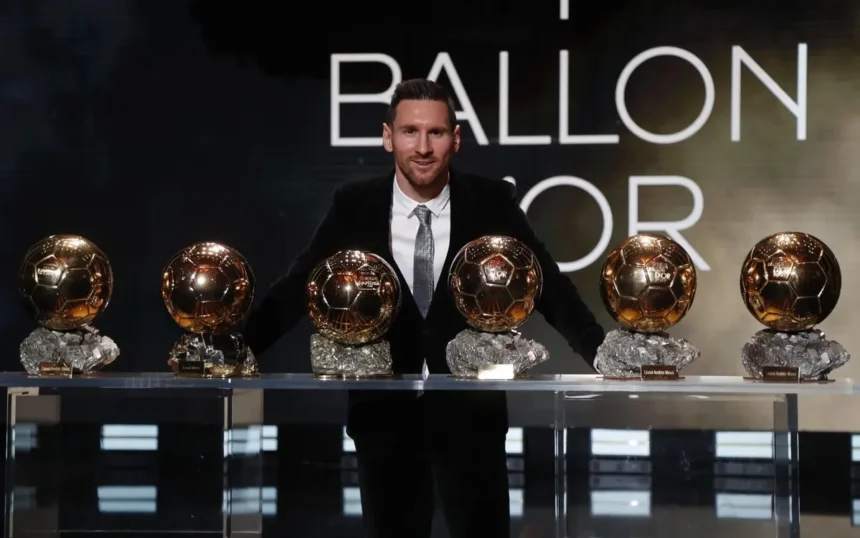
The Lionel Messi Ballon d’Or record is one of the strongest individual achievements in football history.
Messi has won the award:
Eight times.
His victories came in:
2009
2010
2011
2012
2015
2019
2021
2023
No other men’s player has won as many.
UEFA’s complete historical list still places Messi first with eight victories, followed by Cristiano Ronaldo with five. The winners since Messi’s last triumph have been Rodri in 2024 and Ousmane Dembélé in 2025, meaning Messi’s record remained untouched entering 2026.
But the Lionel Messi Ballon d’Or story is about more than the number eight.
His first award came when he was 22.
His eighth came at 36.
Between them were Barcelona trebles, record-breaking scoring seasons, the Messi-Ronaldo rivalry, Copa América glory and finally a FIFA World Cup championship with Argentina.
The awards also came during several different versions of Messi.
The explosive young winger.
The false nine.
The record-breaking scorer.
The deep-lying creator.
The Argentina captain.
The late-career playmaker.
That evolution helps explain why the Lionel Messi Ballon d’Or collection stretches across 14 years.
For Messi’s complete career, start with Lionel Messi Explained.
Lionel Messi Ballon d’Or Wins at a Glance
| Year | Club at Time of Award | Messi’s Win | Main Context |
|---|---|---|---|
| 2009 | Barcelona | 1st | Treble and Champions League glory |
| 2010 | Barcelona | 2nd | Huge individual season and La Liga title |
| 2011 | Barcelona | 3rd | Champions League and La Liga winner |
| 2012 | Barcelona | 4th | 91 goals in calendar year |
| 2015 | Barcelona | 5th | Historic second treble |
| 2019 | Barcelona | 6th | 36 La Liga goals, Golden Shoe, league title |
| 2021 | Paris Saint-Germain | 7th | Copa América breakthrough with Argentina |
| 2023 | Inter Miami | 8th | 2022 World Cup triumph and Golden Ball |
| Total | — | 8 | All-time record |
UEFA confirms all eight winning years and identifies Messi as the most successful player in Ballon d’Or history.
What Is the Ballon d’Or?
The Ballon d’Or was created by France Football in 1956.
Stanley Matthews became the first winner.
Over the decades, the trophy developed into one of football’s most prestigious individual awards.
Its winners include:
Alfredo Di Stéfano,
Johan Cruyff,
Michel Platini,
Marco van Basten,
Ronaldo Nazário,
Zinedine Zidane,
Ronaldinho,
Cristiano Ronaldo,
and Lionel Messi.
The award’s structure has changed.
Between 2010 and 2015, France Football and FIFA operated a merged award called the FIFA Ballon d’Or.
That matters for the Lionel Messi Ballon d’Or record.
Messi won the merged prize four times:
2010
2011
2012
2015.
His 2009, 2019, 2021 and 2023 victories came under the France Football Ballon d’Or structure.
All eight count together in the historical record.
Lionel Messi Ballon d’Or 2009: The First Victory
The first Lionel Messi Ballon d’Or arrived after the season that established him as the world’s leading player.
Barcelona had just produced one of the greatest campaigns in club history.
Under Pep Guardiola, the team won:
La Liga
Copa del Rey
and
UEFA Champions League.
Messi scored in the Champions League final against Manchester United.
Barcelona won 2–0.
The award vote was overwhelming.
UEFA reported that Messi received 473 points out of a possible 480, finishing 240 points ahead of defending winner Cristiano Ronaldo.
That was not merely a victory.
It was a near-unanimous statement about the level Messi had reached.
Why Messi Won the 2009 Ballon d’Or
The argument behind the first Lionel Messi Ballon d’Or combined team success and individual brilliance.
He was a central attacker in a treble-winning Barcelona team.
He scored nine Champions League goals.
He scored in the final.
His dribbling, combination play and finishing had moved beyond the level of an exciting young player.
He had become Barcelona’s primary attacking figure.
The first award therefore marked the beginning of a new phase of football.
Cristiano Ronaldo had won in 2008.
Messi won in 2009.
The rivalry was about to dominate the award for almost a decade.
For the club period behind the first victory, read Lionel Messi at Barcelona.
Lionel Messi Ballon d’Or 2010: A Controversial Second Win
Messi retained the award in 2010.
This was the first edition of the newly merged FIFA Ballon d’Or.
He defeated two Barcelona teammates:
Andrés Iniesta
and
Xavi Hernández.
UEFA confirms Messi finished first despite admitting at the ceremony that he had not expected to win.
The result remains one of the most debated Lionel Messi Ballon d’Or victories.
Spain had won the World Cup.
Iniesta scored the winning goal in the final.
Xavi had been central to both Spain and Barcelona.
Messi’s case, however, rested heavily on his extraordinary club performance.
Messi’s 2010 Individual Case
Messi continued scoring at exceptional levels.
He helped Barcelona win La Liga and produced 47 goals in all competitions during the 2009–10 campaign, according to UEFA’s later historical review.
The important editorial point is not to pretend the 2010 vote was universally accepted.
It wasn’t.
But debate does not change the result.
The second Lionel Messi Ballon d’Or is part of the official historical record.
A researchable article should explain both the achievement and why that particular year still generates discussion.
Lionel Messi Ballon d’Or 2011: European Dominance
The third Lionel Messi Ballon d’Or had a stronger team-trophy foundation.
Barcelona won:
La Liga
and
UEFA Champions League.
Messi scored in the Champions League final against Manchester United at Wembley.
Barcelona won 3–1.
Messi also won UEFA’s inaugural Best Player in Europe award for the 2010–11 season. UEFA reported that he received 38 votes, comfortably ahead of Xavi and Cristiano Ronaldo.
When the FIFA Ballon d’Or was awarded, Messi finished ahead of:
Cristiano Ronaldo
and
Xavi.
It was his third consecutive victory.
Why 2011 Was One of Messi’s Strongest Awards
The 2011 case combined almost everything Ballon d’Or voters traditionally value.
Elite scoring.
Playmaking.
League success.
Champions League success.
Performance in the biggest matches.
Barcelona’s football under Guardiola was at its peak.
Messi was its central attacking player.
UEFA’s historical summary credits Messi with 53 club goals in 2010–11 and notes that he became only the third player at the time to score in two European Cup or Champions League finals.
The third Lionel Messi Ballon d’Or therefore came from one of the most complete seasons of his career.
Lionel Messi Ballon d’Or 2012: The 91-Goal Year
The fourth consecutive Lionel Messi Ballon d’Or came after the most extraordinary scoring year of his career.
The number was:
91 goals.
Messi scored 91 times for Barcelona and Argentina during calendar year 2012.
He surpassed Gerd Müller’s previous record of 85.
Messi also scored:
50 La Liga goals
during the 2011–12 season,
and
73 official goals for Barcelona in all competitions.
UEFA described the 2012 campaign as record-breaking and confirmed Messi became the first player to win four consecutive Ballon d’Or awards.
Four Consecutive Ballon d’Or Awards
Winning once is extraordinary.
Winning twice confirms consistency.
Winning four consecutive editions created a completely different historical benchmark.
The sequence was:
2009
2010
2011
2012.
No player before Messi had won four Ballon d’Or awards in a row.
UEFA’s retrospective describes that four-year monopoly as the period when Messi first established an unprecedented level of individual dominance.
At the end of 2012, the Lionel Messi Ballon d’Or total stood at four.
Cristiano Ronaldo had one.
Then the momentum changed.
Ronaldo Interrupts Messi’s Run in 2013 and 2014
Cristiano Ronaldo won in:
2013
and
2014.
Messi finished runner-up in both years.
UEFA’s contemporary Ballon d’Or coverage confirms those second-place finishes.
That matters because the Messi-Ronaldo rivalry was not a simple sequence of alternating awards.
Messi had raced ahead to four.
Ronaldo then began closing the gap.
By the end of 2014:
Messi 4
Ronaldo 3.
The next year gave Messi another response.
Lionel Messi Ballon d’Or 2015: The Second Treble
The fifth Lionel Messi Ballon d’Or followed another historic Barcelona season.
Barcelona won:
La Liga
Copa del Rey
UEFA Champions League
and later added the UEFA Super Cup and FIFA Club World Cup during the calendar year.
Messi formed the famous MSN attack with Neymar and Luis Suárez.
UEFA said Messi inspired Barcelona to five major trophies in 2015 and scored in the relevant finals as the club completed another extraordinary year.
Messi defeated:
Cristiano Ronaldo
and
Neymar
for the award.
Why the 2015 Ballon d’Or Was Different
The 2015 Lionel Messi Ballon d’Or was not simply about goal totals.
It showcased how his role had evolved.
Messi could start from the right.
Drop centrally.
Create for Suárez.
Combine with Neymar.
Control possession deeper.
And still decide matches himself.
The Champions League semi-final against Bayern Munich produced one of the most memorable performances of the year.
Messi scored twice in the first leg.
Barcelona ultimately won the Champions League.
The fifth award moved Messi further ahead in the historical rankings.
Ronaldo Closes the Gap Again
Cristiano Ronaldo responded by winning in:
2016
and
2017.
Messi finished second in 2016, and the 2017 voting again placed him behind Ronaldo. UEFA’s 2016 result gave Ronaldo 745 votes and Messi 316. The following year’s result put Ronaldo first with Messi second.
At the end of 2017:
Messi 5
Ronaldo 5
The two greatest Ballon d’Or winners were level.
Then Luka Modrić won in 2018, ending the decade-long Messi-Ronaldo monopoly.
Messi responded again one year later.
Lionel Messi Ballon d’Or 2019: The Sixth Victory
The sixth Lionel Messi Ballon d’Or arrived ten years after his first.
Barcelona confirmed that Messi became the first player to reach six victories.
His 2018–19 season included:
36 La Liga goals
La Liga title
European Golden Shoe
and
12 Champions League goals.
Barcelona notes that the 36 league goals delivered Messi his sixth European Golden Shoe, another record.
The sixth award moved him back ahead of Ronaldo:
Messi 6
Ronaldo 5.
Why 2019 Strengthened Messi’s Longevity Case
The first Lionel Messi Ballon d’Or came at 22.
The sixth came at 32.
That decade matters.
Many players produce short peaks.
Messi was still winning the sport’s leading individual prize ten years after first reaching the summit.
His style had also changed.
The 2009 version depended more heavily on explosive dribbling and movement.
By 2019, Messi was controlling matches increasingly through:
passing,
positioning,
free kicks,
tempo,
and selective acceleration.
The sixth award showed that Messi could remain the world’s leading individual player after changing how he played.
What Happened to the 2020 Ballon d’Or?
There was no winner.
The 2020 Ballon d’Or was cancelled.
UEFA’s historical winner list records the edition as not awarded.
This is important because the year is sometimes pulled into arguments about Messi, Ronaldo or Robert Lewandowski.
Those debates can be interesting.
But historically there is no 2020 Ballon d’Or winner.
Do not add an unofficial award to anybody’s total.
The next official Lionel Messi Ballon d’Or came in 2021.
Lionel Messi Ballon d’Or 2021: Argentina Changes the Story
The seventh award represented another turning point.
For years, Messi’s international career had been used against him.
Then Argentina won the 2021 Copa América.
Argentina defeated Brazil 1–0 in the final at the Maracanã.
Messi had finally won a major senior international championship.
When the Ballon d’Or was awarded in November, Messi was technically a Paris Saint-Germain player after leaving Barcelona that summer.
PSG confirms he won the award ahead of:
Robert Lewandowski
and
Karim Benzema.
Why the Copa América Mattered to the Seventh Award
The Lionel Messi Ballon d’Or record had previously been built primarily on club football.
The 2021 award had a stronger international component.
Messi’s Copa América campaign changed the emotional narrative around his Argentina career.
He had already been:
World Cup runner-up,
Copa América runner-up,
and one of Argentina’s greatest scorers.
But the major senior trophy had been missing.
The Copa América filled that gap.
PSG explicitly described the championship as central to Messi’s seventh Ballon d’Or year.
For the complete international story, read Lionel Messi Argentina Career.
The 2021 Ballon d’Or Debate
Like 2010, the 2021 award remains debated.
Robert Lewandowski had produced extraordinary scoring numbers and had been central to Bayern Munich’s success across the surrounding period.
Messi supporters emphasized:
Copa América,
individual tournament performance,
Barcelona production
and his broader year.
A balanced Lionel Messi Ballon d’Or article should acknowledge the debate without pretending it changes the official result.
Messi won.
Lewandowski finished second.
That is the historical record.
Lionel Messi Ballon d’Or 2023: The Eighth Victory
The eighth Lionel Messi Ballon d’Or was built around the achievement that had once been the largest missing piece of his career.
The 2022 FIFA World Cup.
Messi captained Argentina to the title in Qatar.
He scored seven goals.
He won the World Cup Golden Ball.
He scored twice in the final against France.
Argentina won on penalties.
By the time the 2023 Ballon d’Or ceremony arrived, Messi had left Paris Saint-Germain and joined Inter Miami.
UEFA recorded the voting as:
Lionel Messi — 462 points
Erling Haaland — 357
Kylian Mbappé — 270.
The eighth victory extended a record Messi already held.
Why Messi Won the 2023 Ballon d’Or
Erling Haaland had an extraordinary club season.
Manchester City won the treble.
Haaland scored heavily throughout the campaign.
That made the 2023 contest one of the most interesting late-career Lionel Messi Ballon d’Or debates.
Messi’s strongest argument was international.
The World Cup carries extraordinary weight.
He did not merely belong to Argentina’s winning squad.
He was the captain, Golden Ball winner and a central scorer throughout the knockout stages.
UEFA’s 2023 award coverage explicitly highlights Argentina’s World Cup victory as the central achievement behind Messi’s eighth title.
First Active MLS Player to Win the Ballon d’Or
The eighth award created another record.
Messi had joined Inter Miami in July 2023.
That made him the first active Major League Soccer player to win the Ballon d’Or.
Inter Miami confirmed the milestone when celebrating Messi’s eighth victory.
The important nuance is that the award was not earned only through his short initial MLS period.
His World Cup success with Argentina and earlier PSG performances formed the core of the qualifying period.
But his club at the time of receiving the trophy was Inter Miami.
Lionel Messi Ballon d’Or Wins by Club at Time of Award
| Club | Awards While Registered There | Years |
|---|---|---|
| Barcelona | 6 | 2009, 2010, 2011, 2012, 2015, 2019 |
| Paris Saint-Germain | 1 | 2021 |
| Inter Miami | 1 | 2023 |
| Total | 8 | — |
Six of the eight Lionel Messi Ballon d’Or awards therefore came while he was a Barcelona player.
Barcelona remains the defining club behind his Ballon d’Or record.
However, the final two awards show how his career expanded beyond Barcelona.
2021 was strongly connected to Argentina’s Copa América triumph.
2023 was dominated by the World Cup.
Lionel Messi Ballon d’Or vs Cristiano Ronaldo
The historical totals are:
| Player | Ballon d’Or Wins |
|---|---|
| Lionel Messi | 8 |
| Cristiano Ronaldo | 5 |
| Michel Platini | 3 |
| Johan Cruyff | 3 |
| Marco van Basten | 3 |
UEFA continues to list Messi first with eight and Ronaldo second with five.
That means Messi holds a three-award advantage.
The rivalry becomes even more remarkable when viewed chronologically.
2008
Ronaldo
2009
Messi
2010
Messi
2011
Messi
2012
Messi
2013
Ronaldo
2014
Ronaldo
2015
Messi
2016
Ronaldo
2017
Ronaldo
For ten consecutive editions, every winner was either Messi or Ronaldo.
For the complete statistical comparison, read Cristiano Ronaldo vs Lionel Messi.
Messi’s Ballon d’Or Runner-Up Finishes
Winning eight times tells only part of the story.
Messi also finished second repeatedly.
Confirmed runner-up years include:
2008
2013
2014
2016
2017.
UEFA’s historical coverage confirms the 2008, 2013, 2014 and 2016 runner-up finishes, while the 2017 voting again placed Messi second behind Ronaldo.
That means Messi spent an extraordinary number of seasons either winning or finishing second for football’s most famous individual prize.
The Four Consecutive Wins May Be Messi’s Hardest Record
Eight total victories are the headline.
But the sequence from 2009 through 2012 may be even more difficult to reproduce.
Four consecutive Lionel Messi Ballon d’Or awards required sustained superiority across different seasons.
The reasons changed each year.
2009 was built around the treble.
2010 emphasized individual production.
2011 combined scoring with another Champions League.
2012 produced the 91-goal record.
Different seasons.
Different arguments.
Same winner.
Which Lionel Messi Ballon d’Or Win Was the Strongest?
There is no objective answer.
But the eight victories can be grouped by their strongest cases.
2009 — strongest breakthrough season
Treble, Champions League final goal and near-unanimous voting.
2011 — strongest club-football case
La Liga and Champions League, with Messi at the center of Guardiola’s great Barcelona.
2012 — strongest individual scoring case
91 goals in one calendar year.
2015 — strongest later Barcelona team season
Another treble and the peak MSN attack.
2021 — strongest Copa América case
Argentina’s first senior major title of Messi’s career.
2023 — strongest international legacy case
World Cup champion and Golden Ball winner.
If pure individual scoring is prioritized, 2012 stands out.
If club trophies matter most, 2009, 2011 or 2015 are compelling.
If international achievement carries greatest weight, 2023 is difficult to match.
Lionel Messi Ballon d’Or Timeline
| Year | Result |
|---|---|
| 2007 | Third |
| 2008 | Runner-up |
| 2009 | Winner |
| 2010 | Winner |
| 2011 | Winner |
| 2012 | Winner |
| 2013 | Runner-up |
| 2014 | Runner-up |
| 2015 | Winner |
| 2016 | Runner-up |
| 2017 | Runner-up |
| 2018 | Did not win |
| 2019 | Winner |
| 2020 | Award cancelled |
| 2021 | Winner |
| 2022 | Did not win |
| 2023 | Winner |
| 2024 | Rodri wins |
| 2025 | Ousmane Dembélé wins |
| Total Messi wins | 8 |
The timeline shows that the Lionel Messi Ballon d’Or record is not merely about one dominant period.
Messi won his first four by 25.
Then added four more across the next eleven years.
Why Eight Ballon d’Or Awards Matter
The simplest interpretation is obvious.
Eight is the record.
But the deeper significance lies in the span.
Messi changed physically.
Managers changed.
Barcelona changed.
Argentina changed.
He left Spain.
He moved to France.
Then the United States.
Yet the individual awards continued.
The Lionel Messi Ballon d’Or collection therefore measures both peak ability and reinvention.
Very few footballers remain relevant to this award across more than a decade.
Messi remained capable of winning it fourteen years after his first victory.
Frequently Asked Questions About Lionel Messi Ballon d’Or
How many Lionel Messi Ballon d’Or awards are there?
The Lionel Messi Ballon d’Or total is eight, the men’s all-time record. UEFA confirms his victories in 2009, 2010, 2011, 2012, 2015, 2019, 2021 and 2023.
What years did Lionel Messi win the Ballon d’Or?
Messi won in 2009, 2010, 2011, 2012, 2015, 2019, 2021 and 2023.
Who has the most Ballon d’Or awards?
Lionel Messi holds the record with eight. Cristiano Ronaldo is second with five.
How many Ballon d’Or awards did Messi win at Barcelona?
Messi received six of his eight awards while playing for Barcelona: 2009, 2010, 2011, 2012, 2015 and 2019.
How many consecutive Ballon d’Or awards did Messi win?
Messi won four consecutive editions from 2009 through 2012, an unprecedented sequence.
Why did Messi win the 2012 Ballon d’Or?
Messi produced a record 91 goals for club and country during calendar year 2012, while also scoring 50 La Liga goals during the 2011–12 season.
Why did Messi win the 2021 Ballon d’Or?
Messi’s year included his long-awaited Copa América championship with Argentina. He finished ahead of Robert Lewandowski and Karim Benzema.
Why did Messi win the 2023 Ballon d’Or?
The central achievement was Argentina’s 2022 FIFA World Cup triumph, where Messi captained the team and won the Golden Ball. He finished ahead of Erling Haaland and Kylian Mbappé in the 2023 voting.
Did Messi win a Ballon d’Or while at PSG?
Yes. Messi received his seventh Ballon d’Or in 2021 after joining Paris Saint-Germain. Much of the award-winning period included his final Barcelona months and Copa América triumph with Argentina.
Did Messi win a Ballon d’Or at Inter Miami?
Yes. Messi received his eighth award in 2023 while an Inter Miami player, becoming the first active MLS player to win the Ballon d’Or.
How many Ballon d’Or awards does Messi have compared with Ronaldo?
Messi has eight, while Cristiano Ronaldo has five. Messi therefore leads by three.
Conclusion: Lionel Messi Ballon d’Or Record Defines an Era of Football
The Lionel Messi Ballon d’Or story began with a treble.
Barcelona won La Liga.
Barcelona won the Copa del Rey.
Barcelona won the Champions League.
Messi scored in the European final.
Then came the vote.
Four hundred and seventy-three points from a possible 480.
A record margin over Cristiano Ronaldo.
The first award arrived in 2009.
Then Messi kept winning.
Four consecutive Ballon d’Or victories.
By 25, Messi had already established an individual award record that once seemed almost impossible.
The fourth came after the 91-goal calendar year.
That number remains one of the most recognizable statistics of his career.
Then Cristiano Ronaldo responded.
Messi’s fifth came in 2015 after Barcelona’s second treble.
Ronaldo answered again in 2016 and 2017.
For a moment, the rivalry reached perfect balance:
Messi 5
Ronaldo 5
Then the final phase of the Lionel Messi Ballon d’Or story began.
Messi won his sixth in 2019.
Barcelona highlighted 36 La Liga goals, another European Golden Shoe and a league championship among the achievements behind the season.
Then international football changed his career.
Argentina won the 2021 Copa América.
The trophy that had eluded Messi through years of international finals finally arrived.
His seventh Ballon d’Or followed.
And then came Qatar.
For years, people had asked whether Messi needed a World Cup to complete his career.
In 2022, he answered the question.
Argentina became world champion.
Messi won the Golden Ball.
He scored twice in the final.
One year later, the eighth Lionel Messi Ballon d’Or arrived.
The voting placed Messi on 462 points, Haaland on 357 and Mbappé on 270.
No ninth award followed.
Rodri won in 2024.
Ousmane Dembélé won in 2025.
But Messi’s record remained:
Eight.
Ronaldo remained second with five.
Then came the three-time winners.
That gap shows how unusual Messi’s individual award career has been.
The eight victories also tell the story of changing versions of one footballer.
The 2009 Messi was explosive.
The 2012 Messi was producing scoring numbers that seemed almost impossible.
The 2015 Messi was operating inside the MSN attack.
The 2019 Messi was an older Barcelona playmaker and scorer.
The 2021 Messi had finally become a Copa América champion.
The 2023 Messi had become a World Cup champion.
That progression is why the Lionel Messi Ballon d’Or record is not simply a trophy count.
It is a timeline of one of football’s longest elite peaks.
Fourteen years separated the first victory from the eighth.
Different tactical roles.
Different teammates.
Different clubs.
Different stages of his Argentina career.
The award kept returning to the same player.
Whether anyone eventually reaches eight is impossible to predict.
Football records are made to be challenged.
But any player attempting it would need more than one spectacular peak.
They would need to remain among the world’s best across many seasons, survive tactical and physical change, win major trophies and repeatedly outperform new generations.
That is what makes the Lionel Messi Ballon d’Or record so difficult to reproduce.
For Messi’s full career, read Lionel Messi Explained.
For his chronological journey, continue with Lionel Messi Career Explained.
For the scoring numbers behind many award-winning years, read Lionel Messi Career Goals.
For his complete record book, see Lionel Messi Records.
For the club where six of his awards were won, read Lionel Messi at Barcelona.
For the Argentina breakthrough behind his seventh and eighth awards, continue with Lionel Messi Argentina Career.
For the World Cup achievement behind the eighth award, read Lionel Messi World Cup Record.
For the rivalry that defined the award for a decade, read Cristiano Ronaldo vs Lionel Messi.
Follow The News Ink
Stay connected with The News Ink for football, sports, technology and breaking-news coverage:
X
Pinterest
Medium
Quora
TikTok
Instagram
Substack
Threads
Bluesky
Mastodon