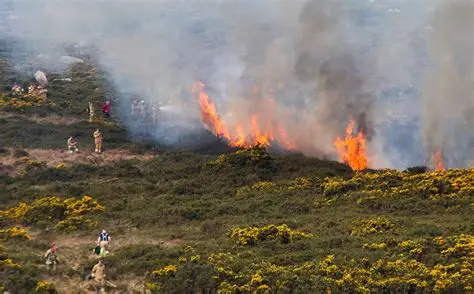
Isle of Man gorse fires 2026 have prompted urgent public safety warnings from fire and rescue crews after two significant blazes broke out across the island within days of each other. Firefighters battled fires near the Point of Ayre on Thursday evening and close to Peel Golf Course on Wednesday afternoon — both spreading rapidly in dry conditions and strong winds. The Isle of Man Fire and Rescue Service has now called on the public to take extra care across the countryside during the current warm and dry weather spell, warning that fires can take hold and spread with alarming speed in these conditions.
The two incidents this week highlighted the very real dangers that dry vegetation, coastal winds, and human activity can create across rural and coastal areas of the island. Both fires required significant resources to bring under control, and one threatened overhead electricity infrastructure before crews managed to contain the flames.
Isle of Man Gorse Fires 2026: The Point of Ayre Blaze
The most recent of the Isle of Man gorse fires 2026 incidents occurred on Thursday evening, when emergency teams from Ramsey responded to reports of a large fire near the Point of Ayre — the island’s most northerly point. The call came in shortly before 22:00 BST, meaning crews arrived to find an established blaze burning in darkness across a large area of gorse and vegetation.
Firefighters described the scale of the fire as significant. Dry conditions and strong coastal winds had allowed the flames to spread quickly across the area before crews arrived on scene. Gorse — a dense, oil-rich shrub common across the Isle of Man’s coastal and moorland areas — burns intensely and spreads rapidly when dry, making it one of the most challenging vegetation types for fire crews to tackle.
Crews spent approximately two hours bringing the Point of Ayre fire under control. The operation faced an additional logistical challenge that extended the response time and required additional resources — a lack of accessible water supply at the remote coastal location.
Point of Ayre fire — key facts:
- Date: Thursday evening
- Time reported: Shortly before 22:00 BST
- Location: Near the Point of Ayre, northern Isle of Man
- Attending crew: Emergency teams from Ramsey
- Time to control: Approximately two hours
- Key challenge: Difficulty accessing water at the remote coastal scene
- Additional resource: Extra water supplies brought in from Douglas
- Vegetation involved: Large area of gorse and general vegetation
The need to bring water supplies all the way from Douglas underlines just how remote and logistically challenging the Point of Ayre location proved for responding crews. Despite those difficulties, firefighters successfully brought the blaze under control without reported injury or structural damage.
Isle of Man Gorse Fires 2026: The Peel Golf Course Fire
The second of the Isle of Man gorse fires 2026 incidents occurred on Wednesday afternoon, when firefighters received a call at approximately 13:00 BST reporting a fire near Peel Golf Course. The circumstances of this blaze carried an important additional detail — it began as a controlled fire that subsequently spread out of control.
Controlled burns are a land management tool used across the Isle of Man and other rural areas to clear vegetation and reduce the build-up of dry combustible material. However, in dry and windy conditions, a controlled burn can transition rapidly from a managed process into an uncontrolled wildfire. That is precisely what happened near Peel Golf Course, demonstrating that even planned and supervised fires carry significant risk during periods of dry weather.
Crews arriving at the scene faced difficult terrain as flames moved fast through grass and gorse across the area. The fire’s path brought it dangerously close to overhead electricity lines — infrastructure that presented both a practical danger to firefighters and a potential risk to power supply across the local area.
Electricity authorities temporarily switched off the overhead lines while firefighters worked to bring the blaze under control. That precautionary measure allowed crews to operate more safely in the area immediately beneath and around the infrastructure, reducing the risk of electrocution as hoses and equipment were deployed near the lines.
Peel Golf Course fire — key facts:
- Date: Wednesday afternoon
- Time reported: Approximately 13:00 BST
- Location: Near Peel Golf Course, Isle of Man
- Origin: A controlled fire that spread out of control
- Terrain: Difficult ground with fast-spreading grass and gorse
- Infrastructure risk: Fire burned close to overhead electricity lines
- Precautionary action: Electricity lines temporarily switched off during firefighting
- Outcome: Fire brought under control by attending crews
The Peel Golf Course incident serves as a stark reminder that controlled burns require careful assessment of weather conditions before they begin. Wind speed, humidity, and surrounding vegetation all affect how quickly and unpredictably a managed burn can escalate beyond its intended boundaries.
Isle of Man Gorse Fires 2026: Why Gorse Burns So Dangerously
Understanding why the Isle of Man gorse fires 2026 spread so quickly requires an appreciation of gorse as a plant and the conditions that make it so combustible. Gorse is one of the most fire-prone plant species found in the British Isles and across many Atlantic coastal environments.
The plant contains high levels of flammable oils within its stems and seed pods. When dry, gorse ignites easily and burns intensely, producing high temperatures and throwing burning embers that can start secondary fires ahead of the main blaze. Its dense, thorny structure also makes it difficult for firefighters to physically access and manage, adding to the challenge of containment.
Why gorse fires spread so rapidly:
- Gorse contains naturally occurring flammable oils that ignite easily when dry
- Dry conditions remove moisture that would otherwise slow ignition and spread
- Strong winds carry burning embers ahead of the main fire front
- Dense gorse structure makes physical access difficult for firefighting crews
- Coastal areas often experience stronger and more unpredictable wind conditions
- Once burning, gorse produces intense heat that dries surrounding vegetation ahead of the flames
- Seed pods can explode in heat, scattering burning material over a wider area
The Isle of Man Fire and Rescue Service explicitly highlighted that dry conditions and strong winds allowed both fires to spread quickly, “particularly in coastal and rural areas” — precisely the environments where gorse is most prevalent and water access is most limited.
Isle of Man Gorse Fires 2026: Public Safety Guidance
Following the Isle of Man gorse fires 2026 incidents, the fire and rescue service issued a clear set of public safety guidelines aimed at reducing the risk of further fires across the island’s countryside during the current warm and dry period.
The guidance covers both deliberate actions — such as discarding cigarettes — and less obvious risks that many people may not consider, including the fire hazard posed by parked vehicles on long grass.
Public safety advice from Isle of Man Fire and Rescue Service:
- Do not throw cigarettes or matches on the ground — discarded smoking materials remain one of the most common causes of vegetation fires and retain enough heat to ignite dry grass and gorse long after being dropped
- Avoid lighting campfires near dry grass and gorse — even a contained campfire can throw sparks into surrounding dry vegetation, particularly in windy conditions
- Do not use disposable barbecues near dry vegetation — disposable barbecues retain significant heat long after use and must never be placed on or near dry grass or gorse
- Do not park vehicles on long grass — vehicle exhaust systems reach very high temperatures during operation and retain that heat after the engine stops, creating a genuine fire risk when parked over dry grass
- Report fires immediately — early reporting allows crews to respond before a small fire grows into a large and difficult-to-control blaze
- Do not attempt to tackle large fires yourself — vegetation fires can change direction and intensity rapidly, posing serious danger to untrained individuals
Each point on that list addresses a real and documented cause of vegetation fires. The vehicle exhaust warning in particular surprises many people — yet hot exhaust systems contacting dry grass is a recognised and recurring cause of countryside fires across the British Isles during dry weather periods.
The Broader Risk: Dry Weather and Countryside Fire Danger
The Isle of Man gorse fires 2026 incidents occur within a broader context of increasing concern about vegetation fire risk during dry and warm weather periods. Fire and rescue services across the British Isles consistently report a rise in countryside fire incidents during prolonged dry spells, particularly when warm temperatures coincide with strong winds.
The Isle of Man’s geography amplifies these risks. The island’s coastal location means wind is a near-constant presence, and many of its most beautiful and popular rural areas — including coastal paths, moorland, and golf course surroundings — feature extensive gorse coverage. When that gorse dries out during a warm spring or summer period, the fire risk across the island rises significantly.
Factors that increase countryside fire risk:
- Prolonged dry weather removes moisture from vegetation
- Warm temperatures accelerate drying of grass and gorse
- Strong winds spread fires faster and carry embers further
- Remote rural and coastal locations limit water access for firefighting crews
- High visitor numbers during warm weather increase the risk of accidental ignition
- Increasing frequency of warm and dry weather periods extends the fire risk season
The fire service’s warning to take extra care in the countryside during warm and dry weather is not precautionary in the abstract — it reflects direct operational experience from this week’s incidents and a clear understanding of how quickly the situation can escalate.
What to Do If You Spot a Fire
If members of the public spot a fire in the countryside on the Isle of Man, the correct course of action is straightforward but important to follow correctly.
If you spot a countryside fire:
- Call emergency services immediately — do not assume someone else has already called
- Provide your exact location as precisely as possible, including landmarks
- Move away from the fire and stay upwind to avoid smoke inhalation
- Do not attempt to tackle the fire yourself unless it is very small and you can do so safely
- Keep roads and access routes clear for emergency vehicles
- Follow any instructions given by fire and rescue crews on scene
Early reporting genuinely saves land, property, and potentially lives. Both fires this week required significant resources and time to control — earlier reports might have allowed crews to contain them at a smaller scale.
Final Word on Isle of Man Gorse Fires 2026
The Isle of Man gorse fires 2026 incidents near the Point of Ayre and Peel Golf Course serve as a timely and serious reminder of the dangers that dry weather and strong winds create across the island’s countryside. Firefighters worked hard in challenging conditions to bring both blazes under control, and the public deserves to understand both what that effort involved and what role individual behaviour plays in preventing future incidents.
The message from the Isle of Man Fire and Rescue Service is clear — take extra care. Dispose of smoking materials responsibly. Avoid campfires and barbecues near dry vegetation. Park vehicles away from long grass. And if something goes wrong, call for help immediately.
Gorse fires move fast. Prevention is always better than a two-hour firefight in the dark at the island’s most remote coastal tip.