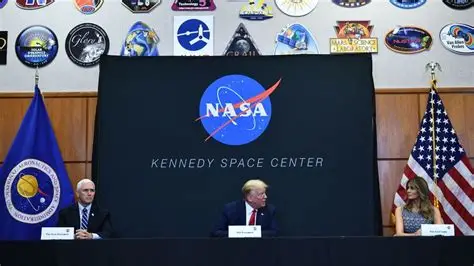
The upcoming Moon mission marks a major moment for the United States as it prepares to send astronauts into deep space for the first time in over 50 years. This mission arrives at a critical point during Donald Trump’s presidency, where political divisions continue to shape national discourse.
A successful mission could shift public attention and create a sense of unity. It may also strengthen the country’s global position, especially in the growing competition with China. Experts believe the mission could open doors to economic opportunities, including access to valuable space resources.
At the center of this effort is NASA’s Artemis program. The mission aims to send astronauts farther into space than any human has traveled before. More importantly, it serves as a foundation for building a long-term presence on the Moon and eventually launching missions to Mars.
During his earlier term, Trump pushed for ambitious space goals, including sending astronauts to Mars. He also established the United States Space Force to strengthen military capabilities in space. Now, his focus has shifted toward returning to the Moon as a strategic priority.
In late 2025, Trump signed an executive order that set clear targets. The plan calls for a human return to the Moon by 2028 and the creation of a permanent lunar base by 2030. This vision highlights space exploration as a key part of national strength, security, and innovation.
Although the policy does not directly mention rivals, competition with China plays a major role in shaping this strategy. Both nations aim to establish dominance in space exploration. According to industry leaders, this new race goes beyond symbolic achievements. It focuses on long-term presence and resource development.
This situation mirrors the historic Space Race between the United States and the Soviet Union. Back then, space exploration became a way to demonstrate technological superiority. The launch of Sputnik 1 in 1957 shocked the US and accelerated its efforts to lead in space.
Today, the stakes include not only prestige but also economic benefits. Scientists have identified valuable resources on the Moon, such as helium-3, which could support future nuclear fusion energy. The Moon also contains water ice and rare minerals like lithium and platinum, which are essential for modern technology and clean energy systems.
Control over these resources could shape future global markets. Since China already leads in several mining sectors on Earth, the US sees lunar exploration as a way to balance that influence.
As the Artemis mission moves forward, it represents more than a scientific milestone. It reflects a broader strategy that combines innovation, national pride, and global competition in the next frontier of space exploration.