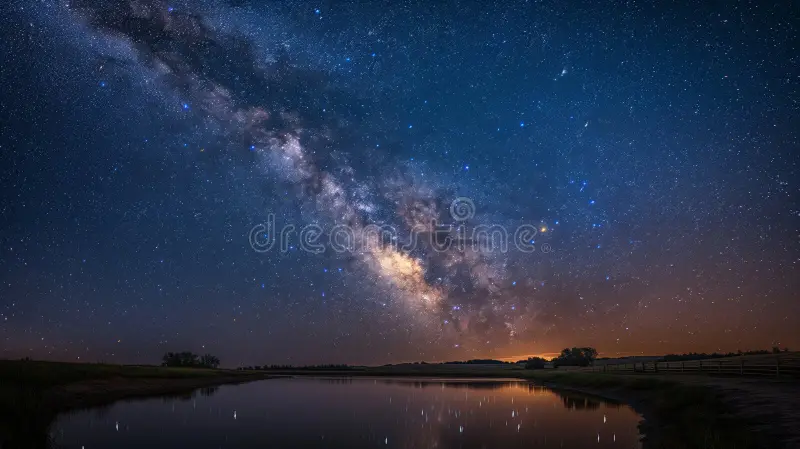
The first thing I noticed was the darkness. Thick clouds covered the sky, and no stars were visible.
Several hours later, everything changed.
At around 10:30 pm, the clouds cleared and the stars appeared. The sky suddenly filled with light. Stars stretched across the horizon in every direction.
The view was breathtaking.
I had travelled to the small Welsh village of Llanddewi-Brefi in the countryside of Ceredigion. I joined Siân and James Harrison, passionate stargazers who came from Cardiff for a special night-sky experience.
We were there for a guided star bathing session, a unique form of astrotourism that invites people to relax and connect with the universe.
Stargazing With Expert Guidance
We lay on blankets placed on the ground and stared at the sky above us.
Bright Jupiter shone clearly among the stars.
Our guide, Dafydd Wyn Morgan, pointed a green laser toward the sky. The beam helped us identify famous star formations. One of them was Orion’s Belt, a line of three stars that many stargazers recognize instantly.
James said Orion is his favourite constellation. The surrounding region contains active star-forming areas in space.
When he described the distance of these stars, the numbers felt almost impossible to imagine.
“I might focus on something that is 150 million light years away,” he said. “It’s hard to understand that scale.”
Looking at the sky created a deep sense of calm. It felt like witnessing the same night sky our ancestors once saw centuries ago.
What Is Star Bathing?
Dafydd Wyn Morgan runs Serydda, an astrotourism company that organizes star bathing experiences.
Participants gather in remote locations with minimal light pollution. They set up telescopes and lie back to observe the sky.
Guides also share myths, legends and stories connected to the stars.
The concept is similar to forest bathing, a wellness practice from Japan that encourages people to immerse themselves in nature.
Star bathing focuses on emotions rather than scientific knowledge.
“It’s about how the moment makes you feel,” Morgan explains. “You don’t need to understand everything you see.”
However, the experience often inspires people to learn more about astronomy later.
A Growing Astrotourism Trend
Morgan launched Serydda in January 2025. He had previously organized stargazing events with renowned astrophotographer Alyn Wallace, who passed away in 2024.
Since launching the company, more than 100 people have joined his workshops. Many visitors return to experience different dark sky locations.
Interest in astrotourism continues to grow worldwide.
A survey by Booking.com found that 72% of travellers are interested in visiting darker destinations for stargazing and star bathing experiences.
Experiencing True Darkness
Later, we drove into the Cambrian Mountains near Llyn Teifi. We stood on a bridge surrounded by rocky hills and marshland.
Morgan asked us to pause and breathe deeply.
Night air felt crisp and clean.
He described it as breathing in the night sky itself — cool, fresh and pure, like drinking water from a natural spring.
Soon after, a shooting star streaked across the sky.
The moment filled me with childlike excitement.
Why Dark Sky Experiences Matter
Humans have always looked toward the stars.
According to Dani Robertson, a dark skies officer for Snowdonia National Park, the night sky connects deeply with human history.
However, modern life makes this connection rare.
Nearly 98% of people in the UK live under light-polluted skies, meaning they can see very few stars.
Wales is home to two International Dark Sky Reserve national parks, making it one of the best places in Europe for stargazing.
Visitors travel from large cities like London just to experience true darkness.
Robertson organizes stargazing sessions, night hikes, meteor-watching events and even night swims under the stars.
Some experiences can be deeply emotional.
One visitor who came to celebrate his 50th birthday cried when he finally saw shooting stars for the first time.
For many urban residents, it becomes a once-in-a-lifetime moment.
Demand for these experiences keeps growing.
“I can’t run enough events to keep up,” Robertson says. “Every event has a waiting list.”