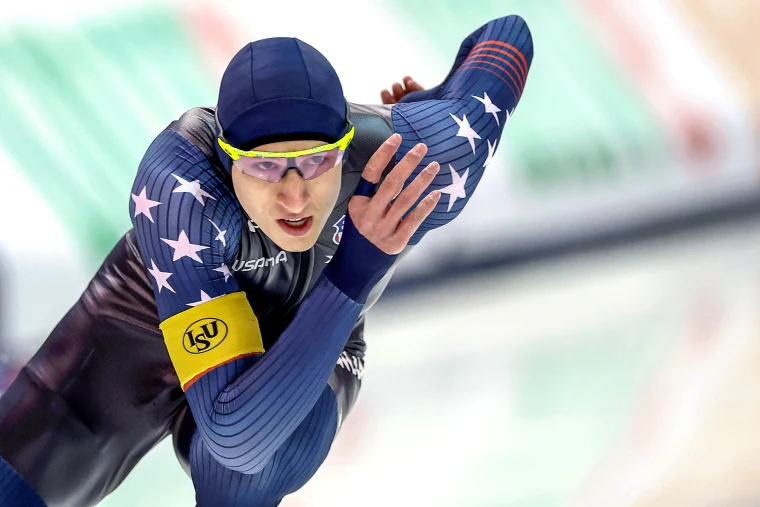
Jordan Stolz Olympics: Stunning Medals and a Painful Mass Start Lesson
Jordan Stolz Olympics coverage could easily be reduced to the final image: a young American speed skater missing mass start bronze by the smallest of margins after waiting too long for the pack to chase. That ending was painful. It was also only one part of a much larger Olympic breakthrough.
Stolz left the 2026 Winter Olympics in Milan with two gold medals, one silver medal and two Olympic records. He won the 1,000m in record time, followed it with another Olympic record in the 500m and then took silver in the 1,500m behind China’s Ning Zhongyan. In the mass start, he finished fourth after Jorrit Bergsma and Viktor Hald Thorup broke away early and Italy’s Andrea Giovannini beat him to bronze.
The Jordan Stolz Olympics story is therefore not a failure story. It is a story about dominance, expectation, tactical learning and the difficulty of moving from controlled individual races into the chaos of a 16-lap pack event. Stolz did not leave Milan with the perfect ending, but he did leave as one of the defining athletes of the Games.
Editor’s update — June 2026: This article has been rebuilt as a complete Olympic retrospective. It now covers Stolz’s full medal haul, the mass start result and why his fourth-place finish should be viewed as a lesson rather than a collapse.
Why the Jordan Stolz Olympics Story Became So Big
Before Milan, Stolz was already one of the most dominant speed skaters in the world. He had world titles, World Cup victories and an unusual ability to compete across distances that usually reward very different athlete profiles. The question was whether that dominance would transfer cleanly to the Olympic stage.
It did, almost immediately.
The Jordan Stolz Olympics story began with the 1,000m, an event that suits his blend of explosive power and late-race strength. He won gold in 1:06.28, setting an Olympic record and finishing half a second ahead of Dutch skater Jenning de Boo. The Guardian’s report described how Stolz used a powerful final lap to secure the title despite a delayed session caused by a reskate. Read the full report here: Jordan Stolz wins 1,000m Olympic gold.
That first gold changed the tone of his Games. Stolz was no longer only a favourite. He had delivered under Olympic pressure.
For wider context on why the 2026 Winter Olympics became one of the year’s major sporting events, The News Ink’s sports tournaments in 2026 guide explains how global championships shape athlete legacies and fan attention.
Stolz’s 1,000m Gold Set the Standard
The 1,000m is a demanding event because it requires controlled aggression. Skaters cannot treat it like a pure sprint, but they also cannot wait too long. Every stride affects speed, rhythm and lactic-acid pressure over the final lap.
Stolz’s race showed why he had become so difficult to beat. He did not panic when the early split was not perfect. Instead, he used his trademark ability to build speed through the closing stages. His final lap turned a close contest into a clear Olympic victory.
The Jordan Stolz Olympics story needed that opening performance. A missed chance in the first race would have changed the pressure around every later start. Instead, Stolz gave himself momentum.
It also reminded the speed skating world of his technical maturity. At 21, he was not racing like a skater dependent only on physical gifts. His pacing, corner control and finishing power looked carefully built through years of repetition.
The 500m Confirmed His Historic Range
Three days later, Stolz won the 500m in 33.77 seconds, again setting an Olympic record. The Guardian reported that the entire podium finished faster than the previous Olympic record, with Stolz ahead of de Boo and Canada’s Laurent Dubreuil. The same report noted that Stolz’s time was the fastest 500m ever skated at sea level. Read the full race report here: Jordan Stolz wins 500m Olympic gold.
That result made the Jordan Stolz Olympics run historic. Winning the 1,000m and 500m at the same Games placed him in rare company, and comparisons with Eric Heiden became unavoidable. Heiden’s five gold medals in 1980 remain one of the most extraordinary achievements in Winter Olympic history.
The 500m mattered because it was considered one of Stolz’s harder tasks. There is almost no recovery time in the race. A poor start, a rough corner or one technical mistake can decide the result. Stolz combined a powerful opening, smooth cornering and enough late speed to beat de Boo by 0.11 seconds.
The Jordan Stolz Olympics story had now moved from promising to historic.
Stolz’s 2026 Olympic Results at a Glance
| Event | Result | Key detail |
|---|---|---|
| 1,000m | Gold | Olympic record of 1:06.28 |
| 500m | Gold | Olympic record of 33.77 |
| 1,500m | Silver | Finished behind China’s Ning Zhongyan |
| Mass start | Fourth | Missed bronze after Bergsma and Thorup broke away |
These results show why the final race should not overshadow the full campaign. The Jordan Stolz Olympics performance included medals across sprint and middle-distance events, plus a serious attempt at the unpredictable mass start.
The 1,500m Silver Was a Shock, Not a Disaster
The 1,500m was the race many expected Stolz to win. He entered as the overwhelming favourite after dominating the distance across the season. Instead, Ning Zhongyan produced one of the performances of the Games.
Reuters reported that Ning won gold in 1:41.98, setting an Olympic record. Stolz took silver, while Dutch veteran Kjeld Nuis earned bronze in his final Olympic race. Reuters also noted that Stolz had entered the event as the favourite after record-breaking wins in the 1,000m and 500m. Read the full report here: Ning Zhongyan wins 1,500m gold.
The Jordan Stolz Olympics narrative changed after that race. A possible sweep was gone. The idea of a perfect Games ended. But a silver medal in an Olympic record-breaking race is still an elite result.
The important lesson is that excellence does not guarantee control over every variable. Ning skated the race of his life. Stolz did not collapse; he was beaten by a brilliant performance. That distinction matters.
Why the Mass Start Is Different From Stolz’s Best Events
The mass start is unlike the 500m, 1,000m or 1,500m. It is not simply a timed race against the clock. It is a tactical pack event with intermediate sprint points, breakaways, positioning battles and a final sprint.
That difference shaped the final chapter of the Jordan Stolz Olympics story. In his individual events, Stolz could control his lane, rhythm and pacing. In the mass start, he had to read the intentions of other skaters. He had to decide whether to chase an early break, conserve energy for the sprint or wait for the group to organise itself.
That uncertainty is exactly what made the result painful. Stolz later acknowledged that the group waited too long. If he chased too early, he risked burning the energy needed for the finish. If he waited, the leaders might become impossible to catch. The second scenario is what happened.
The News Ink’s sports training guide explains how elite performance depends on preparation, analysis, recovery and decision-making under pressure. The mass start showed why decision-making can be just as important as speed.
Bergsma and Thorup Broke the Race Open
The mass start final was decided by courage and timing. Bergsma of the Netherlands and Thorup of Denmark attacked early and forced the rest of the field to make a decision. The pack hesitated.
The Guardian reported that Bergsma won gold in 7:55.50, ahead of Thorup and Giovannini. The report also quoted Stolz saying that “everybody settled for third,” reflecting his frustration that the chase group allowed the breakaway to survive. Read the full mass start report here: Jorrit Bergsma wins Olympic mass start gold.
This was the tactical heart of the Jordan Stolz Olympics finale. Bergsma and Thorup turned the race into a question: who in the pack would sacrifice energy to close them down? No one took responsibility early enough. By the final laps, the gold and silver had effectively escaped.
Stolz was then left fighting for bronze rather than history.
Why the Fourth-Place Finish Hurt
Fourth place is one of the harshest Olympic results. It is close enough to the podium to feel like a lost medal and far enough away to leave no tangible reward.
For Stolz, the pain was sharper because of the wider stakes. A bronze would have given him four medals at one Games. A gold would have created an even greater historical comparison. Instead, Giovannini passed him in the final metres and gave the home crowd a bronze-medal celebration.
The Jordan Stolz Olympics ending was therefore emotionally difficult, but it was not embarrassing. Stolz had limited experience in the mass start compared with specialists who had spent years mastering pack tactics. He had already carried the physical and mental load of three medal races.
The fourth place showed that even a dominant skater can still be learning. It also gave him a clear area to target before future championships and the 2030 Winter Olympics cycle.
What Stolz Learned From the Mass Start
The mass start lesson was simple but difficult: waiting for others can cost everything.
Stolz’s comments after the race reflected the tactical trap. If he chased too early, he might have lost the sprint. If he waited, the leaders might stay away. The pack’s hesitation meant he never got the ideal scenario.
The Jordan Stolz Olympics story should therefore include tactical education. He learned that in a race with breakaways, someone must decide whether the pursuit is worth the risk. A skater with his speed may eventually need to accept the burden of chasing, even when the cost is high.
That does not mean he made an obvious mistake. The mass start is chaotic. Decisions happen in seconds. The best plan can fail if the group does not cooperate. But the race gave Stolz a lesson that timed events cannot provide.
Why His Overall Olympic Performance Still Stands Out
The mass start miss should not shrink the scale of Stolz’s Games. Two gold medals, one silver medal and two Olympic records make the Jordan Stolz Olympics run one of the strongest individual American performances of Milan.
He won the 1,000m with authority. He mastered the 500m, the most unforgiving sprint on the oval. He took silver in the 1,500m despite facing a record-breaking winner. Then he placed fourth in an event outside his usual comfort zone.
That range is rare. Many speed skaters specialise narrowly. Stolz’s ability to threaten across four events is what makes him unusual.
The News Ink’s article on sports records that may never be broken explains why some achievements become legendary because they combine dominance, timing and historical context. Stolz did not match Heiden’s 1980 sweep, but he did create a campaign that invites long-term comparison.
Technique, Power and Patience Built the Medals
Stolz’s success was not only about natural talent. His races in Milan showed technical precision. His 500m required acceleration, corner control and the ability to preserve speed without over-skating. His 1,000m required pacing and final-lap strength. His 1,500m silver showed endurance even on a day when another skater was better.
The Jordan Stolz Olympics story is also about preparation. Elite speed skating punishes tiny errors. A skater who loses rhythm in one corner may never recover the lost time. A poor opening split can force an over-aggressive finish. A badly timed move in the mass start can destroy the final sprint.
The News Ink’s feature on training secrets behind the world’s top athletes explores why elite performers rely on consistent preparation, recovery and mental control rather than one dramatic training trick. Stolz’s results in Milan fit that pattern.
Why Stolz Can Grow the Sport in the United States
American speed skating has a rich Olympic history, but it has not always maintained mainstream attention between Games. Stolz has the ability to change that.
The Jordan Stolz Olympics performance gave the United States a young winter-sport star with a simple story: two golds, one silver, two records and more to chase. His background from Wisconsin, his calm personality and his technical dominance make him easy for casual fans to follow.
Star power matters in niche Olympic sports. Fans may not watch every World Cup event, but they remember athletes who create moments at the Games. Stolz’s medals can bring attention to speed skating clubs, youth participation and future U.S. broadcasts.
A perfect Games would have made the story even bigger. A near-perfect Games may be more human and more durable. Stolz won enough to become a star and lost enough to leave a clear next challenge.
What Comes Next for Jordan Stolz?
The next phase is about converting Olympic lessons into future dominance. Stolz will remain a major figure in the 500m, 1,000m and 1,500m. The mass start is the obvious growth area.
If he wants another shot at that event, he will need more race experience, stronger tactical partnerships and clearer decisions about when to chase. Speed alone is not enough in a pack race. The strongest skater can still lose if the race shape turns against him.
The Jordan Stolz Olympics result also creates new pressure. He will no longer arrive as a rising star. He will arrive as a multiple Olympic champion. Rivals will study his patterns. Media attention will grow. Expectations will become heavier.
That is the cost of a breakthrough. Success creates a new standard.
A Painful Ending, but a Stunning Olympic Rise
The final mass start finish hurt because Stolz was close. He could see the podium. He could feel the race slipping away. Giovannini’s bronze left him outside the medals by the smallest margin.
Still, the Jordan Stolz Olympics story should be remembered first for the medals, records and range. He won the 1,000m and 500m in Olympic-record times. He took silver in the 1,500m behind a historic race from Ning. He finished fourth in a tactical event that does not play to his greatest strengths.
That is not a disappointing Olympics. It is a brilliant Olympics with an unfinished final note.
Stolz left Milan with proof that he can define an era. The mass start denied him a perfect ending, but it also gave him a target. For a 21-year-old already carrying two Olympic gold medals, that may be the most dangerous thing his rivals could have given him.
For more sports analysis and major-event coverage, follow The News Ink on X.