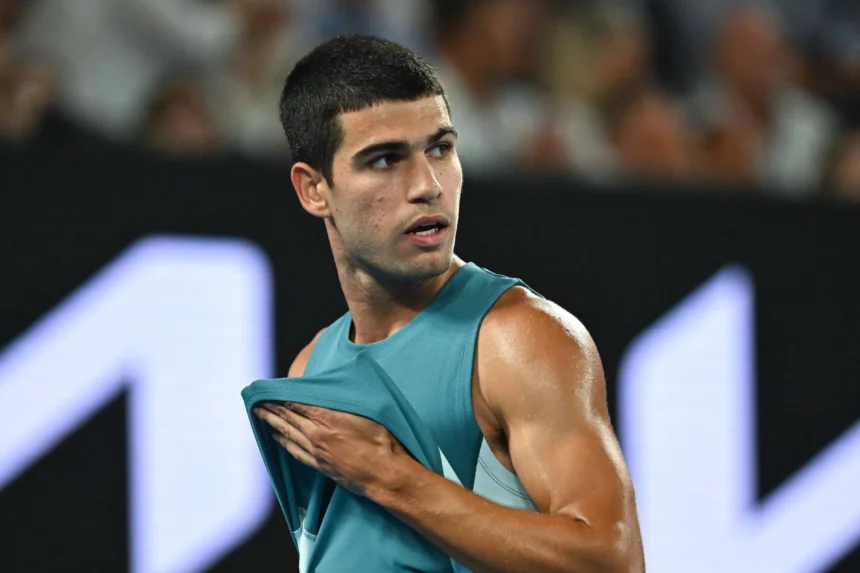
Alcaraz Qatar Open Title: Ruthless 50-Minute Masterclass in Doha
Alcaraz Qatar Open title success arrived with the force of a statement. Carlos Alcaraz defeated Arthur Fils 6-2, 6-1 in Doha on 21 February 2026, completing the final in only 50 minutes and extending his unbeaten start to the season to 12 matches. The scoreline was emphatic, but the wider meaning of the victory was even more significant. Just 20 days earlier, the Spaniard had won his first Australian Open crown and become the youngest man to complete the career Grand Slam.
The Alcaraz Qatar Open title was not built on one spectacular passage or a late surge. It was a controlled performance from the opening game. Alcaraz broke immediately, defended with exceptional speed and prevented Fils from establishing any sustained pressure. The Frenchman arrived in the final after an encouraging comeback tournament, but he had little opportunity to settle.
Months later, the Alcaraz Qatar Open title can be understood more clearly. It was the second trophy of an extraordinary early-season run, a ninth ATP 500 crown and the 26th tour-level title of Alcaraz’s career. Later injury problems changed the direction of his season, but the Doha final remains one of the clearest examples of what his tennis looks like when timing, movement and confidence come together.
Why the Alcaraz Qatar Open Title Mattered
The Alcaraz Qatar Open title came at a moment when Alcaraz was already carrying the momentum of a historic Australian Open. In Melbourne, he defeated Novak Djokovic 2-6, 6-2, 6-3, 7-5 in the final to claim the only major title that had previously been missing from his collection. The Australian Open’s official report confirmed that the 22-year-old became the youngest man to complete the career Grand Slam.
That achievement could have created an emotional letdown. Instead, the Alcaraz Qatar Open title showed that Alcaraz had quickly reset his ambitions. He entered Doha as the top seed and moved through a demanding ATP 500 field before facing Fils in the final. The ATP Tour match report recorded the 6-2, 6-1 result, the 50-minute match time and Alcaraz’s 12-0 record for the year.
Winning quickly does not always mean winning easily. Elite players can make a contest appear simple because they remove options from the opponent. In Doha, Alcaraz did exactly that. He protected his serve, attacked Fils’ weaker moments and moved with enough speed to turn potential winners into longer rallies. The Alcaraz Qatar Open title reflected both aggressive tennis and disciplined decision-making.
How Alcaraz Controlled the 50-Minute Final
The first game established the tone. Alcaraz broke Fils immediately and maintained control throughout the opening set. He took it 6-2 before increasing the pressure in the second. Fils managed to hold serve only once after falling behind, while Alcaraz continued to dictate the pace.
Reuters reported that Alcaraz won 89 per cent of his first-serve points and did not face a single break point during the final. The Reuters report also confirmed that the victory moved him to 12-0 for the season.
The Alcaraz Qatar Open title was impressive because of the balance in his game. His first serve gave Fils very few opportunities to attack. His return game placed the Frenchman under pressure from the beginning of service games. His movement allowed him to defend without becoming passive. His forehand created openings, while his variety prevented rallies from becoming predictable.
| Final detail | Confirmed figure |
|---|---|
| Result | Alcaraz beat Fils 6-2, 6-1 |
| Match duration | 50 minutes |
| Alcaraz first-serve points won | 89% |
| Break points faced by Alcaraz | 0 |
| Alcaraz’s 2026 record after the final | 12-0 |
| Tour-level titles after Doha | 26 |
| ATP 500 titles after Doha | 9 |
The Alcaraz Qatar Open title was therefore not only about speed. It was about preventing Fils from finding a workable pattern. Once Alcaraz established control, he rarely allowed the match to become complicated.
Arthur Fils Still Left Doha With Encouragement
A one-sided final can make the runner-up’s week easy to overlook. Yet the Alcaraz Qatar Open title should not erase the progress Fils made during the tournament. The Frenchman had been working his way back after an injury absence and reached his first tour-level final since winning in Tokyo in 2024.
The official ATP report said Fils had endured eight difficult months with injury and climbed seven places to No. 33 in the live rankings after reaching the Doha final. His route through the draw demonstrated why he remains an important young player. He competed effectively during the week and earned the chance to test himself against the world No. 1.
The final, however, exposed the challenge of facing Alcaraz at full speed. Fils needed strong serving, early control in rallies and a way to prevent Alcaraz from using his defensive movement to extend points. Instead, the Alcaraz Qatar Open title became a demonstration of how quickly a top player can punish small openings.
Fils’ respectful reaction after the match also mattered. A difficult final did not remove the value of his tournament. It gave him a clear measure of the standard required to defeat the strongest players consistently.
The Alcaraz Qatar Open Title Added Another ATP 500 Milestone
The Alcaraz Qatar Open title was his ninth ATP 500 trophy. That moved him level with Andy Murray for fourth place among ATP 500 title leaders since the category was introduced in 2009. Only Roger Federer, Rafael Nadal and Novak Djokovic had won more at that level when the Doha final ended.
| ATP 500 title leader | Titles after Doha 2026 |
|---|---|
| Roger Federer | 16 |
| Rafael Nadal | 15 |
| Novak Djokovic | 14 |
| Andy Murray | 9 |
| Carlos Alcaraz | 9 |
The Alcaraz Qatar Open title also became his 26th tour-level trophy. That total is notable because it reflects success across surfaces and tournament categories rather than one isolated run. Alcaraz has developed a game capable of adapting to different conditions: hard courts reward his movement and first-strike tennis, clay suits his physicality and point construction, while grass rewards his confidence in moving forward.
The broader sporting lesson is familiar. Major titles attract the most attention, but sustained dominance is built through preparation across an entire calendar. The News Ink’s sports training and technology guide explores how performance depends on recovery, analysis, tactical planning and repeatable routines. The Alcaraz Qatar Open title offered a strong example of an athlete returning from a major triumph and immediately meeting a new competitive challenge.
The Doha Trophy Also Carried Valuable Ranking Points
The Alcaraz Qatar Open title came at an ATP 500 tournament rather than a Grand Slam or Masters 1000 event, but that does not make the week minor. The official ATP tournament guide listed $2,833,335 in total prize money for the 2026 Qatar ExxonMobil Open, with the singles champion receiving $529,945 and 500 ranking points. Doha was played on hard courts at the Khalifa International Tennis & Squash Complex from 16 to 21 February.
Those details help explain why the field was strong and why the Alcaraz Qatar Open title carried real value. Players must collect points across the season, protect their ranking position and arrive at larger events with match confidence. An ATP 500 trophy can influence all three goals.
For Alcaraz, the Doha week also showed that he could move from the emotional scale of a major victory into the more routine demands of the tour calendar. That transition is not automatic. The Alcaraz Qatar Open title required focus in earlier rounds and a clinical finish against Fils. The trophy added another milestone, but the week’s deeper value was competitive rhythm.
Doha Came 20 Days After a Historic Australian Open Win
The timing made the Alcaraz Qatar Open title especially meaningful. Alcaraz had spent considerable physical and emotional energy in Melbourne. He defeated Djokovic in a four-set final after a demanding tournament and became the youngest man to complete the career Grand Slam.
A career Grand Slam means winning each of the four major singles championships at least once: the Australian Open, Roland Garros, Wimbledon and the US Open. Alcaraz achieved the full set at 22. The Australian Open report also noted that he became the youngest man in the Open Era to own seven Grand Slam singles titles.
The Alcaraz Qatar Open title showed that the historic achievement had not reduced his appetite for another trophy. In his own comments after Doha, Alcaraz emphasised the need to set new goals after each tournament. The significance of that attitude lies in its practicality. Players cannot compete successfully for an entire season if every major victory is followed by a long emotional decline.
The Doha win did not carry the same historical weight as Melbourne. It did not need to. The Alcaraz Qatar Open title mattered because it demonstrated continuity. Alcaraz converted the confidence of the Australian Open into another week of high-level tennis.
The Perfect Start Continued Beyond Doha
The Alcaraz Qatar Open title extended Alcaraz’s unbeaten start to 12 matches, but the run did not end immediately after Doha. He later reached the semi-finals at Indian Wells and stretched the streak to 16 victories before Daniil Medvedev defeated him 6-3, 7-6(3).
The ATP Tour report on the Indian Wells semi-final described Medvedev’s performance as the one that ended Alcaraz’s perfect start. Medvedev defended with discipline, served well under pressure and denied Alcaraz the comeback he was trying to build in the second set.
That later defeat provides useful context for the Alcaraz Qatar Open title. Doha did not prove that Alcaraz was unbeatable. No player is. It showed that he had reached a very high level early in the year and could sustain it across multiple events. The difference matters because professional tennis rewards adaptation, not invulnerability.
Readers following the major sporting calendar can explore The News Ink’s overview of sports tournaments in 2026. Tennis seasons are shaped by transitions between surfaces, travel demands and the need to balance ambition with recovery.
Injury Later Changed the Direction of Alcaraz’s Season
The Alcaraz Qatar Open title belongs to the most productive phase of Alcaraz’s 2026 season. Later months became more difficult. After losing the Monte-Carlo final to Jannik Sinner, Alcaraz dealt with a wrist injury and withdrew from major events.
On 24 April, the ATP Tour reported that Alcaraz would miss Rome and Roland Garros while waiting to evaluate his recovery. The official ATP injury update said he had decided to end his clay-court season after medical tests. At that stage, he held a 22-3 record for the year.
A further ATP update on 19 May confirmed that Alcaraz would also miss Queen’s Club and Wimbledon. The ATP Tour announcement said the wrist injury had not healed enough for him to return during the grass-court swing.
This later context changes how the Alcaraz Qatar Open title should be viewed. The Doha victory was not the opening chapter of an uninterrupted march through the season. It was a reminder of how quickly tennis can change. A player can look dominant in February and still need to make cautious decisions about recovery by spring.
The News Ink’s feature on the training secrets behind top athletes examines why recovery is not secondary to performance. It is one of the foundations of a long career. Alcaraz’s decision to delay his return reflects that bigger picture.
Why the 50-Minute Performance Still Stands Out
The Alcaraz Qatar Open title remains memorable because the final compressed many of Alcaraz’s strengths into a short match. He served efficiently, returned aggressively, defended with speed and kept the pressure high enough that Fils never found a stable rhythm.
A short final can sometimes result from an opponent’s poor performance alone. Doha was more instructive. Fils struggled, but Alcaraz played a major role in creating that struggle. The Spaniard took time away from him, chased down balls that could have ended rallies and forced him to take greater risks.
The Alcaraz Qatar Open title also demonstrated the value of starting quickly. By breaking in the opening game, Alcaraz immediately changed the psychological demands of the match. Fils was forced to chase the score against an opponent who was protecting serve comfortably. That allowed Alcaraz to play with even more freedom.
The original report correctly described the final as ruthless. However, the strongest analysis goes beyond the adjective. The Alcaraz Qatar Open title was ruthless because it combined technical quality with disciplined control.
A Doha Statement That Looks More Valuable With Time
The Alcaraz Qatar Open title was Alcaraz’s second trophy of 2026, his ninth ATP 500 crown and his 26th tour-level title. It followed a historic Australian Open victory by only 20 days and extended his perfect start to the season to 12 matches. Those facts explain why the final attracted so much attention.
The later months added another layer. Medvedev eventually ended the unbeaten run at Indian Wells, and a wrist injury forced Alcaraz to step away from important tournaments. Those setbacks do not weaken the meaning of Doha. They underline how difficult it is to sustain elite performance across a full calendar.
The Alcaraz Qatar Open title should be remembered as more than a quick final. It was a demonstration of clarity after a historic triumph, a milestone in Alcaraz’s growing collection of trophies and a reminder of the standard he can produce when his body and confidence are aligned.
For more major sports stories and analysis, follow The News Ink on Instagram.