


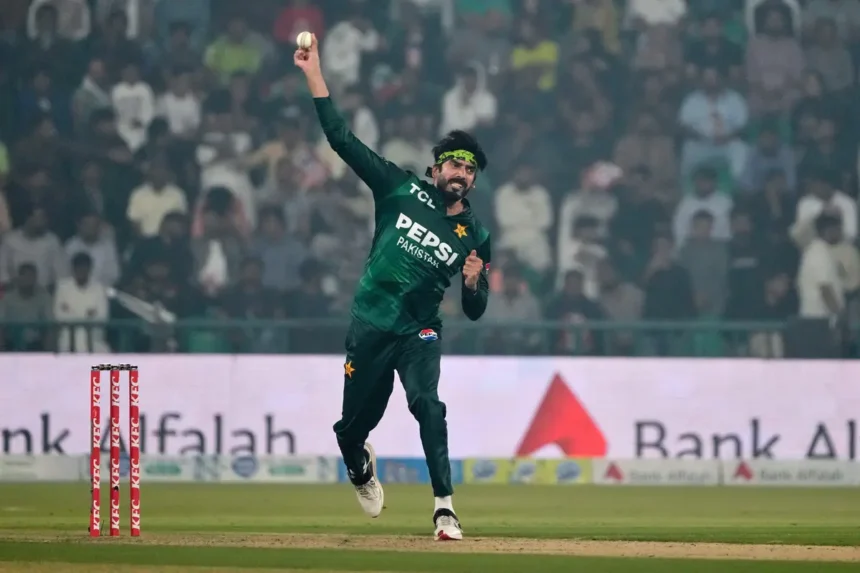
Usman Tariq’s Bowling Action: The Powerful 2026 Debate Explained
Usman Tariq’s bowling action became one of the most discussed stories of the 2026 ICC Men’s T20 World Cup. Before Pakistan faced India in Colombo, the off-spinner’s pause near the crease and low, side-arm release generated almost as much attention as the match itself. Some viewers saw an innovative mystery spinner with an unusual natural technique. Others questioned whether the delivery looked legal. The most important fact, however, is straightforward: Usman Tariq’s bowling action had already been reported twice in domestic cricket and cleared twice after testing.
The tournament has now ended, which makes it possible to examine the issue more carefully. Pakistan exited at the Super Eight stage, while India retained the title by defeating New Zealand in the final. Tariq still emerged as an important figure for Pakistan. Official Pakistan Cricket Board statistics show that he took 10 wickets in five matches at the World Cup, with best figures of 4–16, an average of 14.10 and an economy rate of 7.23.
Usman Tariq’s bowling action deserves explanation rather than speculation. A delivery can look unfamiliar without being illegal. Cricket’s rules are not based on whether an action appears smooth or conventional on television. They are based on specific standards, official reporting procedures and biomechanical testing.
Why Usman Tariq’s Bowling Action Attracted So Much Attention
Usman Tariq’s bowling action stands out immediately. Tariq slows and pauses near the end of his approach before releasing the ball with a low, sling-like motion. The combination can interrupt a batter’s rhythm because the release does not resemble the more familiar action used by many off-spinners.
Reuters described the Pakistan bowler as an “X factor” after captain Salman Agha defended him before the tournament. The Reuters report noted that Tariq had been reported twice for a suspect action in the Pakistan Super League and cleared after testing. Salman’s position was clear: he did not believe there was a problem with the action and considered Tariq an important option for Pakistan.
The discussion intensified because Usman Tariq’s bowling action was exposed to a much larger global audience during the World Cup. Pakistan’s group included India, and any cricketing issue connected to that rivalry was likely to attract attention. The conversation also grew after Australia batter Cameron Green made a throwing-style gesture following his dismissal by Tariq in a T20 international in Lahore.
A visual reaction is not the same as a formal ruling. Tariq’s bowling must be judged through the applicable process rather than social-media clips or gestures made during a competitive match.
What Makes Usman Tariq’s Bowling Action Different?
Usman Tariq’s bowling action is shaped by more than a deliberate attempt to surprise batters. A later profile in The Guardian reported that Tariq was born with a split elbow joint and is unable to straighten his right arm normally. The appearance of his delivery is therefore connected to his anatomy.
That detail matters because viewers often judge a bowling action by appearance alone. Tariq’s arm position can create the impression of throwing, especially when combined with the low release point and brief pause. Yet the visual impression does not establish that Usman Tariq’s bowling action exceeds the legal threshold for elbow extension.
Tariq has also developed several variations. He told The Guardian that he learned to flick a carrom ball while playing in a small space during childhood. Over time, that skill developed into a broader set of deliveries, including a slider and other changes of release. His unusual technique is not merely a pause followed by a standard off-break. It is a complete T20 bowling method designed to make reading the ball difficult.
Readers seeking a broader explanation of formats, bowling styles and match situations can explore The News Ink’s cricket guide. Usman Tariq’s bowling action is easier to understand when viewed within the larger evolution of spin bowling in limited-overs cricket.
What the ICC Rule Actually Says
The most important rule in the debate over Usman Tariq’s bowling action is the ICC standard for illegal bowling actions. According to the ICC’s official explanation, an action is illegal when a player’s elbow extends by more than 15 degrees between the point at which the bowling arm reaches the horizontal and the moment when the ball is released.
That definition is more precise than a general statement that a bowler must keep the arm completely straight. Cricket recognises that natural movement can occur during a delivery. The issue is whether elbow extension exceeds the permitted limit.
The ICC also explains the reporting process. Match officials use their experience and visual assessment to decide whether they believe a player may be using an illegal action. If they submit a report, the bowler is tested at an ICC-accredited centre with specialist technology. A player found to be using an illegal action is suspended from bowling until the action is modified and a further test is passed.
This is why Usman Tariq’s bowling action should not be described as illegal merely because it looks unusual. The formal process exists to separate suspicion from evidence.
| Question | Accurate answer |
|---|---|
| Is an unusual-looking action automatically illegal? | No. The ICC test focuses on elbow extension beyond the permitted threshold. |
| What is the ICC threshold? | More than 15 degrees of elbow extension from the arm reaching horizontal to ball release. |
| Can officials report a bowler? | Yes. Match officials may submit a report when they suspect an illegal action. |
| What happens after a report? | The bowler undergoes testing at an ICC-accredited centre. |
| Has Tariq been tested? | Yes. His action has been tested and cleared twice. |
| Has Tariq been suspended from bowling? | No verified official source cited here records a suspension. |
The Pause Is Not the Same as an Illegal Arm Action
One important correction is necessary when discussing Usman Tariq’s bowling action. The pause in Tariq’s approach should not be treated as if it automatically falls under Law 41.5 of the Laws of Cricket.
The official MCC Law 41 page states that Law 41.5 concerns deliberate distraction, deception or obstruction of a batter by a fielder after the striker has received the ball. It is not the main rule for deciding whether a bowler’s arm action is legal.
That does not mean umpires are powerless to address unfair conduct. Match officials still apply the playing conditions and make decisions during a match. However, the central legality question surrounding Usman Tariq’s bowling action is the ICC illegal-bowling-action standard, not a broad assumption that any visible pause is prohibited.
This distinction improves the article in two ways. First, it prevents an inaccurate legal explanation. Second, it allows readers to focus on the real question: whether the delivery complies with the ICC threshold after proper assessment.
A Timeline of Usman Tariq’s Bowling Action Debate
Usman Tariq’s bowling action did not suddenly become controversial during the India–Pakistan match. The World Cup amplified an issue that had already followed Tariq through domestic and international cricket.
| Period | Development | Why it mattered |
|---|---|---|
| 2024 PSL season | Tariq made his PSL debut | His pause and low release quickly drew attention |
| PSL reporting process | Tariq was reported twice across his PSL appearances | Formal testing became more important than visual debate |
| Before the 2026 T20 World Cup | Pakistan captain Salman Agha defended Tariq | The spinner was publicly described as an X factor |
| Australia series in Lahore | Cameron Green made a throwing-style gesture after dismissal | The debate reached a wider international audience |
| 2026 T20 World Cup | Tariq played an important role for Pakistan | His performances kept the spotlight on his bowling |
| May 2026 | Tariq prepared for the T20 Blast with Warwickshire Bears | A new competition created another stage for scrutiny |
This timeline shows why Usman Tariq’s bowling action has remained a major talking point. It combines three elements that naturally attract attention: an unusual visual style, strong performances and a rule that requires technical explanation.
How Tariq Performed at the 2026 T20 World Cup
Usman Tariq’s bowling action would not have generated the same level of discussion if the bowler had not been effective. Tariq’s value to Pakistan came from his ability to take wickets while forcing batters to adjust quickly.
The PCB’s official tournament averages record 10 wickets for Tariq in five World Cup matches. He bowled 117 deliveries, conceded 141 runs and produced best figures of 4–16. Those are meaningful numbers for a player who entered the event with limited international experience.
The most anticipated group-stage match came against India on 15 February 2026. Pakistan attempted to use spin heavily, but India won by 61 runs after posting 175–7 and dismissing Pakistan for 114. The Reuters match report recorded that Pakistan became the first side to use six spinners in a T20 World Cup match. The strategy did not deliver the result Salman Agha wanted, although the wider tournament still established Tariq as an intriguing short-form bowler.
Pakistan later reached the Super Eight stage but did not progress to the semi-finals. Usman Tariq’s bowling action remained part of the tournament conversation because Tariq kept taking wickets even as Pakistan’s campaign became inconsistent.
The ICC’s team-of-the-tournament article confirmed that Pakistan exited during the Super Eight stage and that India defeated New Zealand by 96 runs in the final to win a record third men’s T20 World Cup title.
Why Biomechanical Testing Matters
Usman Tariq’s bowling action is a useful example of why modern sport needs proper testing methods. Slow-motion footage can be informative, but it can also encourage confident judgments that are not supported by measurements. A camera angle may exaggerate a bend, obscure the release point or make a natural anatomical feature appear suspicious.
Biomechanical testing provides a more disciplined process. It allows experts to examine elbow extension and compare the match action with the tested action. The goal is not to protect a bowler from all criticism. The goal is to establish whether the delivery meets the rules.
The wider role of data, analysis and performance technology is explored in The News Ink’s sports training and technology guide. Usman Tariq’s bowling action shows why technology is not only about improving performance. It can also help sporting authorities make fairer decisions.
There is a broader lesson here. An unusual technique may create an advantage because opponents are unfamiliar with it. That advantage is not automatically unfair. Sports evolve when athletes discover new methods within the rules. Authorities must protect fair competition without treating every unconventional movement as evidence of wrongdoing.
Tariq’s Next Challenge in English Cricket
Usman Tariq’s bowling action will continue to attract attention beyond the World Cup. Tariq joined Warwickshire Bears for the T20 Blast and was also selected by Birmingham Phoenix in The Hundred.
A Reuters report on The Hundred auction recorded that Birmingham Phoenix signed Tariq for £140,000. The move gives him another opportunity to show whether his variations can succeed in a different competition and against batters who will have more time to study his methods.
English domestic cricket may also bring renewed scrutiny. Tariq told The Guardian that he was prepared to return to a testing laboratory if officials raised concerns. That is a sensible response. The proper answer to questions about Usman Tariq’s bowling action is not anger or online argument. It is a transparent process applied consistently.
The News Ink has also examined how sports technology is giving athletes an edge. Tariq’s case adds another dimension: technology can protect both the integrity of a competition and the reputation of an athlete whose technique does not look conventional.
What Cricket Fans Should Remember
Usman Tariq’s bowling action debate can become unnecessarily heated when different questions are mixed together. Viewers may dislike the pause. Batters may find the release difficult to read. Rival supporters may believe the action looks strange. None of those reactions proves that the delivery is illegal.
The most reliable summary is simple:
- Usman Tariq’s bowling action is unconventional and difficult to read.
- Tariq has faced formal scrutiny rather than avoiding it.
- His action has been tested and cleared twice.
- The ICC threshold concerns elbow extension beyond 15 degrees.
- The pause near the crease should not automatically be treated as a Law 41.5 violation.
- Match officials can act if a future delivery raises a formal concern.
This framework allows room for legitimate discussion without turning suspicion into a factual verdict.
A Debate About Innovation, Not Just Controversy
Usman Tariq’s bowling action sits at the intersection of innovation, anatomy and regulation. Tariq’s pause and low release make him unusual. His variations make him difficult to face. His natural arm structure makes visual judgments more complicated. The ICC process exists because those questions cannot be settled responsibly by appearance alone.
The original story was correct to identify Tariq as a player under the spotlight. It needed a clearer explanation of why. Usman Tariq’s bowling action is not merely a viral talking point from an India–Pakistan match. It is a useful case study in how cricket should evaluate unfamiliar techniques.
Tariq will continue to face questions as he plays in new competitions. That scrutiny is part of professional sport. The fair approach is to separate evidence from reaction. Until an official process establishes otherwise, Usman Tariq’s bowling action should be described as unconventional, tested and cleared.
For more cricket stories and sports analysis, follow The News Ink on Instagram.